When I was little, I wanted to be a detective

When I was little, I wanted to be a detective.  Or a writer.  Or a writer of detective stories.  Indecisive from an early age, I was not quite sure which appealed most – or maybe it should be a combination?   

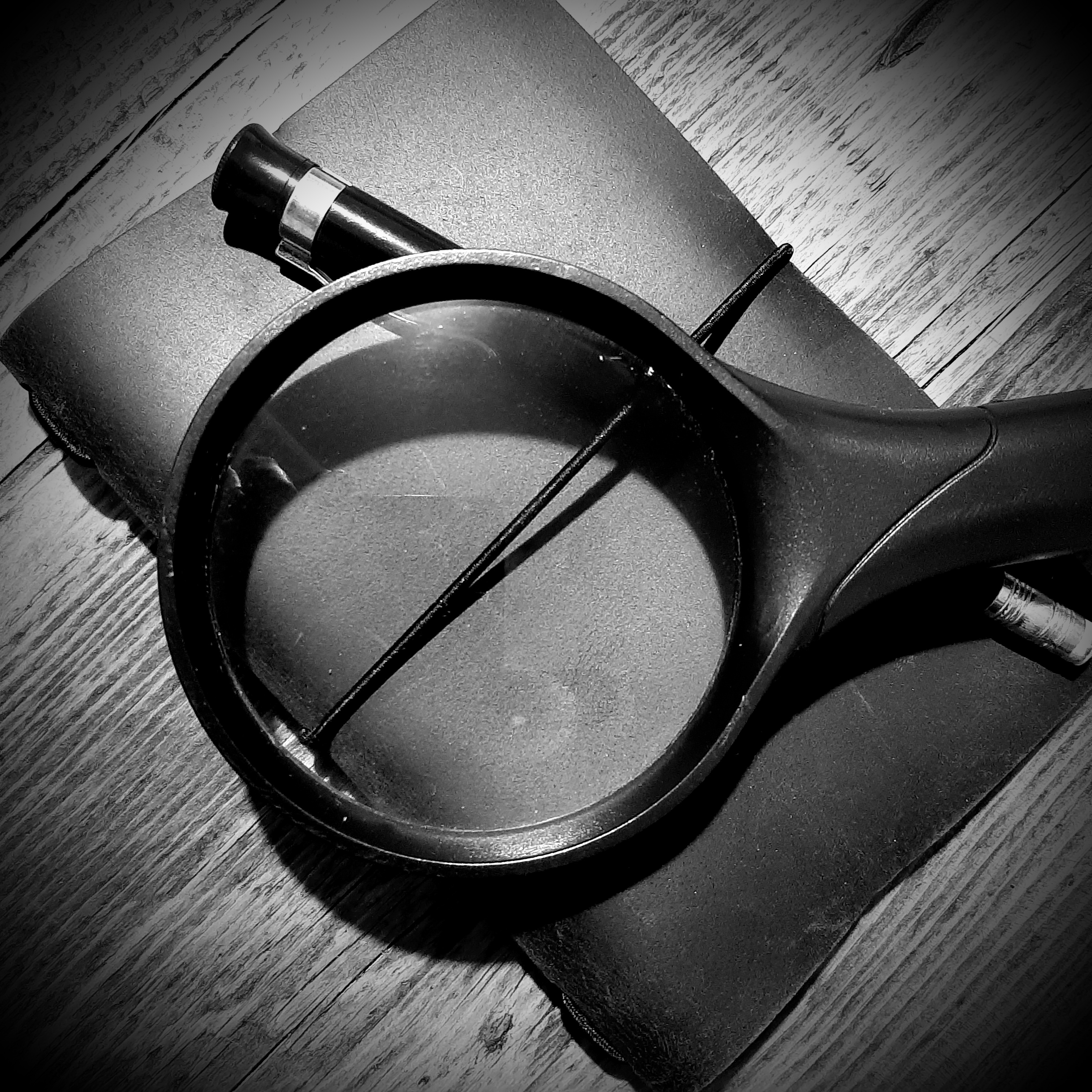
In any event, I was very clear about the kit required.  I had notebooks (always lots of notebooks!) for both professions.  For detection, I also had a magnifying glass (of course – I was an early acolyte of Sherlock Holmes) and a toy revolver (no doubt influenced by reading too much Raymond Chandler at too young an age).  I had a range of disguises, including spectacles, moustaches, and greasepaint.  I improvised a fingerprint set with sellotape and ground-up pencil graphite (with surprisingly clear results).  For writing, I had the Pocket Oxford Dictionary (single volume – a navy blue hardback way too chunky for anyone’s pocket), a selection of pens and pencils, and a modest library of books for inspiration.  I aspired to using a typewriter, because I knew that proper writers always typed their manuscripts, but my fingers were not yet strong enough to strike the keys of my father’s Remington Envoy.

Quite where these tropes came from, I’m really not sure.  I watched very little television (for most of my childhood we didn’t have one), and I was home-educated so there was not much in the way of popular culture influences.  There was, however, the BBC World Service, which was then a much more holistic broadcaster than its present incarnation as a rolling news station, and was responsible for much of my classical and jazz musical education as well as introducing me to Shakespeare (a production of Twelfth Night), Tolkein (The Hobbit, read by Bernard Cribbins), Douglas Adams (the original radio script, unsurpassed by subsequent books, films and television adaptations, of The Hitchhiker’s Guide to the Galaxy), and Dorothy L Sayers (courtesy of the peerless Ian Carmichael as Lord Peter Wimsey – when I subsequently read my grandmother’s copies of the books, it was Carmichael’s voice I heard).  The World Service also broadcast the sit-com The Small Intricate Life of Gerald C Potter, where the eponymous detective writer (again played by Ian Carmichael) and his wife Diana (a much more successful writer, creating breathless romances under the pseudonym of Magnolia Badminton) crashed amusingly through a more or less chaotic but never boring life, accompanied by the sound of a manual typewriter.  It did nothing to lessen the appeal of wordsmithing as a lifestyle.  The signature tune, Leroy Anderson’s The Typewriter, still makes me smile.

There was no shortage of role models for my future career as a detective.  My grandmother had a serious addiction to Golden Age crime fiction (in the original English, despite being an elderly Dutch lady) and I was exposed to Hercule Poirot, Jane Marple, Parker Pyne, Lord Peter Wimsey, Perry Mason, Philip Marlowe, and of course Sherlock Holmes, even before I graduated from reading Enid Blyton’s Secret Seven and The Five Find-Outers.

I have always believed that names are important.  Naturally, my detective alter ego needed a name, and for some reason which I have long since forgotten, I decided on Peggy Reynolds, Private Investigator.  As a nascent writer, my nom de plume was Mara McDonald, and I do know the origin of that – it was the result of a brief infatuation with all things Highland caused by overdosing on Robert Louis Stevenson and reading Kidnapped under the bedclothes with a torch.  I was more than a little in love with Alan Breck Stewart, self-aggrandising and infuriating as he was.  Looking back, it is interesting to see the association in my young mind between writing and romance.

Fast-forward nearly half a century.  What would that child, who responded to the tedious adult questioning about ‘what do you want to be when you grow up’ with such interesting ambitions, think of how life has turned out?  Well, I never did become a PI.  However, my insatiable curiosity, my obsession with collecting obscure facts, and the desire to find out how things work have stood me in good stead in a variety of jobs.  Detective instincts are especially useful for the writer of non-fiction, who inevitably needs to invest large amounts of research in every piece of writing – research is to writing what the base of the iceberg is to the visible tip.  And I am, indeed, a writer – even if not currently a full-time one – with a respectable clutch of publications in print and online (the latter something my young self could not have imagined), in non-fiction and poetry.  However, fiction has proved to be a genre I simply cannot write, and the dream of writing a detective novel remains just that – a dream.
Past, present and future – the origins of my passion for old buildings

Where did my interest in historic buildings, and the way we use them today, first start?  Well, it all started with a quote from Winston Churchill.  I can pinpoint the exact moment: I was a second-year undergraduate, sitting in a seminar on the history of Christian liturgy, and the lecturer was getting us to think about how the layout of a building both affects, and is affected by, the activity taking place within it.  He quoted Churchill’s words: “We shape our buildings, and afterwards our buildings shape us.”

In 1943, Churchill was advocating for the retention of the adversarial, rectangular layout in the re-building of the Commons Chamber of the Houses of Parliament in London, following bomb damage in the Blitz during WWII.  He attributed the two-party system, which he saw as the essence of British parliamentary democracy, to this layout.

In that moment, I realised that Churchill’s principle applied not only to ecclesiastical architecture and the layout of parliamentary debating chambers, but to the buildings we live and work in.  At that time, my home was a tiny eighteenth-century stone cottage in a small town in North Wales, which showed signs of having been altered a number of times to accommodate changes of use.  During its lifetime, it had reputedly been a mead house, and more recently a café, as well as a living and working space for artisan households (as evidenced in more recent centuries by census records). Meanwhile, at the heart of my university campus was the original nineteenth-century building, itself a pastiche of a medieval Oxbridge college – a style reflecting the ambitions of the founders for their fledgling educational institution.

I went on to live in a series of 19th-century terraced cottages, including one that was built for the workers on the newly-constructed railway; two Edwardian townhouses, one of which had been built as a living and working space for a family of glove-makers; a number of 1960s and 1970s boxes, in various stages of dilapidation, with the sensible, regular-shaped rooms that were a hallmark of the period, but all of them a challenge to make homely; a faux-Georgian 1980s house, complete with Grecian columns beside the front door and plasterwork urns and garlands on the fire-surround, but leaky windows and a collapsing sewage drain; and a smart newbuild with four bathrooms but next to no storage (which gives an insight into how architects envisage how people will live in the houses they design), which nevertheless proved to be a nice place to live.  I learned that the nicest-looking houses don’t necessarily make the nicest homes, and that each property influenced how I lived through layout, storage (or the lack of it), heating (or the lack of it), and how safe and at home I felt there.  I learned that I generally have a preference for older properties, made of stone or brick, which have stood for a century or more and promise to carry on standing – and sheltering those who live there – for the foreseeable future.  I learned that I don’t mind the ghosts and echoes of previous lives that have been lived in the buildings I call home, but that I do mind houses that are soulless and sterile, however well-designed they may be.

Some years after the Churchill epiphany, I went back to university to study medieval monasteries, focusing on the relationship between their architecture and infrastructure and the patterns of daily living this facilitated. I then studied vernacular architectural styles, in particular becoming fascinated by palimpsests as evidence of how the people who lived and worked in these buildings continued to shape the evolution of the buildings that had shaped them.

I worked as a consultant, enabling communities to imagine new ways to use their historic buildings, balancing the need for flexible, warm and accessible places with the need to conserve the character and historic significance of the building.  And I now advise on appropriate and effective energy efficiency measures to ensure that traditional buildings and their occupants continue to survive and thrive in the 21st century and beyond.  For me, it’s part of an ongoing dialogue between place and people: “We shape our buildings, and afterwards our buildings shape us.”

I am committed to making this blog freely available, and not putting material behind a paywall. As a writer, I am doing what I love – but I still have to make a living. If you have enjoyed this post, and if you are able to do so, perhaps you would consider supporting my work by making a small contribution via the Buy Me A Coffee button. Thank you!

Buy Me a Coffee at ko-fi.com

An infinity of one’s own – Hawker’s Hut, poetry and place

I am thinking, and writing, a lot about place at the moment – geographical location, borders, and the relationship between where we are and who we are.  As a tangent from this, I’ve been musing about whether, or how, where we are affects what we write.  There are a few obvious connections; for example could Wuthering Heights have been conceived of and written anywhere other than the bleak uplands of the Brontë’s Haworth, or would Persuasion have been as persuasive in its evocation of the social banalities of Bath had not Jane Austen herself experienced the particular torment of the old maid in that context.  But is it a general principle, I have been asking myself, that our location influences us as writers?

In the late spring of last year I tagged along with my wife on a study trip to north Cornwall, that enigmatic stretch of coastline between Bude and the Hartland peninsula where Cornwall becomes Devon, notorious for shipwrecks and (possibly apocryphal) tales of wreckers.  It is less remote and unknown these days than when I first visited a couple of decades ago, and honeypots like Boscastle are now gridlocked, but off season, with the sea fog swirling round you, it can still feel like you’re standing at the edge of the world.  It’s mainly vertiginous cliffs along here, with the South West Coast Path providing access on foot to places that tourists can’t drive to.  My wife having finished at the museum, we went exploring.

Intrigued by the eccentricities of its nineteenth-century vicar, the Reverend Robert Hawker, we went to Morwenstow.  The steep churchyard was knee-deep in wildflowers, framing the replica figurehead of the Caledonia which marks the burial of several of its sailors who drowned when she was shipwrecked on that treacherous coast in 1842.  It is a kind of marker, too, for Parson Hawker’s affinity with the sea – he habitually wore a knitted fisherman’s gansey, was involved in a number of rescues, and took great pains to ensure the decent burial of shipwrecked sailors.

Hawker has other claims to fame.  He was a poet, and as a young man published ‘The Song of the Western Men’ (more commonly known as ‘Trelawney’) which is the de facto national anthem of Cornwall.  And he was the instigator of the modern Harvest Festival, celebrated in churches all over the world, and which was a re-imagining of the medieval practice of Lammas or First Fruits.

His eccentricities are well, although not perhaps always reliably, recorded, and include wearing random and colourful garb such as a poncho made from a yellow horse blanket; bringing his cats to church services (and excommunicating one of them for mousing on a Sunday!) and keeping a pet pig.  He was also almost certainly addicted to laudanum – tincture of opium in alcohol – and this arguably fuelled both his eccentricity and his poetry.

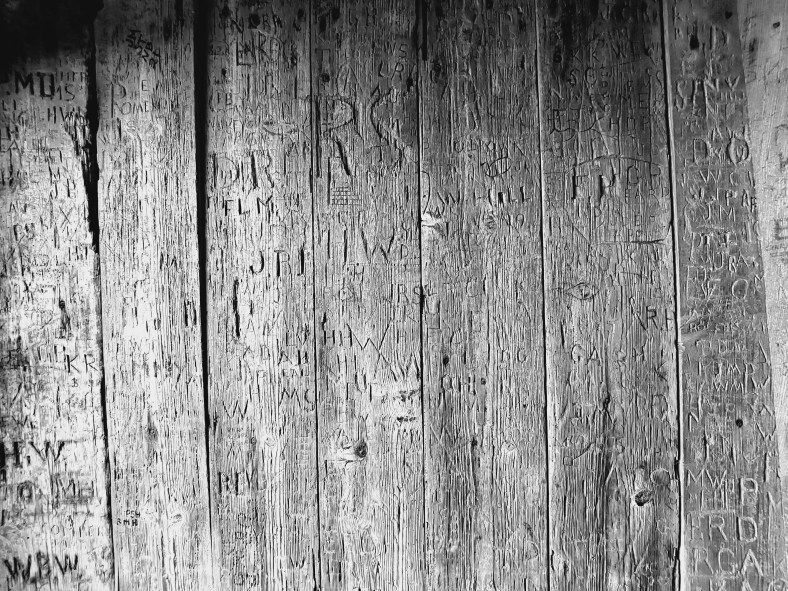
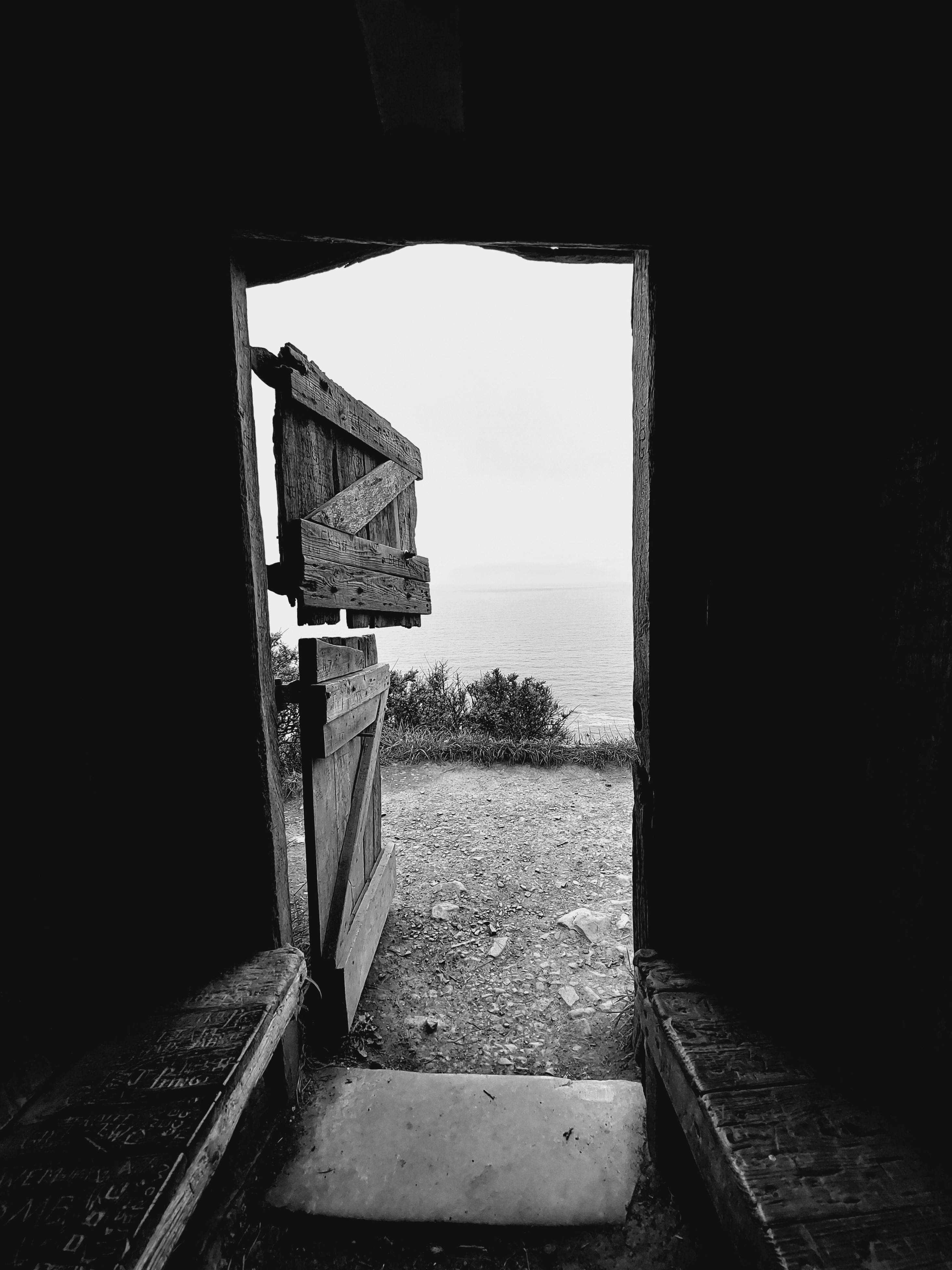
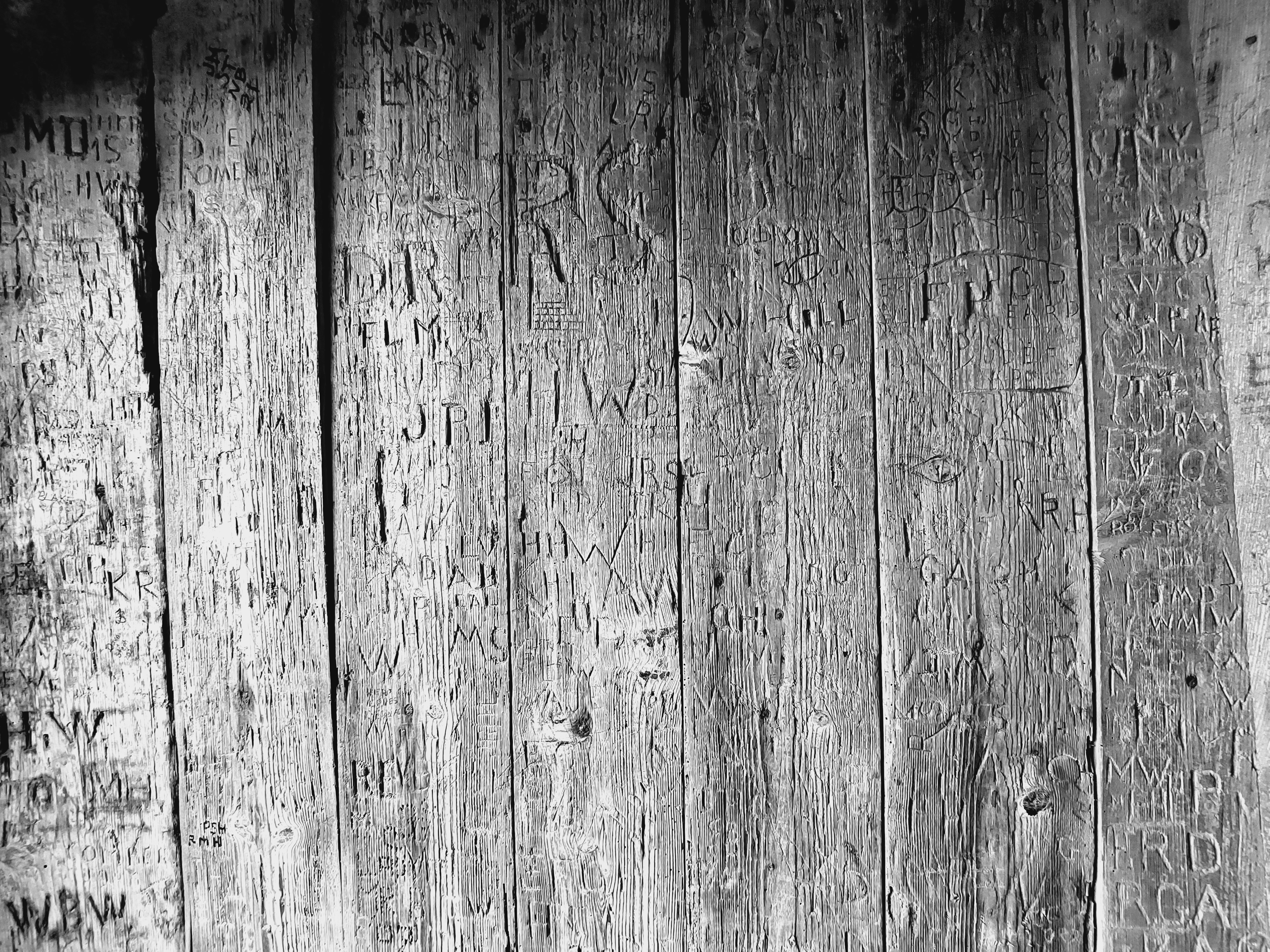
Much of Hawker’s poetry was written in his hut, set into the cliff face a mile or so from the church, constructed from driftwood and roofed with turf.  It is now the smallest property in the care of the National Trust, its planks incised with graffiti and worn to a smooth, mellow patina.  It would be easy to think of it merely as a den, a playhouse, or a man-cave, but we were lucky enough to have the place to ourselves and time to pause and try to see it through Hawker’s eyes.  The stable door opens onto infinity – the Atlantic, the sky, the sea mist.  The view is as unlimited as the human imagination.  What does looking out on infinity do to a person?  To a writer?  Does it stretch the boundaries of the mind, of the possible?

Sixty miles to the north across the Bristol Channel is another shrine to a dead poet – Dylan Thomas’ writing shed at Laugharne.  Decades apart, two men gazing out on infinity and writing poetry.  Infinity + alcohol = Thomas.  Infinity + opium = Hawker.

Maybe it’s not just the window on infinity, or even the stimulants, that are significant here.  Maybe it’s the access to a place to write, uninterrupted by the demands of other, domestic roles.  Jane Austen famously wrote her entire oeuvre at a little side table, using a writing box which had been a present from her father.  Her father couldn’t give her a space to write, or financial independence, but he could give her a writing box, a microcosm of the writer’s world which she could take with her wherever she went.  Virginia Woolf wrote an entire book about A Room of One’s Own, in which her analysis was that women writers were handicapped by the lack of their own space in a domestic context.  Neither Hawker in his hut, nor Thomas in his shed, had that problem.  Both had the luxury of private space – physical space, and headspace away from the demands of domesticity.  And, as a bonus, those private spaces had a window on infinity.

I started this by musing on the relationship between where we are and who we are, and whether, or how, where we are affects what we write.  Perhaps it’s less that a place affects who we are and what we write, but rather that where we are affects what we see from there.  Writers, including Alfred Lord Tennyson and Charles Kingsley, were inspired by Hawker’s hut.  Thousands of literature students and aspiring writers make the pilgrimage to Thomas’ shed.  Maybe the inspiration lies, not in looking into the writer’s space, but looking out of it – seeing what they saw, especially when that is infinity.  Alcohol and laudanum are optional.

I am committed to making this blog freely available, and not putting material behind a paywall. As a writer, I am doing what I love – but I still have to make a living. If you have enjoyed this post, and if you are able to do so, perhaps you would consider supporting my work by making a small contribution via the Buy Me A Coffee button. Thank you!

Buy Me a Coffee at ko-fi.com

Sanctuary – the endangered species in my garden

My garden is nothing special – a patch of scrappy lawn, laid on top of builders’ rubble in this newbuild estate, surrounded by wooden fence panels, enlivened by a few plants in pots brought with us from our previous home.  But this past summer, it has been a place of sanctuary for an endangered species.

It started in the spring – our first in this house – when a small flock started lining up on the fence most days, communicating in their characteristic, monosyllabic ‘CHEEP!’ and speculatively eyeing up the garden.  One of the gardens on the opposite side of the road is bristling with bird feeders, so they were well provided for in terms of food.  But it was shaping up to be a dry spell, and it seemed that the most helpful thing we could do was to provide water.  I duly purchased a small glazed plant saucer from the garden centre, added a pebble (to prevent bees, who also frequent bird baths, from drowning), placed it on the patio far enough from the house not to spook the birds with our movements, and filled it up with water.

Within a day or two, the bathing facilities had been enthusiastically adopted.  For a couple of hours in the morning, and again at midday, queues would form on the fence.  I joked that they were lining up, their towels draped over their wings, waiting for their turn in the bath!  At their peak, once the first broods had fledged and the fluffy youngsters joined their parents, there could be as many as twenty individuals at any one time.  Down at the bath, there were rarely fights (although one particularly large male could be very aggressive), and it was not unusual to see anything up to six birds splashing around at the same time. 

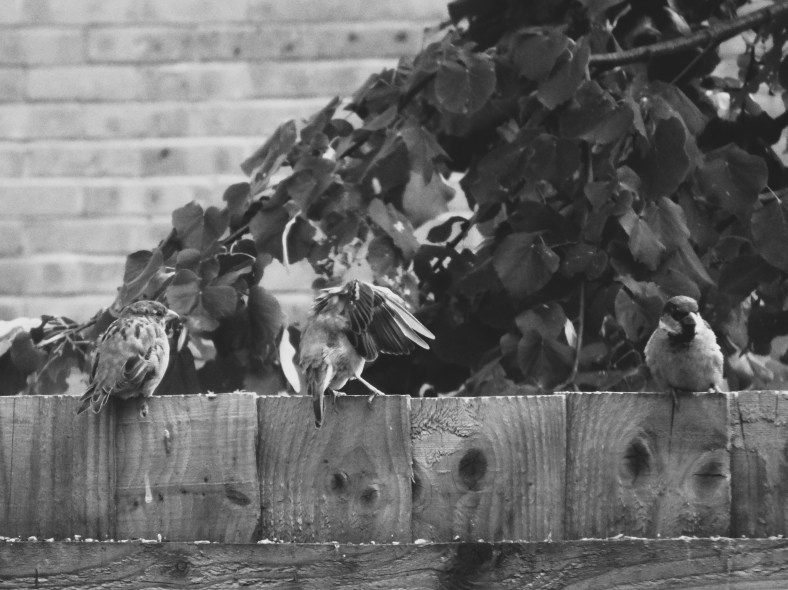
We learned a number of things from watching the birds over several months.  When they come down to drink, they take three sips – never less, and rarely more.  Bathing is a vigorous business, and can go on for several minutes, resulting in a large pool of water all around the bath.  This also means that the bath needs to be topped up several times during the day, especially during a heat wave!  When it is nearly empty, they will fly down, stare into the bath, attempt to bathe, and fly back up to the fence, returning several times before giving up.  After a nice, long, splashy bath, the next stop is the top of the fence, and a lengthy preen (see photo), which can last several minutes and includes forceful wiping of the beak on the edge of the fence panel (the reverberations can be loud enough to be heard in the house).  Occasionally, the bathing has obviously been sub-standard, and the bird will stop in mid-preen and go back for another go in the bath, before resuming preening.

Sometimes, the birds suddenly disappear.  The chorus of cheeps is abruptly silent.  It is worth looking around, because there will usually be an aptly-named sparrowhawk perched on a roof somewhere, surveying the options for lunch.

Mono photograph of three sparrows on a wooden fence.  The one on the left has its back to us.  The one on the right is facing us, and we can tell by its black bib that it is an adult male.  The one in the middle has its back to us and its wings extended, feathers spread, as it preens.  Image Copyright Lisa Tulfer 2022.

Why aptly-named?  Because the endangered species that shares my garden is Passer domesticus, the House Sparrow, which at one point was one of the commonest bird species around human habitation in the United Kingdom.  However, populations have declined by more than 50% since the 1970s, resulting in the sparrow being on the RSPB’s Red List of endangered species.

The House Sparrow is a small, sociable, finch-like bird, with brindled brown and black markings on its upper parts and greyish cream underparts.  The adult males have a distinctive black bib – it has been fun watching the young males, even when still partially fluffy, starting to develop the beginnings of their black bibs.  They live in groups, and it is not uncommon in suburban areas to walk past a bush which is full of loud cheeps from a group of invisible (but very audible!) sparrows.  They pair for life, and normally raise two or even three broods per year – we saw the last youngsters being introduced to the garden as late as September.  This year has evidently been a good breeding year here, as the group has at least tripled in size since the spring, and it’s great to think that we have been able to contribute – by providing sanctuary and water – to the conservation effort for this species.  Hopefully they will escape the avian flu which is spreading so worryingly amongst wild bird populations in the UK at the moment (we have tried to do our bit by disinfecting the birdbath frequently).

The last few weeks it has gone very quiet in the garden.  After raising their young, groups often move to nearby farmland to feed on the hedgerow berries and the leftovers of the harvest.  The bird feeders in the garden across the way are largely deserted, too.  No doubt we’ll see them again if there’s a hard winter – access to water is often more of a problem for wild creatures when there’s a freeze than finding food.  Meanwhile, we have the memory of sharing our garden with this endangered species, being given a glimpse into their busy lives and social interactions (and bathing habits!), and hopefully having helped to secure the next generation of Passer domesticus.

I am committed to making this blog freely available, and not putting material behind a paywall. As a writer, I am doing what I love – but I still have to make a living. If you have enjoyed this post, and if you are able to do so, perhaps you would consider supporting my work by making a small contribution via the Buy Me A Coffee button. Thank you!

Buy Me a Coffee at ko-fi.com

Soundscape – a midsummer evening in my garden

The back garden of this house faces south-east.  This means it’s a suntrap until after lunch – perfect for drying laundry, less good for frazzling my Fitzpatrick Type I skin – while in the evening it is a cool, calm sanctuary on even the hottest of days.  It’s been 27 degrees Celsius today, and this evening we sit outside with our books and our coffee and are comfortable for the first time since dawn.

I finish a chapter, and close my eyes.  I can hear choral music from one of the houses further along the estate.  A car draws up, doors slam.  Voices are raised in greeting.  Over on the other side, a toddler cries.  Cars and the occasional larger vehicle pass along the main-ish road at the front of the house.  Ewes and lambs call to each other – contralto, treble – in the field behind the estate.
Most of what I can hear, though, is birds.  Sparrows cheeping monosyllabically in the little lime tree beyond the fence.  It seems to be a good year for the house martins, and there are dozens of them cruising around the sky over the gardens, chirruping and scooping up the evening’s crop of insects.  They flap-flap-flap-glide, chubby little bodies with stumpy tails and triangular wings, perpetually looking as if they are about to crash.  This evening they are joined by a lone swallow, elegant, long tail streaming.

A passenger plane crosses behind the martins, tinted pink by the setting sun.  With a crash and a rumble, a tractor and trailer passes, the trailer full of silage – they’ve been going past at all hours for much of the last month, gathering fodder in preparation for the winter.

And now there’s a new sound, as a squadron of shrieking sickles moves into the airspace high over the estate.  The swifts are here!  They’ve been in the valley for a few weeks now, but mostly hunting for insects over the river.  From my study in the attic, which faces that way, I hear their screams all day.  Their forays over the estate are rarer, though, and all the more special.  There are about twenty of them this evening, freestyling through the air, their squeals the very essence of being alive.

It’s turned chillier now, and it’s getting dark – almost time to go back indoors.  But a tinkle of birdsong proves, on investigation, to be a goldfinch on the roof of the house opposite.  Usually there’s a group – a ‘charm’ – who frequent the bird feeders in their garden, but this time there’s just one.  He tunes up, does a few practice runs, then fills the cool air with his rippling song.  Into the silence that follows, the swifts screech in for one last, scything fly-past.

A border of lavender and nigella in the sunshine, in front of a garden wall with a bench in the background.

I am committed to making this blog freely available, and not putting material behind a paywall. As a writer, I am doing what I love – but I still have to make a living. If you have enjoyed this post, and if you are able to do so, perhaps you would consider supporting my work by making a small contribution via the Buy Me A Coffee button. Thank you!

Buy Me a Coffee at ko-fi.com

Wool gathering – what brings thousands of people to a barn in Mid Wales

On the last weekend in April, I re-connected with my tribe.  After a break of two years because of the pandemic, Wonderwool Wales was finally able to go ahead in its traditional slot of the last weekend in April, and nothing was going to keep me away.  The event at the Royal Welsh Showground near Builth Wells in rural Mid Wales has taken place since 2006, and whilst it started with the idea of raising the profile of Welsh wool and providing a showcase for craftspeople and small businesses using wool, it has developed into a gathering of the fibre-obsessed from all over the UK and beyond.

Colourful skeins of yarn.
Fivemoons yarn hand painted yarn from the Blackdown Hills, Devon. www.theslowwardrobe.co.uk/collections/fivemoons-yarns

Let me try to set the scene.  The venue is three large barns which, when used for agricultural shows, are full of pens containing trimmed and brushed sheep and cattle, the elites of their breeds.  During Wonderwool, however, the barns become like the inside of a kaleidoscope, a sensory overload of colour and texture with nearly two hundred stalls representing sheep breed societies, craft guilds, boutique textile mills, purveyors of equipment for knitters, spinners, weavers, dyers, feltmakers – but mainly yarn, more yarn in a dizzying rainbow of colours than I have ever seen in one place.  The choice is overwhelming.  The first time I came, I felt like I needed a lie down in a darkened room for the rest of the weekend.

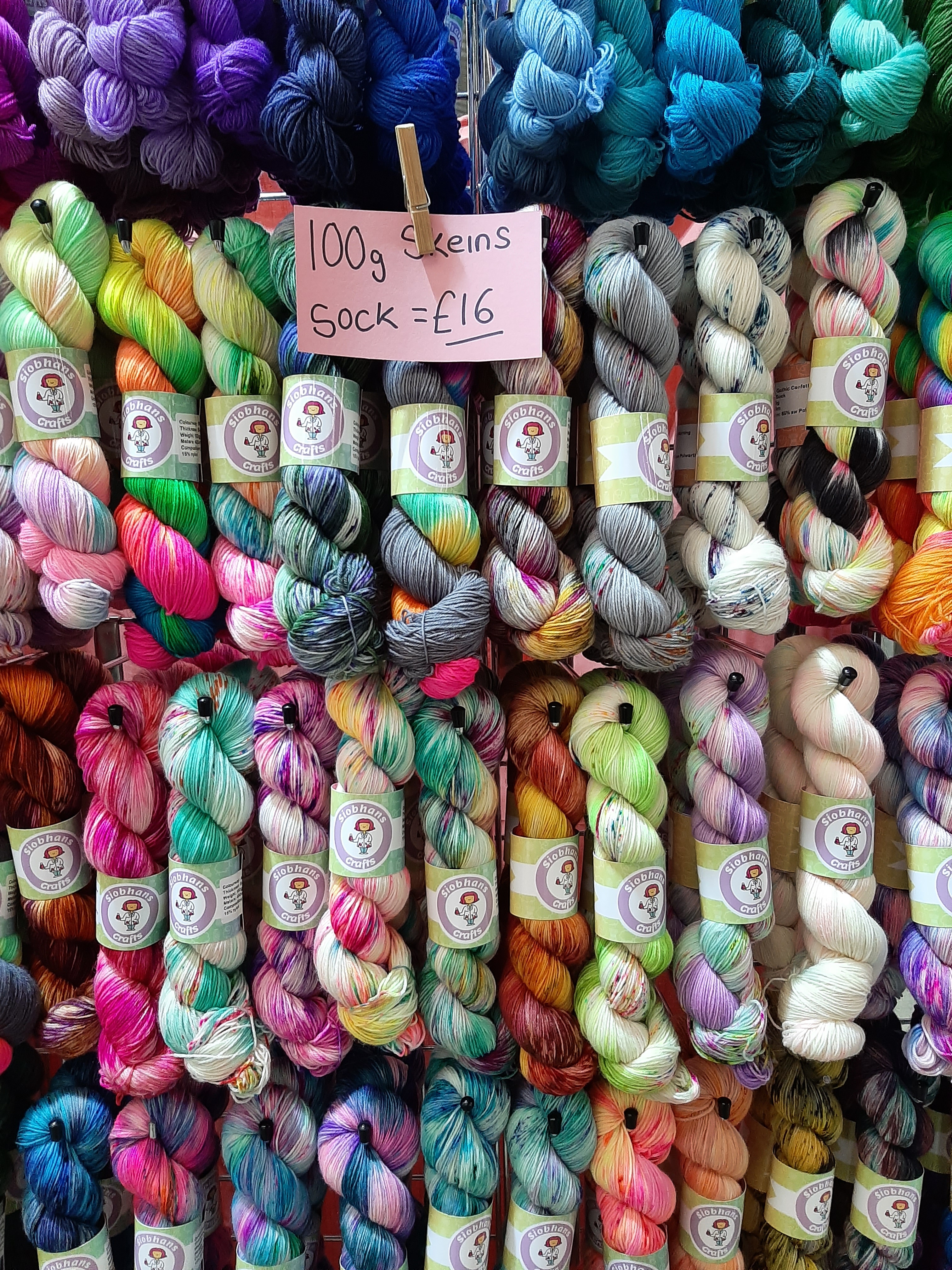
Dozens of skeins of brightly coloured yarn.
Sock yarn by Siobhans Crafts www.siobhanscrafts.co.uk

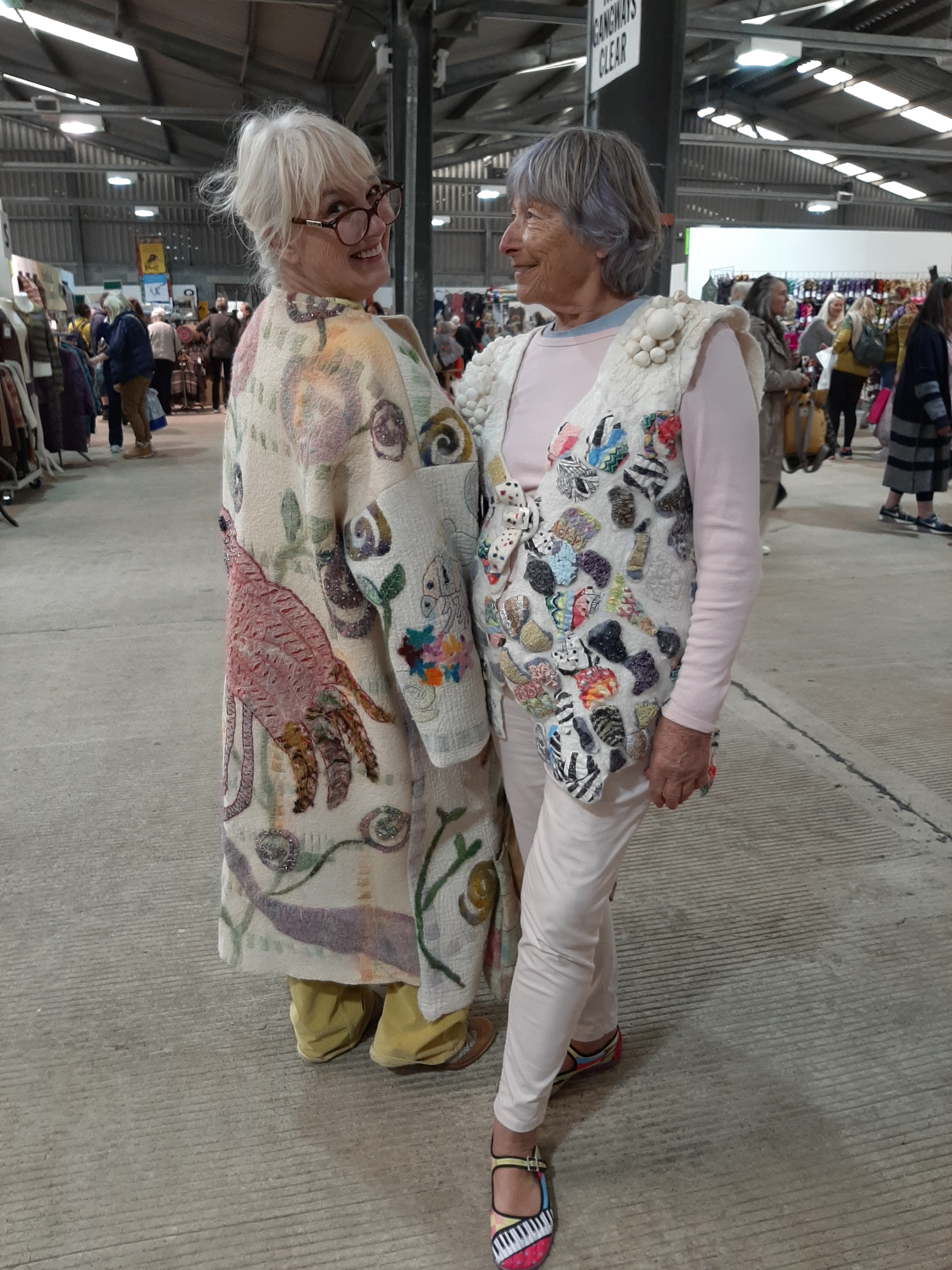
But it is not only the cornucopia of goods for sale which draw the eye.  Fibre events like this (similar gatherings in the UK include Yarn Fest in Yorkshire and Woolfest in Cumbria) are an opportunity for people to show off their creations.  There are several thousand people here, and seemingly every second person is wearing a handmade scarf, hat, sweater or dress.  I could have photographed dozens of examples at Wonderwool, but I settled on these two ladies who had travelled to Wonderwool from Cheshire, resplendent in their stunning, unique creations which incorporate felting and stitching techniques.  Fortunately, they were happy to pose for me!

Two smiling ladies modelling a coat and waistcoat.
Ali and Christine modelling their creations

Over the years that I have been coming to Wonderwool, I have noticed trends within the fibre crafts world.  For example, a few years ago there was a plethora of yarns made from hemp/linen, organic cotton, and nettle fibres.  This year, when I specifically wanted some cotton yarn for a project, there was none to be found, and remarkably little linen either.  Neither was there any sign this year of the giant knitting – with yarn as thick as rope, and broomsticks for needles – which was all the rage the last time I went.  The theme I could see this year was traceability – there was a strong emphasis on the provenance of the yarn on sale, with information on the flock that the fleece came from and the mill or hand-spinner that had processed it.  One vendor was even able to show a prospective customer a picture on her phone of the individual sheep whose fleeces had contributed to the balls of undyed knitting yarn on sale!

Sacks of sheep's fleeces in a range of natural colours.
Sacks of raw fleece. British Coloured Sheep Breeders’ Association www.bcsba.org.uk
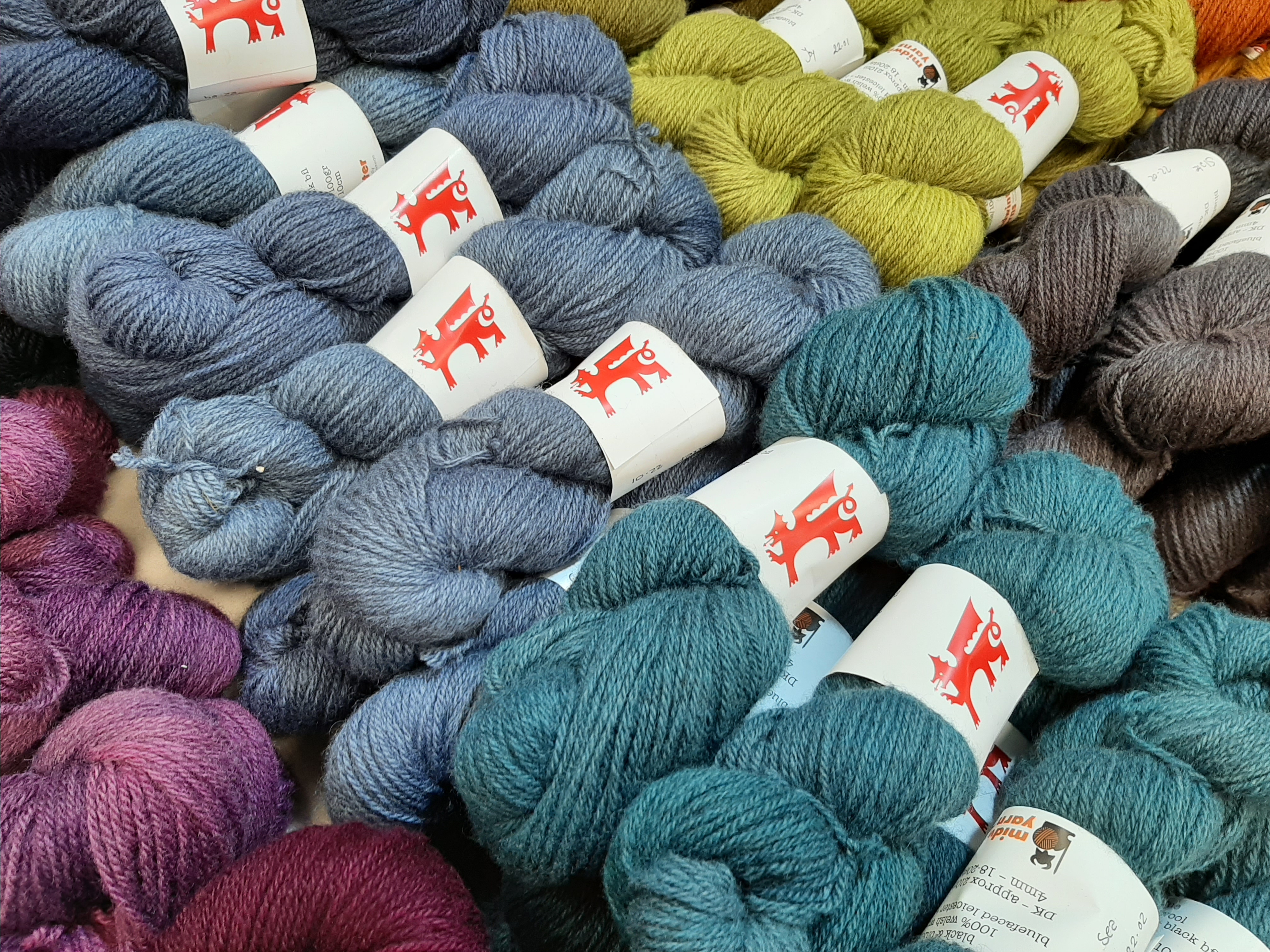
Skeins of coloured wool featuring the red Welsh dragon on the labels.
Yarn from Welsh flocks by Midwinter Yarns www.midwinteryarns.com

I was interested, too, to see an exhibit of natural dyestuffs – a range of plant products which have traditionally been used to dye yarn and fabric – together with the yarn that has been dyed with them.  There is increasing interest in natural dyes, with a number of how-to books now available (I have tried it myself, using onion skins to dye some silk fabric a vibrant, autumnal orange) and in view of the environmental impact of conventional (artificial) dyes it was good to see awareness of natural processes being raised in this way.
A selection of natural dyestuffs.
A selection of natural dyestuff from Allium Threads www.etsy.com/uk/shop/AlliumThreads
A selection of naturally-dyed yarns in shades of cream, wheat and green.
A selection of naturally-dyed yarns from Allium Threads www.etsy.com/uk/shop/AlliumThreads

Despite the name, it’s not all about the wool – one particularly eye-catching stall was selling yarn made from recycled saris.  The fabric is ripped into narrow strips, which can then be used to knit, crochet or weave.  The colours are luminous.

Photo of a woman winding a skein of bright orange recycled sari yarn.
Making a skein of recycled sari yarn at www.lalawithlove.co.uk
A display of recycled sari yarn in a range of bright colours.
Recycled sari yarns by www.lalawithlove.co.uk

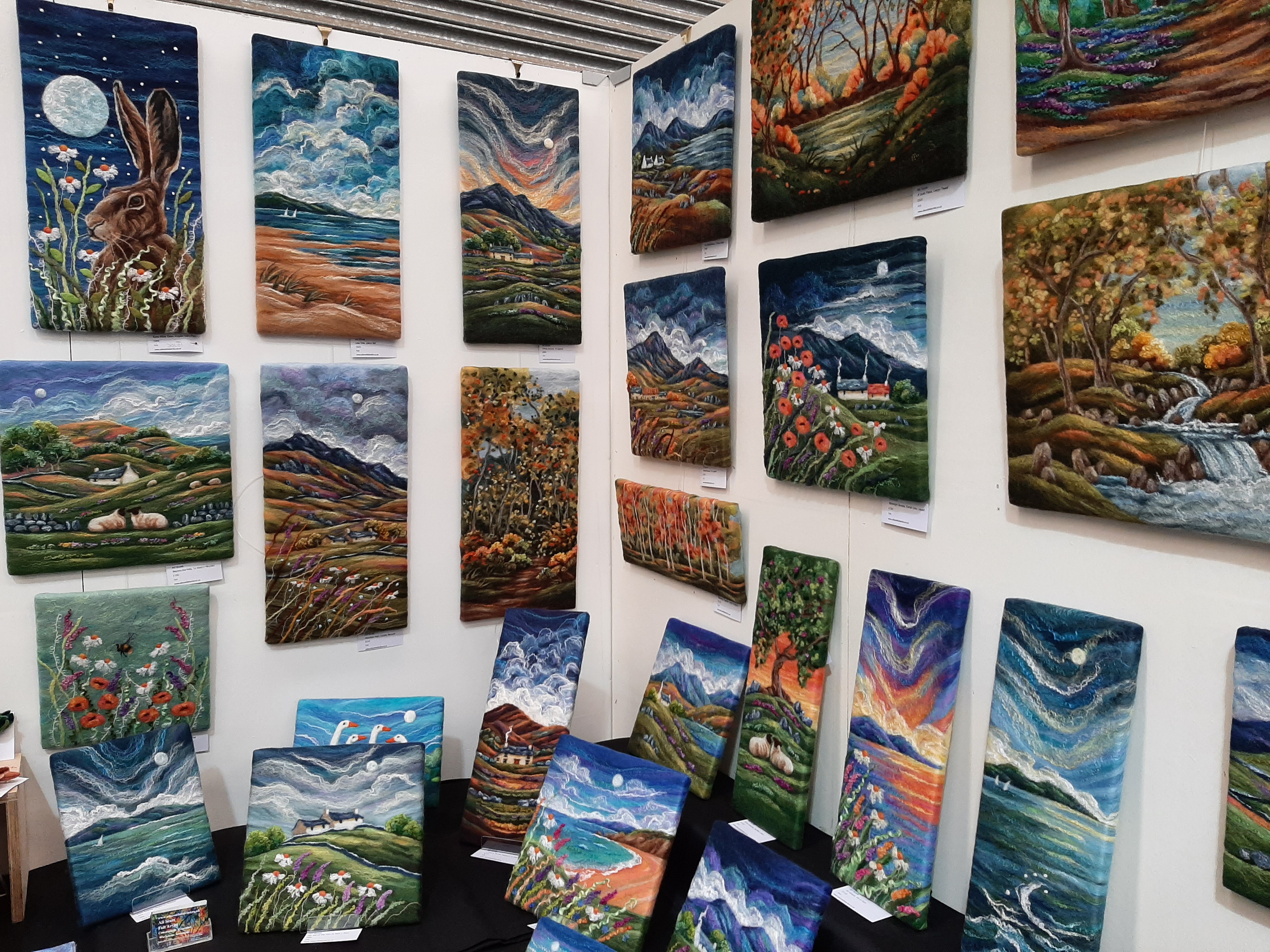
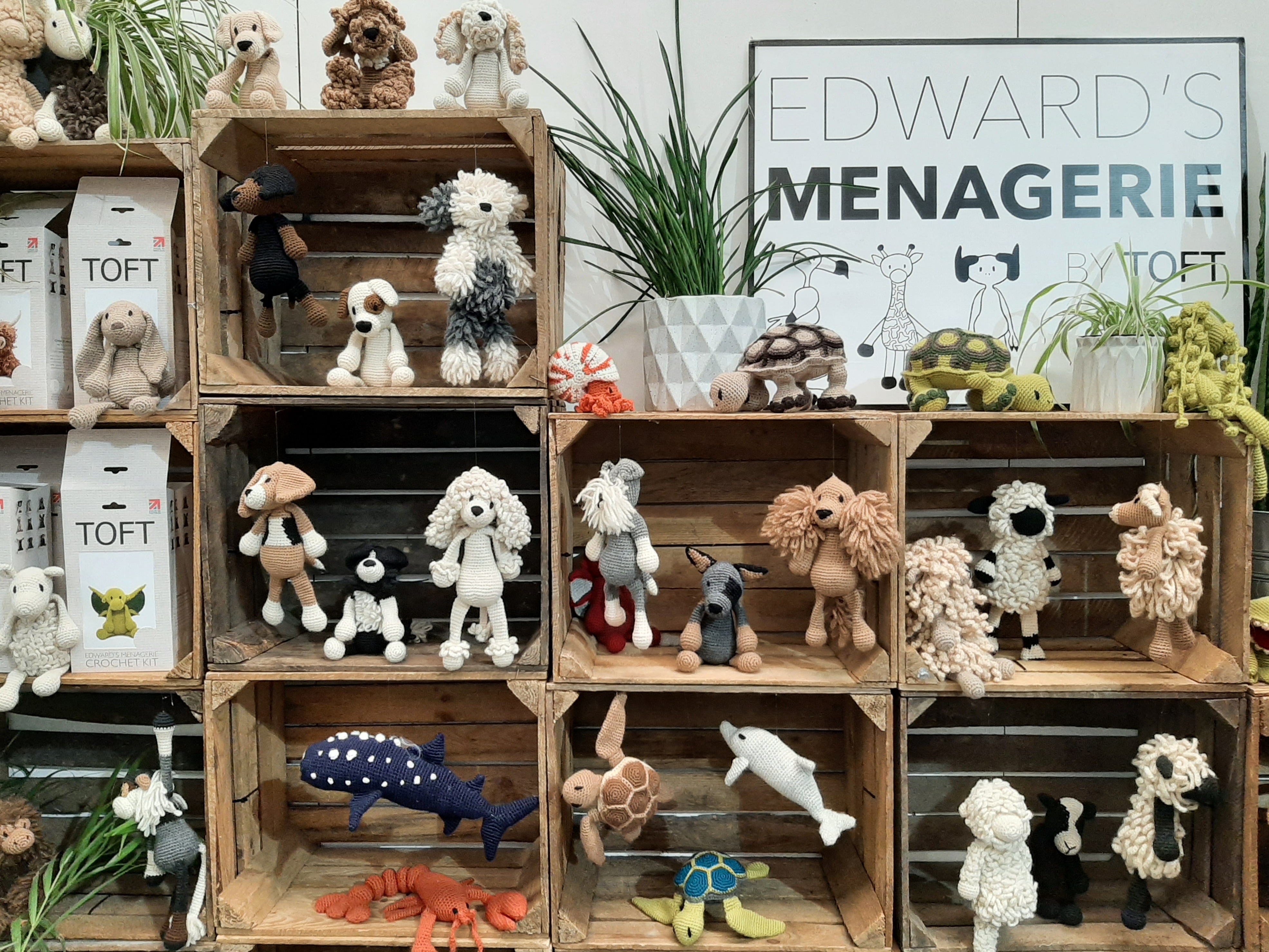
Wonderwool sets out to showcase all the processes from sheep to finished article.  Some of the breed societies bring ewes, with their lambs, to the show, and these are always popular.  ‘Raw’ fleece – clipped from the sheep last summer – is available for those who like to process and spin their own fibre, as well as combed fibres for feltmakers and spinners who prefer a little less lanolin in their fibres!  And, of course, there is yarn – so much yarn.  Knitting patterns.  Spindles, carders, looms.  Knitting needles, crochet hooks, spinning wheels, buttons.  Embellishments, dyes, bags of dyed combed ‘tops’ for feltmakers.  Knitted toys.  Traditional ganseys.  Textile art.  Yarn.  And yet more yarn.

Felt art by Ali Scott www.aliscottfeltartist.co.uk
A display of knitted and crochet toy animals including a poodle, a whale and a lobster.
Kits for toys by Toft www.toftuk.com

For many of us, though, it isn’t only about the retail opportunity – although I very much doubt anyone leaves empty-handed!  There is an aspect of the event which is more like a pilgrimage, a gathering of like-minded people, an opportunity for people to connect around the passion for fibre crafts that unites us.  It serves an as annual reunion – in the weeks before Wonderwool, many of us were emailing each other to ask ‘are you going to Wonderwool?  Shall we meet up?’  Everywhere, there were greetings, especially enthusiastic this year because of the enforced separation of the pandemic which means it’s been several years since we’ve all got together like this.  I arranged to meet up with friends I haven’t seen since the last time I was at Wonderwool, texting ‘I’m here!  Where are you?’ and rendezvousing for coffee, where we compared purchases and recommended stalls as well as catching up on our lives.  And the world of wool is international – I encountered people from Sweden, Germany, and the USA, as well as from all over the UK.  Guilds and groups hire coaches to bus their members to Mid Wales.  Conversations start over a shared admiration for a yarn, a texture, a colour.  I know I’m not the only one to have made friends through casual meetings at Wonderwool.  Here, we all understand the enthusiasm for that amazing sock yarn, that beautiful spindle, the lustre of that fleece.  Here, we are amongst our own, our tribe.

A wall display of coloured yarns.
Yarns by John Arbon Textiles, Devon www.jarbon.com
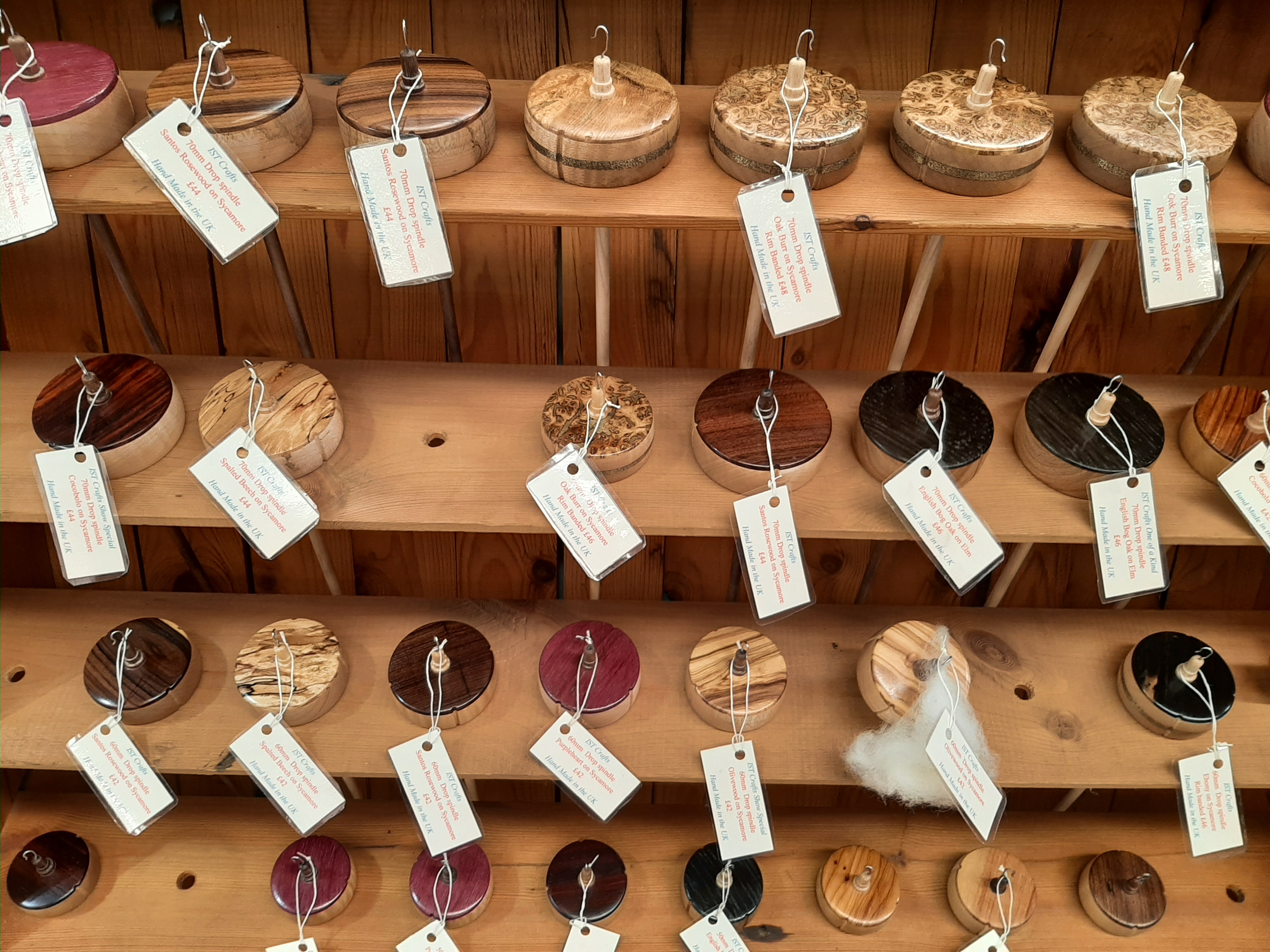
Display of hand-turned wooden spindles.
Spindles hand-turned by Ian Tait on the Isle of Wight www.thewoodemporium.co.uk

I am committed to making this blog freely available, and not putting material behind a paywall. As a writer, I am doing what I love – but I still have to make a living. If you have enjoyed this post, and if you are able to do so, perhaps you would consider supporting my work by making a small contribution via the Buy Me A Coffee button. Thank you!

Buy Me a Coffee at ko-fi.com

Judging a book by its cover – the book as art and artefact

I have always been fascinated by old books and their tooled and gilded bindings.  Years ago, when I worked at an academic library in Cambridge, a favourite part of my job was to carefully rub a special kind of polish into the leather covers to keep them fed and supple.  I would fetch the key to the climate-controlled, fireproof strong room in which the ‘special’ books were stored, select a volume which looked in need of attention, and get to work with a soft cloth.  As I worked, I would marvel at the intricate designs, and above all at the antiquity of these objects – we held books dating back to less than a century after Gutenberg’s revolutionary invention of printing with moveable type, most of them in their original bindings.  Whose hands had touched these covers and turned these pages before me?

Recently I was able to visit a remarkable exhibition at the National Library of Wales in Aberystwyth.  Entitled Beautiful Books, the exhibition consists of twenty-two books and an accompanying film which shows the bookbinding process.  Perhaps counterintuitively for a library, the emphasis is not on the content of the books, but on their bindings.  Created between 1849 and 1993, the books showcase the talents of remarkable bookbinders whose work goes far beyond simply making covers to protect the words within.

Colour photograph of the binding of Houses of Leaves, poems by Dafydd ap Gwylim, binding by Julian Thomas.  Image: Julian Thomas/National Library of Wales.
Houses of Leaves, poems by Dafydd ap Gwylim. Binding by Julian Thomas. Image: Julian Thomas/National Library of Wales

For a few years, I subscribed to the Folio Society, and a number of attractively-bound limited edition volumes were added to my bookshelves.  Apart from that, I have had little exposure to modern binding, and this exhibition was therefore quite an eye-opener for me.  As I worked my way around the glass cabinets, a few themes emerged.

These bindings are works of art, and not just in the way one says of something impressive, ‘wow, that’s a work of art!’  These fine bindings create pictures, images, in way that is reminiscent of textile art.  The use of blocks and lines of colour, gilding, texture, and motifs which respond to the subject of the book, combine to make artworks which stand in their own right.

Stylistically, they are very much of their time.  For example, the binding by Elizabeth Greenhill for Louis MacNeice’s The Burning Perch (1963) put me in mind of a tapestry by Graham Sutherland, and would not have looked out of place scaled up on the wall of a brutalist concrete building on the South Bank in London. 

In many cases, it really is possible to judge the book by its cover, as the binding gives a hint or preview of the contents.  For example, the cover created by Julian Thomas for Houses of Leaves, a translation of the work of fourteenth-century Welsh poet Dafydd ap Gwylim by Rachel Bromwich, published in 1993, takes its inspiration from the book’s title, and features lines based on the outlines of leaves and the tendrils of foliage which ornament medieval manuscripts.  And with the binding for Across the Straights by Kyffin Williams, Thomas’ collaboration with arguably Wales’ most famous artist results in Williams’ essential simplification of landscape being expressed on the book’s cover.

Colour photograph of the binding of Across the Straits by Kyffin Williams, binding by Julian Thomas.  Image: Julian Thomas/National Library of Wales
Across the Straits by Kyffin Williams, binding by Julian Thomas. Image: Julian Thomas/National Library of Wales

As a writer, it is a strange experience for me to be looking at books as artefacts as well as texts (or indeed as artefacts instead of texts – with the exhibits contained within glass cases, it is of course not possible to interact with the printed words within).  This has made me muse about the books I own.  Are some of these, too, artefacts rather than just texts?  Do I choose to have them because they symbolise my aspirations to be knowledgeable, cultured, or well-read (whether or not I’ve actually read them)?  Do some of them earn their place on the shelves because of the tactile quality of their bindings, or their attractive cover designs?  There are certainly some books I have bought because I was entranced by their covers, and others where I have been pleasantly surprised when their plain, worthy covers prove, on actually reading the book, to belie the fascinating content.  Book covers matter.

The exhibition Beautiful Books continues at the National Library of Wales until 9 December 2022- more details here: https://www.library.wales/visit/things-to-do/exhibitions/beautiful-books

Just upstairs from this exhibition is another, which also caused me to think about the significance of books.  Beibl i Bawb (A Bible for All) celebrates the four hundredth anniversary of the publication, in 1620, of the translation that became the standard text of the bible in Welsh until the 1980s.  The significance of the Welsh bible goes far beyond religion – as with many languages, the standard translation defined the language, providing a benchmark for written Welsh and a foundation for cultural and literary life to the present day.

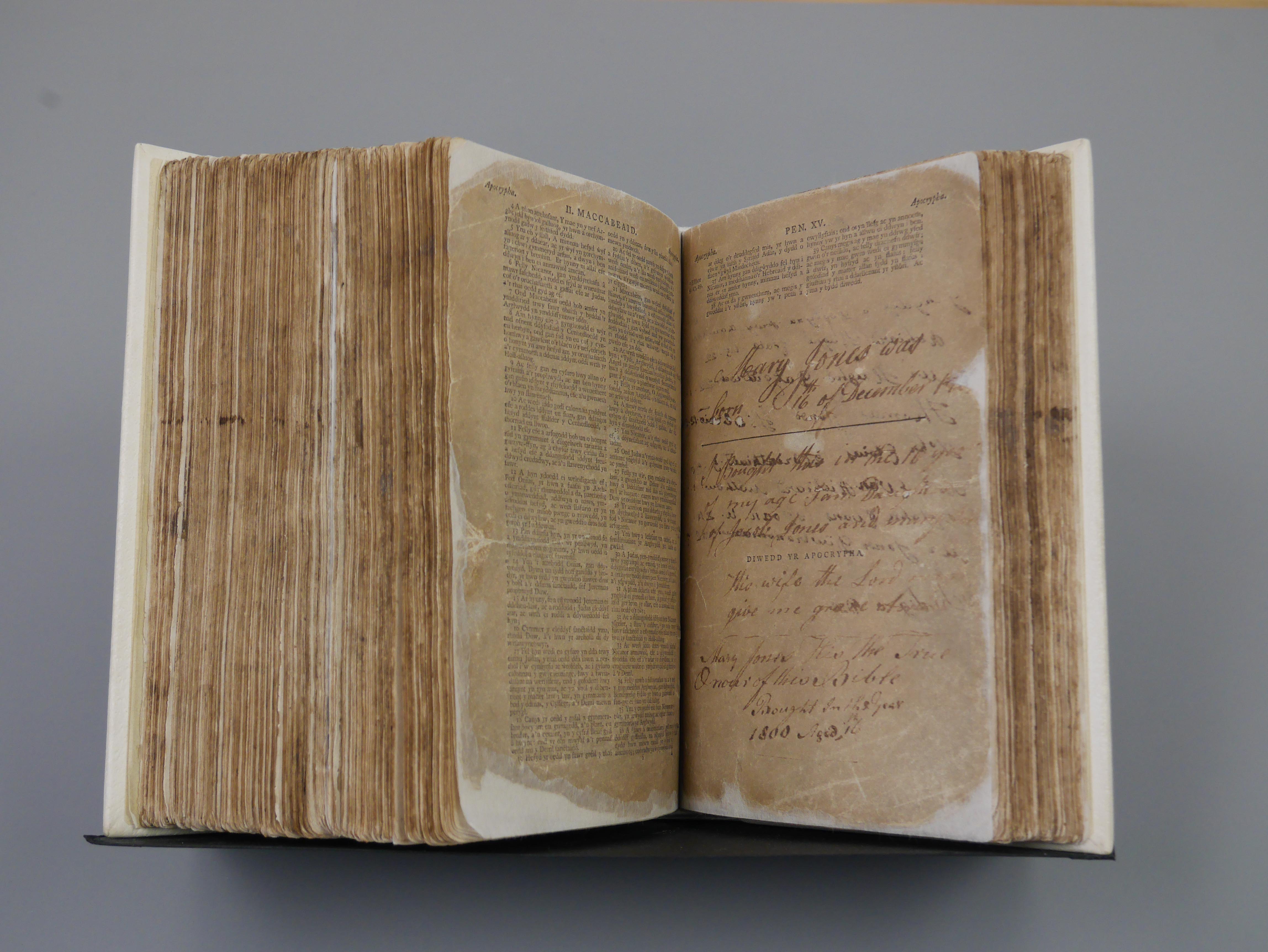
Colour photograph of Mary Jones' bible.  Image reproduced by kind permission of the Bible Society
Mary Jones’ bible. Image reproduced by kind permission of the Bible Society

Here, too, I am brought face to face with the book as artefact.  In this case, it is the bible owned by Mary Jones.  Her barefoot journey across North Wales in 1800 to buy her own copy of the bible in her own language has become a story that is told across the world.  This object – dark with use and age – is more than a book.  It connects us to an individual, a real person who held it and turned its pages, and also to a whole history of a language and the people who speak it.  And it tells the story of reading – at that time, Wales had one of the highest rates of literacy in the world thanks to the ‘circulating schools’ pioneered by Griffith Jones and his successors, which would come to a district for a while and teach people of all ages and genders to read, the aim being that they would be able to read the bible for themselves.  Literacy was perceived as what we still know it to be today – the gateway to knowledge and independent learning that can change lives.  Mary Jones’ bible is symbolic of the world of words and ideas that was opened up to her when she learned to read.  There can be few greater gifts than the ability to read.

The exhibition Beibl i Bawb (A Bible for All) is on until 2 April 2022 – more details here: https://www.library.wales/visit/things-to-do/beibl-i-bawb

I am committed to making this blog freely available, and not putting material behind a paywall. As a writer, I am doing what I love – but I still have to make a living. If you have enjoyed this post, and if you are able to do so, perhaps you would consider supporting my work by making a small contribution via the Buy Me A Coffee button. Thank you!

Buy Me a Coffee at ko-fi.com

In other words – writing, reading and literary translation

I have recently been working on a translation into English of a short story in Dutch.  It’s part of an ongoing project, and I am finding the process fascinating.  As a writer who is also a translator, there are a number of things going on at the same time when I undertake literary translation, and although the temptation is to say that much of it is instinctive, in fact there are layers of practice at work which I find it helpful to analyse and articulate.

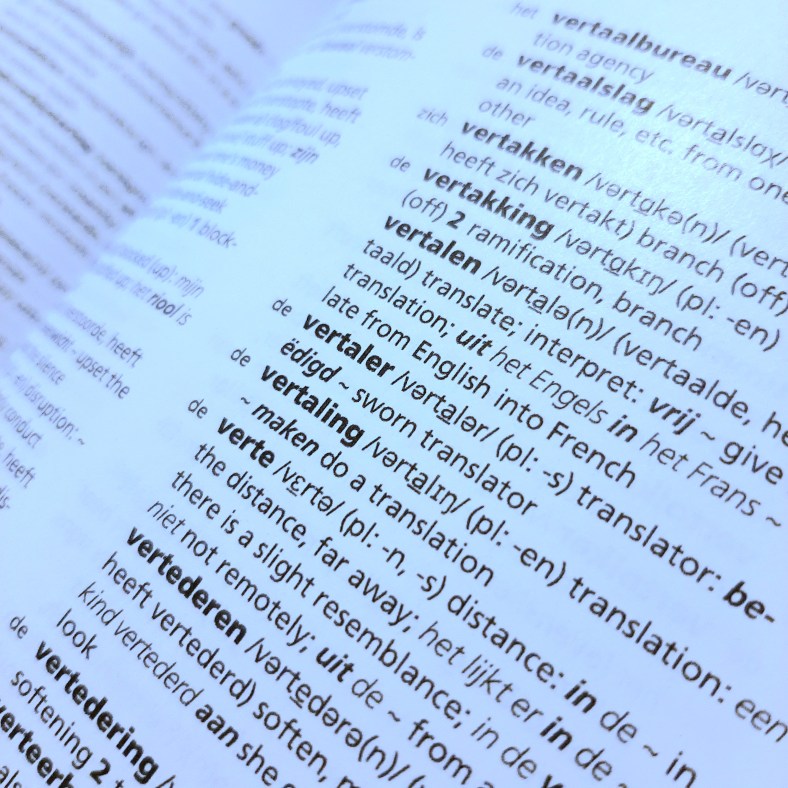
Any translation has elements of decoding meaning from the source language (which in my case is Dutch) and encoding it in the target language (in my case, English).  Sound straightforward enough?  Well, not really, because the differences between how languages work, the building blocks that make up meaning – things like word order – mean that it’s not simply a case of grabbing a dictionary and swapping one word for another.  Also, you can’t just translate expressions and idioms literally, because the same idea may be expressed completely differently in the two languages.  For example, iets kennen als zijn broekzak literally translates as ‘knowing something like his trouser pocket’ – which makes no sense whatsoever in English.  The equivalent idiom in English would be ‘knowing something like the back of his hand’.

But what if the meaning of the text is made up, not only of dictionary words, or even idioms and colloquial phrases, but of subtle nuances of tone, sound, repetition, alliteration, rhythm, pace, and so on.  This is most obvious in translating poetry, of course, but any literary text is more than the sum of its words, and my challenge is to extract a sense of those extra layers of meaning and to convey that into English.  It is my job to write the short story in English which the original author would have written if they had been a native speaker of English.

This is, of course, impossible, but the best translations get so close to this ideal that the reader forgets that they are reading a translation.  This is what I am aiming for.  I need to identify and isolate the quirks, style and individual voice of the author and find a way of distilling that into an equivalent voice in English.  If the story reads as if I wrote it, then I’ve failed.

Ironically, I believe that it is the fact that I am a writer which equips me to do literary translation.  Finding my own voice, using all those tools of tone, sound, repetition, alliteration, rhythm, pace, and so on in my own writing, enables me to put that toolbox at the disposal of the author whose words I am translating.  Because I am a writer, I am well-placed to see the workings behind the scenes of the original text, to recognise what the author is doing, and to do what is necessary to create the corresponding effect in English.

It can be a slow process.  This is not like translating an online article about a new archaeological discovery, or even like translating a piece of academic writing.  Those kinds of texts are mainly about conveying the content.  The voice of the original author is rarely the main feature of the translation, and the task is to convey the information in appropriate, equivalent English.  It may take time to do the necessary research to find that appropriate equivalence – especially where there is specialised vocabulary involved – but it is not an especially lengthy process.  With literary translation, by contrast, I need to live with the text for a while before attempting to start translating it.  In the case of this short story, I first read it more than six months ago, and have gone back to it many times since.  I have it read straight through; read it for structure; for style; for vocabulary; for geographically-specific references (the author is Flemish, and the story is set in Antwerp).  I have marked up ‘problems’, passages where it is not immediately apparent how I should translate the text.  One particular phrase occupied me for a long time – in the end I decided to take a risk and move quite a long way from the literal meaning of the original Dutch word in order to create the same shock-value and controversy in English.  Re-reading my translation now, I am really pleased with the ‘solution’ to that particular ‘problem’.

There is a campaign ongoing in the translation and publishing industries at the moment to put ‘translators on the cover’ – in the vast majority of cases, literary translators are not named on the covers of the books they translate, even when these translations go on to win major book  prizes.  Often – in Anglophone markets, anyway – it is hard to know that the book you are reading is a translation.  At best, you might find the translator mentioned on the title page, but usually they will merely get a credit tucked away on the copyright page, which only the most nerdy amongst readers ever actually reads (I do – but I’m an ex-librarian and back in the day, when cataloguing was done manually, this was where you found the information you needed in order to catalogue a book).  If you live in an English-speaking country, you have probably read the work of literary translators without even realising it.  It is my hope that, having read this post, you may seek out the work of literary translators and enjoy the results of the process that I have described.  There is a whole world of books out there, and literary translators are the people who make it possible for you to read them in your own language.

Photograph of part of a page from a Dutch/English dictionary, showing the entries for 'vertalen' (to translate), 'vertaler' (translator) and 'vertaling' (translation).

I am committed to making this blog freely available, and not putting material behind a paywall. As a writer, I am doing what I love – but I still have to make a living. If you have enjoyed this post, and if you are able to do so, perhaps you would consider supporting my work by making a small contribution via the Buy Me A Coffee button. Thank you!

Buy Me a Coffee at ko-fi.com

2021 – My Year In Books

2021 – My Year In Books

New Year’s Eve has come upon me suddenly – in the limbo between the public festivals of Christmas and New Year, the days seem to merge into each other, especially this year when the grey skies touch the ground (alternating occasionally with thick fog) and it never seems to get properly light.  There have been a lot of ‘best books of 2021’ posted on social media over the past few weeks, and it set me thinking about what I have read this year.  Some I have reviewed on this blog or in other publications, but others I have read simply for pleasure or out of curiosity.  Here, in roughly chronological order, are my top 10 books of 2021.

Mudlarking: Lost and Found on the River Thames by Lara Maiklem.  I originally bought this for my beachcombing mother-in-law, but it looked so interesting that I got a copy for myself too.  The author posts prolifically on Twitter, Facebook and Instagram, so the book is very much a starting point for an ongoing engagement with the finds that emerge from the Thames, and the stories and history behind them.  Maiklem moves down the river, from the tidal head at Teddington to the estuary at Southend-on-Sea, telling the story of the riverbank, the characters who inhabit(ed) it, and her own experience of mudlarking along the shore and the artefacts she has discovered.  The book sits between travel writing, social history, and memoir, and is accompanied by photographs of some of the finds she refers to.  I am always entranced by the humble objects, sometimes lost for centuries, which give a glimpse into people’s everyday lives, so for me this book was a treasure trove.

Ghost Town: a Liverpool Shadowplay, by Jeff Young was another book which was originally a gift which I ended up reading myself.  This had a personal resonance for me, as the streets which Young describes so evocatively were trodden by my own father, half a century earlier.  Many of the places are familiar to me from tracing my family history.  In Young’s luminous memoir, he walks through his ‘ghost town’, and explores themes of metamorphosis – his own, and that of the city of Liverpool –and loss, remembering and mis-remembering.  A compelling narrative, highly recommended for anyone interested in place writing.

Next up was The Screaming Sky by Charles Foster, illustrated by Jonathan Pomroy.  I read this just a few days before the swifts arrived from Africa, perfect timing for this love song to the marvel of nature that is the swift.  Born of a passion bordering on the obsessional, Foster’s book describes the bird’s life-cycle, its mind-boggling feats of aerobatics and endurance, its biology, and the history of humans’ relationship with the species.  I wrote a full review on this blog here.

Where? Life and death in the Shropshire hills by Simon Moreton was a new departure for me – I have no experience of the graphic novel/zine genre which Moreton specializes in, and this innovative book combines text with illustration and collage in a way I’ve not seen done before.  Where? is a memoir, in which Moreton juxtaposes the narrative of his father’s illness and death with memories of a childhood in rural Shropshire, in a landscape dominated by the presence of Titterstone Clee which looms over the surrounding countryside, and near the summit of which is a radar station where Moreton’s father worked.  Again, this is place writing about somewhere I know slightly, and I enjoyed reading it, admiring the weaving together of the two strands.  I am aware, though, that there were aspects I didn’t ‘get’ because I don’t have the visual lexicon to understand the artwork which is such a large component of this book.

A Still Life: A Memoir by Josie George.  I have followed Josie George on Twitter for a long time, and pre-ordered this book when she announced its publication.  However, it took me a long time to summon up the courage to read it.  In a year where so many themes were dark and hopeless, it seemed perverse to read an account of disability and chronic illness.  I was wrong.  George’s account of her life with a condition which long defied diagnosis and which continues to deliver twists and turns of challenge and disability, is full of light, hope and love.  Not that there is any false cheeriness here – she pulls no punches about the pain and hardships of her situation – nor is there any of the ‘disabled person as an inspiration to us all’ nonsense.  This is an exceptional person, taking life one moment at a time, doing what she can, not doing what she can’t, refusing to get frustrated, determined to continue loving, convinced that the world is good, that life is good, that being alive is the most amazingly wonderful thing, to be savoured and celebrated in whatever way we can in that moment.  It is heartwarming, not in an It’s A Wonderful Life kind of way, but in a way that stays with you, challenging the way you look at the world, at each small moment of our small lives.

The Long Field by Pamela Petro is again memoir/place writing about somewhere I know – in this case, Petro’s love affair with rural Wales started in Lampeter, at the university we both attended.  I reviewed The Long Field here.

Fifty Sounds by Polly Barton was initially quite a challenging read (I don’t do philosophy, which dominates the opening chapters) but my persistence was rewarded by an insightful exploration of how language and culture influence and shape each other.  Barton tells of her experiences as an English teacher in Japan, and the fifty sounds of the title (which form the chapter headings) are onomatopoeic words in Japanese which she unpacks in her journey into Japanese language and culture, and into her own personality.  I wrote a full review for the Cardiff Review.

You will have noticed that all the titles in this list are non-fiction.  I have struggled with reading fiction since the beginning of the pandemic, but The Listeners by Edward Parnell may have rehabilitated me.  This clever, taut, beautifully written delight gave me more reading pleasure than anything else this year, and I reviewed it joyfully here on this blog.

Finally, two books which I am still reading.  Light Rains Sometimes Fall: a British Year Through Japan’s 72 Seasons by Lev Parikian is arranged in short chapters covering 5 or six days each, in which Parikian closely observes the natural world around him, partly through pandemic lockdowns, noticing details of the changing seasons.  I am a big fan of Parikian’s nature writing, and as I’m consciously attempting to live more in the present (rather than the past or the future) I liked the idea of reading this in ‘real time’, a chapter at a time for a whole year.  The current ‘season’ is called ‘Storms Sometimes Blow,’ which seems about right! 

As an utter map nerd, and a fan of his other writing, it was inevitable that I would eventually read Map Addict by Mike Parker.  At the time of writing, I am halfway through this blend of memoir, cartographical history, and celebration of the glorious Ordnance Survey map, and it’s so nice to connect with a fellow map addict! (I’ve written about the origins of my own map obsession here).

And, on this last day of 2021, I bring you good news – I have a whole lot more books lined up to read in 2022!  My ‘To Be Read’ pile includes poetry, a lot of exciting non-fiction, and even (tentatively) a bit of fiction.  I can’t wait!

Wishing you a Happy New Year.

Photograph of the books referred to in this blog post.

I am committed to making this blog freely available, and not putting material behind a paywall. As a writer, I am doing what I love – but I still have to make a living. If you have enjoyed this post, and if you are able to do so, perhaps you would consider supporting my work by making a small contribution via the Buy Me A Coffee button. Thank you!

Buy Me a Coffee at ko-fi.com

Belated book review – The Listeners by Edward Parnell

It grieves me that it took so long for me to get round to reading this book.  I know Ed Parnell, and have read his non-fiction Ghostland, so I knew his debut novel would be good.  But the arrival of my signed copy of The Listeners was followed closely by the arrival of Covid and the first lockdown, and I suddenly found it impossible to read fiction.  It was as if the surreality of real life, with everything we took for granted suddenly swept away into an unknowable and dystopian future, seemed to make my brain incapable of coping with imagined realities.  I had a large ‘to be read’ pile which included a number of fiction books by authors I knew I liked, but each one was closed and put aside after only a few pages.  I just couldn’t hack fiction. 

For a year and a half I read only non-fiction.  Then, last summer, I started re-reading the Golden Age crime fiction collection on my Kindle (Agatha Christie, Dorothy L Sayers, Margery Allingham).  These were safe, generally not graphically violent, with structures that were familiar and worlds which trundled along on their predictable tracks.  All very comforting.  Stella Gibbons’ Cold Comfort Farm, too.  But it has taken until last week for me to feel up to tacking new, more challenging fiction.  It was time to open The Listeners.

I love this book.  I’m sad I’ve finished it – I eked out the last few chapters over several days, to put off the moment when it would be over.  It is a treat, a gem, a perfectly-formed little treasure, like a beautifully crafted piece of work by a skilled artisan.  It is utterly beguiling.  And yes, I know that sounds hyperbolical, but I mean every word.

The Listeners is set in the wartime years of the 1940s in rural Norfolk – in an area near to where I used to live, so I recognize the descriptions of landscape and wildlife that provide the staging for the events of the book.  It is not so much the events that carry the reader forward, as the voices of the various narrators who take turns to give their perspectives.  It takes quite a while to work out which, if any, of the narrators are reliable.  Much of the action is in the shadow of events up to a generation earlier, events which are only hinted at.  The way those past events, and their implications for the present and the future, are gradually and subtly revealed to us is a masterclass in understated writing.  At several points in the narrative, I had a sudden, nauseating jolt as I realized what was actually being referred to, what it was that had happened and was not being talked about, or what was, with a sickening inevitability, going to happen next.

It is, in many ways, a dark book.  Anyone who has read Ghostland will know that Edward Parnell is an aficionado of the dark, the weird, of things hinted from the shadows.  The Listeners, which predates Ghostland, should really be depressing – I can’t tell you about all the motifs because it would spoil the plot for you, but let’s say that most kinds of violence, abuse, betrayal and grief feature in it – but the writing is so beautiful and the characters so deftly painted that it glows with chiaroscuro like the work of an Old Master.

The pace is measured – a pace appropriate to country folk who are, despite the upheavals of WWII, simply getting on with the necessary cycle of the agricultural year and domestic life – but the book never drags.  The change of voice with each chapter shifts our viewpoint, keeps the reader on their toes (and often doubting everything they’ve just read in the previous chapter).  And the ending – with the reader now knowing something which the protagonists do not – is genius.

The Listeners (the title is borrowed from the poem by Walter de la Mare, for reasons which will be come apparent) won the Rethink New Novels Competition in 2014 – this is another reason why I am calling this a ‘belated’ review.  The good news for those of us who are late to the party is that it is still available to buy (direct from the author at https://edwardparnell.com/buy-signed-copies/, or from Amazon as a print-on-demand book or on Kindle).  I have reviewed a lot of books this year which I have very much enjoyed but, for me, this is my book of 2021.  I just wish I could un-read it so that I could have the joy of reading it again for the first time.

I am committed to making this blog freely available, and not putting material behind a paywall. As a writer, I am doing what I love – but I still have to make a living. If you have enjoyed this post, and if you are able to do so, perhaps you would consider supporting my work by making a small contribution via the Buy Me A Coffee button. Thank you!

Buy Me a Coffee at ko-fi.com