Book review. The Hare and the Moon: A Calendar of Paintings by Catherine Hyde

As regular readers of this blog may have gathered, I am a bit of a fan of the hare.  I was delighted, therefore, to find this rather wonderful little book with the evocative title The Hare and the Moon: A Calendar of Paintings.  It is pleasingly square, with a tactile cover, which is always a good start.  And it had me at the first page, which is an illustration of the three hares motif!
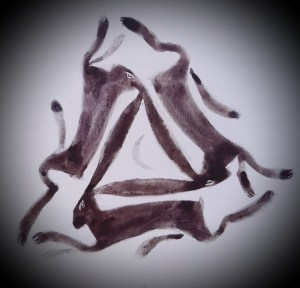
There are a number of elements to the ‘calendar’ aspect of the book.  A poem, with the refrain which recites the folk names for the full moons (The Snow Moon, The Wolf Moon, The Hunger Moon, The Sap Moon etc) is woven through it.  Each month then has six themes.  There are black and white illustrations of the moon phases.  There are double page colour paintings of the hare in the seasonal landscape (I especially like January, where the hare is joined in the snowy countryside by the barn owl and the raven).   There are Indian ink drawings of the hare in action and at rest.  For each month there is a flower, a tree, and a bird, each accompanied by a colour painting and a note about the folklore and alternative country names.  For example, June’s flower is honeysuckle:

“Used for rope-making in the Bronze Age and also known as woodbine, honeybind, trumpet flowers, Irish vine, Goat’s leaf, sweet suckle and fairly trumpets.  Honeysuckle grown around the entrance to the home prevented a witch from entering and would bring good luck.”

The Hare and the Moon subtly weaves poetry and art together, blurring the boundaries and creating what has been described as ‘visual poetry’.  This is so much more than a book of poems and folksy factoids with illustrations.  The images have a dreamy quality which lend a timeless air to this charming book.  Perfect for reading, as I did, while curled up on the sofa on a dark winter afternoon, a steaming mug of tea by my side (think hygge!), this would make a fine Christmas/Yule present for anyone who loves the natural world, folklore, or art.  Or indeed hares!


(For more about Catherine Hyde, take a look at https://catherinehyde.co.uk/)

Portraits of the past – my family history in photographs

Last year I came into possession of a large collection of family photographs.  I am the last person standing on that side of the family, so on the death of the last of the previous generation is all passed to me.  We’re not talking a few albums here – the collection completely filled the back of an SUV!  Most of the albums were in poor condition and had been stored in damp or dusty places, so a priority was to remove all the photographs (copying the annotations onto the back of the photos where appropriate) and throw away the wreckage of the albums.  There were also a lot of loose photographs, as well as some in frames (many with broken glass).

Eventually, I was able to group them into rough families, eras and locations.  There were a huge number of duplicates, so the first edit was to choose the best of the duplicates, again copying any annotations, and put aside duplicates for cousins in America if they were likely to be of any interest to them.  Then, I went through each group of photographs, weeding out any which were of no particular family history interest, or where the features were blurred, or choosing one from a series of almost identical shots (there were lots of these, especially 1950s landscapes.  It was apparently a thing in Scandinavia to take many photographs of the back of people standing in a field gazing at distant hills…).

After many evenings and weekends of going through photographs, peering through a magnifying glass at blurry faces, and getting very dusty, I have now whittled the collection down to a single crate, all divided into acid-free archival envelopes labelled with details of the contents (pre-war Holland, Helsinki Olympics 1952, holiday to Wales July 1961, etc).  I also started a notebook, with a page for each year, so that I could track the events and movements relating to the various strands of the family.  One wet Sunday afternoon this winter I plan to create a timeline from the notebook, which colour coding for each branch of the family, for the whole of the 20th century (and also scanning the most interesting ones of shared ancestors to send to my American cousins).

This side of my family is Dutch (via military service in the Dutch East Indies and internment in Japanese camps during WWII), with various members emigrating to America, Finland and Britain.  It has been a fascinating – and occasionally harrowing – exercise to follow individuals from newborns, through rites of passage, family memories, pets and holidays, to ageing, and in one case, death (it seems it was the fashion to take open casket photographs in 1940s America).

I have glimpsed the interiors of Dutch colonial houses of the 1930s, Scandinavian holiday shacks in the 1950s, and American ranches in the 1970s.  I have found that some of the stories I was told as a child were true, and others were not, while still others have got garbled in the telling.  I have been saddened by the toll that WWII took on my grandfather (he was in his 60s when I was born, so I never knew him as anything other than old).  I have been moved by how much my teenage grandparents were obviously in love, in photographs from their courting days which I had never seen.  I have seen my own features and expressions looking out at me from the faces of long-dead relatives.  And I now have a much clearer sense of who I am, and where I have come from.