Books – why I love them, why I buy them, why e-readers are OK, and why libraries are amazing

I’m sure it won’t come as a surprise to readers of this blog to find that I love books.  I’m a writer, after all, and I’ve never yet met a writer, in any genre, who didn’t love books.  Not only that, but I spent quite a few years working in academic and public libraries, which was rather like working in a sweetie shop (but less fattening).  I’ve got it bad.

As a child, I didn’t have many books.  We lived in various parts of Europe, and in those pre-internet days (1970s and early 1980s) getting English- or Dutch-language books abroad was pretty much impossible (see my post about being brought up bilingual).  My father would make an annual trip to London to shop at Foyles bookshop, and bring back as many books as he could carry (which wasn’t a lot to last a voracious young reader a whole year).  When we stayed with my Dutch grandparents, I would read their extensive collection of English-language whodunits (my grandmother was severely addicted – her favourites were Dorothy L Sayers, Erle Stanley Gardner and Agatha Christie, in that order) which sowed the seed of a life-long love of classic crime fiction.  I read Lewis Carrol’s Alice’s Adventures in Wonderland and Through the Looking Glass a dozen times.  When all else failed, I read the Pocket Oxford Dictionary like a novel – there are worse ways to train as a writer.

I may not have had many books, but I knew what I did and didn’t like.  I liked Enid Blyton’s mysteries and adventure stories, but not her more surreal, fantasy output.  I adored Cicely M Barker’s Flower Fairies books, not least because of what they taught me about plants – I can still recall snatches of them when I see wildflowers growing in the hedgerows.  I didn’t care for classic children’s stories like Mary Poppins or Peter Pan, but then, given that I was by that stage already a fan of Lord Peter Wimsey, that’s perhaps not surprising.  I was at best ambivalent about classic novels – to be truthful I still am.  Apart from Persuasion, I am unmoved by Jane Austen.  I appreciate her talent, I just don’t much care for the books.  I found Dickens interesting, but heavy going.  Amongst the Brontë sisters’ output, I liked Wuthering Heights, and once I’d discovered Jean Rhys’ Wide Sargasso Sea I could see the point of Jane Eyre.  Sherlock Holmes came into my life at the age of 16, and I still re-read those stories when I need something comforting.

In fact, I discovered lots of books at the age of 16, because that’s when we settled in the UK and I started to use libraries.  My school library had virtually no fiction on its shelves, but the local public library was huge, and I systematically stripped the shelves.  I was doing A level English too, so there was Chaucer (yay!), Shakespeare (OK, especially Hamlet and Twelfth Night), D H Lawrence (hmmm), Austen (see above), R S Thomas (dark and melancholy but wonderful), and my beloved Dylan Thomas (with whose work I had fallen in love when I first heard Richard Burton intone the opening lines of Under Milk Wood).  John Donne (sorry, I’m sure it’s great writing but I haven’t got time for this), Wordsworth (lovely but a tad self-indulgent), Tennyson (the less said about that the better), and Keats (lyrical but lengthy), also figured in the syllabus.  I did three A levels, but the only one I can remember in detail is English – I can still quote the odd line here and there.  For light relief I read James Herriot, Gerald Durrell and Robert Louis Stevenson (Kidnapped was possibly my favourite book through my teenage years), and every Agatha Christie and Dorothy L Sayers I could find.

It’s probably no coincidence that I went on to spend many years working in libraries (university and public).  The windows on the world offered to a teenager in a remote Snowdonian town by the presence of a good library were a gift, and I am passionate about the continued provision of public libraries.  Yes, the internet is an amazing repository of knowledge (and misinformation!) but it cannot replace the serendipity of going to the shelf for a book and becoming entranced by its neighbour, which you didn’t know existed and would consequently never have searched for.  As a student, some of my best essays were written using books which weren’t on the reading list (because those had all been borrowed by other students writing the same essay), which meant I had a slightly different slant on the topic.  Being able to access, for free, a huge range of fiction, poetry and non-fiction, is a precious thing and can be truly life-changing for a child whose home is not filled with books or whose family cannot afford to buy them.  Libraries set people free to out-grow their circumstances – just look at Jeannette Winterson.

As soon as I could afford it, I bought books.  I love being surrounded by books in my home, books I can savour at my leisure and don’t have to give back.  I have mixed feelings about bookshops – on the one hand, there is the rush of excitement at being surrounded by so many books, doorways into parallel universes, questioning minds, and illuminating knowledge.  On the other hand, there are so many books that it can feel hard to make a decision about what to buy.  Is it OK to treat myself to this book that I really fancy, even though I don’t actually need it for a course, or for research?  How can I hush the voice in my head that says “Not MORE books!?  You haven’t read the ones you bought last month!”

I have quite a lot of books.  A couple of years ago we downsized massively, and sold hundreds (literally) of books.  For a while, we had just two small bookcases full.  But inevitably, stealthily, the books are taking over again.  “Of course you need that book for your research…Have you read the review for this?  It looks so interesting…Oh look, she’s got a new book coming out next month, shall we pre-order it?…If we buy the paperback it’s easier to share it between us than if we get it on Kindle.”  You get the picture.  Because of where we live, most book purchases are online (using Hive or independent bookshops where possible) and the thump of a book landing on the doormat is so exciting.  All those new words, new ideas, new pictures in my head.  I love having a whole shelf of books I haven’t read yet – so much to look forward to.

Kindle came into my life a decade ago, and I don’t regret it for a moment.  It’s especially good when I go away on holiday, and want to take some light reading with me without lugging heavy books around.  Because it’s hard to flick back and forth inside an e-book, I find it less good for reference books, or indeed non-fiction in general, and my elderly device doesn’t show illustrations well.  I use the app on my smartphone when I’m out and about – on the train, or dining alone.  I often buy the Kindle version of a whodunit which I know I’ll only read once, or if it’s by an author I’m not familiar with and I’m not sure I’ll like it – and I admit that’s because it’s cheaper on Kindle.  But for reading pleasure, the aesthetic experience of words on the page, an attractive cover, and the tactile heft of a book, I’ll choose a ‘real’ book over an e-book every time.  Oh, and let me be clear about this – marking pages or turning down page corners is a sin!

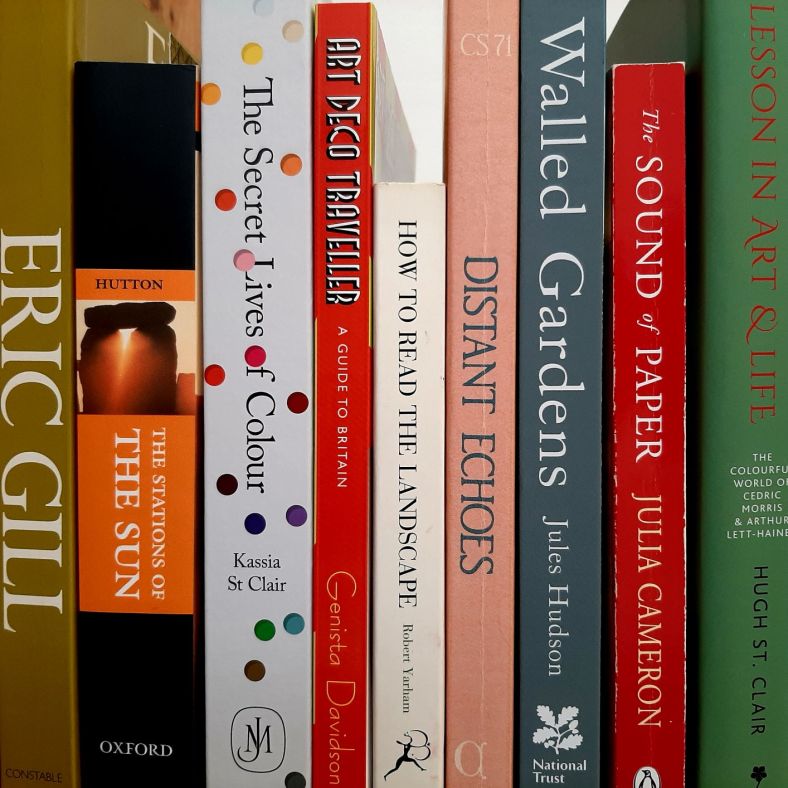
Colour picture of a shelf of books.


Working from home – welcome to my world

The recent move towards working from home as a response to the Coronavirus pandemic has flooded the internet with cries for help from people who aren’t coping with it, and advice for how to make it work for you.  The fact that it’s proving so difficult for so many people, and requires so much adaptation, has really flagged up to me how relatively unusual my preferred way of living and working actually is.

First, some disclaimers.  I don’t (any longer) work for a company, where I have to account for my working time at home, be available for virtual meetings during normal office hours, virtually ‘clock on’, and have my productivity monitored.  I appreciate that for many, that’s the kind of working from home you are doing.  Also, I don’t have children, so I’m not attempting to home educate/entertain them 24/7 while simultaneously working.  That must be the stuff of madness, and if that’s your situation, I salute you.   I have not lost my job, and I’ve not been furloughed on reduced salary.  I have the good fortune to have a home that’s large enough not to have to share my workspace with the other inmate, and some (albeit small) outside space.  And above all, we are both well, and I realise that a lot of readers of this blog will be experiencing illness or bereavement and may feel that my comments are shallow and facile.  I’m just writing about how things are for me.

We are sticking diligently to the rules: only going out (singly) once every few days for essentials such as shopping (we’ve not been able to get supermarket delivery slots) and picking up prescriptions, and going out together once a day for a walk in our local area, keeping social distancing when we encounter anyone else.  From that point of view, we’re in the same boat as everyone else in the UK.

What has struck me is how little my life has changed during lockdown.  The main components of my working day are reading, researching online, and writing, with a bit of work-related social media (mostly Twitter) and some of the boring administrative tasks associated with self-employment.  None of that has changed.  I’m still writing, I’m still planning my book and doing research for it, I’m still submitting commissioned articles, I’m still blogging.  My working life is almost totally solitary, and I need it like that to be able to think, to be creative, to make work that I’m happy with.  The only exceptions are when I interview people for a piece I’m writing, or when I do a ‘field trip’ to somewhere I’m going to be writing about, or when I occasionally go on a writing-related course.

Travel, of course, isn’t happening – and frankly that’s the main impact of lockdown on my work, as I was just at the stage when I was going to spend the late spring and summer travelling round the country doing a dozen field trips in preparation for the book.  I’m having to completely re-think how I can use this time to research effectively until such times as I can make those field trips, while hopefully not delaying the completion of the book more than I can help.

Lockdown has demonstrated that there are times when being an introvert is an advantage.  Mostly, it isn’t.  Societally, extraversion is seen as preferable, and introverts are regarded with either pity or suspicion (being perceived as a ‘loner’ isn’t good in our society – being a ‘people person’ or a ‘team player’ is).  I used to feel lesser, like however hard I tried I was never quite good enough because I found being around lots of people knackering rather than stimulating.  To be honest, I find meetings and socialising with groups of people exhausting, I prefer humans in ones and twos (any more, and I long to lie down quietly in a darkened room to recover), and I’m happiest on my own or with one or two carefully chosen people, ideally with a pile of books to lose myself in.  Susan Cain’s book Quiet: the Power of Introverts in a World that Can’t Stop Talking was a revelation.  It isn’t just me – it’s about one third of the human race. It’s OK to be an introvert.  We are not failed extraverts – we are successfully, happily introverts – well, we’re happy and successful if we’re allowed to live and work in ways that allow us to thrive.  Don’t put me in a noisy, busy open-plan office with a dozen other people and expect me to be productive and creative.  And certainly don’t expect me then to be sociable in the evenings or at weekends – that’s when I need peace and quiet to recover from being all peopled-out during the working day.  I know there’s a lot of concern about the impact of social media on people’s mental health, but for me it’s been a boon – I can keep in touch with people, in my own time and when I’m in a place to welcome and enjoy it, rather than getting peopled-out by socialising.  I have joined online groups of people with shared interests, and I love it – for me, it’s the best of both worlds.

It also means that during lockdown I’m in the fortunate position of not missing the stimulation of colleagues and friends around me.  People I’m collaborating with for work are still there, via email, phone, social media or Zoom, as are my friends.  I’m sorry that a couple of large events and conferences, which I had geared myself up for because the content was sufficiently interesting to make it worth the crowds, have been cancelled – but it’s the content, rather than the buzz, that I miss.  I’m just getting on with what I do every day: reading, researching, writing, pitching to commissioning editors, keeping up to date with the writing industry, invoicing.  When I’m not working, I’m going on my daily walk, reading, knitting, planning weaving projects, spinning, weaving, playing with my camera, baking.

Actually, that is one thing that is different because of lockdown – I am baking more than usual.  Going out for coffee and cake is one of our favourite treats, and as the cafés are closed, I’ve stepped into the breach and baked cakes and cookies, scones and parkin.  Fortunately we had just acquired a coffee machine, so at least we have decent coffee while we can’t go out!

Photograph of scones with butter and jam

Planting a herb garden – history, food and wellbeing

Now that there is some warmth in the spring sunshine, I have planted a herb garden.  It’s a very small herb garden – a vintage Belfast sink and a couple of pots – but it’s attractive and will serve my purposes.

The Belfast sink has been empty over the winter – when we moved house last autumn we emptied out the old herbs which were well past their best, ready for fresh ones this season.  It’s lovely to see it fully planted up, beside the back door so that it’s in easy reach of the kitchen, in a corner which is a suntrap.  The challenge is to remember the watering!

Colour photograph of a Belfast sink planted with herbs, and a green watering can.

The choice of herbs for sale was a bit limited so early in the year, but the plants were in very good condition, and there’s room to pop a couple more into the gaps later in the season if I find some.  I chose two purple sages, one oregano, and two thymes (one gold, one silver).  The sages will grow quite tall, so I put them at the back, with the oregano in the middle, and the thymes at the front.  They will spread, and be able to trail over the edge of the sink.  I also bought Moroccan mint, and a medium-sized rosemary – as mint is invasive and would take over the whole sink given half a chance, and as rosemary grows large and is long lived and will soon outgrow the sink, I have put each in a separate pot.  Ideally I’d also have some chives and some tarragon, although I’ve never had much luck with growing the latter, and maybe some flatleaf parsley (which I use where recipes call for coriander, which I don’t like).

Growing herbs has a long and venerable tradition.  Used for thousands of years for culinary, medicinal and ritual purposes, they have been an enduring part of human civilisation and their cultivation is an international phenomenon.  Much of what we know in the West about herbs and their uses was written down by medieval monks who grew herbs in the physic gardens of their abbeys, and a significant proportion of modern medicines have their origins in herbal compounds, so growing them today feels like connecting with the past.

So what of the herbs in my garden?  Let’s look at their history, uses and properties.

Sage

Its Latin name, Salvia, comes from salvare, to cure, so its medicinal reputation is long-established.  It has been used to treat sore throats and digestive problems.  Clinical trials in 2011 suggested that sage’s reputation of being helpful in the menopause may have scientific backing, as a trial reported its effectiveness in reducing hot flushes.  Originating in the Mediterranean area, sage is grown around the world, thriving in warm sunny locations – so my suntrap by the back door should suit it well.

Perhaps best known in Britain for its role in sage and onion stuffing, sage is strongly-flavoured and I use it a lot in casseroles, as well as torn up and tossed with buttered pasta.  Being a ‘lady of a certain age’, I also drink it as a tea (although as I’ve only had the plants a few weeks, it’s too early to report an improvement in symptoms!).

Oregano/marjoram

Another native of the Mediterranean (this time the Middle East), this is also a sun-lover.  Its antiseptic qualities made it a medieval cure-all, and the first settlers to New England took this herb with them.  I like it with chicken, fish, or pasta, and it is delicate enough not to swamp subtly-flavoured foods.  To me, this is a real sunshine herb – just crushing the leaves and sniffing your fingers will give you a lift.

Thyme

Prescribed by the 17th century herbalist Nicholas Culpeper as a treatment for whooping cough in children, thyme has long been regarded as having antiseptic properties and being useful in respiratory conditions.  It’s a staple culinary herb (although incredibly fiddly to prepare, as you need to strip the tiny leaves from the woody stems) and gives a fresh, warm flavour which is hard to beat.  Pretty much all ‘mixed herbs’ include dried thyme, but it’s less potent when used fresh and partners well with rosemary, oregano and sage.

Mint

The Moroccan mint I’m growing is a kind of spearmint, so it’s warm in flavour rather than cool peppermint.  Its culinary uses are almost endless – salads, mint sauce, cakes, desserts, cold drinks, and mint tea, for example.  Humans have used mint for a long time – it has been found in Egyptian pyramids dating from 1000 BCE, and the Greeks and Romans used it – but curiously it only came into widespread use in Western Europe as late as the 18th century.  Medicinally, it has been used to aid digestion, and specifically to deal with wind, which may be the reason for the popularity of after dinner mints!

Rosemary

“There’s rosemary, that’s for remembrance,” said Ophelia in Shakespeare’s Hamlet.  Since antiquity rosemary has been believed to help strengthen the memory, and it is still used in Greece in the homes of those preparing for exams.  Another herb which likes hot, dry conditions, rosemary has a pungent, invigorating flavour and aroma – and the white, lilac or blue flowers are adored by bees and other insects.  I have always grown rosemary, and use it generously in cooking.  The traditional partner is, of course, roast lamb, but I use it (either as whole sprigs, removed before serving, or finely chopped) in almost anything that’s going to be cooked for a while – casseroles especially.

Photograph of a chopping board with chopped herbs and a large kitchen knife.

Whilst the whole ‘grow your own’ phenomenon may require more space, time and energy than many of us have available in 21st century Britain, it’s possible to have a herb garden in the smallest of spaces – in a pot or in a window box, or even indoors on a windowsill at a pinch.  And nothing beats the pleasure of cooking with herbs that you have grown and harvested yourself.