Walking in a Winter Wonderland – a walk down Glastonbury high street

In a normal year, the centre of Glastonbury would be bustling at this time of year, with shoppers visiting the many emporia of alternative retail culture in the town.  This year, it has been very different – because of social distancing rules, there has been no Frost Fayre, and far fewer visitors than usual for the Winter Solstice.  Nevertheless, the shopkeepers have done a wonderful job of decorating their windows, in defiantly bright contrast to a season which has seemed even darker than usual this year.  I would like to share with you a walk, in pictures, down the High Street to the Market Place and along Magdalene Street, after dark.  For me, the lit windows are like magic lanterns or stained glass, glowing with light and colour, with images and symbols which bring out different aspects of the seasonal festivals.
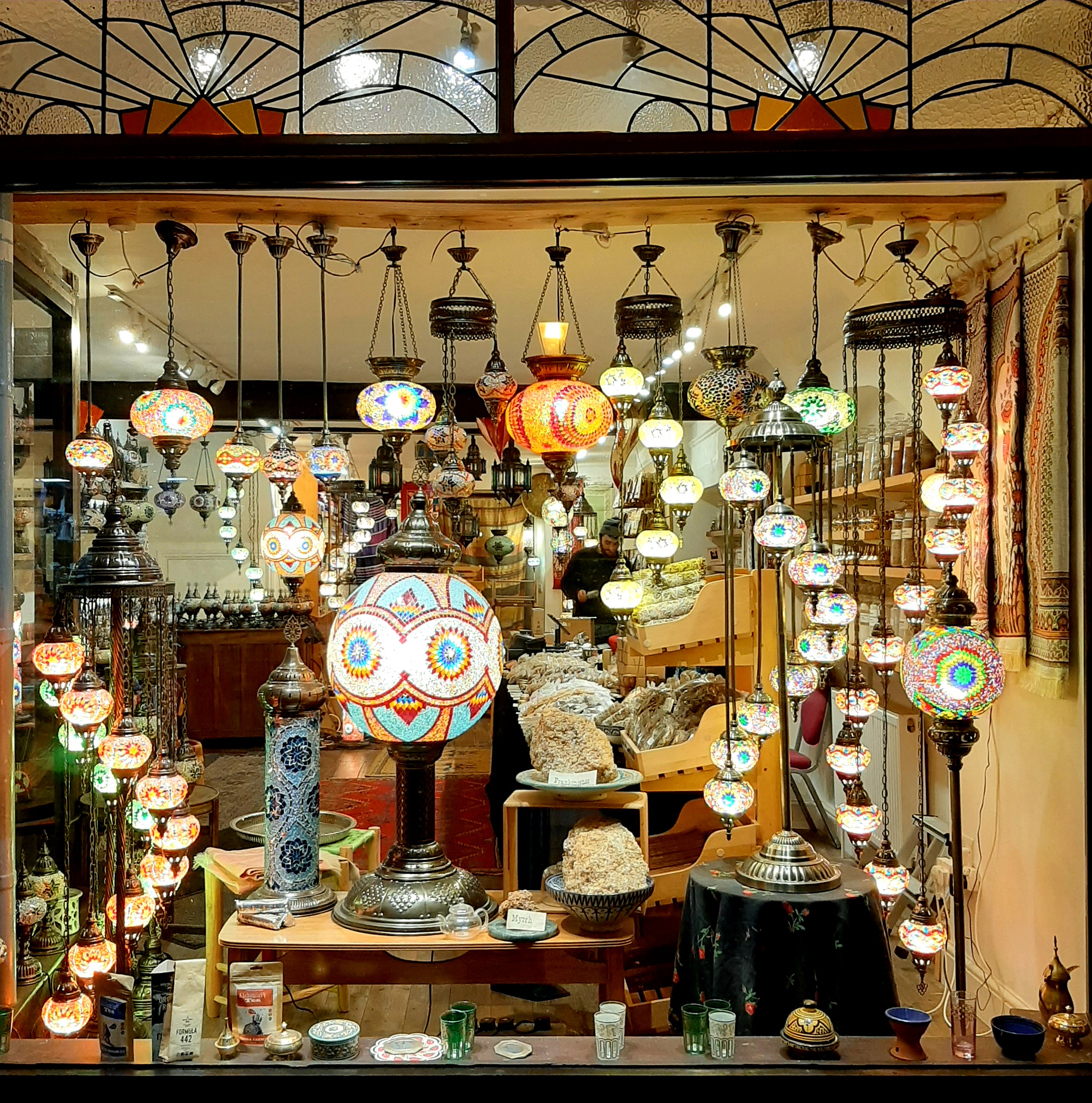
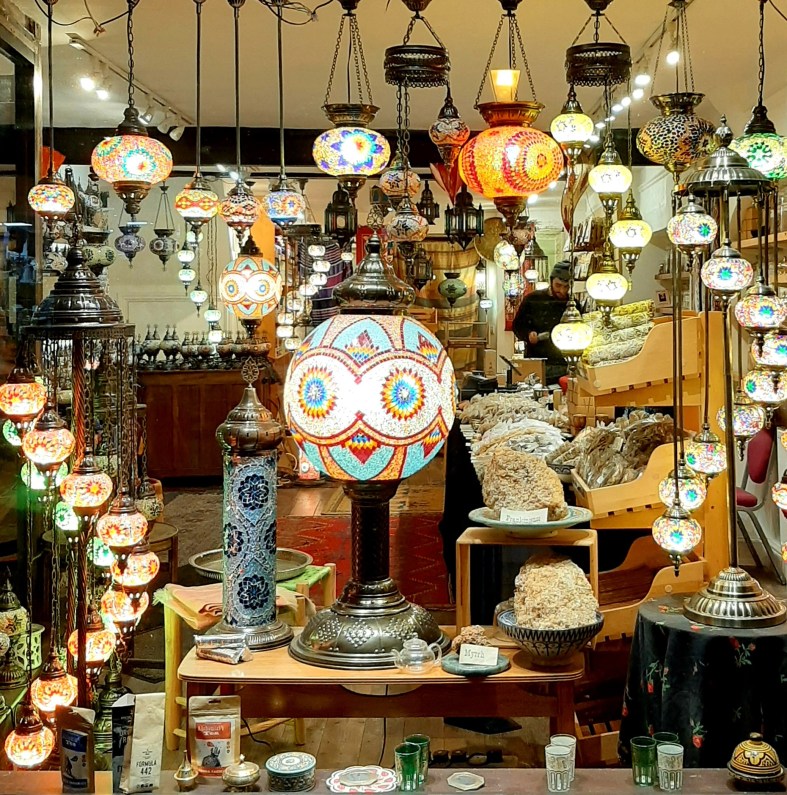
Let’s start on the High Street.  This is one of my favourite shops, with its Art Deco window panels and kaleidoscopic lanterns.  The big lump in the middle of the display is myrrh – one of the three gifts traditionally brought to the Christ child in the manger in Bethlehem, by the wise men who came from the east.  There is something of the souk about this shop, and the owner always keeps an incense burner alight outside the door, sending exotic fragrances out into the Somerset town.
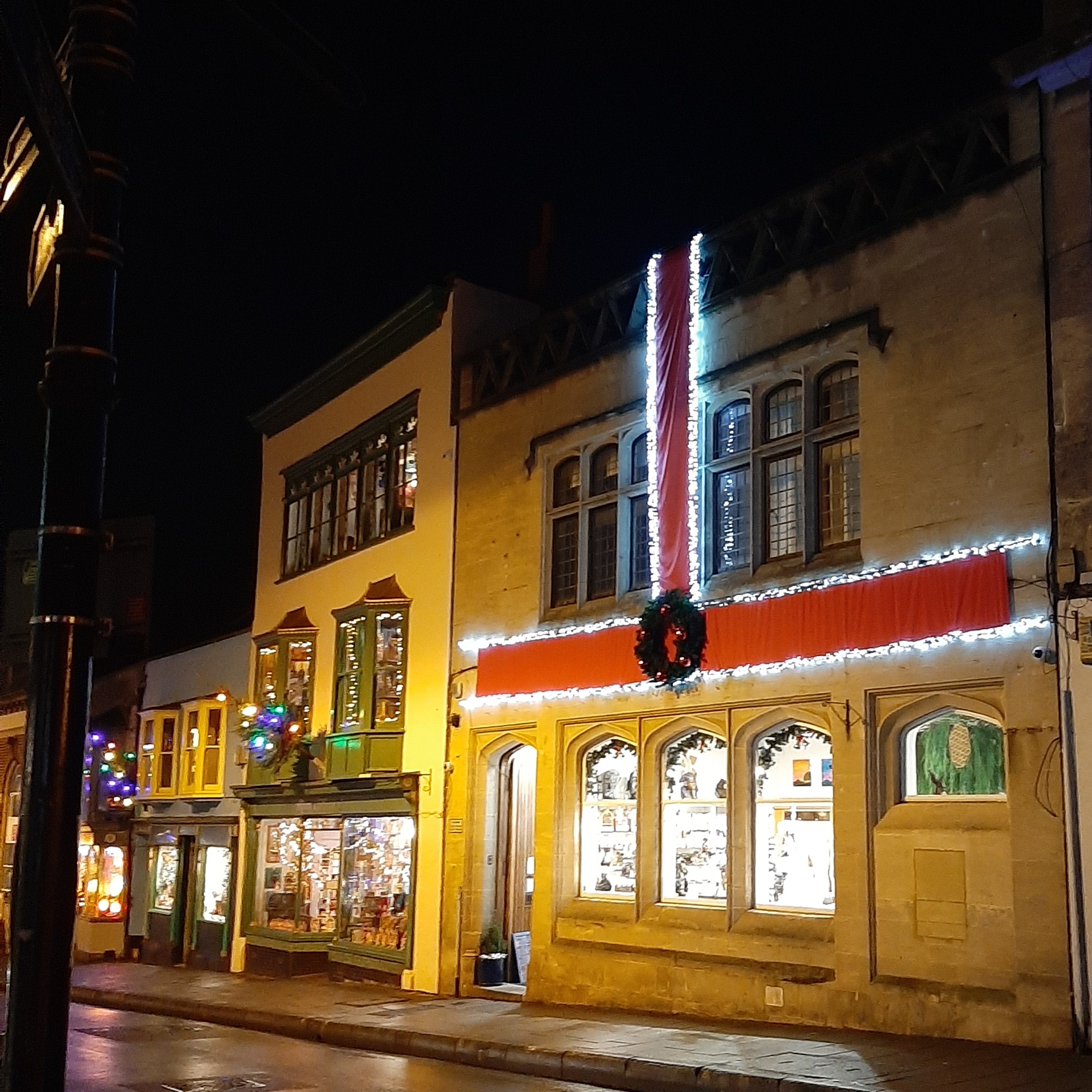
Just across the road, I like the whimsy of a gift shop wrapped up like a present, picking up on the tradition of exchanging gifts which has been part of midwinter celebrations for millennia.  I don’t envy them fixing those lights up on the roof!  I know it’s a shop which sells lovely things, and it looks very inviting, but this evening I’m photographing, not shopping, so I keep walking.

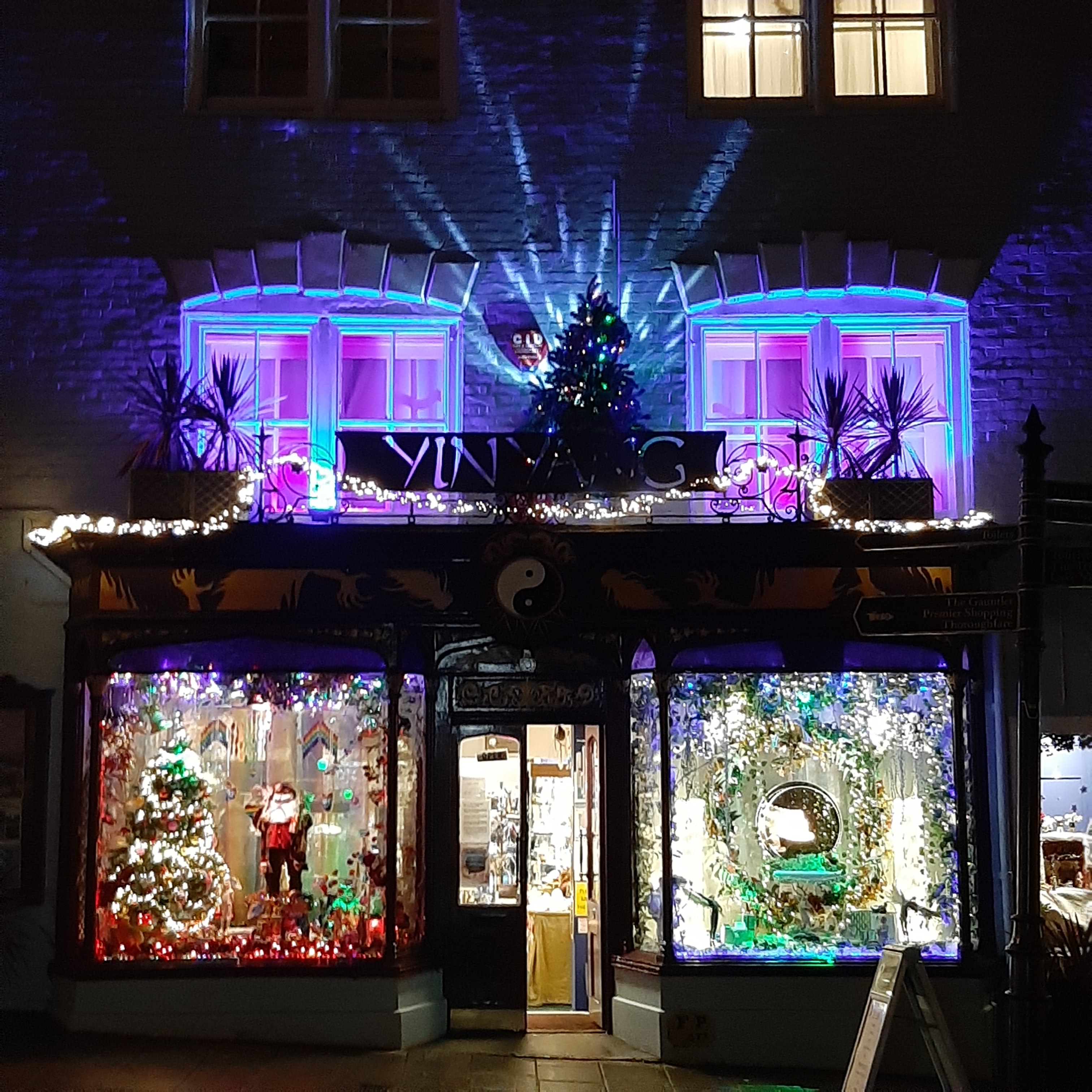
This shop has been recently refurbished, and the gilding of the lettering catches the light (gold, frankincense, myrrh).  This shop sells mostly Indian items, and its window display is full of little lights, hinting at Diwali.  The top floor, which I must admit I have never noticed in daylight, has a rainbow of lanterns suspended from the ceiling.  I think they go very well with the municipal Christmas tree on the front of the shop.

The Green Man is a significant folkloric and pagan symbol, and at this season of evergreens he is everywhere in Glastonbury.  This is a particularly fine example, framed by greenery and bringing a touch of the wildwood to the high street.

More Green Men here too, who have been joined by Cernunnos, the Celtic horned god.  The interweaving of traditions and beliefs is a major feature of Glastonbury, and is reflected in the range of merchandise which shops offer to modern-day pilgrims and visitors.  It is said that over 70 religions and beliefs are represented in the town, making Glastonbury perhaps one of the most spiritually diverse places on earth.

But amid all the paraphernalia of spirituality, people’s physical needs are catered for too, and the baker’s shop has a cornucopia of seasonal goodies in the window.  The mince pies look delicious, and I don’t even like mince pies!  Let’s hope the Scandi-style elves in the display don’t eat them all…

Across the road, one of Glastonbury’s best-known shops covers all the bases for seasonal gift-buying – a witches’ calendar for 2021, a cushion showing moon phases, a Green Man apron, magic spell kits and oracle cards, and a book on the Winter Solstice.  There is a tree, with snow-filled baubles, and a wreath with greenery and berries, and also the Tree of Life.
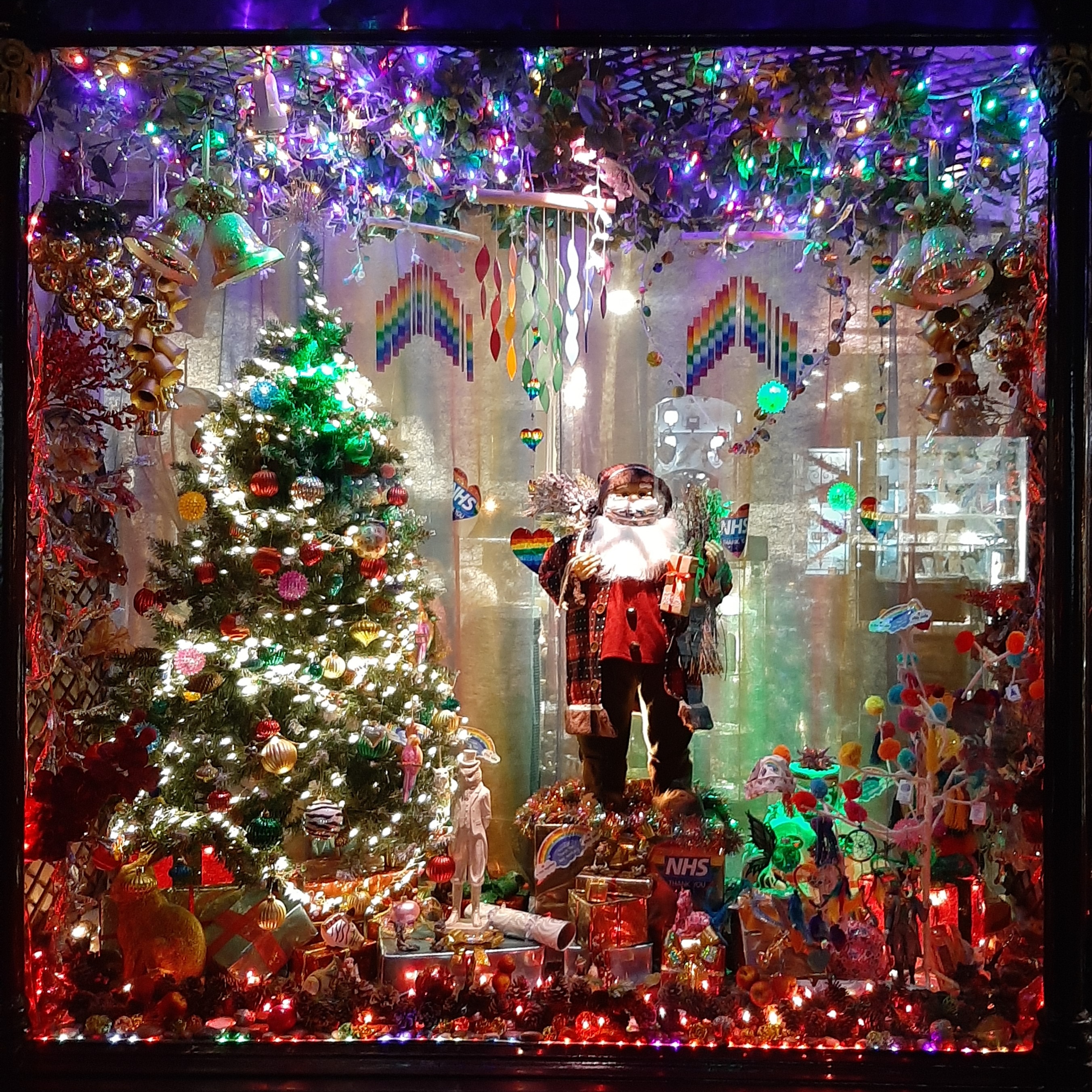
The next window seems quite conventional, for Glastonbury – a Christmas tree and Santa Claus.  But if you look closely, you’ll see that it’s not exactly the Santa of popular culture – this chap is nearer to the old images of Father Christmas, looking rather as if he’s just come walking out of the forest with an armful of kindling for the Yule fire.

A couple of doors down, we have more trees and another Father Christmas – but again, he isn’t the scarlet-clad figure with the sleigh and the ho-ho-ho.  This one is dressed in brown, smiling benevolently amid frosty-white trees, lit with cool whites and blues and populated with cuddly woodland animals.  It looks like an illustration from a children’s book, and I’d love to read the whole story.
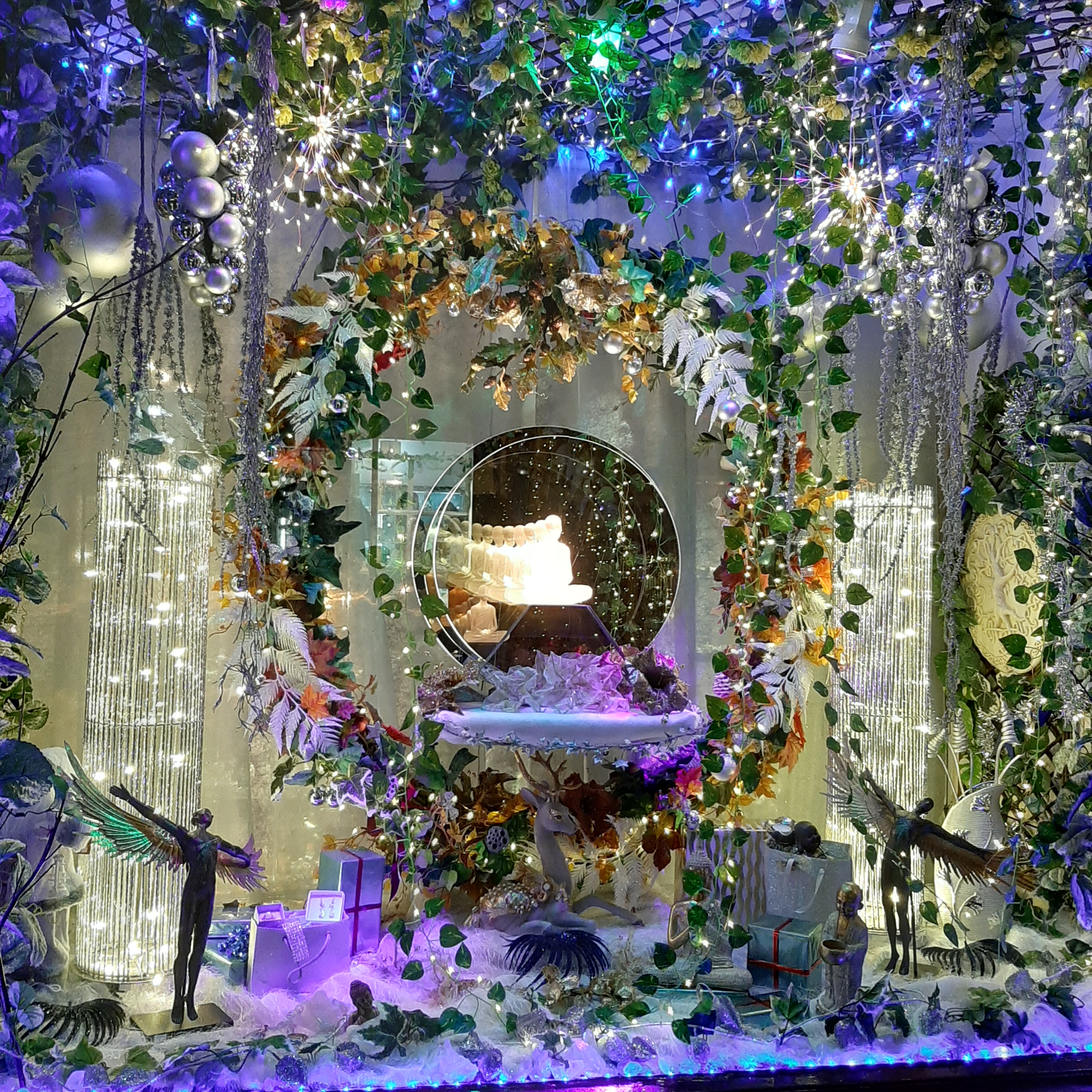
By way of contrast, the next window has nothing conventional about it at all – there may be a wreath of leaves, but they frame a seated figure of the Buddha, reflected to infinity in a circular mirror, and flanked by a pair of anglels who look like they were crafted by Jacob Epstein.  Cascades of light and washes of colour create an ephemeral magic.

We have reached the bottom of the high street, and turn left into the Market Place.  Here, there’s a clothes line of colourful stockings, strung above a vast selection of crystals.  A decorated Christmas tree sits beside geodes and ammonites, which are echoed in the signage above the shop window.
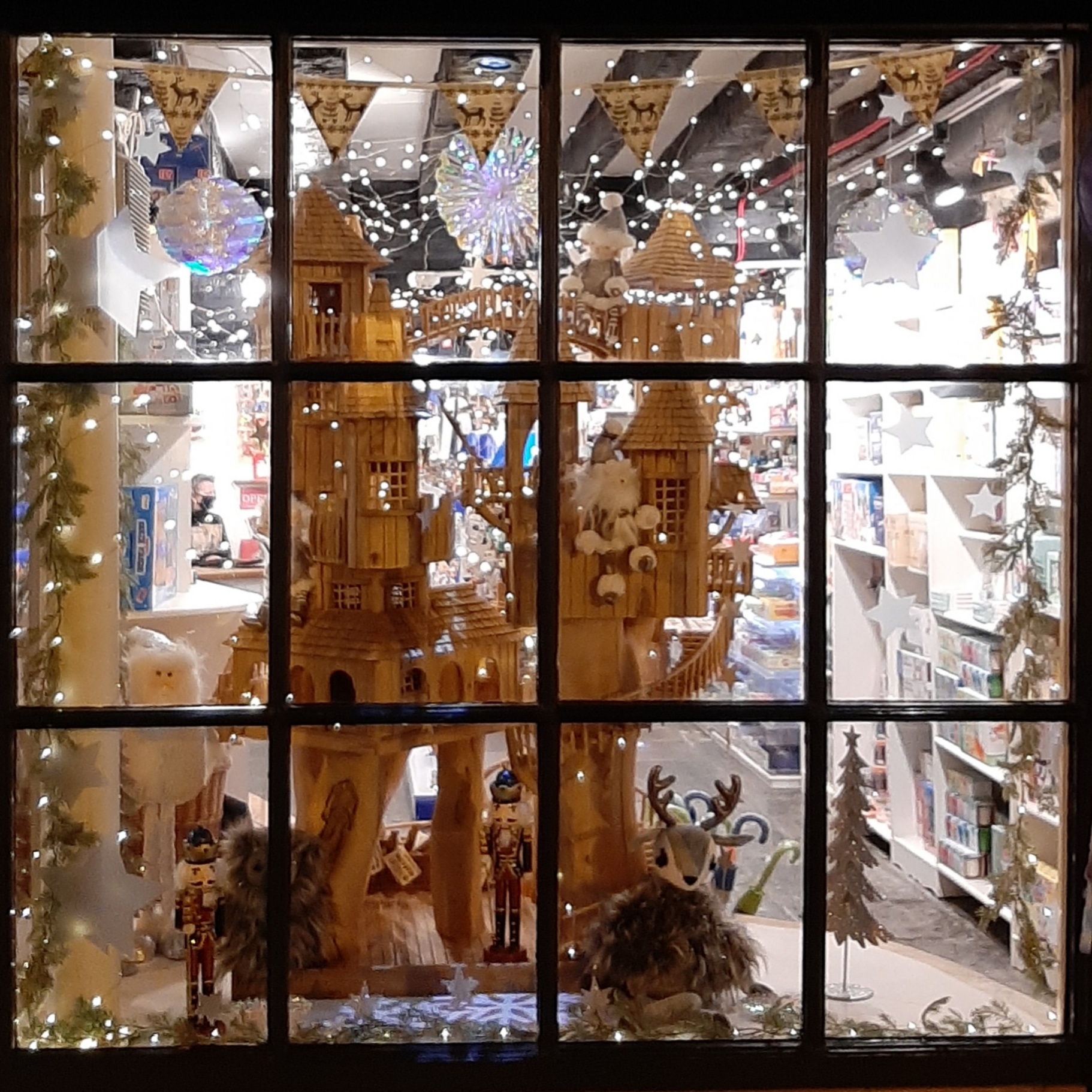
In the toy shop next door, the stunning wooden fairy tale castle which is a permanent fixture has been joined for the season by a couple of Nutcracker figures and a very cute reindeer in a winter wonderland that is all sparkle and ice.  The nod to continental Christmas customs is continued in the Nordic bunting across the window.

And so, finally, we come to Magdalene Street, and the last of the lit shops.  In a building which is one of only three in Glastonbury to survive from the 15th century, a handsome reindeer follows a trail of shining stars, with the inky-black winter sky above.

Whichever of the midwinter festivals you celebrate, may I send you – despite the particular challenges of this year – peace, love and happiness.
I am committed to making this blog freely available, and not putting material behind a paywall. As a writer, I am doing what I love – but I still have to make a living. If you have enjoyed this post, and if you are able to do so, perhaps you would consider supporting my work by making a small contribution via the Buy Me A Coffee button. Thank you!

Buy Me a Coffee at ko-fi.com

In their own handwriting – connecting to the creators of the Lindisfarne Gospels

For the last few weeks I have been researching the Lindisfarne Gospels and writing an article about them for an e-magazine.  For those of you not familiar with the Lindisfarne Gospels, they are a lavishly illuminated hand-written book of the four Gospels (Matthew, Mark, Luke and John) of the New Testament, in Latin, produced by a scribe-artist called Eadfrith around 700CE, in the monastic community on the island of Lindisfarne (aka Holy Island) off the coast of Northumberland in North East England.  About 250 years later, a word by word translation (or ‘gloss’) in Old English was added above each line by a priest-scribe called Adred, at Chester-le-Street where the community was then living, having fled the island after raids by Vikings.

Incipit, Matthew’s gospel, Lindisfarne Gospels. British Library Cotton MS Nero D IV f.027r

The art of the Lindisfarne Gospels is quite widely known today – the manuscript has been digitised and is available on the British Library website, and its motifs are used on all manner of historically-inspired merchandise.  But, though beautiful, the art is not what excites me about the Lindisfarne Gospels.  What makes my heart beat faster is that sense of glimpsing into the distant past something which connects us physically with the individuals who created it more than a millennium ago.

Far from being dry and academic, my research has been a fascinating journey into the England of the early medieval period – what used to be called the Dark Ages, between the departure of the Romans in the 5th century CE and the Norman Conquest in 1066, during which time it was thought that culture, learning and civilisation were largely absent.  Historians think differently now, in no small part due to the artefacts produced in this period which have been found in various excavated hoards, and probably most famously at the ship-burial at Sutton Hoo which was excavated on the eve of World War II and which was found to contain jewellery of breath-taking beauty and craftsmanship.  The sophistication shown in the illuminated manuscripts of the time is now seen, not as an exception, but as representative of the high standards of creative skill on the part of the peoples of the time.

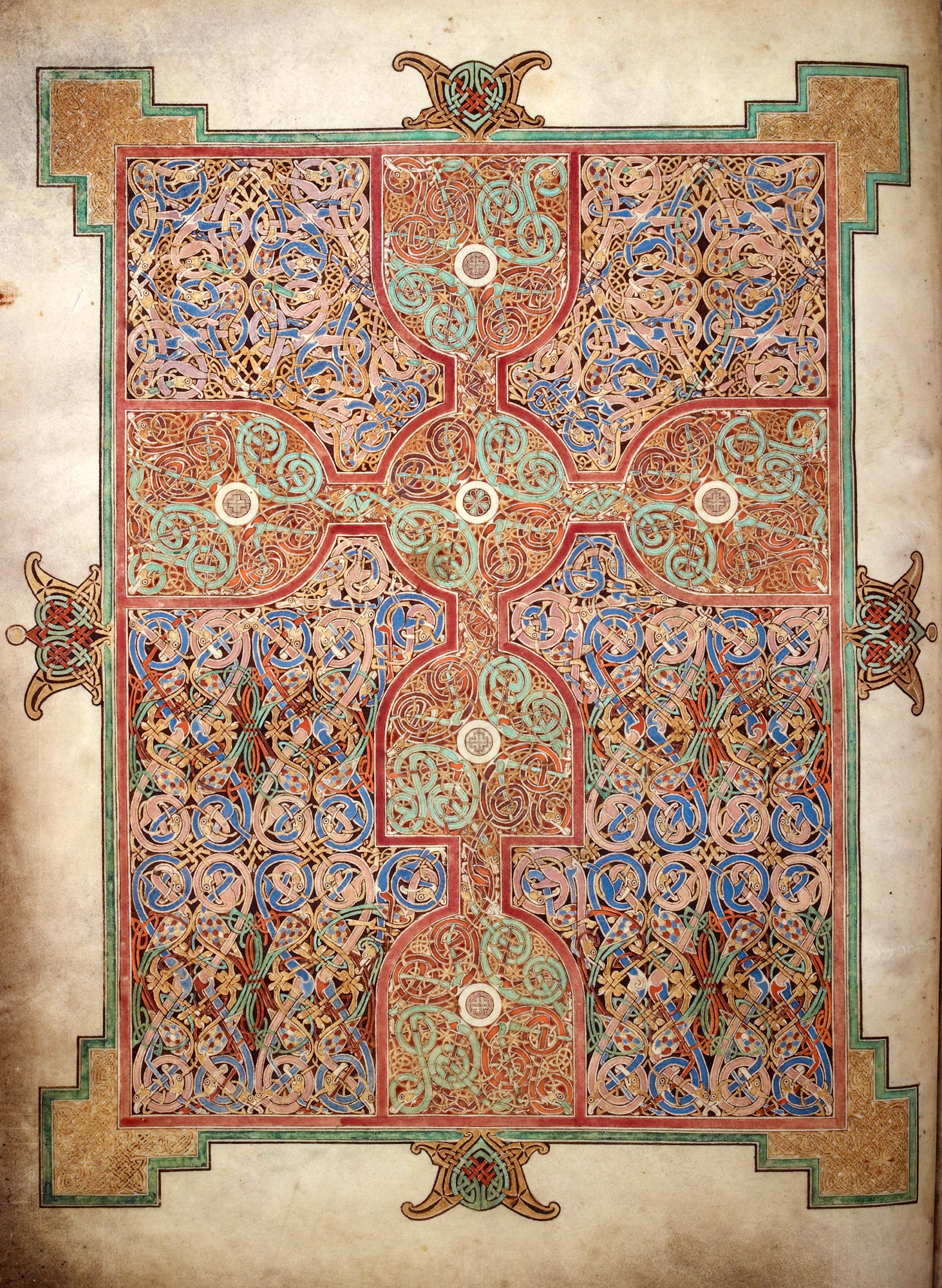
Carpet page, Matthew’s gospel, Lindisfarne Gospels. British Library Cotton MS Nero D IV f.026v

In an era before print, the production of a book – even the most plain and workaday one – was a major undertaking.  First, the vellum which formed the pages had to be prepared from the skins of young animals – calves or lambs – and trimmed and pricked in preparation for the binding process (making the Lindisfarne Gospels required the skins of almost 150 calves).  Lines had to be marked out on the page (Eadfrith invented the lead pencil, and the lightbox, to do this).  Ink had to be prepared, using oak galls and iron.  Feathers – ideally big sturdy ones like the flight feathers of swans – had to be trimmed into pens.  Then the scribe had to copy the book painstakingly from an exemplar, without the benefit of electric light.  It could take years to produce a book – years of dedication, focus, bad backs, cold, working in a scriptorium lit only by south-facing windows in the summer and candles in the winter.  A number of scribes left notes in the books they produced, complaining about their discomforts – issues around health and safety at work and RSI are not new!

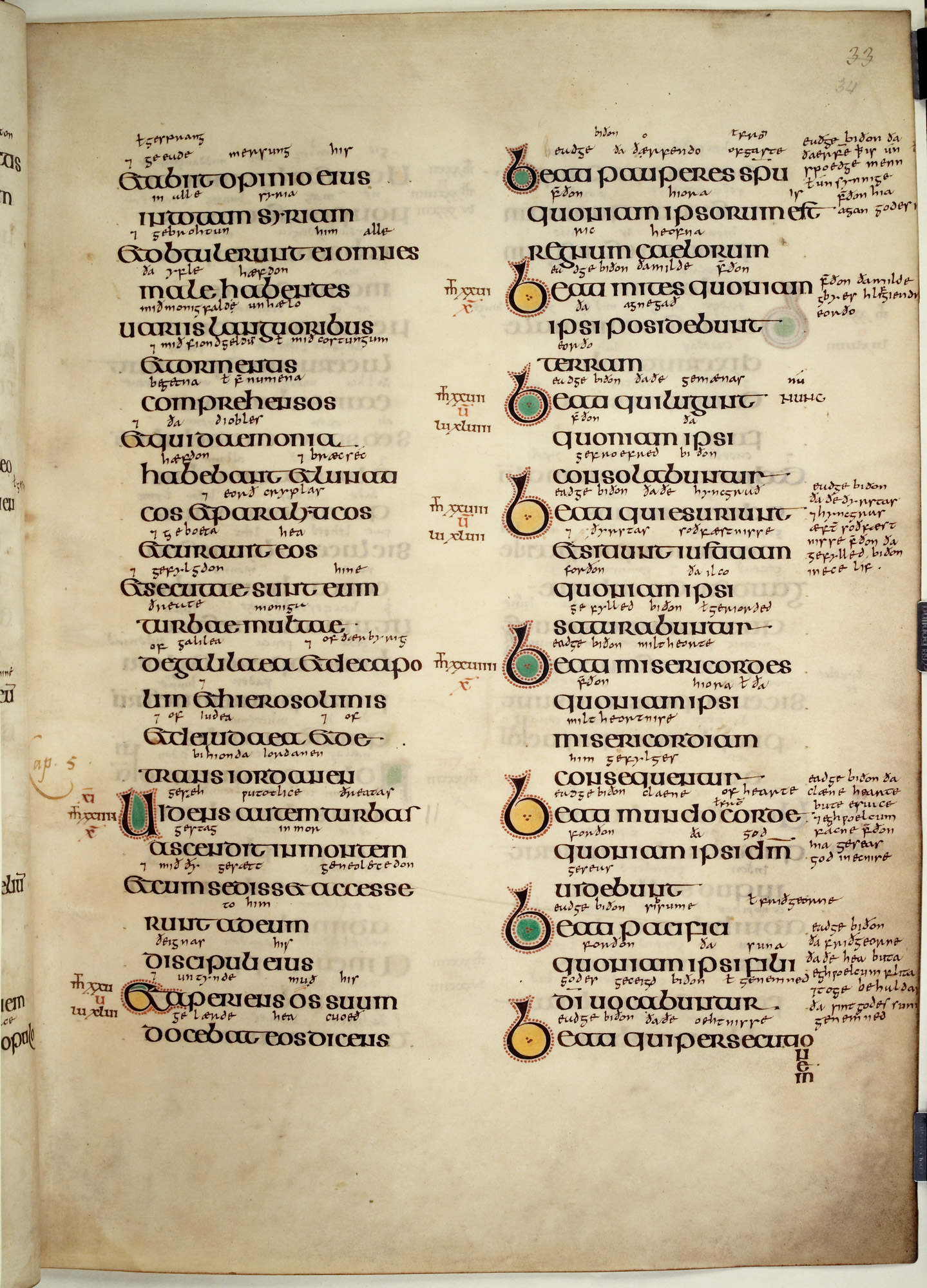
The Beatitudes, Matthew’s gospel, Lindisfarne Gospels. British Library Cotton MS Nero D IV f.034r

What I love about these documents, though, is the immediacy of something which was produced by hand.  Just as our own handwriting is distinctive to each of us, it is possible to identify individual scribes by their handwriting.  Often, teams of up to half a dozen scribes and artists would work on a book – the Lindisfarne Gospels are unusual in having been written by just one man.  It is thought that it must have taken Eadfrith several years to produce the text and illustrations for this work.  It can be a stretch of the imagination, in 21st century Britain, to imagine the life of a 7th century monk on a windswept island in the North Sea, toiling on this work of great beauty, to the glory – as he would have seen it – of God.  Even as a visitor to Lindisfarne, it’s a challenge to look beyond the cafés and gift shops, the retreat centre and the museum, and the ruins of the later Norman priory, and picture this as a working monastery, its central work of prayer and worship buttressed by farming, fishery and the creation of high-quality books.  Seeing the personal handwriting of one of those monks, the strokes made by his pen, the drawings and embellishments he drew in the colours he chose (and created himself from mineral and plant pigments), brings him within reach.  Just as when, while researching your own family history you come across a 1911 census return in the handwriting of an ancestor you have never met and who died long before you were born, it makes them more real, so seeing Eadfrith’s handwriting brings him to life for us.

And in the Lindisfarne Gospels we are lucky enough to have the handwriting of two identified people.  I mentioned earlier that an Old English word-for-word translation (or gloss) was added in the middle of the 10th century.  We know that the man who did this was called Aldred, because he left us a note (a colophon) at the end of the Gospels to tell us so.  He also names Eadfrith as the original scribe/artist, as well as crediting the people who bound the book and made a jewelled cover for it.  By translating the text into English, Aldred was part of a movement championed by King Alfred (‘the Great’) in the late 9th century to make English a language not only of the people but also of learning and religion, alongside Latin.  Here we not only have Aldred’s handwriting, we can also see him wrestling with language as he frequently offers several alternative translations of Latin worlds into Old English.  Anyone who has ever attempted to translate from one language to another will relate to this!

Aldred’s colphon, Lindisfarne Gospels. British Library Cotton MS Nero D IV f.259r

In these times of emails, word-processing and SMS, handwriting is becoming a dying art.  In one way, that doesn’t matter – as long as we are communicating with words, it’s irrelevant how they are produced – but in other ways we are maybe losing something.  There is no digital equivalent of the personal, intimate legacy of someone’s handwriting – the notes and letters of past generations, which are often all we have left of our own families – and future generations will not experience the particular thrill of poring over a hand-written document produced by known, named people over a millennium ago.  I wonder what ways they will have instead to connect to the human individuality of the people whose words they are reading?

My article on the Lindisfarne Gospels is published in Issue 7 of The Pilgrim, which is available online here.

I am committed to making this blog freely available, and not putting material behind a paywall. As a writer, I am doing what I love – but I still have to make a living. If you have enjoyed this post, and if you are able to do so, perhaps you would consider supporting my work by making a small contribution via the Buy Me A Coffee button. Thank you!

Buy Me a Coffee at ko-fi.com

Midwinter festivals of light – why we need them more than ever this year

A couple of nights ago a lantern appeared in the window of a house round the corner, with banners wishing passers-by a ‘Happy Hanukkah.’  In my street, each evening sees more Christmas lights wrapped around shrubs or strung up in windows.  A few weeks ago, millions of people celebrated Diwali, the festival of light.  Very soon, we in the northern hemisphere will be rejoicing that the shortest day has come and that, with the Winter Solstice, the world is moving back towards the longer, lighter days.

Until recently, I wasn’t an enthusiast for festive lights – a pyrophobe since childhood, the risks of fire associated with strings of electric lights always put me off having them on the tree.  But these days, lights are safer and the bulbs cooler, and there are even battery-powered ones available which don’t require power cables snaking across the room to trip up the unwary, and my partner has always liked lights, so for the last few years I have joined in quite happily, if passively.  This year, though, has been different.

Not only have we used our ‘old’ lights but we have been out and bought three sets of new ones.  We have lights in the Christmas tree.  We have lights in the front window, and we make sure they are switched on as soon as dusk falls to cheer passers-by.  There are five metres of lights draped around the fireplace.  A glass vase has been filled with tiny LED lights.  There’s a candle in the festive wreath on the coffee table.  There’s a candle on the dinner table.   There is sparkly tinsel everywhere to reflect the lights.  The only reason that there are not more lights is that we have run out of sockets to plug them into!  This year, it feels particularly important to participate in lighting the dark evenings of the last weeks of the year.  Each evening, the switching on of the lights creates a glow of positivity and cosiness in our home, whatever is going on in the world outside.

I find it interesting that, over thousands of years, religions and cultures across the world have felt the need to develop customs and festivals associated with light in the darkest time of the year.  In Judaism, Hanukkah commemorates the re-dedication of the Temple in Jerusalem, and the story of how one day’s supply of blessed oil miraculously lasted for eight days, so that the menorah (branched candlestick) could be kept lit until new oil could be prepared.  Traditionally, a nine-branched menorah is lit during the festival (one light for each of the eight days of the miracle – the ninth branch holds the light from which the others are lit).  Across the world, Jewish households place the menorah in windows which face the street, and it is a time of feasting.

 Diwali is also known as the Festival of Light.  Its name derives from the Sanskrit deepavali, meaning ‘row of lights’ and is celebrated as a religious festival by Hindus, Sikhs and Jains.  It represents the triumph of light over darkness (and by extension the triumph of good over evil and knowledge over ignorance).  Homes, temples and businesses are decorated with lights inside and out, and the skies are lit by fireworks.  And there is, of course, feasting.

Christmas celebrates the birth of Jesus Christ, whom Christians call the Light of the World.  Although the date of his birth is unknown, celebrating it around the time of the pagan midwinter festival has been the custom in the northern hemisphere for many hundreds of years, and a wealth of imagery in art, carols and literature places the Nativity in snowy scenes, with the Star of Bethlehem clearly visible over the stable in a dark, frosty sky.  Candles figured largely, with real candles shown on the first Victorian Christmas trees when the custom was imported from Germany (allegedly introduced by Queen Victoria’s German husband, Prince Albert).  As you can imagine, the idea of lighted candles amongst the resinous branches of fir trees is the stuff of nightmares for me!  Christianity borrowed many of the midwinter customs of the peoples it converted, including – perhaps inevitably – feasting.

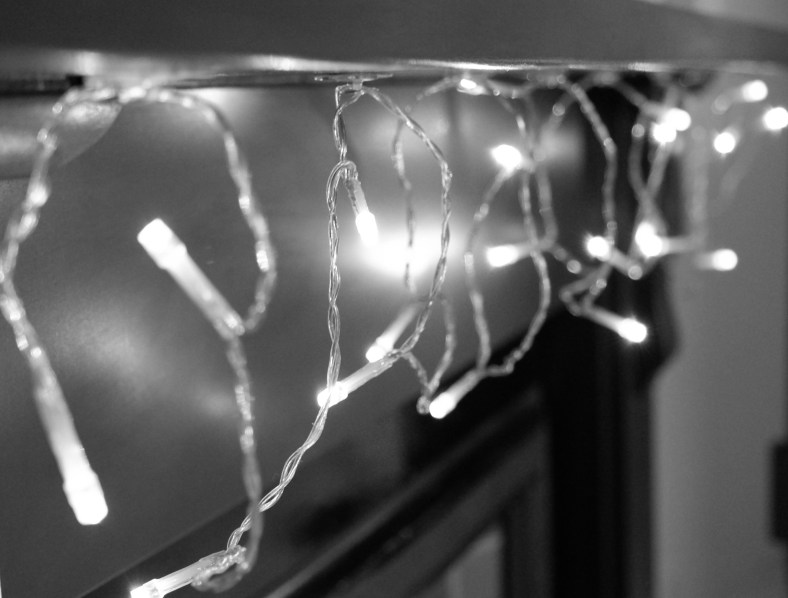
Image of a string of electric lights

Here in Glastonbury, there are probably as many people preparing to celebrate the Winter Solstice, or Yule, as there are those who celebrate the Christian Christmas.  Most of us will have a fusion of customs – lights will mark the ‘Light of all people’ who came into the world at Christmas, or the triumph of the sun as it defeats the darkness of the longest night.  We sing the carols “Deck the Halls with Boughs of Holly” and “The Holly and the Ivy” and decorate our homes with the same evergreen branches which have been a staple of midwinter celebrations for millennia, symbolising the continuity of life even in the dark depths of winter.  Normally, of course, there would be feasting – roast birds, Christmas pudding and mince pies all part of a rich heritage of midwinter jollification going back to before records began – but in this year of Covid-related restrictions there will probably be rather less feasting than usual.  Certainly the family and community feasting of Diwali and Hanukkah have already had to be more subdued this year.

But in a year that feels dark, sad and fearful for many, it feels like an act of defiance to light the candles and switch on the lights.  Our community celebrations may be muted, and our feasting limited to our own households, but we can still shine our lights into the darkness and say that we are still here, we are still celebrating, and that we know that light will overcome the darkness.

I am committed to making this blog freely available, and not putting material behind a paywall. As a writer, I am doing what I love – but I still have to make a living. If you have enjoyed this post, and if you are able to do so, perhaps you would consider supporting my work by making a small contribution via the Buy Me A Coffee button. Thank you!

Buy Me a Coffee at ko-fi.com