Walking in a Winter Wonderland – a walk down Glastonbury high street

In a normal year, the centre of Glastonbury would be bustling at this time of year, with shoppers visiting the many emporia of alternative retail culture in the town.  This year, it has been very different – because of social distancing rules, there has been no Frost Fayre, and far fewer visitors than usual for the Winter Solstice.  Nevertheless, the shopkeepers have done a wonderful job of decorating their windows, in defiantly bright contrast to a season which has seemed even darker than usual this year.  I would like to share with you a walk, in pictures, down the High Street to the Market Place and along Magdalene Street, after dark.  For me, the lit windows are like magic lanterns or stained glass, glowing with light and colour, with images and symbols which bring out different aspects of the seasonal festivals.
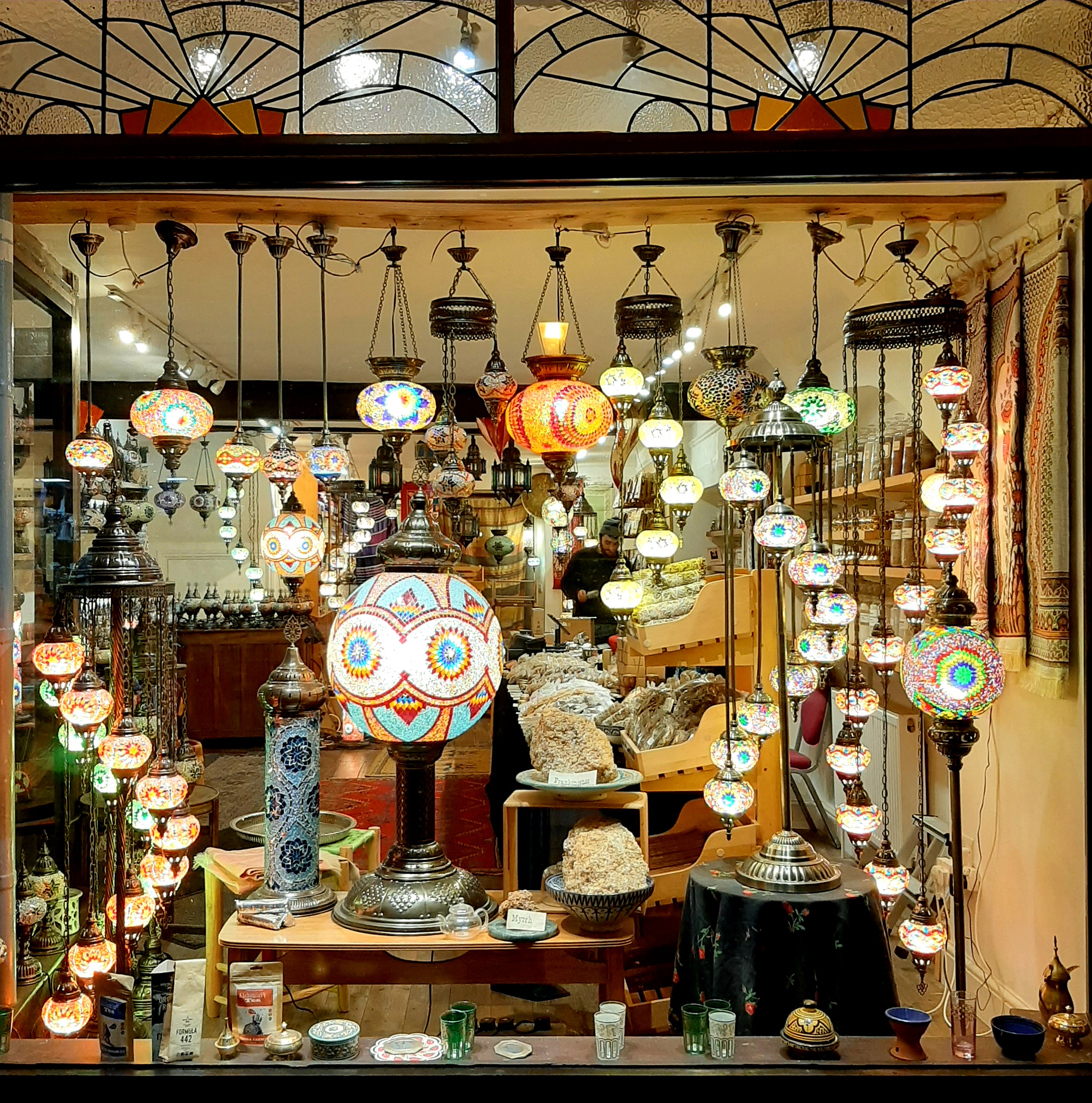
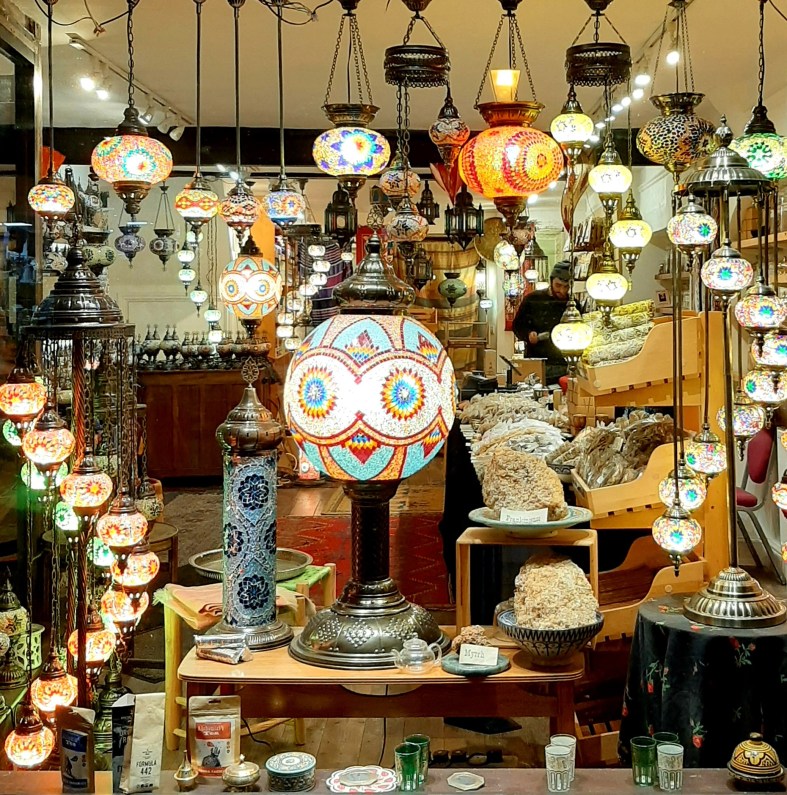
Let’s start on the High Street.  This is one of my favourite shops, with its Art Deco window panels and kaleidoscopic lanterns.  The big lump in the middle of the display is myrrh – one of the three gifts traditionally brought to the Christ child in the manger in Bethlehem, by the wise men who came from the east.  There is something of the souk about this shop, and the owner always keeps an incense burner alight outside the door, sending exotic fragrances out into the Somerset town.
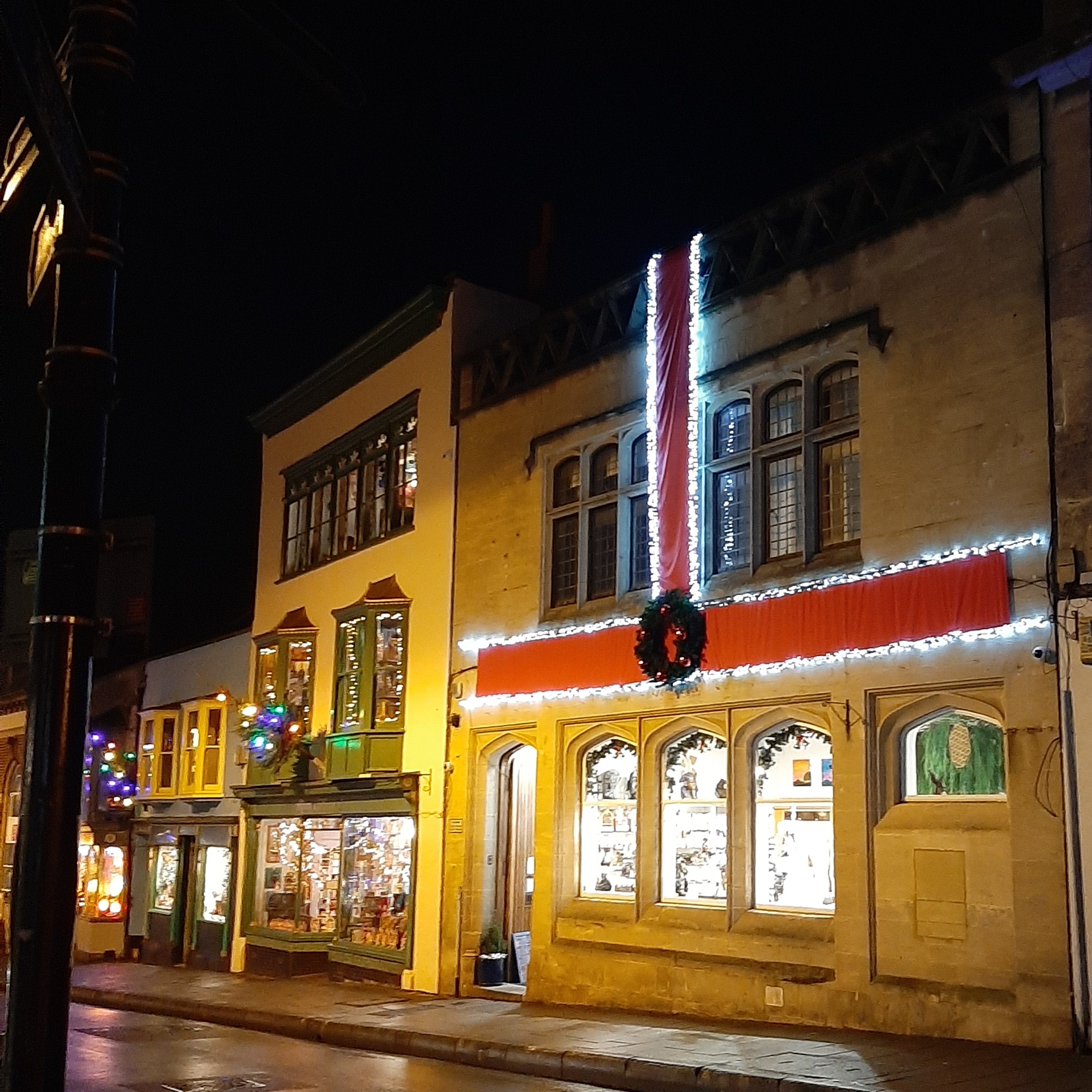
Just across the road, I like the whimsy of a gift shop wrapped up like a present, picking up on the tradition of exchanging gifts which has been part of midwinter celebrations for millennia.  I don’t envy them fixing those lights up on the roof!  I know it’s a shop which sells lovely things, and it looks very inviting, but this evening I’m photographing, not shopping, so I keep walking.

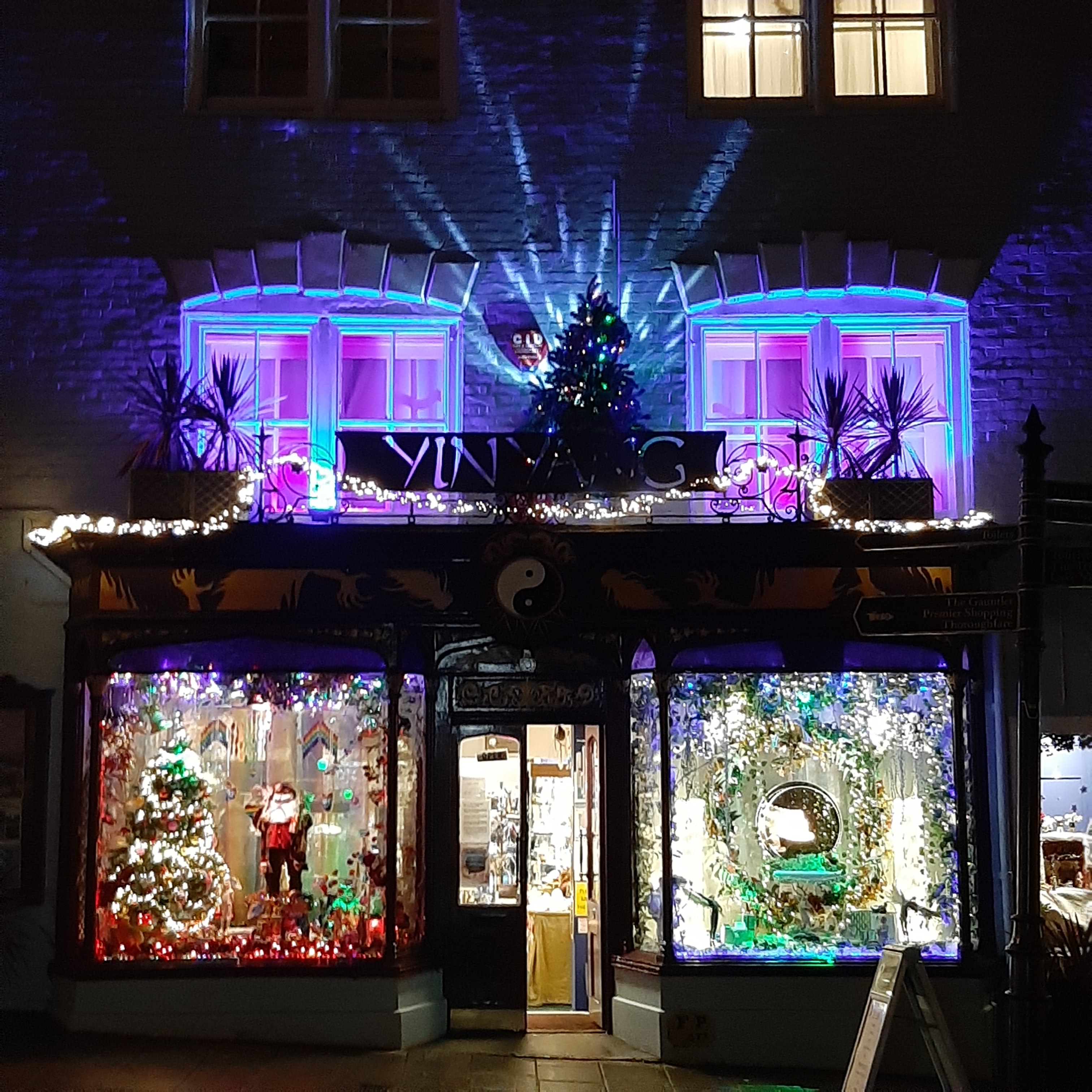
This shop has been recently refurbished, and the gilding of the lettering catches the light (gold, frankincense, myrrh).  This shop sells mostly Indian items, and its window display is full of little lights, hinting at Diwali.  The top floor, which I must admit I have never noticed in daylight, has a rainbow of lanterns suspended from the ceiling.  I think they go very well with the municipal Christmas tree on the front of the shop.

The Green Man is a significant folkloric and pagan symbol, and at this season of evergreens he is everywhere in Glastonbury.  This is a particularly fine example, framed by greenery and bringing a touch of the wildwood to the high street.

More Green Men here too, who have been joined by Cernunnos, the Celtic horned god.  The interweaving of traditions and beliefs is a major feature of Glastonbury, and is reflected in the range of merchandise which shops offer to modern-day pilgrims and visitors.  It is said that over 70 religions and beliefs are represented in the town, making Glastonbury perhaps one of the most spiritually diverse places on earth.

But amid all the paraphernalia of spirituality, people’s physical needs are catered for too, and the baker’s shop has a cornucopia of seasonal goodies in the window.  The mince pies look delicious, and I don’t even like mince pies!  Let’s hope the Scandi-style elves in the display don’t eat them all…

Across the road, one of Glastonbury’s best-known shops covers all the bases for seasonal gift-buying – a witches’ calendar for 2021, a cushion showing moon phases, a Green Man apron, magic spell kits and oracle cards, and a book on the Winter Solstice.  There is a tree, with snow-filled baubles, and a wreath with greenery and berries, and also the Tree of Life.
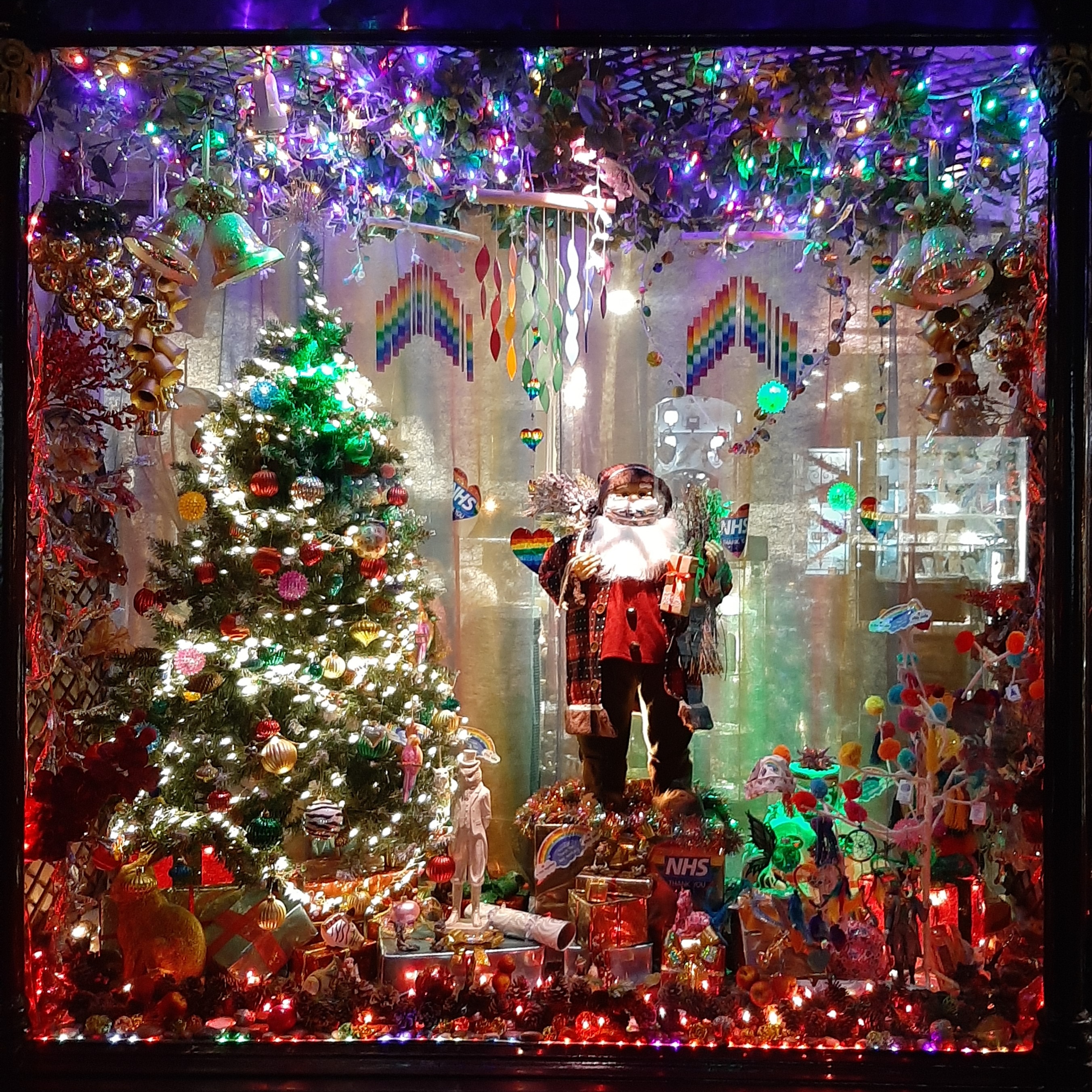
The next window seems quite conventional, for Glastonbury – a Christmas tree and Santa Claus.  But if you look closely, you’ll see that it’s not exactly the Santa of popular culture – this chap is nearer to the old images of Father Christmas, looking rather as if he’s just come walking out of the forest with an armful of kindling for the Yule fire.

A couple of doors down, we have more trees and another Father Christmas – but again, he isn’t the scarlet-clad figure with the sleigh and the ho-ho-ho.  This one is dressed in brown, smiling benevolently amid frosty-white trees, lit with cool whites and blues and populated with cuddly woodland animals.  It looks like an illustration from a children’s book, and I’d love to read the whole story.
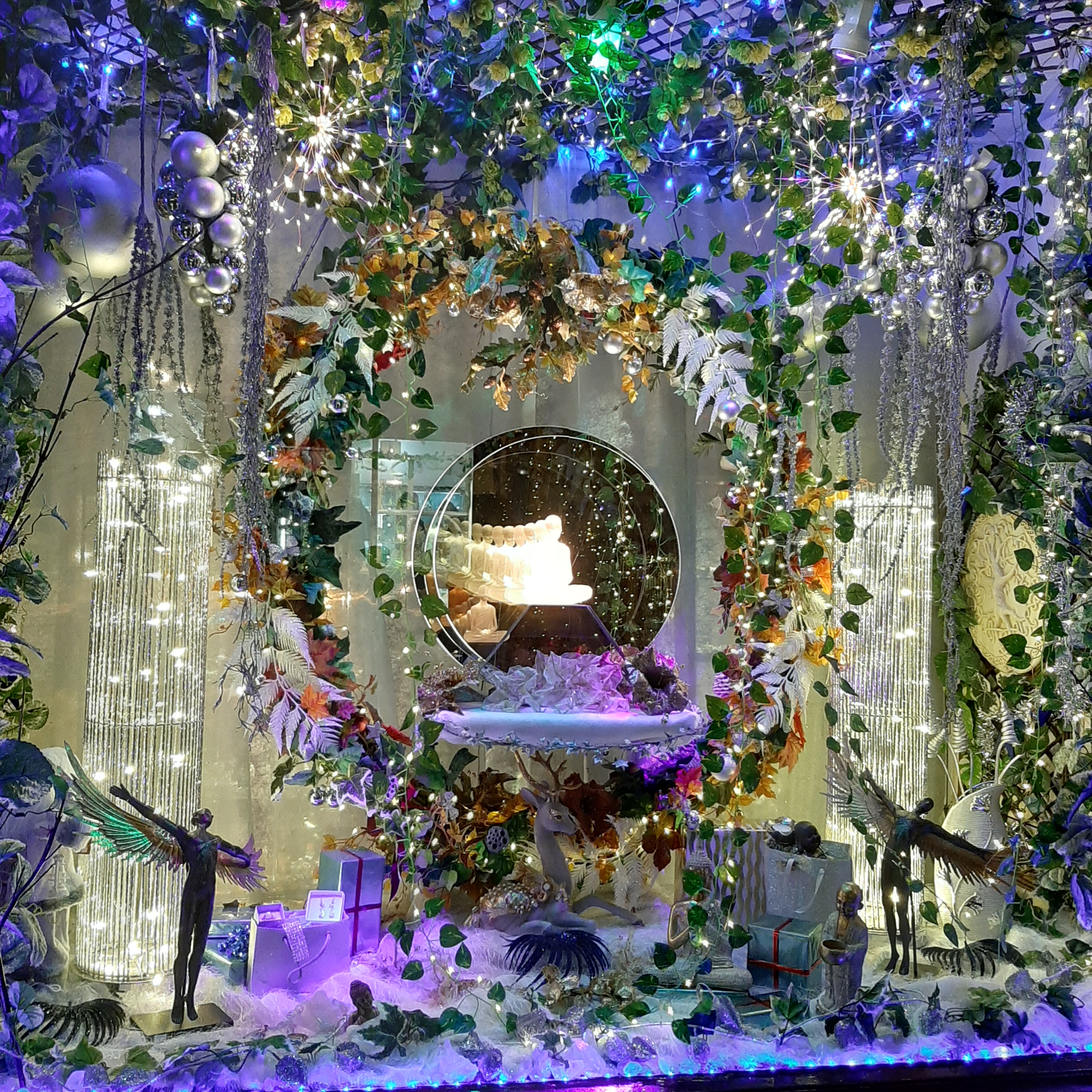
By way of contrast, the next window has nothing conventional about it at all – there may be a wreath of leaves, but they frame a seated figure of the Buddha, reflected to infinity in a circular mirror, and flanked by a pair of anglels who look like they were crafted by Jacob Epstein.  Cascades of light and washes of colour create an ephemeral magic.

We have reached the bottom of the high street, and turn left into the Market Place.  Here, there’s a clothes line of colourful stockings, strung above a vast selection of crystals.  A decorated Christmas tree sits beside geodes and ammonites, which are echoed in the signage above the shop window.
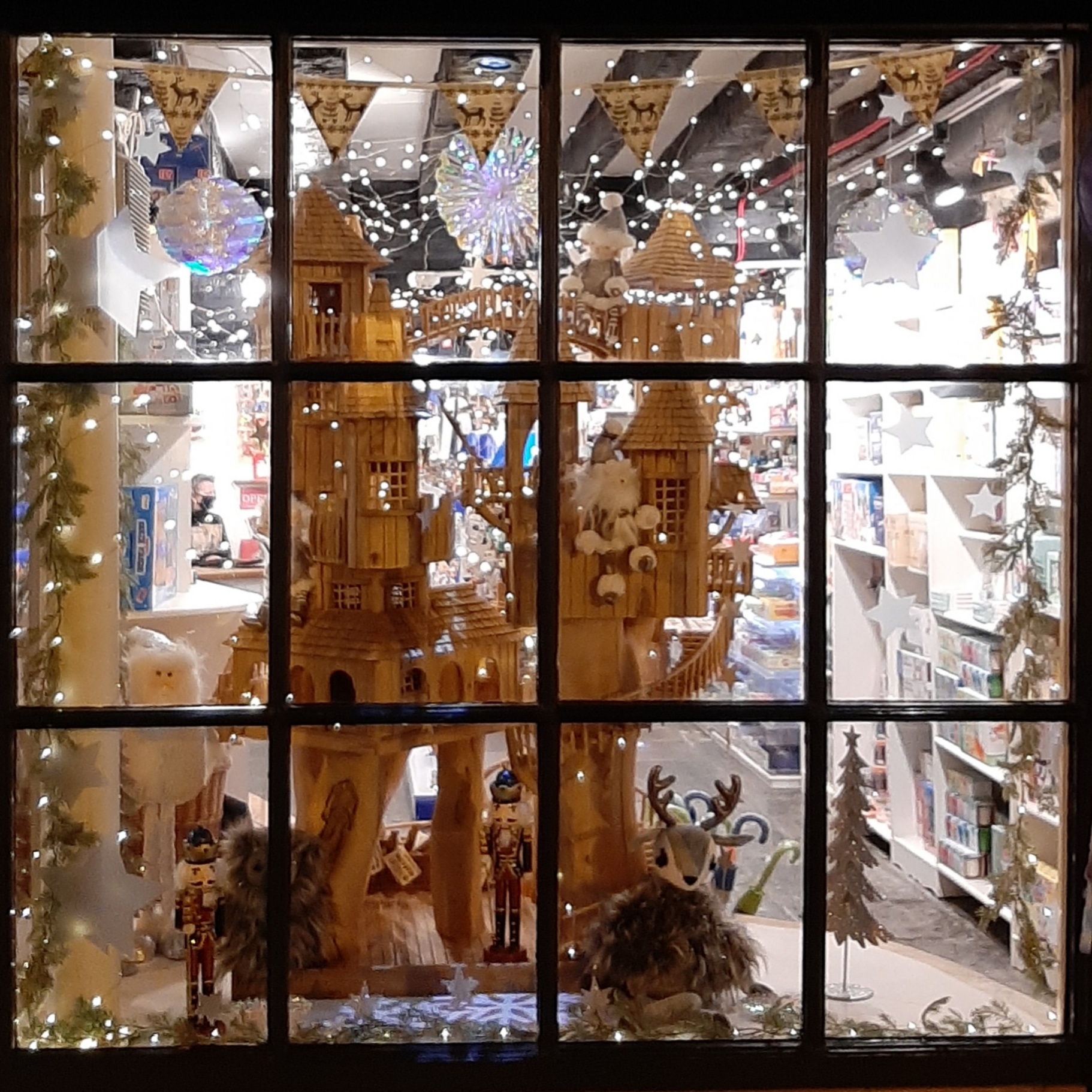
In the toy shop next door, the stunning wooden fairy tale castle which is a permanent fixture has been joined for the season by a couple of Nutcracker figures and a very cute reindeer in a winter wonderland that is all sparkle and ice.  The nod to continental Christmas customs is continued in the Nordic bunting across the window.

And so, finally, we come to Magdalene Street, and the last of the lit shops.  In a building which is one of only three in Glastonbury to survive from the 15th century, a handsome reindeer follows a trail of shining stars, with the inky-black winter sky above.

Whichever of the midwinter festivals you celebrate, may I send you – despite the particular challenges of this year – peace, love and happiness.
I am committed to making this blog freely available, and not putting material behind a paywall. As a writer, I am doing what I love – but I still have to make a living. If you have enjoyed this post, and if you are able to do so, perhaps you would consider supporting my work by making a small contribution via the Buy Me A Coffee button. Thank you!

Buy Me a Coffee at ko-fi.com

Where does our food come from? Open Farm Sunday

Where does our food come from?  It seems many of our children haven’t a clue.  A few days ago saw the publication of research http://www.bbc.co.uk/news/education-22730613 which suggests that a significant proportion of children have no idea about the difference between wheat and meat, or dairy and plants.

This weekend could give families all over the country a chance to change that – Sunday 9 June is Open Farm Sunday.  The weather forecast is pretty good for much of the country.  With so many farms, large and small, all over the country taking part, you’re never far from a participating farm.  Take the opportunity (and the children) to visit, and maybe start making the connections  between what happens on the farm, and what we all eat.  If you eat food, surely you want to know more about where it comes from?  Full details at http://www.farmsunday.org

Musings on farming and food, in the light of recent weather-related disasters in the UK

All views in this blog are my own.  Some people will, no doubt, disagree strongly with some or all of them.

As I write this, farmers in parts of the UK are still digging animals, many of them dead, out of snowdrifts.  Carcasses cannot be disposed of, because the roads are still impassable.  In at least one case the RSPCA has now become involved, apparently  because walkers are complaining about seeing dead animals.  I must admit this incenses me  – having lived in North Wales, where tourists in flip-flops used regularly to venture up Cader Idris, which is really suitable only for experienced hill walkers with specialist equipment and clothing, and then have to be air-lifted off the mountain when they got into difficulties, at vast expense to the taxpayer and personal risk to the helicopter crews, I have no patience at all with walkers who go out in hazardous conditions.  It is selfish and arrogant.  I have even less patience with those who want the pretty scenery but come over all indignant when they are brought face to face with the harsh reality of life and death in the country.  Surely it cannot have escaped their attention that in the last couple of weeks parts of the farming community have experienced an almost unprecedented  crisis, on top of 18 months of  weather related misery?  And that this has resulted in the death of thousands of animals?  Presumably these are the same kind of people who let their dogs run loose near pregnant sheep, refusing to believe that, to a sheep, dear little Bonzo is a wolf, and that their precious leisure activity can cause ewes to abort, threatening the farmer’s already precarious livelihood (not to mention the welfare of the sheep).  That’s always assuming Bonzo doesn’t actually savage the sheep, which is a very common occurrence.

The attitude of wider society, and civil authority such as the Welsh Assembly Government, to the recent snow crisis, seems to me to be part of an at best ambivalent attitude to farming and farmers which is, I feel, a significant threat to our national future.  Figures seem to vary enormously, but it is safe to say that in the UK we only produce about half the food we eat.  Therefore, should we be involved in a war, or should international transportation be interrupted through energy supply problems, industrial action, terrorism etc we would be in a poor position to feed ourselves, and the shelves of our shops and supermarkets would soon be very empty indeed.  However, addressing this does not seem to be a priority for government, nor does it seem to figure in our national security policy.  It should.

Not only are we, collectively, content to make ourselves hostages of fortune in this way, but we also have a very negative attitude to those farmers who are providing the food that is still produced in the UK.  Farmers are,  variously, regarded as rich, moaners, getting fat on handouts from the EU, preventing free access to the countryside (I sometimes wonder if the people who moan about this would be happy for complete strangers to come wandering through their gardens, leaving the gates open and dropping litter everywhere?), and (the greatest sin in this country of ‘animal lovers’) being cruel to animals.  The recent thread on BBC Radio 2’s Facebook page brought the latter element out in force.  Apparently it is cruel to raise animals for meat, and also cruel to let them get caught in freak unseasonal blizzards, and no sense of these being mutually contradictory.  Farmers can’t win.

The reality of farming life is very mixed.  Yes, there are prosperous farmers.  Generally in the east of England, with large arable farms where economies of scale help.  But even they are not immune to 18 months of relentless wet, leaving their land underwater and their crops rotting in the fields.  In the north and west, farms are generally smaller, more livestock based, and rural poverty is a reality.  Yes, they own large chunks of land with big houses on them.  Yes, they drive 4wds.  But the value of the land is tied up, the houses are unheatable, and the 4wds are not a status symbol but a necessity for getting around off-road (which is where the animals will be, obviously).  Diversification (adding value eg ice cream, or B&B’s), farmers markets and farmers wives working off the farm to bring in some money have become a necessity for survival, not a choice.  Foodbanks, ironically, are a lifeline in many farming communities.

I don’t begin to understand the complexities of EU farming payments.  Fortunately, farmers have learned to, although the amount of time and energy this (and other paperwork) takes diverts them from the core business of raising crops and livestock.  None of this would be necessary if we had not, as a society, bought into the idea (some time post-WWII) that food should be cheap.  The supermarkets seem to have become effectively the Ministry of Food, telling us what we can have and at what price, and keeping farm gate prices so low (eg milk) that any connection between the cost of production and the cost to the consumer has been lost.  We have been terrorised into thinking that it’s only the benevolence of the supermarkets which prevents the UK consumer from starving, as local shops and producers are all hideously expensive.  Well, it simply isn’t true.  Readers of this blog will remember my own fears about moving to the country, away from supermarkets, at a time when we were moving from two incomes to one.  In fact my food expenditure is down at least 30%, and my food miles are down more as I shop locally.  I appreciate that those who live in the middle of London, say, may have fewer local producers than here in Somerset, but towns have markets!  Food shoppers of the UK, you have CHOICES – you don’t have to believe everything the supermarkets tell you.  Explore the alternatives.  Yes, if you work 9-5 you may have to work a bit harder at accessing other sources, but it can be done, and really, what is more important than the food we eat?  The cheap food culture has led, inevitably, to a devaluation of food, from something precious around which family life revolves, to processed fuel grazed on the move or in front of the telly.  The demise of the dining room, and the dining table, from the homes of the UK tells its own story.

It’s time to put food back into the place it deserves in our lives.  You are what you eat – on that basis most of us are Chorleywood ‘bread’ and processed meat, with lashings of fat and sugar.  Somehow, we have, as a nation, to re-learn to value what we eat, and the people who make it and bring it to us: the farmer, the butcher, the baker, the greengrocer, the farm shop, the deli.  The vet, the abattoir manager, the shearer, the AI technician, the scanner.  The milker, the mechanic, the cheesemaker, the brewer, the shepherd, the sheepdog.  The people working unsociable hours to get us fed, on the milkround, in the corner shop, in the milking parlour, in the lambing shed.  And in the last fortnight, out on the hill digging animals out of snowdrifts.

The government isn’t going to make that change.  Left-wing governments tend to have it in for farmers, and the current one is too full of urban millionaires to be able to relate to what’s going on in the real world.  The supermarkets aren’t going to make that change.  Their entire business model depends on the status quo.  It’s down to you and me.  I fully appreciate that those living on benefits or the minimum wage won’t have the option to spend a little more time, energy or (sometimes) money on buying local and cooking from scratch.  Many people, raised on two generations of the supermarket and processed food, no longer know how to cook from raw ingredients, and since cooking is no longer on the school curriculum, I am hugely worried about that too, for the future health of the nation.

But just because some cannot, it doesn’t mean that the rest of us – middle class, middle income and above – shouldn’t be taking responsibility and doing our bit for change.  I am now no longer routinely doing food shopping in supermarkets.  If I really can’t get something locally, or in the village Co-Op, then I try Waitrose (those two chains have a slightly less awful record of dealing with the farming community).  But that’s only every 2 or 3 months.   I try not to eat out of season or imported fruit and veg – and as a result, this winter I have discovered swede, turnips and curly kale, none of which I had regularly eaten before.  I am buying all my meat from local butchers and farm shops, and trying out cuts which are simply not available in supermarkets.  I WON’T buy New Zealand lamb while we still produce UK lamb (as I write this, on Easter Sunday, this evening’s leg of Exmoor lamb is slow cooking with garlic and rosemary.  Bought from the farm shop, and cheaper than the NZ leg for sale in the Co-Op).  And I think we have eaten better this winter than ever before.

My small changes in buying and cooking habits may not, by themselves, make the difference to making UK farming viable, thriving and a valued part of the nation’s economy and life, but what if you did it too? And you?  And maybe you?

Buy local.  Failing that, buy regional or national.  Buy fresh and cook real food, not processed.  Enjoy seasonal treats (asparagus, strawberries, plums, apples) fresh when in season, don’t eat imported versions all year round.  Find your local farm shop, butcher, market.  Ask where the produce comes from.  Make it clear to your retailers that you value local produce.  Be prepared to make a bit more of an effort to get good, fresh food, produced in the UK (and ideally in your county) onto your dining table.  You are what you eat.

If we don’t, farming in the UK will continue to decline, and we will have no-one to blame but ourselves.  After 18 months of relentless wet, flooding, poor grass growth (grass=meat), rising feed prices, higher vet bills, and now, in many places, huge losses at what should have been the most optimistic part of the farming year, the question must be why on earth anyone stays in farming.  The rates of bankruptcy and suicide speak for themselves.  We simply have to take responsibility for supporting our farming industry, or we will all starve.