An infinity of one’s own – Hawker’s Hut, poetry and place

I am thinking, and writing, a lot about place at the moment – geographical location, borders, and the relationship between where we are and who we are.  As a tangent from this, I’ve been musing about whether, or how, where we are affects what we write.  There are a few obvious connections; for example could Wuthering Heights have been conceived of and written anywhere other than the bleak uplands of the Brontë’s Haworth, or would Persuasion have been as persuasive in its evocation of the social banalities of Bath had not Jane Austen herself experienced the particular torment of the old maid in that context.  But is it a general principle, I have been asking myself, that our location influences us as writers?

In the late spring of last year I tagged along with my wife on a study trip to north Cornwall, that enigmatic stretch of coastline between Bude and the Hartland peninsula where Cornwall becomes Devon, notorious for shipwrecks and (possibly apocryphal) tales of wreckers.  It is less remote and unknown these days than when I first visited a couple of decades ago, and honeypots like Boscastle are now gridlocked, but off season, with the sea fog swirling round you, it can still feel like you’re standing at the edge of the world.  It’s mainly vertiginous cliffs along here, with the South West Coast Path providing access on foot to places that tourists can’t drive to.  My wife having finished at the museum, we went exploring.

Intrigued by the eccentricities of its nineteenth-century vicar, the Reverend Robert Hawker, we went to Morwenstow.  The steep churchyard was knee-deep in wildflowers, framing the replica figurehead of the Caledonia which marks the burial of several of its sailors who drowned when she was shipwrecked on that treacherous coast in 1842.  It is a kind of marker, too, for Parson Hawker’s affinity with the sea – he habitually wore a knitted fisherman’s gansey, was involved in a number of rescues, and took great pains to ensure the decent burial of shipwrecked sailors.

Hawker has other claims to fame.  He was a poet, and as a young man published ‘The Song of the Western Men’ (more commonly known as ‘Trelawney’) which is the de facto national anthem of Cornwall.  And he was the instigator of the modern Harvest Festival, celebrated in churches all over the world, and which was a re-imagining of the medieval practice of Lammas or First Fruits.

His eccentricities are well, although not perhaps always reliably, recorded, and include wearing random and colourful garb such as a poncho made from a yellow horse blanket; bringing his cats to church services (and excommunicating one of them for mousing on a Sunday!) and keeping a pet pig.  He was also almost certainly addicted to laudanum – tincture of opium in alcohol – and this arguably fuelled both his eccentricity and his poetry.

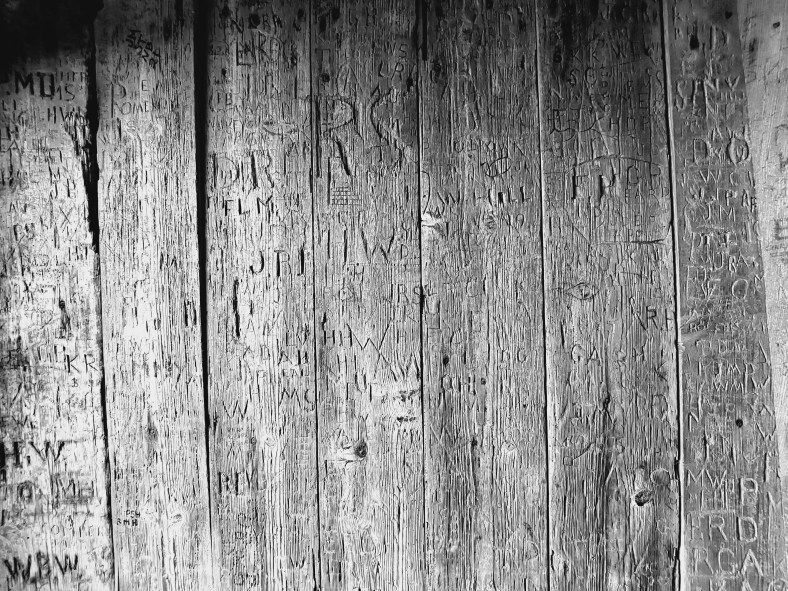
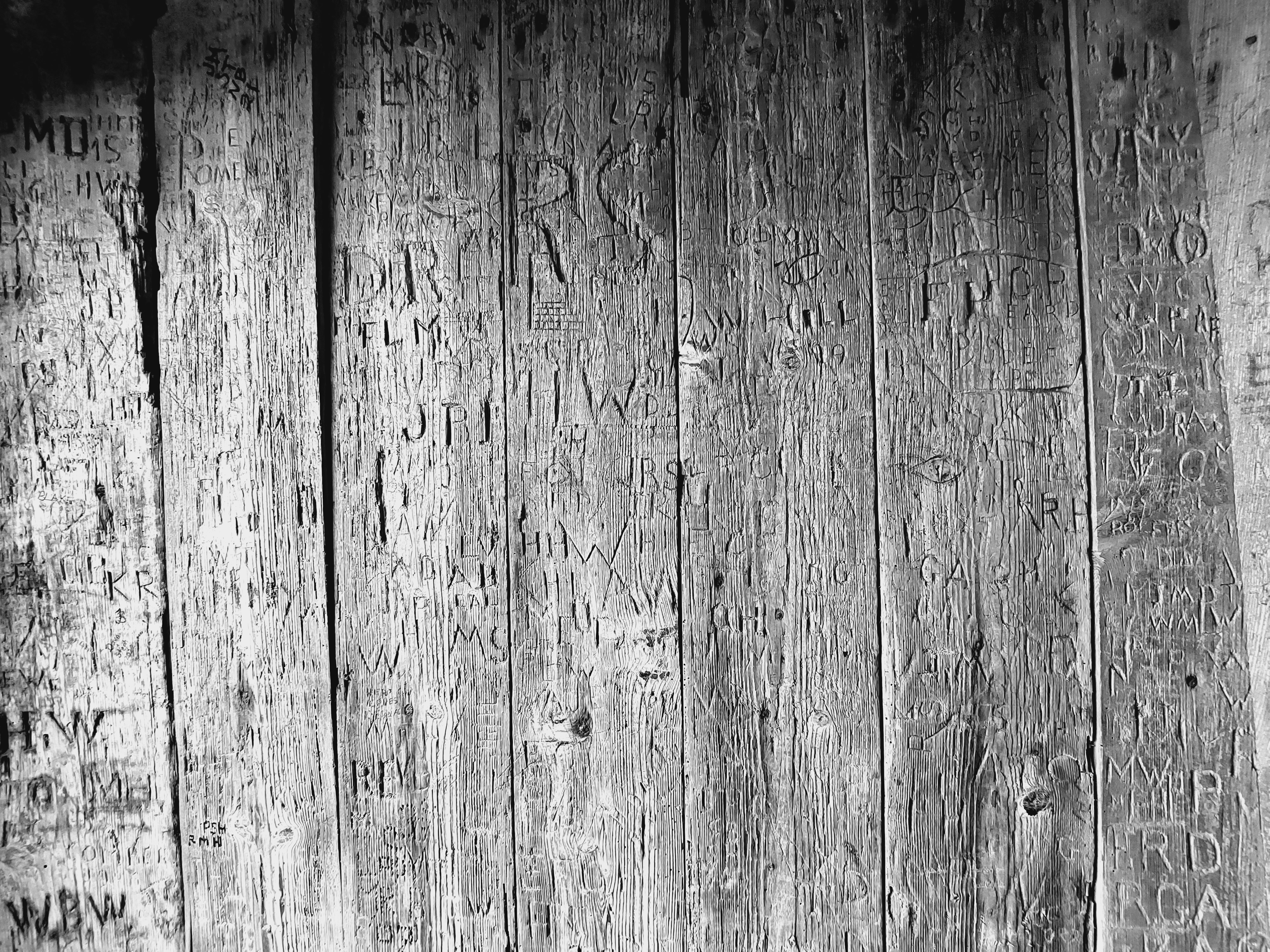
Much of Hawker’s poetry was written in his hut, set into the cliff face a mile or so from the church, constructed from driftwood and roofed with turf.  It is now the smallest property in the care of the National Trust, its planks incised with graffiti and worn to a smooth, mellow patina.  It would be easy to think of it merely as a den, a playhouse, or a man-cave, but we were lucky enough to have the place to ourselves and time to pause and try to see it through Hawker’s eyes.  The stable door opens onto infinity – the Atlantic, the sky, the sea mist.  The view is as unlimited as the human imagination.  What does looking out on infinity do to a person?  To a writer?  Does it stretch the boundaries of the mind, of the possible?

Sixty miles to the north across the Bristol Channel is another shrine to a dead poet – Dylan Thomas’ writing shed at Laugharne.  Decades apart, two men gazing out on infinity and writing poetry.  Infinity + alcohol = Thomas.  Infinity + opium = Hawker.
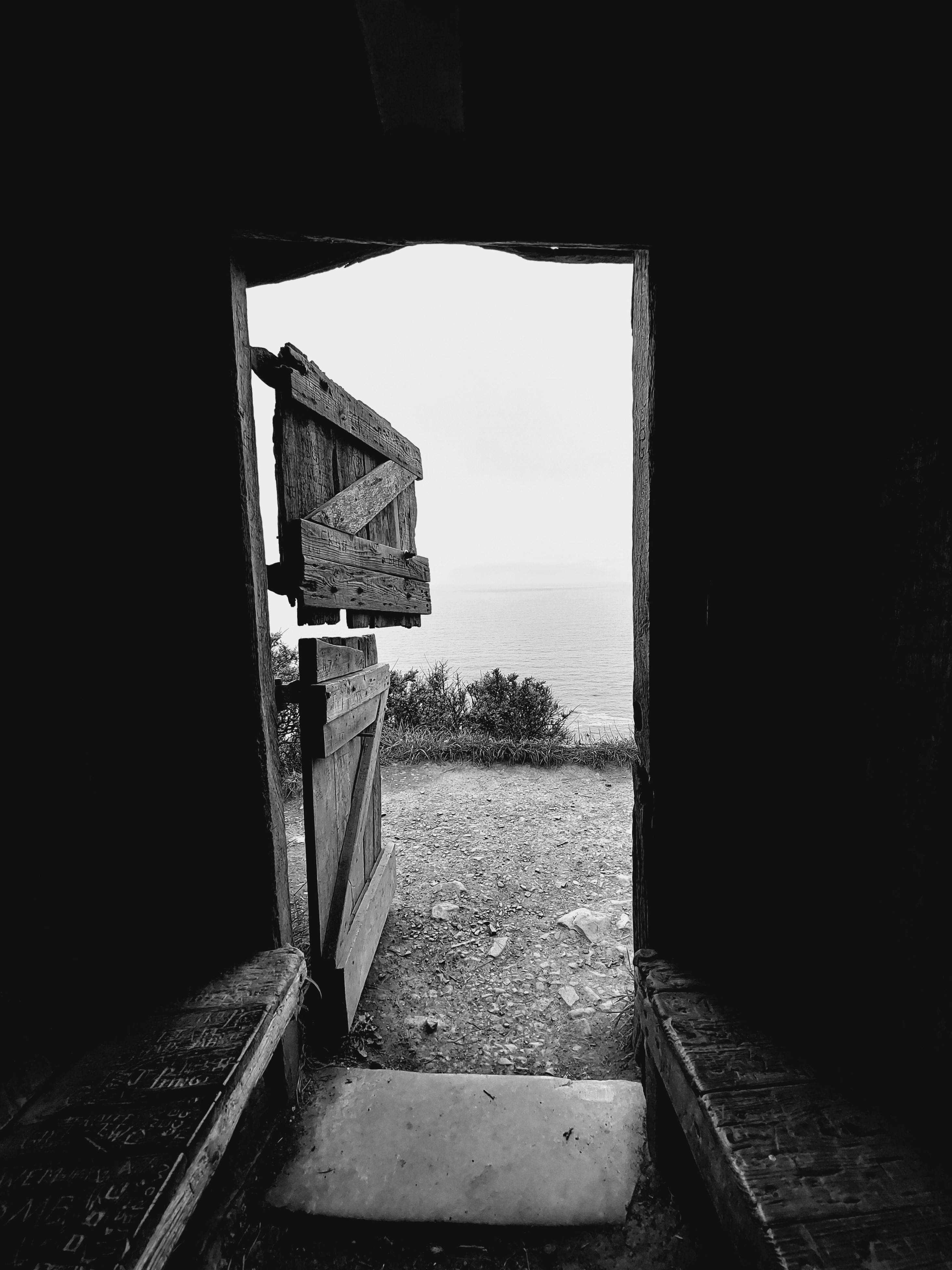
Maybe it’s not just the window on infinity, or even the stimulants, that are significant here.  Maybe it’s the access to a place to write, uninterrupted by the demands of other, domestic roles.  Jane Austen famously wrote her entire oeuvre at a little side table, using a writing box which had been a present from her father.  Her father couldn’t give her a space to write, or financial independence, but he could give her a writing box, a microcosm of the writer’s world which she could take with her wherever she went.  Virginia Woolf wrote an entire book about A Room of One’s Own, in which her analysis was that women writers were handicapped by the lack of their own space in a domestic context.  Neither Hawker in his hut, nor Thomas in his shed, had that problem.  Both had the luxury of private space – physical space, and headspace away from the demands of domesticity.  And, as a bonus, those private spaces had a window on infinity.

I started this by musing on the relationship between where we are and who we are, and whether, or how, where we are affects what we write.  Perhaps it’s less that a place affects who we are and what we write, but rather that where we are affects what we see from there.  Writers, including Alfred Lord Tennyson and Charles Kingsley, were inspired by Hawker’s hut.  Thousands of literature students and aspiring writers make the pilgrimage to Thomas’ shed.  Maybe the inspiration lies, not in looking into the writer’s space, but looking out of it – seeing what they saw, especially when that is infinity.  Alcohol and laudanum are optional.
I am committed to making this blog freely available, and not putting material behind a paywall. As a writer, I am doing what I love – but I still have to make a living. If you have enjoyed this post, and if you are able to do so, perhaps you would consider supporting my work by making a small contribution via the Buy Me A Coffee button. Thank you!

Buy Me a Coffee at ko-fi.com

2021 – My Year In Books

2021 – My Year In Books

New Year’s Eve has come upon me suddenly – in the limbo between the public festivals of Christmas and New Year, the days seem to merge into each other, especially this year when the grey skies touch the ground (alternating occasionally with thick fog) and it never seems to get properly light.  There have been a lot of ‘best books of 2021’ posted on social media over the past few weeks, and it set me thinking about what I have read this year.  Some I have reviewed on this blog or in other publications, but others I have read simply for pleasure or out of curiosity.  Here, in roughly chronological order, are my top 10 books of 2021.

Mudlarking: Lost and Found on the River Thames by Lara Maiklem.  I originally bought this for my beachcombing mother-in-law, but it looked so interesting that I got a copy for myself too.  The author posts prolifically on Twitter, Facebook and Instagram, so the book is very much a starting point for an ongoing engagement with the finds that emerge from the Thames, and the stories and history behind them.  Maiklem moves down the river, from the tidal head at Teddington to the estuary at Southend-on-Sea, telling the story of the riverbank, the characters who inhabit(ed) it, and her own experience of mudlarking along the shore and the artefacts she has discovered.  The book sits between travel writing, social history, and memoir, and is accompanied by photographs of some of the finds she refers to.  I am always entranced by the humble objects, sometimes lost for centuries, which give a glimpse into people’s everyday lives, so for me this book was a treasure trove.

Ghost Town: a Liverpool Shadowplay, by Jeff Young was another book which was originally a gift which I ended up reading myself.  This had a personal resonance for me, as the streets which Young describes so evocatively were trodden by my own father, half a century earlier.  Many of the places are familiar to me from tracing my family history.  In Young’s luminous memoir, he walks through his ‘ghost town’, and explores themes of metamorphosis – his own, and that of the city of Liverpool –and loss, remembering and mis-remembering.  A compelling narrative, highly recommended for anyone interested in place writing.

Next up was The Screaming Sky by Charles Foster, illustrated by Jonathan Pomroy.  I read this just a few days before the swifts arrived from Africa, perfect timing for this love song to the marvel of nature that is the swift.  Born of a passion bordering on the obsessional, Foster’s book describes the bird’s life-cycle, its mind-boggling feats of aerobatics and endurance, its biology, and the history of humans’ relationship with the species.  I wrote a full review on this blog here.

Where? Life and death in the Shropshire hills by Simon Moreton was a new departure for me – I have no experience of the graphic novel/zine genre which Moreton specializes in, and this innovative book combines text with illustration and collage in a way I’ve not seen done before.  Where? is a memoir, in which Moreton juxtaposes the narrative of his father’s illness and death with memories of a childhood in rural Shropshire, in a landscape dominated by the presence of Titterstone Clee which looms over the surrounding countryside, and near the summit of which is a radar station where Moreton’s father worked.  Again, this is place writing about somewhere I know slightly, and I enjoyed reading it, admiring the weaving together of the two strands.  I am aware, though, that there were aspects I didn’t ‘get’ because I don’t have the visual lexicon to understand the artwork which is such a large component of this book.

A Still Life: A Memoir by Josie George.  I have followed Josie George on Twitter for a long time, and pre-ordered this book when she announced its publication.  However, it took me a long time to summon up the courage to read it.  In a year where so many themes were dark and hopeless, it seemed perverse to read an account of disability and chronic illness.  I was wrong.  George’s account of her life with a condition which long defied diagnosis and which continues to deliver twists and turns of challenge and disability, is full of light, hope and love.  Not that there is any false cheeriness here – she pulls no punches about the pain and hardships of her situation – nor is there any of the ‘disabled person as an inspiration to us all’ nonsense.  This is an exceptional person, taking life one moment at a time, doing what she can, not doing what she can’t, refusing to get frustrated, determined to continue loving, convinced that the world is good, that life is good, that being alive is the most amazingly wonderful thing, to be savoured and celebrated in whatever way we can in that moment.  It is heartwarming, not in an It’s A Wonderful Life kind of way, but in a way that stays with you, challenging the way you look at the world, at each small moment of our small lives.

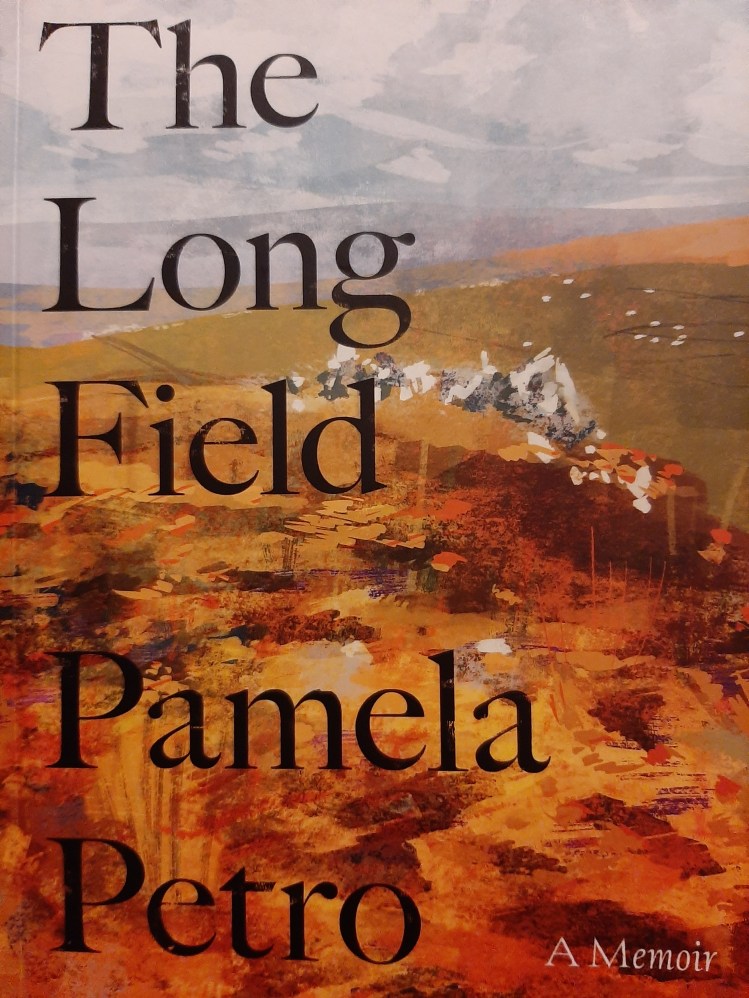
The Long Field by Pamela Petro is again memoir/place writing about somewhere I know – in this case, Petro’s love affair with rural Wales started in Lampeter, at the university we both attended.  I reviewed The Long Field here.

Fifty Sounds by Polly Barton was initially quite a challenging read (I don’t do philosophy, which dominates the opening chapters) but my persistence was rewarded by an insightful exploration of how language and culture influence and shape each other.  Barton tells of her experiences as an English teacher in Japan, and the fifty sounds of the title (which form the chapter headings) are onomatopoeic words in Japanese which she unpacks in her journey into Japanese language and culture, and into her own personality.  I wrote a full review for the Cardiff Review.

You will have noticed that all the titles in this list are non-fiction.  I have struggled with reading fiction since the beginning of the pandemic, but The Listeners by Edward Parnell may have rehabilitated me.  This clever, taut, beautifully written delight gave me more reading pleasure than anything else this year, and I reviewed it joyfully here on this blog.

Finally, two books which I am still reading.  Light Rains Sometimes Fall: a British Year Through Japan’s 72 Seasons by Lev Parikian is arranged in short chapters covering 5 or six days each, in which Parikian closely observes the natural world around him, partly through pandemic lockdowns, noticing details of the changing seasons.  I am a big fan of Parikian’s nature writing, and as I’m consciously attempting to live more in the present (rather than the past or the future) I liked the idea of reading this in ‘real time’, a chapter at a time for a whole year.  The current ‘season’ is called ‘Storms Sometimes Blow,’ which seems about right! 

As an utter map nerd, and a fan of his other writing, it was inevitable that I would eventually read Map Addict by Mike Parker.  At the time of writing, I am halfway through this blend of memoir, cartographical history, and celebration of the glorious Ordnance Survey map, and it’s so nice to connect with a fellow map addict! (I’ve written about the origins of my own map obsession here).

And, on this last day of 2021, I bring you good news – I have a whole lot more books lined up to read in 2022!  My ‘To Be Read’ pile includes poetry, a lot of exciting non-fiction, and even (tentatively) a bit of fiction.  I can’t wait!

Wishing you a Happy New Year.

Photograph of the books referred to in this blog post.

I am committed to making this blog freely available, and not putting material behind a paywall. As a writer, I am doing what I love – but I still have to make a living. If you have enjoyed this post, and if you are able to do so, perhaps you would consider supporting my work by making a small contribution via the Buy Me A Coffee button. Thank you!

Buy Me a Coffee at ko-fi.com

Book review – The Long Field by Pamela Petro

First, a confession.  Reading Pamela Petro’s The Long Field was an exercise in nostalgia for me.  I followed Petro to the university at Lampeter in West Wales (‘Probably the smallest university in the world,’ as the T-shirts in the Students’ Union shop proclaimed, Carlsberg advert-style) just four years later.  All her descriptions ring so very true for me, were part of the landscape of my own young life.  Even the cottage she lived in is well known to me, as a friend of mine rented it in my first year – I can picture myself back in that kitchen, drinking tea, watching my friend making jelly for dessert.  My challenge in writing this review has been to come to the book from the outside, as it were, rather than from that place of shared experience.

The Long Field is, fundamentally, about hiraeth, a complex Welsh word which encompasses elements of longing, nostalgia, distance, absence, homesickness.  It is famously untranslatable into English.  But the book is also a love story.  A love story on several levels, most obviously Petro’s sudden, unexpected, and deep passion for the landscape of rural Wales – again, something which resonates with me.  But it is also about her relationships with her partner and with her parents, and an exploration of the complexities of those relationships.  Perhaps it is an acknowledgement that love stories more nuanced than ‘boy meets girl and they live happily ever after’ are part of the lived experience of queer writers.

Although Petro is passionate about Wales – her Wales – she manages to stop short of being entirely rose-tinted about it.  She acknowledges some of the nuanced complexity of Welsh identity and history, some of the ways in which her adopted homeland’s sense of itself as a colonial victim of English occupation can hold it back.  As someone who has lived in Wales for a significant part of my adult life, it seems to me that Petro’s analysis of Wales is predominantly rural – the Wales of Ceredigion and the Cambrian Mountains – and intellectual and cultural.  She does nod at the life of the Valleys, especially as she was in Wales in 1984 during the miners’ strike, but the industrial and post-industrial conurbations of South and North-East Wales, the product of migration from within Wales and beyond, are not the Wales that she knows and loves.  Her Wales is that of the past etched into the landscape of the present.  Of people connected, umbilically, to the places that shaped the generations before them.  Of story made tangible in the land.  Landscape – not only the fields, the mountains, the hills, but also the cultural echoes, the resonance that they have – is what Petro loves.  Her inexplicable feeling of having ‘come home’ to that landscape when she, an American with no Welsh antecedents, arrived in Lampeter in 1983 is the starting point for the experiences that have shaped this book.

The Long Field is a remarkable book.  Although it self-identifies on the cover as ‘A Memoir,’ it draws together strands of history, travelogue, a whistle-stop tour of Welsh literary heritage, place writing, pronunciation notes for the Welsh place names, linguistic detours, a coming-out narrative, family saga, and an exploration of identity.  It is this last element, I think, which is the most important.  Can someone identify with a place which they are not ‘from’ but where they nevertheless felt a shock of recognition when they first encountered it?  Yes, says Petro – but is she is not claiming Welshness.  Rather like entering into a relationship with a lover from a different culture who speaks a different language, she seeks – respectfully, gently – to learn, to understand, to value what the beloved values.  What Petro found when she found her Wales filled a profound void in her psyche, provided a connectedness between the people of the present and the past which her upbringing in suburban America had not.  In an era when more people than ever are living where we are not from, The Long Field has much to say about place, identity, past, present – and future.

The Long Field by Pamela Petro is published by Little Toller Books.  ISBN 9781908213853

I am committed to making this blog freely available, and not putting material behind a paywall. As a writer, I am doing what I love – but I still have to make a living. If you have enjoyed this post, and if you are able to do so, perhaps you would consider supporting my work by making a small contribution via the Buy Me A Coffee button. Thank you!

Buy Me a Coffee at ko-fi.com