The promise of light and life – Imbolc, Candlemas and St Bridget

Today, the first day of February, is the festival of Imbolc (the ‘b’ is usually silent).  A pre-Christian festival celebrating the end of winter and the beginning of spring, it marks the point in the year when, although some of the worst weather might still be to come, nevertheless the first signs of hope and life are emerging.  Days are noticeably longer, trees are budding and the catkins are out (though as a hay fever sufferer with a particular sensitivity to tree pollen, I’m less thrilled about this last development).  The plump, green shoots of flowering  bulbs have nosed their way out of the cold earth, and the first of them – aconites, snowdrops, crocuses, even the occasional daffodil – are blooming.  Their splashes of yellow, white and purple are the first colour after the monochrome months of winter.

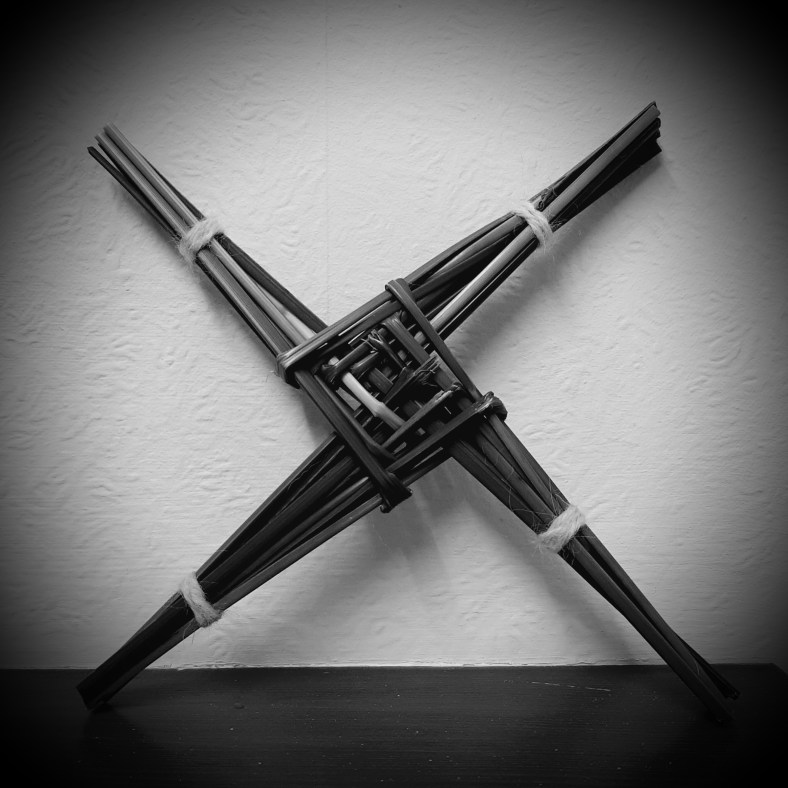
The beginning of February has been a popular time for festivals.  In the Christian era in Ireland, the date became associated with St Bridget (Brigid, Bride, Brighde, etc), second only to St Patrick as the country’s principal saint.  She in turn was conflated with the great pagan goddess of the same name.  St Bridget was invoked by metalworkers, in healing, and in warfare, as well as in connection with fire and thunderstorms.  By the 18th century it was believed that Bridget would visit the homes of the virtuous on the night before her feast, and bless the inhabitants.  In some places, offerings of food – cakes or bread – would be left on window sills for her, but more usually a cross would be woven out of rushes or straw, and hung near a door or window to welcome her.  This custom has been widely adopted well beyond Ireland, and is popular in the neo-pagan community as a way of marking Imbolc.  There are even tutorials on YouTube to teach you how to make a St Bridget’s cross.  I made mine yesterday, although as I didn’t have any rushes or straw to hand I raided the garden and used the dried stems of a large ornamental grass instead.  Traditionally, the crosses are left up all year, the old cross being burned when the new one is made.

Mono photograph of a St Bridget's Cross.

The second day of February is the Christian festival of Candlemas, also known as the Feast of the Purification of the Virgin Mary, or the Presentation of Christ in the Temple.  In the Gospel of Luke, the baby Jesus is taken to the Temple in Jerusalem by his parents, for his mother to make the traditional Jewish offering to purify herself.  Under Jewish law, this happened 40 days after childbirth, so once the Church had fixed the birth of Jesus to 25 December, this festival took place on 2 February.  Little is known about how it was celebrated in the early Church, but by the end of the seventh century it had reached Britain, and a couple of decades later the Venerable Bede described rituals including candlelit processions.   Maybe the candles harked back to the words of Simeon, the old man at the Temple, who recognised in the baby Jesus as the Messiah who would be ‘a light to lighten the Gentiles’?

As well as giving their name to the festival, candles were a major part of the customs that marked it, with candles being blessed and used in procession.  They were then either burned in front of a statue of the Virgin Mary, or taken home to be lit to protect the household against illness or storms.  The Reformation saw the end of these customs, the blessing of candles being seen as superstitious and the making of magical objects, and the customs of Candlemas lay dormant until the nineteenth century, with the revival of interest in the pre-Reformation Church and medievalism.

Candlemas is traditionally the very end of the season of Christmas, and in some places the evergreen decorations are not taken down on Twelfth Night but kept up until Candlemas – an echo, perhaps, of the Imbolc celebration of the end of winter.  Those shy harbingers of spring, snowdrops, are also known as Candlemas Bells, because they flower at this time.

Photo of hand cupping a snowdrop.

February festivals have a long and varied history – to the Romans, February was a month of rituals of cleansing and purification, in preparation for the new life of spring.  Those of us who still practice ‘spring cleaning’ are following in a very long tradition!  Next time you wash your curtains, go down to the recycling centre or take your unwanted clothes to the charity/thrift shop, you can remind yourself that you are taking part in a spring ritual which has being going on for over two thousand years.  Like the Romans, we can start to think beyond nesting, hibernating, snuggling down in our homes and look ahead to longer days, open windows, warm sunshine.

This is the point in the year when we can feel a shift from passive winter to active spring.  No longer are we hunkered down, waiting for the dark and cold to pass – now we are looking forward to new life, new growth, warmth and light.  Next stop, spring flowers and baby birds everywhere!  There may still be snow and storms and dark days to come, but psychologically the worst of winter is behind us.  This is a time of promise.  Spring is coming.

If you would like to know more about the festivals of the year, their origins and traditions, I highly recommend the following books. The Stations of the Sun: a History of the Ritual Year in Britain by Ronald Hutton provides an academic but very readable introduction, while Glennie Kindred’s Sacred Earth Celebrations is the best guide I have found to the festivals of the Wheel of the Year as celebrated by the pagan community today.

I am committed to making this blog freely available, and not putting material behind a paywall. As a writer, I am doing what I love – but I still have to make a living. If you have enjoyed this post, and if you are able to do so, perhaps you would consider supporting my work by making a small contribution via the Buy Me A Coffee button. Thank you!

Buy Me a Coffee at ko-fi.com

Planting a herb garden – history, food and wellbeing

Now that there is some warmth in the spring sunshine, I have planted a herb garden.  It’s a very small herb garden – a vintage Belfast sink and a couple of pots – but it’s attractive and will serve my purposes.

The Belfast sink has been empty over the winter – when we moved house last autumn we emptied out the old herbs which were well past their best, ready for fresh ones this season.  It’s lovely to see it fully planted up, beside the back door so that it’s in easy reach of the kitchen, in a corner which is a suntrap.  The challenge is to remember the watering!

Colour photograph of a Belfast sink planted with herbs, and a green watering can.

The choice of herbs for sale was a bit limited so early in the year, but the plants were in very good condition, and there’s room to pop a couple more into the gaps later in the season if I find some.  I chose two purple sages, one oregano, and two thymes (one gold, one silver).  The sages will grow quite tall, so I put them at the back, with the oregano in the middle, and the thymes at the front.  They will spread, and be able to trail over the edge of the sink.  I also bought Moroccan mint, and a medium-sized rosemary – as mint is invasive and would take over the whole sink given half a chance, and as rosemary grows large and is long lived and will soon outgrow the sink, I have put each in a separate pot.  Ideally I’d also have some chives and some tarragon, although I’ve never had much luck with growing the latter, and maybe some flatleaf parsley (which I use where recipes call for coriander, which I don’t like).

Growing herbs has a long and venerable tradition.  Used for thousands of years for culinary, medicinal and ritual purposes, they have been an enduring part of human civilisation and their cultivation is an international phenomenon.  Much of what we know in the West about herbs and their uses was written down by medieval monks who grew herbs in the physic gardens of their abbeys, and a significant proportion of modern medicines have their origins in herbal compounds, so growing them today feels like connecting with the past.

So what of the herbs in my garden?  Let’s look at their history, uses and properties.

Sage

Its Latin name, Salvia, comes from salvare, to cure, so its medicinal reputation is long-established.  It has been used to treat sore throats and digestive problems.  Clinical trials in 2011 suggested that sage’s reputation of being helpful in the menopause may have scientific backing, as a trial reported its effectiveness in reducing hot flushes.  Originating in the Mediterranean area, sage is grown around the world, thriving in warm sunny locations – so my suntrap by the back door should suit it well.

Perhaps best known in Britain for its role in sage and onion stuffing, sage is strongly-flavoured and I use it a lot in casseroles, as well as torn up and tossed with buttered pasta.  Being a ‘lady of a certain age’, I also drink it as a tea (although as I’ve only had the plants a few weeks, it’s too early to report an improvement in symptoms!).

Oregano/marjoram

Another native of the Mediterranean (this time the Middle East), this is also a sun-lover.  Its antiseptic qualities made it a medieval cure-all, and the first settlers to New England took this herb with them.  I like it with chicken, fish, or pasta, and it is delicate enough not to swamp subtly-flavoured foods.  To me, this is a real sunshine herb – just crushing the leaves and sniffing your fingers will give you a lift.

Thyme

Prescribed by the 17th century herbalist Nicholas Culpeper as a treatment for whooping cough in children, thyme has long been regarded as having antiseptic properties and being useful in respiratory conditions.  It’s a staple culinary herb (although incredibly fiddly to prepare, as you need to strip the tiny leaves from the woody stems) and gives a fresh, warm flavour which is hard to beat.  Pretty much all ‘mixed herbs’ include dried thyme, but it’s less potent when used fresh and partners well with rosemary, oregano and sage.

Mint

The Moroccan mint I’m growing is a kind of spearmint, so it’s warm in flavour rather than cool peppermint.  Its culinary uses are almost endless – salads, mint sauce, cakes, desserts, cold drinks, and mint tea, for example.  Humans have used mint for a long time – it has been found in Egyptian pyramids dating from 1000 BCE, and the Greeks and Romans used it – but curiously it only came into widespread use in Western Europe as late as the 18th century.  Medicinally, it has been used to aid digestion, and specifically to deal with wind, which may be the reason for the popularity of after dinner mints!

Rosemary

“There’s rosemary, that’s for remembrance,” said Ophelia in Shakespeare’s Hamlet.  Since antiquity rosemary has been believed to help strengthen the memory, and it is still used in Greece in the homes of those preparing for exams.  Another herb which likes hot, dry conditions, rosemary has a pungent, invigorating flavour and aroma – and the white, lilac or blue flowers are adored by bees and other insects.  I have always grown rosemary, and use it generously in cooking.  The traditional partner is, of course, roast lamb, but I use it (either as whole sprigs, removed before serving, or finely chopped) in almost anything that’s going to be cooked for a while – casseroles especially.

Photograph of a chopping board with chopped herbs and a large kitchen knife.

Whilst the whole ‘grow your own’ phenomenon may require more space, time and energy than many of us have available in 21st century Britain, it’s possible to have a herb garden in the smallest of spaces – in a pot or in a window box, or even indoors on a windowsill at a pinch.  And nothing beats the pleasure of cooking with herbs that you have grown and harvested yourself.