An infinity of one’s own – Hawker’s Hut, poetry and place

I am thinking, and writing, a lot about place at the moment – geographical location, borders, and the relationship between where we are and who we are.  As a tangent from this, I’ve been musing about whether, or how, where we are affects what we write.  There are a few obvious connections; for example could Wuthering Heights have been conceived of and written anywhere other than the bleak uplands of the Brontë’s Haworth, or would Persuasion have been as persuasive in its evocation of the social banalities of Bath had not Jane Austen herself experienced the particular torment of the old maid in that context.  But is it a general principle, I have been asking myself, that our location influences us as writers?

In the late spring of last year I tagged along with my wife on a study trip to north Cornwall, that enigmatic stretch of coastline between Bude and the Hartland peninsula where Cornwall becomes Devon, notorious for shipwrecks and (possibly apocryphal) tales of wreckers.  It is less remote and unknown these days than when I first visited a couple of decades ago, and honeypots like Boscastle are now gridlocked, but off season, with the sea fog swirling round you, it can still feel like you’re standing at the edge of the world.  It’s mainly vertiginous cliffs along here, with the South West Coast Path providing access on foot to places that tourists can’t drive to.  My wife having finished at the museum, we went exploring.

Intrigued by the eccentricities of its nineteenth-century vicar, the Reverend Robert Hawker, we went to Morwenstow.  The steep churchyard was knee-deep in wildflowers, framing the replica figurehead of the Caledonia which marks the burial of several of its sailors who drowned when she was shipwrecked on that treacherous coast in 1842.  It is a kind of marker, too, for Parson Hawker’s affinity with the sea – he habitually wore a knitted fisherman’s gansey, was involved in a number of rescues, and took great pains to ensure the decent burial of shipwrecked sailors.

Hawker has other claims to fame.  He was a poet, and as a young man published ‘The Song of the Western Men’ (more commonly known as ‘Trelawney’) which is the de facto national anthem of Cornwall.  And he was the instigator of the modern Harvest Festival, celebrated in churches all over the world, and which was a re-imagining of the medieval practice of Lammas or First Fruits.

His eccentricities are well, although not perhaps always reliably, recorded, and include wearing random and colourful garb such as a poncho made from a yellow horse blanket; bringing his cats to church services (and excommunicating one of them for mousing on a Sunday!) and keeping a pet pig.  He was also almost certainly addicted to laudanum – tincture of opium in alcohol – and this arguably fuelled both his eccentricity and his poetry.

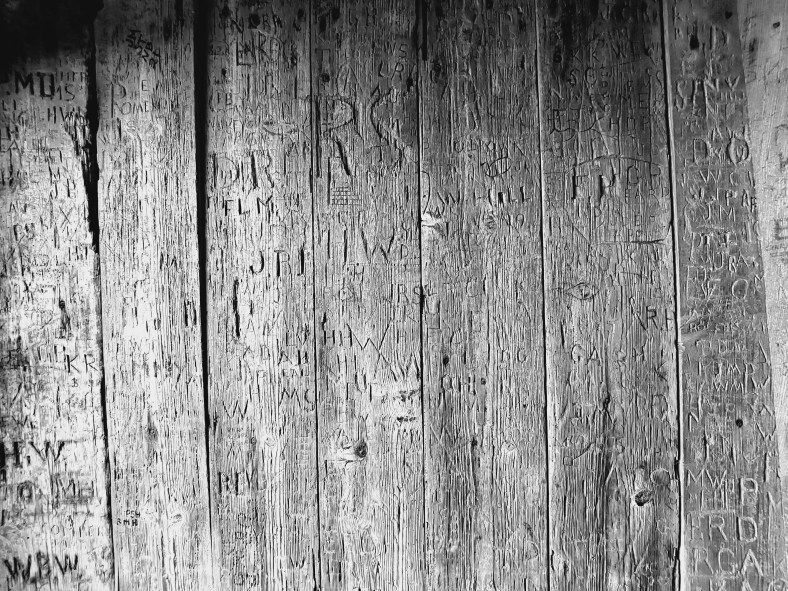
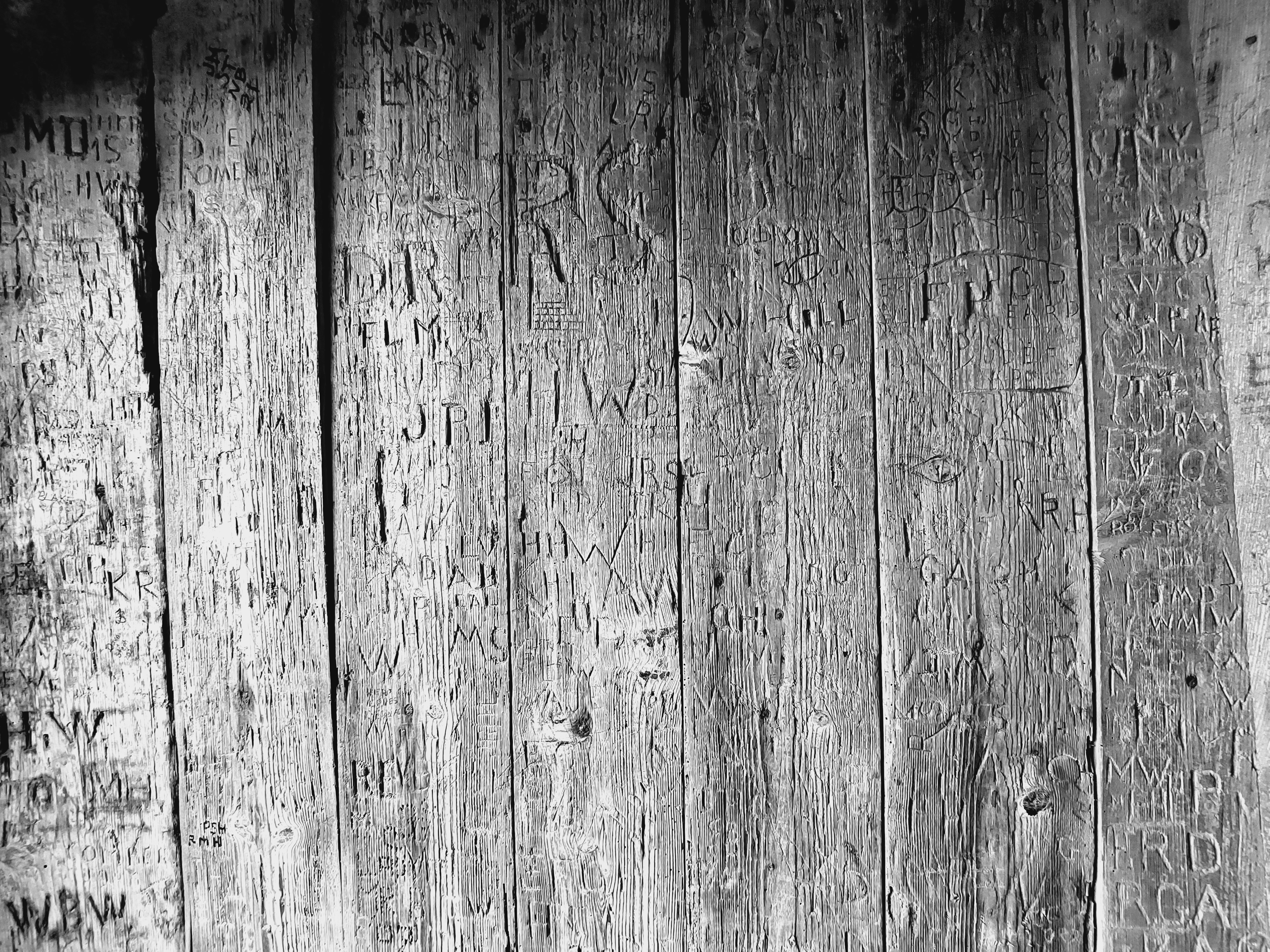
Much of Hawker’s poetry was written in his hut, set into the cliff face a mile or so from the church, constructed from driftwood and roofed with turf.  It is now the smallest property in the care of the National Trust, its planks incised with graffiti and worn to a smooth, mellow patina.  It would be easy to think of it merely as a den, a playhouse, or a man-cave, but we were lucky enough to have the place to ourselves and time to pause and try to see it through Hawker’s eyes.  The stable door opens onto infinity – the Atlantic, the sky, the sea mist.  The view is as unlimited as the human imagination.  What does looking out on infinity do to a person?  To a writer?  Does it stretch the boundaries of the mind, of the possible?

Sixty miles to the north across the Bristol Channel is another shrine to a dead poet – Dylan Thomas’ writing shed at Laugharne.  Decades apart, two men gazing out on infinity and writing poetry.  Infinity + alcohol = Thomas.  Infinity + opium = Hawker.
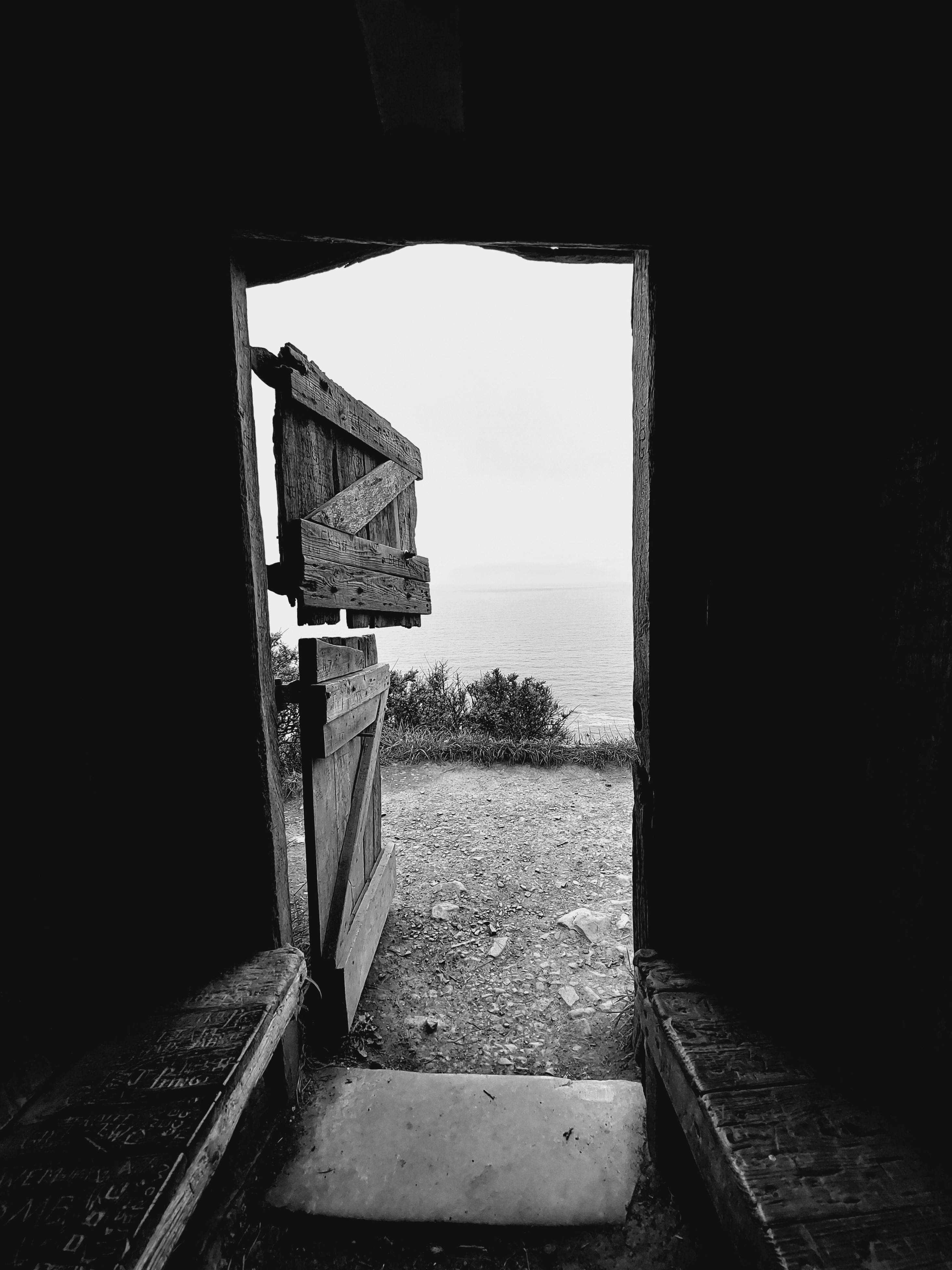
Maybe it’s not just the window on infinity, or even the stimulants, that are significant here.  Maybe it’s the access to a place to write, uninterrupted by the demands of other, domestic roles.  Jane Austen famously wrote her entire oeuvre at a little side table, using a writing box which had been a present from her father.  Her father couldn’t give her a space to write, or financial independence, but he could give her a writing box, a microcosm of the writer’s world which she could take with her wherever she went.  Virginia Woolf wrote an entire book about A Room of One’s Own, in which her analysis was that women writers were handicapped by the lack of their own space in a domestic context.  Neither Hawker in his hut, nor Thomas in his shed, had that problem.  Both had the luxury of private space – physical space, and headspace away from the demands of domesticity.  And, as a bonus, those private spaces had a window on infinity.

I started this by musing on the relationship between where we are and who we are, and whether, or how, where we are affects what we write.  Perhaps it’s less that a place affects who we are and what we write, but rather that where we are affects what we see from there.  Writers, including Alfred Lord Tennyson and Charles Kingsley, were inspired by Hawker’s hut.  Thousands of literature students and aspiring writers make the pilgrimage to Thomas’ shed.  Maybe the inspiration lies, not in looking into the writer’s space, but looking out of it – seeing what they saw, especially when that is infinity.  Alcohol and laudanum are optional.
I am committed to making this blog freely available, and not putting material behind a paywall. As a writer, I am doing what I love – but I still have to make a living. If you have enjoyed this post, and if you are able to do so, perhaps you would consider supporting my work by making a small contribution via the Buy Me A Coffee button. Thank you!

Buy Me a Coffee at ko-fi.com

Spirit of the sea – art, music and glass

There are few sounds more magical than the sound of the sea. Whether it’s the slow, breathing cadence of the beach at Aldeburgh, with the North Sea washing the pebbles up and down the shoreline with each wave of the swell, or the thunder of the storm waves hitting the breakwater at the Cob in Lyme Regis, sending a plume of white into the air, I find the sound of the sea compelling. Sadly I am rarely successful at taking photographs of the sea – in the time it takes for my eye to see the image, by brain to send instructions to my finger to press the shutter release, and the camera to respond, the scene has moved on, and the moment is lost. Writing about the sea is hard too, with words often feeling too solid to convey something so mercurial and transient.

Paintings can be more successful at evoking the sea – I am especially admiring of Maggi Hambling’s sea paintings (there’s a video here where she speaks about ‘painting the sound of the sea’, with images from her exhibition at the Fitzwilliam Museum in Cambridge in 2010). Music can do it too, and for me the most moving examples are by Benjamin Britten (his Four Sea Interludes from the opera Peter Grimes) and his teacher Frank Bridge (his symphonic poem The Sea). Britten lived and worked in Aldeburgh, on Suffolk’s North Sea coast, and when I walk on the quiet beach there the soundrack in my head is his first sea interlude (On The Beach: Dawn).

My love of the sea is not sentimental. I was brought up on or near it, and I know all too well how its moods can change, and the destruction and death it can cause. It’s not all blue, bathing beaches and bobbing boats. The sea demands respect, and takes revenge on those who trifle with it. It’s also merciless to those who are in the wrong place at the wrong time, those who have to make their living on it and risk their lives doing so. For me, the heroes of the sea are the volunteer lifeboat crews who set to sea in the worst of conditions in order to rescue those for whom they are the last resort. Yes, the sea is beautiful, but it is also powerful and cannot be tamed by humankind.

The British coastline is shaped by that power. Breakwaters and sea defences notwithstanding, the sea has created – and continues to create – a dynamic coast. Erosion and encroachment by the sea (to stick with the North Sea examples, think of Happisburgh which is being ‘lost’ to the sea at a sometimes dramatic rate) is balanced by the creative forces of deposition (for example the giant and ever-growing shingle bank of Orford Ness).

There has been much concern, and rightly so, about the amount of plastic debris being washed up on our coastlines, and the effect of this on wildlife and the marine ecosystem. But there is something else which is regularly washed up on our beaches, which to my mind is a great example of the power of the sea at work to create something beautiful from the cast-offs of our past. I think of it as a kind of recycling, the forces of nature reworking the mundane into unintended gems. I’m talking about sea glass.

Sea glass is formed when pieces of waste glass are abraded by being tumbled in the sea for extended periods of time (sometimes decades or centuries), their sharp edges eventually ground down into a frosted smoothness and pleasing pebble shapes. I have collected sea glass for some years, and there is a vast network of collectors around the world – Instagram is a good place to see their finds.

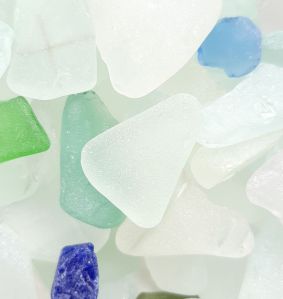
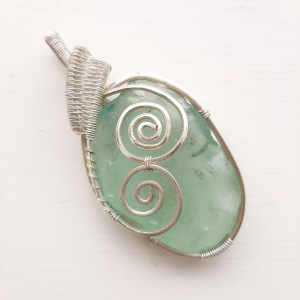
Sea glass can be found on beaches anywhere – as with any beachcombing, the best pickings are often to be found at the first low tide after a storm, when all manner of interesting things can be washed up. Some parts of the UK coastline, however, seem to yield more glass than others – I have found a lot in the North West, and also some on beaches in North Devon and East Anglia. I hear that the North East of England is a favourite location for collectors, due to the presence of several bottle works in the 19th and 20th centuries – the largest in the country was at Seaham – which dumped their waste glass into the North Sea. I have included a few photographs from my collection, most of which I display in a large glass vase, although the best way to see sea glass and the way it plays with light and colour is to handle it. The blue pendant is a gift from my partner, who found this unusual aqua-coloured and very large piece of sea glass at Lynmouth in North Devon (other people’s partners give them gemstones. Mine gives me sea glass. I am very lucky!).

Sea glass pendant

Most sea glass is a magical pale aqua colour, but some is white, a lot is green, and other rare colours include amber, blue, orange and (most prized of all) red. As most sea glass originated as glass bottles, the abundance of any colour depends on how common the bottles were – blue, for example, started life as medicine or poison bottles, while amber bottles held spirits. Glass bottle tops are sometimes found too, as are the glass marbles which formed the stoppers of early carbonated drinks. Keen collectors have researched the origins of sea glass, which is in itself a social history and archaeology of glass. Occasionally I am lured into researching a piece – for example the reinforced glass incorporating rusting metal wire grids which occur on Crosby beach on Merseyside, which are part of the debris from buildings destroyed in WWII air raids on the city of Liverpool which was dumped there. Mostly, though, I collect it because I am enchanted by what the sea has made from our thoughtless waste. The power that destroys coastlines and wrecks ships has formed something which, in its colour and ever changing reaction to light, is a kind of echo of itself. Have nothing in your homes, said William Morris famously, that you do not know to be useful or believe to be beautiful. Sea glass, I believe, is the most beautiful thing in my home.

I am committed to making this blog freely available, and not putting material behind a paywall. As a writer, I am doing what I love – but I still have to make a living. If you have enjoyed this post, and if you are able to do so, perhaps you would consider supporting my work by making a small contribution via the Buy Me A Coffee button. Thank you!

Buy Me a Coffee at ko-fi.com