Sanctuary – the endangered species in my garden

My garden is nothing special – a patch of scrappy lawn, laid on top of builders’ rubble in this newbuild estate, surrounded by wooden fence panels, enlivened by a few plants in pots brought with us from our previous home.  But this past summer, it has been a place of sanctuary for an endangered species.

It started in the spring – our first in this house – when a small flock started lining up on the fence most days, communicating in their characteristic, monosyllabic ‘CHEEP!’ and speculatively eyeing up the garden.  One of the gardens on the opposite side of the road is bristling with bird feeders, so they were well provided for in terms of food.  But it was shaping up to be a dry spell, and it seemed that the most helpful thing we could do was to provide water.  I duly purchased a small glazed plant saucer from the garden centre, added a pebble (to prevent bees, who also frequent bird baths, from drowning), placed it on the patio far enough from the house not to spook the birds with our movements, and filled it up with water.

Within a day or two, the bathing facilities had been enthusiastically adopted.  For a couple of hours in the morning, and again at midday, queues would form on the fence.  I joked that they were lining up, their towels draped over their wings, waiting for their turn in the bath!  At their peak, once the first broods had fledged and the fluffy youngsters joined their parents, there could be as many as twenty individuals at any one time.  Down at the bath, there were rarely fights (although one particularly large male could be very aggressive), and it was not unusual to see anything up to six birds splashing around at the same time. 

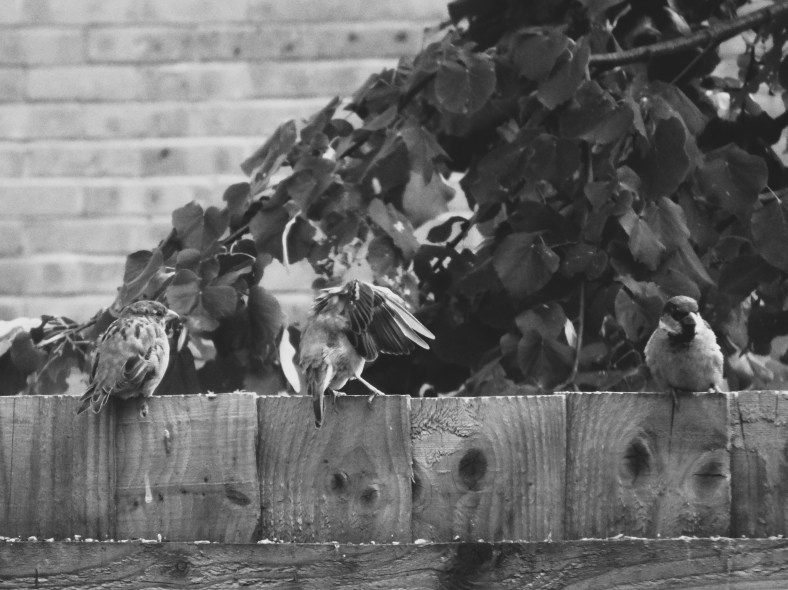
We learned a number of things from watching the birds over several months.  When they come down to drink, they take three sips – never less, and rarely more.  Bathing is a vigorous business, and can go on for several minutes, resulting in a large pool of water all around the bath.  This also means that the bath needs to be topped up several times during the day, especially during a heat wave!  When it is nearly empty, they will fly down, stare into the bath, attempt to bathe, and fly back up to the fence, returning several times before giving up.  After a nice, long, splashy bath, the next stop is the top of the fence, and a lengthy preen (see photo), which can last several minutes and includes forceful wiping of the beak on the edge of the fence panel (the reverberations can be loud enough to be heard in the house).  Occasionally, the bathing has obviously been sub-standard, and the bird will stop in mid-preen and go back for another go in the bath, before resuming preening.

Sometimes, the birds suddenly disappear.  The chorus of cheeps is abruptly silent.  It is worth looking around, because there will usually be an aptly-named sparrowhawk perched on a roof somewhere, surveying the options for lunch.

Mono photograph of three sparrows on a wooden fence.  The one on the left has its back to us.  The one on the right is facing us, and we can tell by its black bib that it is an adult male.  The one in the middle has its back to us and its wings extended, feathers spread, as it preens.  Image Copyright Lisa Tulfer 2022.

Why aptly-named?  Because the endangered species that shares my garden is Passer domesticus, the House Sparrow, which at one point was one of the commonest bird species around human habitation in the United Kingdom.  However, populations have declined by more than 50% since the 1970s, resulting in the sparrow being on the RSPB’s Red List of endangered species.

The House Sparrow is a small, sociable, finch-like bird, with brindled brown and black markings on its upper parts and greyish cream underparts.  The adult males have a distinctive black bib – it has been fun watching the young males, even when still partially fluffy, starting to develop the beginnings of their black bibs.  They live in groups, and it is not uncommon in suburban areas to walk past a bush which is full of loud cheeps from a group of invisible (but very audible!) sparrows.  They pair for life, and normally raise two or even three broods per year – we saw the last youngsters being introduced to the garden as late as September.  This year has evidently been a good breeding year here, as the group has at least tripled in size since the spring, and it’s great to think that we have been able to contribute – by providing sanctuary and water – to the conservation effort for this species.  Hopefully they will escape the avian flu which is spreading so worryingly amongst wild bird populations in the UK at the moment (we have tried to do our bit by disinfecting the birdbath frequently).

The last few weeks it has gone very quiet in the garden.  After raising their young, groups often move to nearby farmland to feed on the hedgerow berries and the leftovers of the harvest.  The bird feeders in the garden across the way are largely deserted, too.  No doubt we’ll see them again if there’s a hard winter – access to water is often more of a problem for wild creatures when there’s a freeze than finding food.  Meanwhile, we have the memory of sharing our garden with this endangered species, being given a glimpse into their busy lives and social interactions (and bathing habits!), and hopefully having helped to secure the next generation of Passer domesticus.

I am committed to making this blog freely available, and not putting material behind a paywall. As a writer, I am doing what I love – but I still have to make a living. If you have enjoyed this post, and if you are able to do so, perhaps you would consider supporting my work by making a small contribution via the Buy Me A Coffee button. Thank you!

Buy Me a Coffee at ko-fi.com

Planting a herb garden – history, food and wellbeing

Now that there is some warmth in the spring sunshine, I have planted a herb garden.  It’s a very small herb garden – a vintage Belfast sink and a couple of pots – but it’s attractive and will serve my purposes.

The Belfast sink has been empty over the winter – when we moved house last autumn we emptied out the old herbs which were well past their best, ready for fresh ones this season.  It’s lovely to see it fully planted up, beside the back door so that it’s in easy reach of the kitchen, in a corner which is a suntrap.  The challenge is to remember the watering!

Colour photograph of a Belfast sink planted with herbs, and a green watering can.

The choice of herbs for sale was a bit limited so early in the year, but the plants were in very good condition, and there’s room to pop a couple more into the gaps later in the season if I find some.  I chose two purple sages, one oregano, and two thymes (one gold, one silver).  The sages will grow quite tall, so I put them at the back, with the oregano in the middle, and the thymes at the front.  They will spread, and be able to trail over the edge of the sink.  I also bought Moroccan mint, and a medium-sized rosemary – as mint is invasive and would take over the whole sink given half a chance, and as rosemary grows large and is long lived and will soon outgrow the sink, I have put each in a separate pot.  Ideally I’d also have some chives and some tarragon, although I’ve never had much luck with growing the latter, and maybe some flatleaf parsley (which I use where recipes call for coriander, which I don’t like).

Growing herbs has a long and venerable tradition.  Used for thousands of years for culinary, medicinal and ritual purposes, they have been an enduring part of human civilisation and their cultivation is an international phenomenon.  Much of what we know in the West about herbs and their uses was written down by medieval monks who grew herbs in the physic gardens of their abbeys, and a significant proportion of modern medicines have their origins in herbal compounds, so growing them today feels like connecting with the past.

So what of the herbs in my garden?  Let’s look at their history, uses and properties.

Sage

Its Latin name, Salvia, comes from salvare, to cure, so its medicinal reputation is long-established.  It has been used to treat sore throats and digestive problems.  Clinical trials in 2011 suggested that sage’s reputation of being helpful in the menopause may have scientific backing, as a trial reported its effectiveness in reducing hot flushes.  Originating in the Mediterranean area, sage is grown around the world, thriving in warm sunny locations – so my suntrap by the back door should suit it well.

Perhaps best known in Britain for its role in sage and onion stuffing, sage is strongly-flavoured and I use it a lot in casseroles, as well as torn up and tossed with buttered pasta.  Being a ‘lady of a certain age’, I also drink it as a tea (although as I’ve only had the plants a few weeks, it’s too early to report an improvement in symptoms!).

Oregano/marjoram

Another native of the Mediterranean (this time the Middle East), this is also a sun-lover.  Its antiseptic qualities made it a medieval cure-all, and the first settlers to New England took this herb with them.  I like it with chicken, fish, or pasta, and it is delicate enough not to swamp subtly-flavoured foods.  To me, this is a real sunshine herb – just crushing the leaves and sniffing your fingers will give you a lift.

Thyme

Prescribed by the 17th century herbalist Nicholas Culpeper as a treatment for whooping cough in children, thyme has long been regarded as having antiseptic properties and being useful in respiratory conditions.  It’s a staple culinary herb (although incredibly fiddly to prepare, as you need to strip the tiny leaves from the woody stems) and gives a fresh, warm flavour which is hard to beat.  Pretty much all ‘mixed herbs’ include dried thyme, but it’s less potent when used fresh and partners well with rosemary, oregano and sage.

Mint

The Moroccan mint I’m growing is a kind of spearmint, so it’s warm in flavour rather than cool peppermint.  Its culinary uses are almost endless – salads, mint sauce, cakes, desserts, cold drinks, and mint tea, for example.  Humans have used mint for a long time – it has been found in Egyptian pyramids dating from 1000 BCE, and the Greeks and Romans used it – but curiously it only came into widespread use in Western Europe as late as the 18th century.  Medicinally, it has been used to aid digestion, and specifically to deal with wind, which may be the reason for the popularity of after dinner mints!

Rosemary

“There’s rosemary, that’s for remembrance,” said Ophelia in Shakespeare’s Hamlet.  Since antiquity rosemary has been believed to help strengthen the memory, and it is still used in Greece in the homes of those preparing for exams.  Another herb which likes hot, dry conditions, rosemary has a pungent, invigorating flavour and aroma – and the white, lilac or blue flowers are adored by bees and other insects.  I have always grown rosemary, and use it generously in cooking.  The traditional partner is, of course, roast lamb, but I use it (either as whole sprigs, removed before serving, or finely chopped) in almost anything that’s going to be cooked for a while – casseroles especially.

Photograph of a chopping board with chopped herbs and a large kitchen knife.

Whilst the whole ‘grow your own’ phenomenon may require more space, time and energy than many of us have available in 21st century Britain, it’s possible to have a herb garden in the smallest of spaces – in a pot or in a window box, or even indoors on a windowsill at a pinch.  And nothing beats the pleasure of cooking with herbs that you have grown and harvested yourself.


Today is not World Book Day

Yesterday was World Book Day.  For various reasons which I won’t bore you with, I managed not to realise this until the evening, by which time it was a bit late to blog about it/post #shelfie pictures on Twitter along with the rest of the reading and writing community.

But it set me thinking.  One of the commissioning editors for whom I write a lot often commissions articles about World/International Days, and the range of topics I’ve researched and written about over the past few years is amazing.  I thought I would share a few of them with you.

International Women’s Day (Sun 8 March 2020)

This day has been around for a long while – it was first marked in 1911, and initially focussed on women’s right to work without discrimination.  Inevitably, it soon also started to campaign for women’s right to vote.  Following the day’s adoption by the feminist movement in the 1960s, the United Nations declared it an International Day in the 1970s.  It continues to raise awareness of issues affecting women around the world, which we might have hoped would have been addressed by now: inequality and discrimination, the impact of war and displacement, sexual violence, and the lack of access to education.

World Day Against Child Labour (Fri 12 June 2020)

A more recent development is World Day Against Child Labour, which started in 2002.  Its focus is the global extent of child labour, and the campaign to eliminate it.  The 2015 Sustainable Development Goals include a global commitment to end “child labour in all its forms” by 2025, but currently over 200 million children around the world work, many full-time.  This matters, not only because it deprives them of the chance to be children and to play, but because it means that they are denied the opportunity to go to school, and traps them in a cycle of poverty.  In the West we probably think of child labour in terms of having a paper round, or being a child actor, with legal protections in place.  Worldwide, however, 70% or working children work in agriculture, often hard and dangerous work.

World Bee Day (Wed 20 May 2020)

With so much publicity for the pollinator crisis over the past few years, we can’t fail to be aware that there’s so much more to bees than honey.  Until I began researching for this article, though, I hadn’t appreciated that as much as a third of world food production depends on bees for pollination.  This makes it very worrying that 10% of bee species worldwide are facing extinction.  Although there is dispute about what is causing the decline in bees, with possible culprits being the varroa mite, other viruses, diseases and pests, climate change, and neonicotinoid pesticides, the statistics suggest that bee numbers are down by a third in the USA, with significant losses being reported elsewhere including Europe.

It’s not all doom and gloom though – this is one area of environmental crisis where ordinary people like you and I can make a difference.  Bee-friendly gardening, providing bees with flowers which yield plentiful and easily-accessed nectar, can help to boost the health and numbers of these essential creatures, whose future survival is so closely entwined with our own.

World Braille Day (Mon 4 January 2021)

On this day in 1809, Louis Braille was born in France.  He was blinded by a childhood accident, but applied his intellect to the problems he faced, and by the age of 15 had created a system for reading and writing.  A system of military night-writing had been developed by Charles Barbier, at Napoleon’s request, to provide a tactile way for soldiers to communicate silently and without a light source.  It consisted of sets of dots which encoded sound.  Louis adapted this into a matrix of ‘cells’ of raised dots, 3 high by 2 wide, which can be used to read (and, with the right equipment, to write) in any language.

World Braille Day was declared by the United Nations to celebrate the system’s role in giving independence to people who are blind and visually impaired, and to encourage its use.  Sadly, there is a world shortage of trained Braille teachers, and Braille writing equipment is expensive.  Some years ago I was able to get funding to produce a Braille version of an adult education programme I had developed, but was saddened that so many users said this was the first time they had been able to take part in learning on an equal basis with their sighted colleagues.  I found that public bodies and businesses rarely use Braille to make their premises and services independently accessible to blind and partially sighted users – often the only place you will encounter Braille is on the buttons in the lift.

World Toilet Day (Tues 19 November 2020)

This day is particularly dear to my heart – having had IBS for 30 years, I have a personal interest in the provision of toilet facilities, and am the proud owner of a RADAR key which has come to my rescue many times.  I know how lucky I am to live in a country where flush toilets are the norm, widely available, and safe.

However, despite the United Nations declaring in 2010 that access to sanitation and water is a human right, over a third of the world’s population still doesn’t have access to a safe toilet.  Over a billion have no toilet at all.  Amazingly, more people own a mobile phone than have access to a toilet.

This lack of safe toilets has enormous implications worldwide.  Firstly, there are the health implications, with diseases such a cholera and dysentery being spread because of inadequate sanitation, and untreated sewage contaminating the environment and the food chain.  Secondly, one fifth of schools have no toilet facilities, effectively preventing girls from attending once they start menstruating.  And thirdly, women who have no alternative but to engage in ‘open defecation’, especially after dark, are vulnerable to attack and rape.  World Toilet Day seeks to address a subject which can be taboo or socially unacceptable, but which is really about basic human rights.

A number of organisations are involved in providing toilets where they are most needed.  One which I have supported is WaterAid – see https://www.wateraid.org/uk/the-crisis/toilets for more details.