Sanctuary – the endangered species in my garden

My garden is nothing special – a patch of scrappy lawn, laid on top of builders’ rubble in this newbuild estate, surrounded by wooden fence panels, enlivened by a few plants in pots brought with us from our previous home.  But this past summer, it has been a place of sanctuary for an endangered species.

It started in the spring – our first in this house – when a small flock started lining up on the fence most days, communicating in their characteristic, monosyllabic ‘CHEEP!’ and speculatively eyeing up the garden.  One of the gardens on the opposite side of the road is bristling with bird feeders, so they were well provided for in terms of food.  But it was shaping up to be a dry spell, and it seemed that the most helpful thing we could do was to provide water.  I duly purchased a small glazed plant saucer from the garden centre, added a pebble (to prevent bees, who also frequent bird baths, from drowning), placed it on the patio far enough from the house not to spook the birds with our movements, and filled it up with water.

Within a day or two, the bathing facilities had been enthusiastically adopted.  For a couple of hours in the morning, and again at midday, queues would form on the fence.  I joked that they were lining up, their towels draped over their wings, waiting for their turn in the bath!  At their peak, once the first broods had fledged and the fluffy youngsters joined their parents, there could be as many as twenty individuals at any one time.  Down at the bath, there were rarely fights (although one particularly large male could be very aggressive), and it was not unusual to see anything up to six birds splashing around at the same time. 

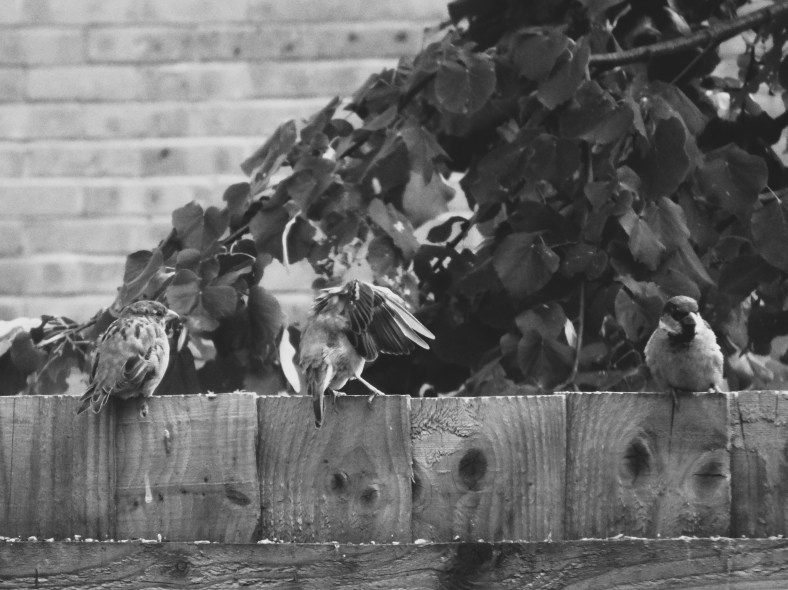
We learned a number of things from watching the birds over several months.  When they come down to drink, they take three sips – never less, and rarely more.  Bathing is a vigorous business, and can go on for several minutes, resulting in a large pool of water all around the bath.  This also means that the bath needs to be topped up several times during the day, especially during a heat wave!  When it is nearly empty, they will fly down, stare into the bath, attempt to bathe, and fly back up to the fence, returning several times before giving up.  After a nice, long, splashy bath, the next stop is the top of the fence, and a lengthy preen (see photo), which can last several minutes and includes forceful wiping of the beak on the edge of the fence panel (the reverberations can be loud enough to be heard in the house).  Occasionally, the bathing has obviously been sub-standard, and the bird will stop in mid-preen and go back for another go in the bath, before resuming preening.

Sometimes, the birds suddenly disappear.  The chorus of cheeps is abruptly silent.  It is worth looking around, because there will usually be an aptly-named sparrowhawk perched on a roof somewhere, surveying the options for lunch.

Mono photograph of three sparrows on a wooden fence.  The one on the left has its back to us.  The one on the right is facing us, and we can tell by its black bib that it is an adult male.  The one in the middle has its back to us and its wings extended, feathers spread, as it preens.  Image Copyright Lisa Tulfer 2022.

Why aptly-named?  Because the endangered species that shares my garden is Passer domesticus, the House Sparrow, which at one point was one of the commonest bird species around human habitation in the United Kingdom.  However, populations have declined by more than 50% since the 1970s, resulting in the sparrow being on the RSPB’s Red List of endangered species.

The House Sparrow is a small, sociable, finch-like bird, with brindled brown and black markings on its upper parts and greyish cream underparts.  The adult males have a distinctive black bib – it has been fun watching the young males, even when still partially fluffy, starting to develop the beginnings of their black bibs.  They live in groups, and it is not uncommon in suburban areas to walk past a bush which is full of loud cheeps from a group of invisible (but very audible!) sparrows.  They pair for life, and normally raise two or even three broods per year – we saw the last youngsters being introduced to the garden as late as September.  This year has evidently been a good breeding year here, as the group has at least tripled in size since the spring, and it’s great to think that we have been able to contribute – by providing sanctuary and water – to the conservation effort for this species.  Hopefully they will escape the avian flu which is spreading so worryingly amongst wild bird populations in the UK at the moment (we have tried to do our bit by disinfecting the birdbath frequently).

The last few weeks it has gone very quiet in the garden.  After raising their young, groups often move to nearby farmland to feed on the hedgerow berries and the leftovers of the harvest.  The bird feeders in the garden across the way are largely deserted, too.  No doubt we’ll see them again if there’s a hard winter – access to water is often more of a problem for wild creatures when there’s a freeze than finding food.  Meanwhile, we have the memory of sharing our garden with this endangered species, being given a glimpse into their busy lives and social interactions (and bathing habits!), and hopefully having helped to secure the next generation of Passer domesticus.

I am committed to making this blog freely available, and not putting material behind a paywall. As a writer, I am doing what I love – but I still have to make a living. If you have enjoyed this post, and if you are able to do so, perhaps you would consider supporting my work by making a small contribution via the Buy Me A Coffee button. Thank you!

Buy Me a Coffee at ko-fi.com

Soundscape – a midsummer evening in my garden

The back garden of this house faces south-east.  This means it’s a suntrap until after lunch – perfect for drying laundry, less good for frazzling my Fitzpatrick Type I skin – while in the evening it is a cool, calm sanctuary on even the hottest of days.  It’s been 27 degrees Celsius today, and this evening we sit outside with our books and our coffee and are comfortable for the first time since dawn.

I finish a chapter, and close my eyes.  I can hear choral music from one of the houses further along the estate.  A car draws up, doors slam.  Voices are raised in greeting.  Over on the other side, a toddler cries.  Cars and the occasional larger vehicle pass along the main-ish road at the front of the house.  Ewes and lambs call to each other – contralto, treble – in the field behind the estate.

Most of what I can hear, though, is birds.  Sparrows cheeping monosyllabically in the little lime tree beyond the fence.  It seems to be a good year for the house martins, and there are dozens of them cruising around the sky over the gardens, chirruping and scooping up the evening’s crop of insects.  They flap-flap-flap-glide, chubby little bodies with stumpy tails and triangular wings, perpetually looking as if they are about to crash.  This evening they are joined by a lone swallow, elegant, long tail streaming.

A passenger plane crosses behind the martins, tinted pink by the setting sun.  With a crash and a rumble, a tractor and trailer passes, the trailer full of silage – they’ve been going past at all hours for much of the last month, gathering fodder in preparation for the winter.

And now there’s a new sound, as a squadron of shrieking sickles moves into the airspace high over the estate.  The swifts are here!  They’ve been in the valley for a few weeks now, but mostly hunting for insects over the river.  From my study in the attic, which faces that way, I hear their screams all day.  Their forays over the estate are rarer, though, and all the more special.  There are about twenty of them this evening, freestyling through the air, their squeals the very essence of being alive.

It’s turned chillier now, and it’s getting dark – almost time to go back indoors.  But a tinkle of birdsong proves, on investigation, to be a goldfinch on the roof of the house opposite.  Usually there’s a group – a ‘charm’ – who frequent the bird feeders in their garden, but this time there’s just one.  He tunes up, does a few practice runs, then fills the cool air with his rippling song.  Into the silence that follows, the swifts screech in for one last, scything fly-past.

A border of lavender and nigella in the sunshine, in front of a garden wall with a bench in the background.

I am committed to making this blog freely available, and not putting material behind a paywall. As a writer, I am doing what I love – but I still have to make a living. If you have enjoyed this post, and if you are able to do so, perhaps you would consider supporting my work by making a small contribution via the Buy Me A Coffee button. Thank you!

Buy Me a Coffee at ko-fi.com

2021 – My Year In Books

2021 – My Year In Books

New Year’s Eve has come upon me suddenly – in the limbo between the public festivals of Christmas and New Year, the days seem to merge into each other, especially this year when the grey skies touch the ground (alternating occasionally with thick fog) and it never seems to get properly light.  There have been a lot of ‘best books of 2021’ posted on social media over the past few weeks, and it set me thinking about what I have read this year.  Some I have reviewed on this blog or in other publications, but others I have read simply for pleasure or out of curiosity.  Here, in roughly chronological order, are my top 10 books of 2021.

Mudlarking: Lost and Found on the River Thames by Lara Maiklem.  I originally bought this for my beachcombing mother-in-law, but it looked so interesting that I got a copy for myself too.  The author posts prolifically on Twitter, Facebook and Instagram, so the book is very much a starting point for an ongoing engagement with the finds that emerge from the Thames, and the stories and history behind them.  Maiklem moves down the river, from the tidal head at Teddington to the estuary at Southend-on-Sea, telling the story of the riverbank, the characters who inhabit(ed) it, and her own experience of mudlarking along the shore and the artefacts she has discovered.  The book sits between travel writing, social history, and memoir, and is accompanied by photographs of some of the finds she refers to.  I am always entranced by the humble objects, sometimes lost for centuries, which give a glimpse into people’s everyday lives, so for me this book was a treasure trove.

Ghost Town: a Liverpool Shadowplay, by Jeff Young was another book which was originally a gift which I ended up reading myself.  This had a personal resonance for me, as the streets which Young describes so evocatively were trodden by my own father, half a century earlier.  Many of the places are familiar to me from tracing my family history.  In Young’s luminous memoir, he walks through his ‘ghost town’, and explores themes of metamorphosis – his own, and that of the city of Liverpool –and loss, remembering and mis-remembering.  A compelling narrative, highly recommended for anyone interested in place writing.

Next up was The Screaming Sky by Charles Foster, illustrated by Jonathan Pomroy.  I read this just a few days before the swifts arrived from Africa, perfect timing for this love song to the marvel of nature that is the swift.  Born of a passion bordering on the obsessional, Foster’s book describes the bird’s life-cycle, its mind-boggling feats of aerobatics and endurance, its biology, and the history of humans’ relationship with the species.  I wrote a full review on this blog here.

Where? Life and death in the Shropshire hills by Simon Moreton was a new departure for me – I have no experience of the graphic novel/zine genre which Moreton specializes in, and this innovative book combines text with illustration and collage in a way I’ve not seen done before.  Where? is a memoir, in which Moreton juxtaposes the narrative of his father’s illness and death with memories of a childhood in rural Shropshire, in a landscape dominated by the presence of Titterstone Clee which looms over the surrounding countryside, and near the summit of which is a radar station where Moreton’s father worked.  Again, this is place writing about somewhere I know slightly, and I enjoyed reading it, admiring the weaving together of the two strands.  I am aware, though, that there were aspects I didn’t ‘get’ because I don’t have the visual lexicon to understand the artwork which is such a large component of this book.

A Still Life: A Memoir by Josie George.  I have followed Josie George on Twitter for a long time, and pre-ordered this book when she announced its publication.  However, it took me a long time to summon up the courage to read it.  In a year where so many themes were dark and hopeless, it seemed perverse to read an account of disability and chronic illness.  I was wrong.  George’s account of her life with a condition which long defied diagnosis and which continues to deliver twists and turns of challenge and disability, is full of light, hope and love.  Not that there is any false cheeriness here – she pulls no punches about the pain and hardships of her situation – nor is there any of the ‘disabled person as an inspiration to us all’ nonsense.  This is an exceptional person, taking life one moment at a time, doing what she can, not doing what she can’t, refusing to get frustrated, determined to continue loving, convinced that the world is good, that life is good, that being alive is the most amazingly wonderful thing, to be savoured and celebrated in whatever way we can in that moment.  It is heartwarming, not in an It’s A Wonderful Life kind of way, but in a way that stays with you, challenging the way you look at the world, at each small moment of our small lives.

The Long Field by Pamela Petro is again memoir/place writing about somewhere I know – in this case, Petro’s love affair with rural Wales started in Lampeter, at the university we both attended.  I reviewed The Long Field here.

Fifty Sounds by Polly Barton was initially quite a challenging read (I don’t do philosophy, which dominates the opening chapters) but my persistence was rewarded by an insightful exploration of how language and culture influence and shape each other.  Barton tells of her experiences as an English teacher in Japan, and the fifty sounds of the title (which form the chapter headings) are onomatopoeic words in Japanese which she unpacks in her journey into Japanese language and culture, and into her own personality.  I wrote a full review for the Cardiff Review.

You will have noticed that all the titles in this list are non-fiction.  I have struggled with reading fiction since the beginning of the pandemic, but The Listeners by Edward Parnell may have rehabilitated me.  This clever, taut, beautifully written delight gave me more reading pleasure than anything else this year, and I reviewed it joyfully here on this blog.

Finally, two books which I am still reading.  Light Rains Sometimes Fall: a British Year Through Japan’s 72 Seasons by Lev Parikian is arranged in short chapters covering 5 or six days each, in which Parikian closely observes the natural world around him, partly through pandemic lockdowns, noticing details of the changing seasons.  I am a big fan of Parikian’s nature writing, and as I’m consciously attempting to live more in the present (rather than the past or the future) I liked the idea of reading this in ‘real time’, a chapter at a time for a whole year.  The current ‘season’ is called ‘Storms Sometimes Blow,’ which seems about right! 

As an utter map nerd, and a fan of his other writing, it was inevitable that I would eventually read Map Addict by Mike Parker.  At the time of writing, I am halfway through this blend of memoir, cartographical history, and celebration of the glorious Ordnance Survey map, and it’s so nice to connect with a fellow map addict! (I’ve written about the origins of my own map obsession here).

And, on this last day of 2021, I bring you good news – I have a whole lot more books lined up to read in 2022!  My ‘To Be Read’ pile includes poetry, a lot of exciting non-fiction, and even (tentatively) a bit of fiction.  I can’t wait!

Wishing you a Happy New Year.

Photograph of the books referred to in this blog post.

I am committed to making this blog freely available, and not putting material behind a paywall. As a writer, I am doing what I love – but I still have to make a living. If you have enjoyed this post, and if you are able to do so, perhaps you would consider supporting my work by making a small contribution via the Buy Me A Coffee button. Thank you!

Buy Me a Coffee at ko-fi.com

Book Review – The Screaming Sky by Charles Foster

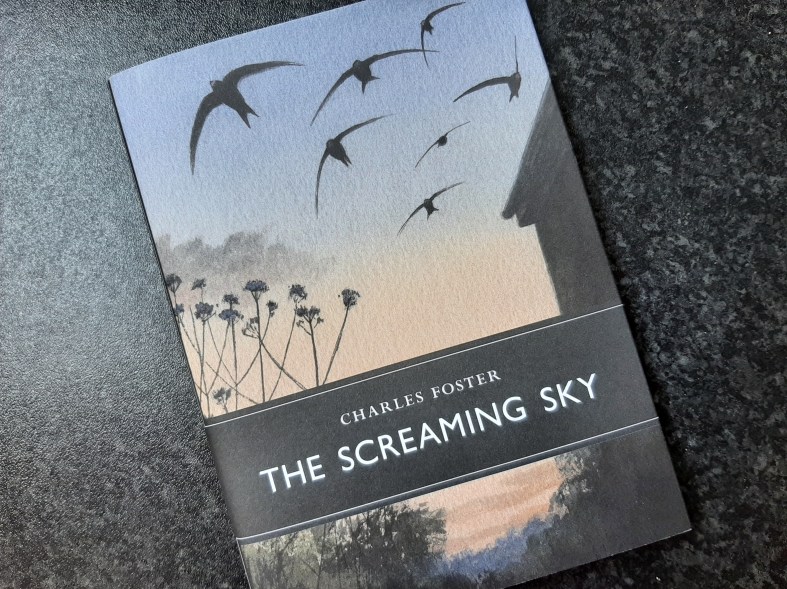
This book arrived three days before the swifts returned to the skies above Somerset.  When I unwrapped the tissue-packed parcel, I was captivated by the cover – Jonathan Pomroy’s illustrations are so evocative of the drama and vertiginous speed of these remarkable, ancient birds.

The Screaming Sky is a book born of an obsession.  On his own admission, Charles Foster is obsessed with swifts – where others might be content to watch them in the skies over Oxford, and be blessed by their occupation of nest sites in the roof of his house, Foster travels on pilgrimage to see them in Spain, Greece and Israel, as well as in the tropical heat and humidity of their African winter homes.  He tracks the progress of their migrations via other obsessives on the internet, and the swifts’ presence or absence in the air above him is mirrored in the highs and lows of his mood.  It is as if he cannot live without them.

This gorgeously tactile little book is divided into monthly chapters, January to December.  In each chapter, Foster explores what the swifts are doing that month, and where, as well as delving into the history, biology and statistics of these enigmatic creatures.  We know quite a bit about Apus apus, the Common Swift.  For example, they spend most of their lives on the wing, landing only to breed and occasionally when encountering very bad weather during migration.  They sleep while flying – the two halves of the brain take it in turns to sleep.  Following the cornucopia of insect life (what Foster refers to as aerial plankton or krill), they migrate inconceivable distances – the swifts breeding in Foster’s summertime Oxford spend the winter months 6,000 miles south in Mozambique.   They lay up to four eggs, but the fourth hatchling (if there is one) never survives.  Young swifts set off for their winter homes within weeks, sometimes days, of fledging. 

We know that swifts are truly ancient, having evolved over 30 million years ago. Swifts are also long-lived – they can have a lifespan of 20+ years.  They return to the place where they were hatched, spending their first couple of summers screaming around the sky with their companions and generally, it seems, having a ball, maybe even tentatively pairing up, before scoping out a potential nest site for the serious business of claiming a nest and breeding.  We know that most of the birds which travel to western Europe for the summer breeding season spend a while over Liberia, gorging on the insect soup swirling in the air after the rains.  From there, the swifts I see in Somerset will have travelled some 3,100 miles, in as little as five days.

However, there is so much we don’t know about swifts.  There are myriad theories, for example, about how they navigate over these immense distances, how they decide that the time is right to start their migration, how they re-unite with their mate, and what accounts for the wide variations in how long it takes individual birds to make the journey.

Foster explores the place of the swift in literature, the emphasis on the bird’s speed (the clue is in the name) and its totemic role as the essence of the northern European summer.  He also rails against the appropriation of the swift as somehow the possession of the observer.  Swifts, he says, are not ‘yours’ or ‘mine’ or ‘his’.  They are their own selves, untameable, masters of the sky in a way that we can only dream of, and in no way reciprocating the sense of connectedness we feel with the swifts who condescend to make fleeting use of our roof-eaves and insect supplies.  It is this unconquerable wildness which, for Foster (and for me) makes swifts so compelling.

Perhaps more than anything, though, he is full of admiration for their mastery of their environment, the sky: ‘they inhabit the air as fish inhabit the sea’.  Their speed and seemingly effortless command of the tides of the air is not only functional (hunting insects) but also seems to have a powerful element of fun and joy: ‘not everything is about the algorithms of survival’ and the screaming parties of swifts hurtling through the sky are ‘colossal fun’.

I love this book.  The blend of facts and personal enthusiasm for the subject makes it an engaging read, and Jonathan Pomroy’s illustrations are perfect.  Of course, I loved it all the more – and was so excited when I heard that Little Toller Books were going to be publishing it – because of how I feel about swifts.  The sight of those exuberant little black sickles slicing through the late spring sky at the end of their epic migration is viscerally energising.  Shrieking squadrons, skimming just over my head between the red-brick cliffs of the town houses, sound so intensely full of life that they make me feel alive, too.  And the day in August when suddenly the sky is silent, empty of little black sickles as they follow the call of their African winter home, is the day the year turns towards winter for me, too.

The Screaming Sky by Charles Foster, illustrated by Jonathan Pomroy, is published by (and available from) Little Toller Books, 2021.  ISBN 9781908213846

Photograph of the front cover of The Screaming Sky by Charles Foster

A recycled landscape – five thousand years in the life of a hill

I am again writing about place – places in the landscape which have a long tradition of spiritual significance.  Looking beyond obvious places like Stonehenge, I’m interested in holy wells, hilltops and groves, and sites where, for example, a present church overlays earlier, even pre-Christian, places of worship.  At a time when travel around the United Kingdom is constrained by regulations to control the pandemic, my early researches will mostly need to be limited to books and online, but there are a number of sites which I can get to easily from home, or which I know well, these seem like a good place to start.

Map of Hambledon Hill

Some years ago I lived in the neighbouring county of Dorset.  Specifically, I lived at the foot of Hambledon Hill, and its green mass filled the view from my study window.  In the summer, I would walk up to the top and lie flat on my back in the grass, squinting up into the blue sky and trying to spot the skylarks which I could always hear, but rarely see.  If I was very lucky, I would be visited by an Adonis Blue butterfly, a rare species which likes the chalk grassland habitat where the grass is kept short by conservation grazing.

I never felt on my own up there.   Even when there were no dog-walkers, butterfly enthusiasts or hikers, there was always a sense of people being present – as if at any moment I might glance up and see someone.  The hill felt at once very peaceful and very busy, and also very, very old.  Some places feel like that – as if the echoes of human footsteps and the shadows of their movements are left behind from the distant past, maybe even from before history as we know it.  I notice it especially in places that have been inhabited longest – the landscape of barrows or stone circles, of hill forts or cave art.  It is probably fanciful – but I think I’m not the only person who is sensitive to the fleeting impressions left by the people who were in a place long ago.

Hambledon Hill has drawn people to it for over five thousand years.  The Neolithic peoples who had started to farm the land in the valleys below built an enclosure on the top of Hambledon Hill.  It was a significant high point in the landscape, providing a good defensive position against both the east (the chalk uplands of Cranborne Chase) and the west (the fertile Blackmore Vale).  There is archaeological evidence for at least seasonal occupation over several hundred years, with remains of goods originating as far away as Devon, and some of the earliest evidence of grape cultivation in Britain.  These people buried their dead in the long barrows – burial mounds – on the crest of the hill.  The site continued to be used by the Beaker People – early Bronze Ages arrivals – but the main impact on the hill as we see it today came in the Iron Age.  Three rings of ramparts were built, changing the outline of the hill and creating an impressive defensive hill fort, complete with three staggered entrances.  The enclosure created by the ramparts contained some hundreds of small roundhouses.  Despite the scale of this endeavour, archaeologists believe that Hambledon Hill was eventually abandoned, probably about 300 BCE, possibly in favour of nearby Hod Hill, which was itself in turn appropriated by the invading Romans.

But Hambledon Hill continued to be a significant feature in the landscape, and when the Anglo-Saxons arrived in the area several hundred years later they adopted the hill as a cemetery site.  Who knows whether their choice was influenced by an understanding that the long barrows were ancient burial sites?  In any event, the Anglo-Saxons identified Hambledon Hill as a suitably exalted location for the burial of their own dead.

Nowadays, the dead of the village at the foot of the hill are buried in its churchyard, but people still come to Hambledon Hill.  It is on a long-distance walking route, bringing many hikers to marvel at the view of Blackmore Vale, set out like a chessboard below.  Locals walk their dogs here, naturalists come to study the rare species of plants and insects.  And the ongoing significance of the hill, with its millennia of human history and its present role as a nature reserve, is reflected in its purchase in 2014 by the National Trust, the largest conservation charity in Europe.

Up on the hill, the skylark’s song seems timeless, connecting the stories of the people who have come to Hambledon Hill down the millennia.  Sadly the skylark is on the Red List of endangered species, so it is unlikely that many more generations of visitors will be able to enjoy their ethereal trilling high in the summer sky.  But the place has seen many species come and go, including humans, shaping it and leaving traces of their lives behind them.  I wonder what relationship the humans of a thousand years from now will have with Hambledon Hill? 

Spirit of the sea – art, music and glass

There are few sounds more magical than the sound of the sea. Whether it’s the slow, breathing cadence of the beach at Aldeburgh, with the North Sea washing the pebbles up and down the shoreline with each wave of the swell, or the thunder of the storm waves hitting the breakwater at the Cob in Lyme Regis, sending a plume of white into the air, I find the sound of the sea compelling. Sadly I am rarely successful at taking photographs of the sea – in the time it takes for my eye to see the image, by brain to send instructions to my finger to press the shutter release, and the camera to respond, the scene has moved on, and the moment is lost. Writing about the sea is hard too, with words often feeling too solid to convey something so mercurial and transient.

Paintings can be more successful at evoking the sea – I am especially admiring of Maggi Hambling’s sea paintings (there’s a video here where she speaks about ‘painting the sound of the sea’, with images from her exhibition at the Fitzwilliam Museum in Cambridge in 2010). Music can do it too, and for me the most moving examples are by Benjamin Britten (his Four Sea Interludes from the opera Peter Grimes) and his teacher Frank Bridge (his symphonic poem The Sea). Britten lived and worked in Aldeburgh, on Suffolk’s North Sea coast, and when I walk on the quiet beach there the soundrack in my head is his first sea interlude (On The Beach: Dawn).

My love of the sea is not sentimental. I was brought up on or near it, and I know all too well how its moods can change, and the destruction and death it can cause. It’s not all blue, bathing beaches and bobbing boats. The sea demands respect, and takes revenge on those who trifle with it. It’s also merciless to those who are in the wrong place at the wrong time, those who have to make their living on it and risk their lives doing so. For me, the heroes of the sea are the volunteer lifeboat crews who set to sea in the worst of conditions in order to rescue those for whom they are the last resort. Yes, the sea is beautiful, but it is also powerful and cannot be tamed by humankind.

The British coastline is shaped by that power. Breakwaters and sea defences notwithstanding, the sea has created – and continues to create – a dynamic coast. Erosion and encroachment by the sea (to stick with the North Sea examples, think of Happisburgh which is being ‘lost’ to the sea at a sometimes dramatic rate) is balanced by the creative forces of deposition (for example the giant and ever-growing shingle bank of Orford Ness).

There has been much concern, and rightly so, about the amount of plastic debris being washed up on our coastlines, and the effect of this on wildlife and the marine ecosystem. But there is something else which is regularly washed up on our beaches, which to my mind is a great example of the power of the sea at work to create something beautiful from the cast-offs of our past. I think of it as a kind of recycling, the forces of nature reworking the mundane into unintended gems. I’m talking about sea glass.

Sea glass is formed when pieces of waste glass are abraded by being tumbled in the sea for extended periods of time (sometimes decades or centuries), their sharp edges eventually ground down into a frosted smoothness and pleasing pebble shapes. I have collected sea glass for some years, and there is a vast network of collectors around the world – Instagram is a good place to see their finds.

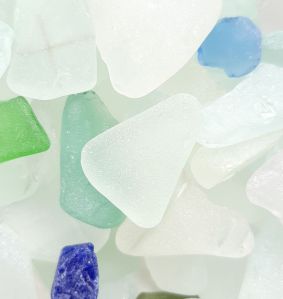
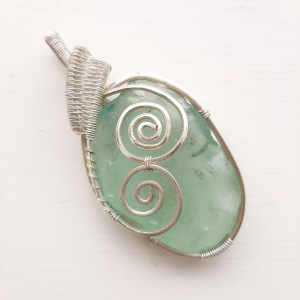
Sea glass can be found on beaches anywhere – as with any beachcombing, the best pickings are often to be found at the first low tide after a storm, when all manner of interesting things can be washed up. Some parts of the UK coastline, however, seem to yield more glass than others – I have found a lot in the North West, and also some on beaches in North Devon and East Anglia. I hear that the North East of England is a favourite location for collectors, due to the presence of several bottle works in the 19th and 20th centuries – the largest in the country was at Seaham – which dumped their waste glass into the North Sea. I have included a few photographs from my collection, most of which I display in a large glass vase, although the best way to see sea glass and the way it plays with light and colour is to handle it. The blue pendant is a gift from my partner, who found this unusual aqua-coloured and very large piece of sea glass at Lynmouth in North Devon (other people’s partners give them gemstones. Mine gives me sea glass. I am very lucky!).

Sea glass pendant

Most sea glass is a magical pale aqua colour, but some is white, a lot is green, and other rare colours include amber, blue, orange and (most prized of all) red. As most sea glass originated as glass bottles, the abundance of any colour depends on how common the bottles were – blue, for example, started life as medicine or poison bottles, while amber bottles held spirits. Glass bottle tops are sometimes found too, as are the glass marbles which formed the stoppers of early carbonated drinks. Keen collectors have researched the origins of sea glass, which is in itself a social history and archaeology of glass. Occasionally I am lured into researching a piece – for example the reinforced glass incorporating rusting metal wire grids which occur on Crosby beach on Merseyside, which are part of the debris from buildings destroyed in WWII air raids on the city of Liverpool which was dumped there. Mostly, though, I collect it because I am enchanted by what the sea has made from our thoughtless waste. The power that destroys coastlines and wrecks ships has formed something which, in its colour and ever changing reaction to light, is a kind of echo of itself. Have nothing in your homes, said William Morris famously, that you do not know to be useful or believe to be beautiful. Sea glass, I believe, is the most beautiful thing in my home.

I am committed to making this blog freely available, and not putting material behind a paywall. As a writer, I am doing what I love – but I still have to make a living. If you have enjoyed this post, and if you are able to do so, perhaps you would consider supporting my work by making a small contribution via the Buy Me A Coffee button. Thank you!

Buy Me a Coffee at ko-fi.com

Book review. The Hare and the Moon: A Calendar of Paintings by Catherine Hyde

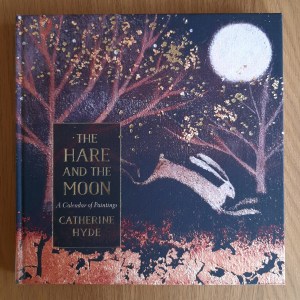
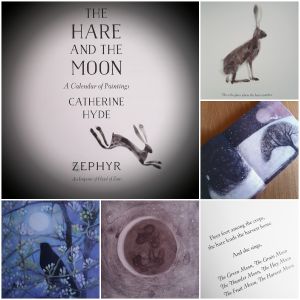
As regular readers of this blog may have gathered, I am a bit of a fan of the hare.  I was delighted, therefore, to find this rather wonderful little book with the evocative title The Hare and the Moon: A Calendar of Paintings.  It is pleasingly square, with a tactile cover, which is always a good start.  And it had me at the first page, which is an illustration of the three hares motif!

There are a number of elements to the ‘calendar’ aspect of the book.  A poem, with the refrain which recites the folk names for the full moons (The Snow Moon, The Wolf Moon, The Hunger Moon, The Sap Moon etc) is woven through it.  Each month then has six themes.  There are black and white illustrations of the moon phases.  There are double page colour paintings of the hare in the seasonal landscape (I especially like January, where the hare is joined in the snowy countryside by the barn owl and the raven).   There are Indian ink drawings of the hare in action and at rest.  For each month there is a flower, a tree, and a bird, each accompanied by a colour painting and a note about the folklore and alternative country names.  For example, June’s flower is honeysuckle:

“Used for rope-making in the Bronze Age and also known as woodbine, honeybind, trumpet flowers, Irish vine, Goat’s leaf, sweet suckle and fairly trumpets.  Honeysuckle grown around the entrance to the home prevented a witch from entering and would bring good luck.”

The Hare and the Moon subtly weaves poetry and art together, blurring the boundaries and creating what has been described as ‘visual poetry’.  This is so much more than a book of poems and folksy factoids with illustrations.  The images have a dreamy quality which lend a timeless air to this charming book.  Perfect for reading, as I did, while curled up on the sofa on a dark winter afternoon, a steaming mug of tea by my side (think hygge!), this would make a fine Christmas/Yule present for anyone who loves the natural world, folklore, or art.  Or indeed hares!


(For more about Catherine Hyde, take a look at https://catherinehyde.co.uk/)

Family life – the swans of Oxburgh Hall

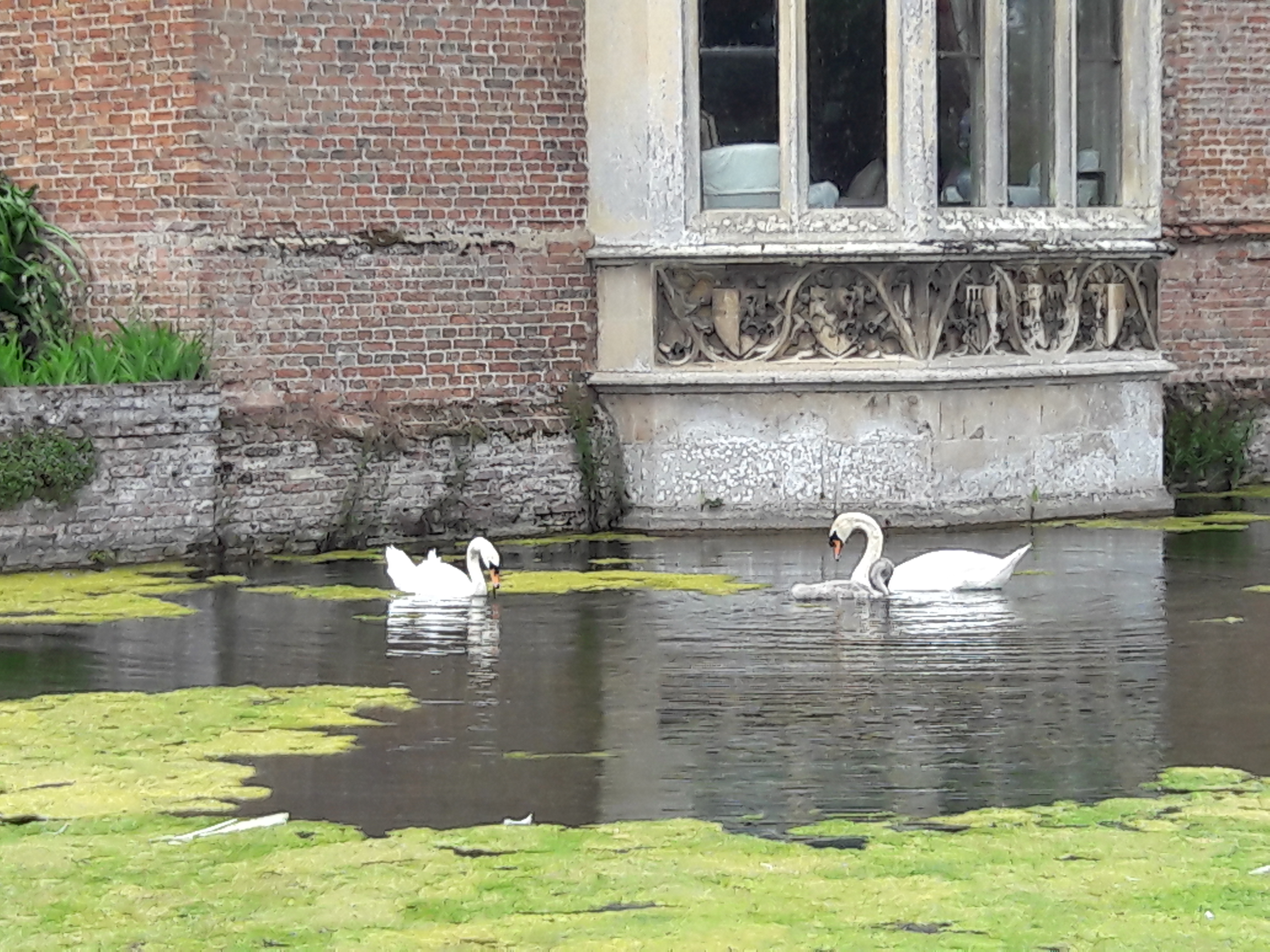
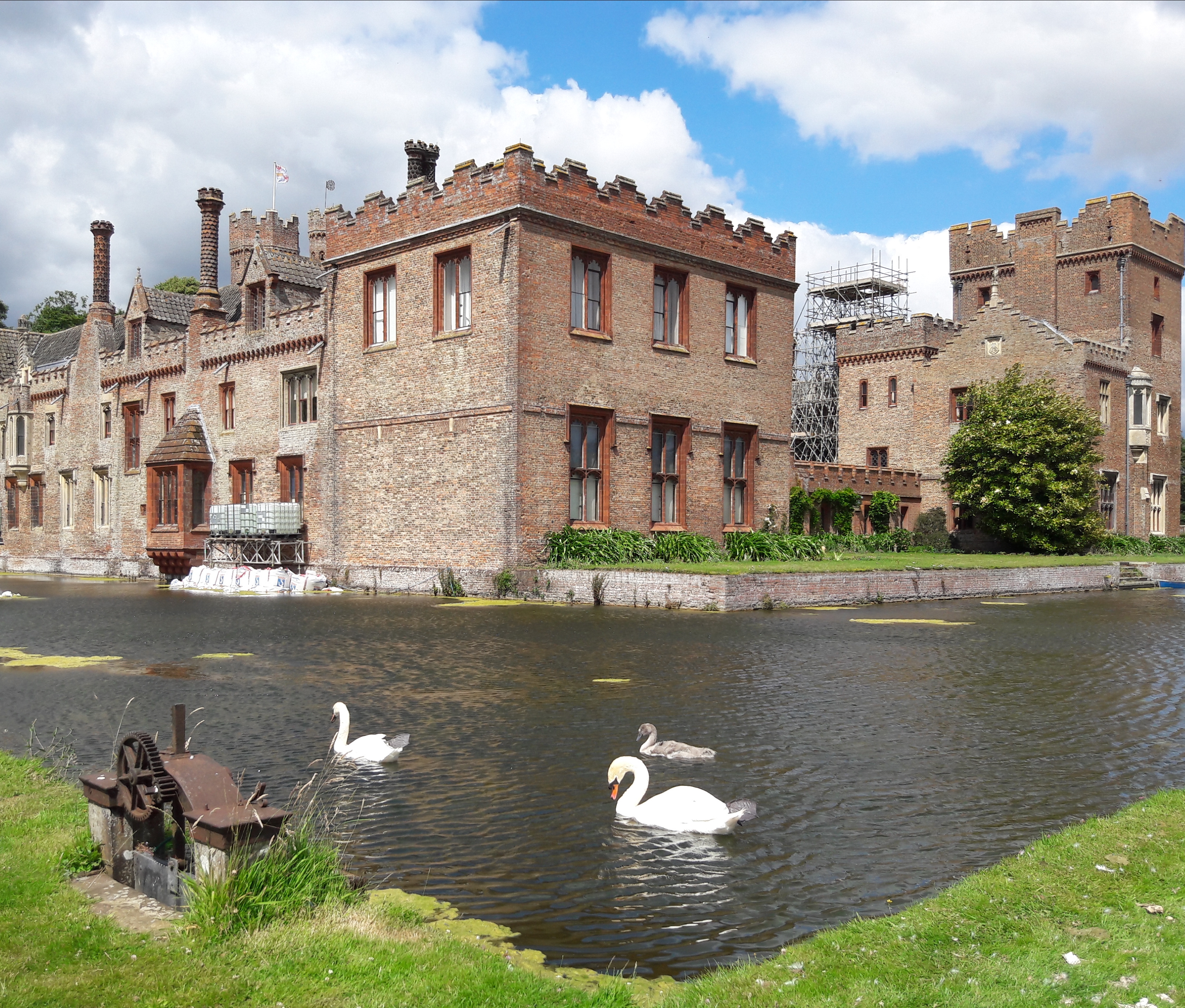
As the summer comes to a close, I’m sharing a family saga that’s been unfolding over the past few months.  I am fortunate to have Oxburgh Hall (National Trust) just down the road, and the fine moat is home to a pair of swans.  Last summer, while swan couples in the surrounding countryside reared their families, there were no little silver puffballs for the Oxburgh swans.

This year, however, they had more luck.  Back in June, they were proudly showing off their single baby.  Small, fluffy and grey, they guarded it fiercely.  Any visitor venturing too near was seen off by a hissing parent.  As an adult swan can easily break your arm if sufficiently cross, visitors wisely left well alone!  We got some nice pictures though.

Cygnets (baby swans) are quite vulnerable.  As well as having the usual youngsters’ talent for getting into life-threatening scrapes, when they are tiny they are also vulnerable to predators such as foxes, herons and raptors.  Prolonged wet periods can cause them to get waterlogged and chilled, and in hot weather they can easily overheat.  They can also be targeted by parasites, which weaken their system.  About a third of hatchlings don’t make it past the first two weeks of life.  They are not fed by their parents, but feed themselves from the start, so they have to learn quickly how to find enough suitable food to fuel their rapid growth.

On my next visit to Oxburgh, in July, I was thrilled to find that the lone cygnet was not only surviving, but thriving!  The parents were a little less protective now that the crucial first couple of weeks were past, and our little cygnet was growing well.

Much less fluffy, s/he (too early to tell if it’s a cob or a pen) is a sturdy little thing, and seems to have mastered the art of hoovering food up out of the moat.  It was actually quite hard to get a photograph, as the cygnet spent most of its time upended, feeding!  I got dozens of pictures of its backside, but not many of its head…

Fast forward to late August, and there was a heart-stopping moment as we couldn’t find the swan family.  We walked all round the moat, searched the fields, but there was no sign of them.   Just as we were about to go and find a member of staff to enquire what had happened to the swans, we spotted them in the river beyond the moat.  The cygnet is now HUGE!  It is rapidly growing to be as big as its mother, and is confidently swimming off by itself.

I stood on the little footbridge to take this photograph, but had to move aside when the flotilla headed my way, with the parents hissing loudly – they wanted to swim under the footbridge, and objected to my presence!  I obediently made way (I don’t argue with swans) and they ducked under the bridge and headed off downstream.

It’s been lovely to follow this youngster’s progress, and it’s great that the pair have finally managed to raise young – even if it is just the one.  Maybe they are an inexperienced pair and they’ll be more successful in future years – it’s a good excuse to keep going back to Oxburgh Hall to find out!