
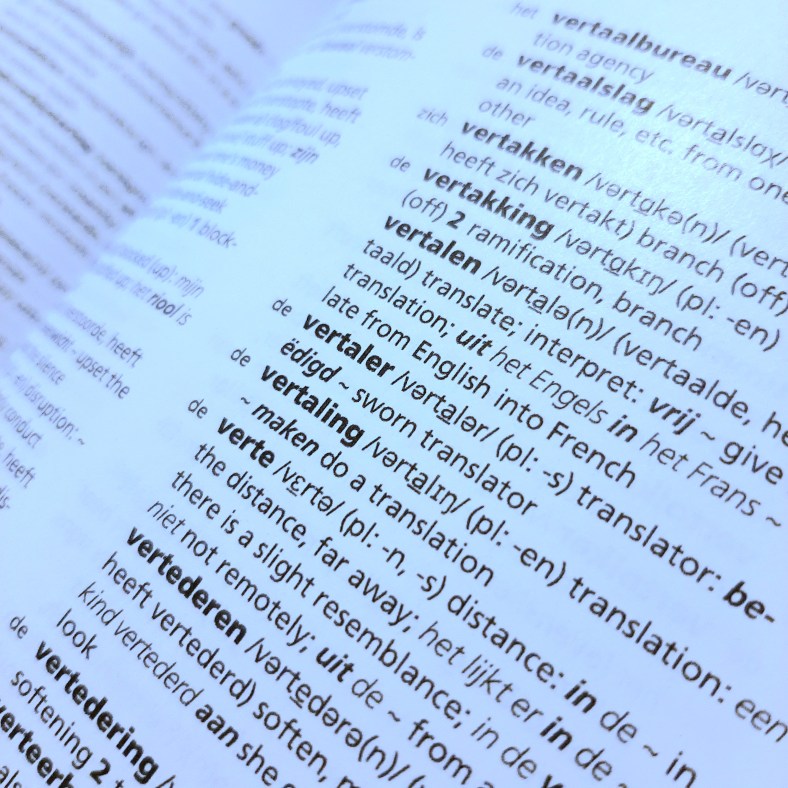
I have recently been working on a translation into English of a short story in Dutch. It’s part of an ongoing project, and I am finding the process fascinating. As a writer who is also a translator, there are a number of things going on at the same time when I undertake literary translation, and although the temptation is to say that much of it is instinctive, in fact there are layers of practice at work which I find it helpful to analyse and articulate.
Any translation has elements of decoding meaning from the source language (which in my case is Dutch) and encoding it in the target language (in my case, English). Sound straightforward enough? Well, not really, because the differences between how languages work, the building blocks that make up meaning – things like word order – mean that it’s not simply a case of grabbing a dictionary and swapping one word for another. Also, you can’t just translate expressions and idioms literally, because the same idea may be expressed completely differently in the two languages. For example, iets kennen als zijn broekzak literally translates as ‘knowing something like his trouser pocket’ – which makes no sense whatsoever in English. The equivalent idiom in English would be ‘knowing something like the back of his hand’.
But what if the meaning of the text is made up, not only of dictionary words, or even idioms and colloquial phrases, but of subtle nuances of tone, sound, repetition, alliteration, rhythm, pace, and so on. This is most obvious in translating poetry, of course, but any literary text is more than the sum of its words, and my challenge is to extract a sense of those extra layers of meaning and to convey that into English. It is my job to write the short story in English which the original author would have written if they had been a native speaker of English.
This is, of course, impossible, but the best translations get so close to this ideal that the reader forgets that they are reading a translation. This is what I am aiming for. I need to identify and isolate the quirks, style and individual voice of the author and find a way of distilling that into an equivalent voice in English. If the story reads as if I wrote it, then I’ve failed.
Ironically, I believe that it is the fact that I am a writer which equips me to do literary translation. Finding my own voice, using all those tools of tone, sound, repetition, alliteration, rhythm, pace, and so on in my own writing, enables me to put that toolbox at the disposal of the author whose words I am translating. Because I am a writer, I am well-placed to see the workings behind the scenes of the original text, to recognise what the author is doing, and to do what is necessary to create the corresponding effect in English.
It can be a slow process. This is not like translating an online article about a new archaeological discovery, or even like translating a piece of academic writing. Those kinds of texts are mainly about conveying the content. The voice of the original author is rarely the main feature of the translation, and the task is to convey the information in appropriate, equivalent English. It may take time to do the necessary research to find that appropriate equivalence – especially where there is specialised vocabulary involved – but it is not an especially lengthy process. With literary translation, by contrast, I need to live with the text for a while before attempting to start translating it. In the case of this short story, I first read it more than six months ago, and have gone back to it many times since. I have it read straight through; read it for structure; for style; for vocabulary; for geographically-specific references (the author is Flemish, and the story is set in Antwerp). I have marked up ‘problems’, passages where it is not immediately apparent how I should translate the text. One particular phrase occupied me for a long time – in the end I decided to take a risk and move quite a long way from the literal meaning of the original Dutch word in order to create the same shock-value and controversy in English. Re-reading my translation now, I am really pleased with the ‘solution’ to that particular ‘problem’.
There is a campaign ongoing in the translation and publishing industries at the moment to put ‘translators on the cover’ – in the vast majority of cases, literary translators are not named on the covers of the books they translate, even when these translations go on to win major book prizes. Often – in Anglophone markets, anyway – it is hard to know that the book you are reading is a translation. At best, you might find the translator mentioned on the title page, but usually they will merely get a credit tucked away on the copyright page, which only the most nerdy amongst readers ever actually reads (I do – but I’m an ex-librarian and back in the day, when cataloguing was done manually, this was where you found the information you needed in order to catalogue a book). If you live in an English-speaking country, you have probably read the work of literary translators without even realising it. It is my hope that, having read this post, you may seek out the work of literary translators and enjoy the results of the process that I have described. There is a whole world of books out there, and literary translators are the people who make it possible for you to read them in your own language.

I am committed to making this blog freely available, and not putting material behind a paywall. As a writer, I am doing what I love – but I still have to make a living. If you have enjoyed this post, and if you are able to do so, perhaps you would consider supporting my work by making a small contribution via the Buy Me A Coffee button. Thank you!



 The Three Hares Blog