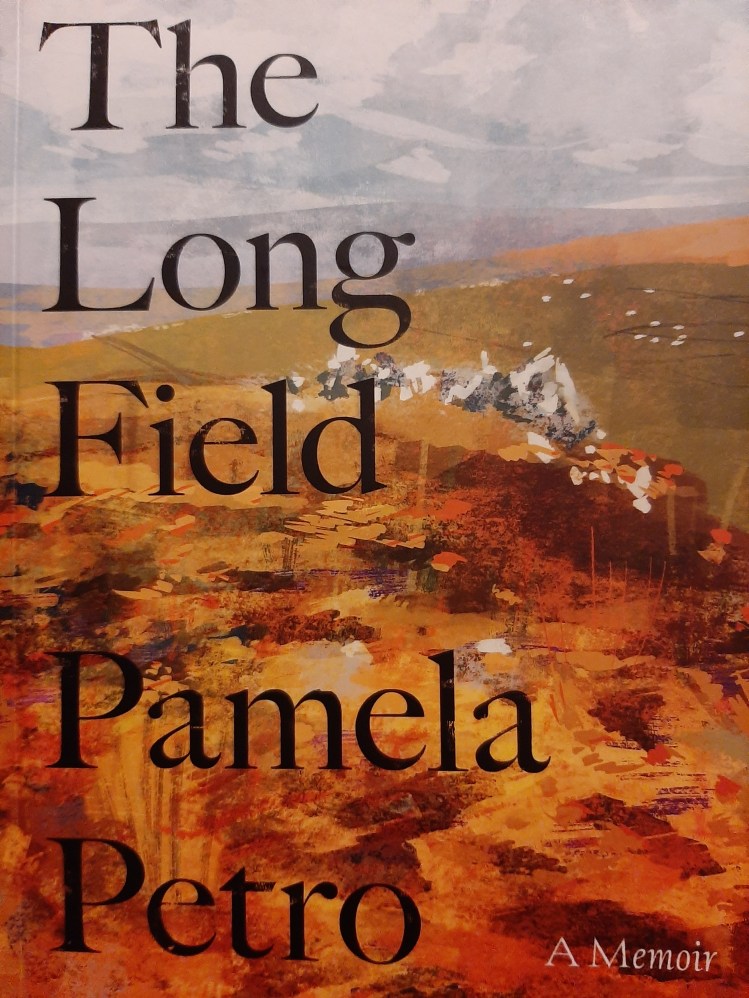
Book review – The Long Field by Pamela Petro

First, a confession.  Reading Pamela Petro’s The Long Field was an exercise in nostalgia for me.  I followed Petro to the university at Lampeter in West Wales (‘Probably the smallest university in the world,’ as the T-shirts in the Students’ Union shop proclaimed, Carlsberg advert-style) just four years later.  All her descriptions ring so very true for me, were part of the landscape of my own young life.  Even the cottage she lived in is well known to me, as a friend of mine rented it in my first year – I can picture myself back in that kitchen, drinking tea, watching my friend making jelly for dessert.  My challenge in writing this review has been to come to the book from the outside, as it were, rather than from that place of shared experience.

The Long Field is, fundamentally, about hiraeth, a complex Welsh word which encompasses elements of longing, nostalgia, distance, absence, homesickness.  It is famously untranslatable into English.  But the book is also a love story.  A love story on several levels, most obviously Petro’s sudden, unexpected, and deep passion for the landscape of rural Wales – again, something which resonates with me.  But it is also about her relationships with her partner and with her parents, and an exploration of the complexities of those relationships.  Perhaps it is an acknowledgement that love stories more nuanced than ‘boy meets girl and they live happily ever after’ are part of the lived experience of queer writers.

Although Petro is passionate about Wales – her Wales – she manages to stop short of being entirely rose-tinted about it.  She acknowledges some of the nuanced complexity of Welsh identity and history, some of the ways in which her adopted homeland’s sense of itself as a colonial victim of English occupation can hold it back.  As someone who has lived in Wales for a significant part of my adult life, it seems to me that Petro’s analysis of Wales is predominantly rural – the Wales of Ceredigion and the Cambrian Mountains – and intellectual and cultural.  She does nod at the life of the Valleys, especially as she was in Wales in 1984 during the miners’ strike, but the industrial and post-industrial conurbations of South and North-East Wales, the product of migration from within Wales and beyond, are not the Wales that she knows and loves.  Her Wales is that of the past etched into the landscape of the present.  Of people connected, umbilically, to the places that shaped the generations before them.  Of story made tangible in the land.  Landscape – not only the fields, the mountains, the hills, but also the cultural echoes, the resonance that they have – is what Petro loves.  Her inexplicable feeling of having ‘come home’ to that landscape when she, an American with no Welsh antecedents, arrived in Lampeter in 1983 is the starting point for the experiences that have shaped this book.

The Long Field is a remarkable book.  Although it self-identifies on the cover as ‘A Memoir,’ it draws together strands of history, travelogue, a whistle-stop tour of Welsh literary heritage, place writing, pronunciation notes for the Welsh place names, linguistic detours, a coming-out narrative, family saga, and an exploration of identity.  It is this last element, I think, which is the most important.  Can someone identify with a place which they are not ‘from’ but where they nevertheless felt a shock of recognition when they first encountered it?  Yes, says Petro – but is she is not claiming Welshness.  Rather like entering into a relationship with a lover from a different culture who speaks a different language, she seeks – respectfully, gently – to learn, to understand, to value what the beloved values.  What Petro found when she found her Wales filled a profound void in her psyche, provided a connectedness between the people of the present and the past which her upbringing in suburban America had not.  In an era when more people than ever are living where we are not from, The Long Field has much to say about place, identity, past, present – and future.

The Long Field by Pamela Petro is published by Little Toller Books.  ISBN 9781908213853

I am committed to making this blog freely available, and not putting material behind a paywall. As a writer, I am doing what I love – but I still have to make a living. If you have enjoyed this post, and if you are able to do so, perhaps you would consider supporting my work by making a small contribution via the Buy Me A Coffee button. Thank you!

Buy Me a Coffee at ko-fi.com

A recycled landscape – five thousand years in the life of a hill

I am again writing about place – places in the landscape which have a long tradition of spiritual significance.  Looking beyond obvious places like Stonehenge, I’m interested in holy wells, hilltops and groves, and sites where, for example, a present church overlays earlier, even pre-Christian, places of worship.  At a time when travel around the United Kingdom is constrained by regulations to control the pandemic, my early researches will mostly need to be limited to books and online, but there are a number of sites which I can get to easily from home, or which I know well, these seem like a good place to start.

Map of Hambledon Hill

Some years ago I lived in the neighbouring county of Dorset.  Specifically, I lived at the foot of Hambledon Hill, and its green mass filled the view from my study window.  In the summer, I would walk up to the top and lie flat on my back in the grass, squinting up into the blue sky and trying to spot the skylarks which I could always hear, but rarely see.  If I was very lucky, I would be visited by an Adonis Blue butterfly, a rare species which likes the chalk grassland habitat where the grass is kept short by conservation grazing.

I never felt on my own up there.   Even when there were no dog-walkers, butterfly enthusiasts or hikers, there was always a sense of people being present – as if at any moment I might glance up and see someone.  The hill felt at once very peaceful and very busy, and also very, very old.  Some places feel like that – as if the echoes of human footsteps and the shadows of their movements are left behind from the distant past, maybe even from before history as we know it.  I notice it especially in places that have been inhabited longest – the landscape of barrows or stone circles, of hill forts or cave art.  It is probably fanciful – but I think I’m not the only person who is sensitive to the fleeting impressions left by the people who were in a place long ago.

Hambledon Hill has drawn people to it for over five thousand years.  The Neolithic peoples who had started to farm the land in the valleys below built an enclosure on the top of Hambledon Hill.  It was a significant high point in the landscape, providing a good defensive position against both the east (the chalk uplands of Cranborne Chase) and the west (the fertile Blackmore Vale).  There is archaeological evidence for at least seasonal occupation over several hundred years, with remains of goods originating as far away as Devon, and some of the earliest evidence of grape cultivation in Britain.  These people buried their dead in the long barrows – burial mounds – on the crest of the hill.  The site continued to be used by the Beaker People – early Bronze Ages arrivals – but the main impact on the hill as we see it today came in the Iron Age.  Three rings of ramparts were built, changing the outline of the hill and creating an impressive defensive hill fort, complete with three staggered entrances.  The enclosure created by the ramparts contained some hundreds of small roundhouses.  Despite the scale of this endeavour, archaeologists believe that Hambledon Hill was eventually abandoned, probably about 300 BCE, possibly in favour of nearby Hod Hill, which was itself in turn appropriated by the invading Romans.

But Hambledon Hill continued to be a significant feature in the landscape, and when the Anglo-Saxons arrived in the area several hundred years later they adopted the hill as a cemetery site.  Who knows whether their choice was influenced by an understanding that the long barrows were ancient burial sites?  In any event, the Anglo-Saxons identified Hambledon Hill as a suitably exalted location for the burial of their own dead.

Nowadays, the dead of the village at the foot of the hill are buried in its churchyard, but people still come to Hambledon Hill.  It is on a long-distance walking route, bringing many hikers to marvel at the view of Blackmore Vale, set out like a chessboard below.  Locals walk their dogs here, naturalists come to study the rare species of plants and insects.  And the ongoing significance of the hill, with its millennia of human history and its present role as a nature reserve, is reflected in its purchase in 2014 by the National Trust, the largest conservation charity in Europe.

Up on the hill, the skylark’s song seems timeless, connecting the stories of the people who have come to Hambledon Hill down the millennia.  Sadly the skylark is on the Red List of endangered species, so it is unlikely that many more generations of visitors will be able to enjoy their ethereal trilling high in the summer sky.  But the place has seen many species come and go, including humans, shaping it and leaving traces of their lives behind them.  I wonder what relationship the humans of a thousand years from now will have with Hambledon Hill?