When I was little, I wanted to be a detective

When I was little, I wanted to be a detective.  Or a writer.  Or a writer of detective stories.  Indecisive from an early age, I was not quite sure which appealed most – or maybe it should be a combination?   

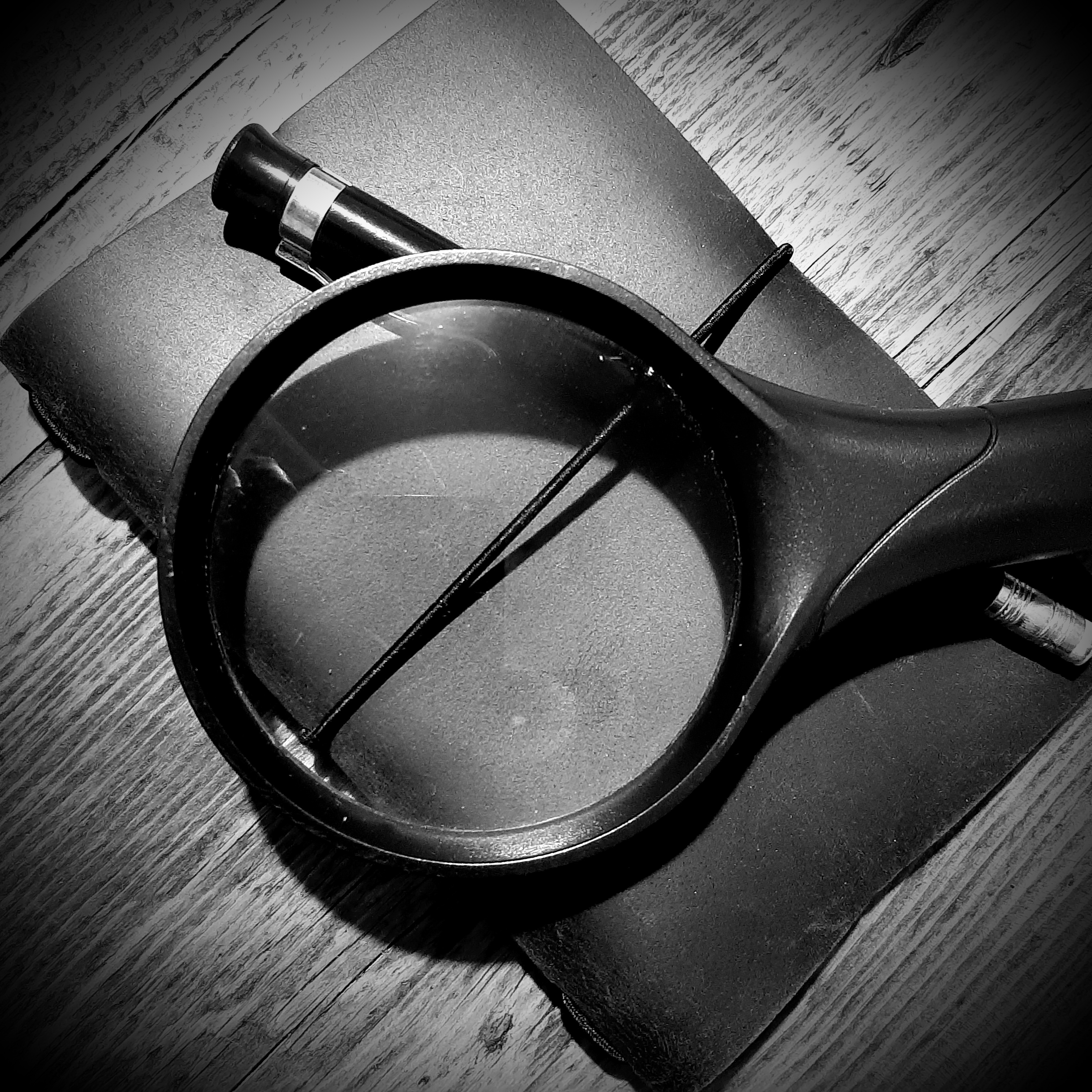
In any event, I was very clear about the kit required.  I had notebooks (always lots of notebooks!) for both professions.  For detection, I also had a magnifying glass (of course – I was an early acolyte of Sherlock Holmes) and a toy revolver (no doubt influenced by reading too much Raymond Chandler at too young an age).  I had a range of disguises, including spectacles, moustaches, and greasepaint.  I improvised a fingerprint set with sellotape and ground-up pencil graphite (with surprisingly clear results).  For writing, I had the Pocket Oxford Dictionary (single volume – a navy blue hardback way too chunky for anyone’s pocket), a selection of pens and pencils, and a modest library of books for inspiration.  I aspired to using a typewriter, because I knew that proper writers always typed their manuscripts, but my fingers were not yet strong enough to strike the keys of my father’s Remington Envoy.

Quite where these tropes came from, I’m really not sure.  I watched very little television (for most of my childhood we didn’t have one), and I was home-educated so there was not much in the way of popular culture influences.  There was, however, the BBC World Service, which was then a much more holistic broadcaster than its present incarnation as a rolling news station, and was responsible for much of my classical and jazz musical education as well as introducing me to Shakespeare (a production of Twelfth Night), Tolkein (The Hobbit, read by Bernard Cribbins), Douglas Adams (the original radio script, unsurpassed by subsequent books, films and television adaptations, of The Hitchhiker’s Guide to the Galaxy), and Dorothy L Sayers (courtesy of the peerless Ian Carmichael as Lord Peter Wimsey – when I subsequently read my grandmother’s copies of the books, it was Carmichael’s voice I heard).  The World Service also broadcast the sit-com The Small Intricate Life of Gerald C Potter, where the eponymous detective writer (again played by Ian Carmichael) and his wife Diana (a much more successful writer, creating breathless romances under the pseudonym of Magnolia Badminton) crashed amusingly through a more or less chaotic but never boring life, accompanied by the sound of a manual typewriter.  It did nothing to lessen the appeal of wordsmithing as a lifestyle.  The signature tune, Leroy Anderson’s The Typewriter, still makes me smile.

There was no shortage of role models for my future career as a detective.  My grandmother had a serious addiction to Golden Age crime fiction (in the original English, despite being an elderly Dutch lady) and I was exposed to Hercule Poirot, Jane Marple, Parker Pyne, Lord Peter Wimsey, Perry Mason, Philip Marlowe, and of course Sherlock Holmes, even before I graduated from reading Enid Blyton’s Secret Seven and The Five Find-Outers.

I have always believed that names are important.  Naturally, my detective alter ego needed a name, and for some reason which I have long since forgotten, I decided on Peggy Reynolds, Private Investigator.  As a nascent writer, my nom de plume was Mara McDonald, and I do know the origin of that – it was the result of a brief infatuation with all things Highland caused by overdosing on Robert Louis Stevenson and reading Kidnapped under the bedclothes with a torch.  I was more than a little in love with Alan Breck Stewart, self-aggrandising and infuriating as he was.  Looking back, it is interesting to see the association in my young mind between writing and romance.

Fast-forward nearly half a century.  What would that child, who responded to the tedious adult questioning about ‘what do you want to be when you grow up’ with such interesting ambitions, think of how life has turned out?  Well, I never did become a PI.  However, my insatiable curiosity, my obsession with collecting obscure facts, and the desire to find out how things work have stood me in good stead in a variety of jobs.  Detective instincts are especially useful for the writer of non-fiction, who inevitably needs to invest large amounts of research in every piece of writing – research is to writing what the base of the iceberg is to the visible tip.  And I am, indeed, a writer – even if not currently a full-time one – with a respectable clutch of publications in print and online (the latter something my young self could not have imagined), in non-fiction and poetry.  However, fiction has proved to be a genre I simply cannot write, and the dream of writing a detective novel remains just that – a dream.
An infinity of one’s own – Hawker’s Hut, poetry and place

I am thinking, and writing, a lot about place at the moment – geographical location, borders, and the relationship between where we are and who we are.  As a tangent from this, I’ve been musing about whether, or how, where we are affects what we write.  There are a few obvious connections; for example could Wuthering Heights have been conceived of and written anywhere other than the bleak uplands of the Brontë’s Haworth, or would Persuasion have been as persuasive in its evocation of the social banalities of Bath had not Jane Austen herself experienced the particular torment of the old maid in that context.  But is it a general principle, I have been asking myself, that our location influences us as writers?

In the late spring of last year I tagged along with my wife on a study trip to north Cornwall, that enigmatic stretch of coastline between Bude and the Hartland peninsula where Cornwall becomes Devon, notorious for shipwrecks and (possibly apocryphal) tales of wreckers.  It is less remote and unknown these days than when I first visited a couple of decades ago, and honeypots like Boscastle are now gridlocked, but off season, with the sea fog swirling round you, it can still feel like you’re standing at the edge of the world.  It’s mainly vertiginous cliffs along here, with the South West Coast Path providing access on foot to places that tourists can’t drive to.  My wife having finished at the museum, we went exploring.

Intrigued by the eccentricities of its nineteenth-century vicar, the Reverend Robert Hawker, we went to Morwenstow.  The steep churchyard was knee-deep in wildflowers, framing the replica figurehead of the Caledonia which marks the burial of several of its sailors who drowned when she was shipwrecked on that treacherous coast in 1842.  It is a kind of marker, too, for Parson Hawker’s affinity with the sea – he habitually wore a knitted fisherman’s gansey, was involved in a number of rescues, and took great pains to ensure the decent burial of shipwrecked sailors.

Hawker has other claims to fame.  He was a poet, and as a young man published ‘The Song of the Western Men’ (more commonly known as ‘Trelawney’) which is the de facto national anthem of Cornwall.  And he was the instigator of the modern Harvest Festival, celebrated in churches all over the world, and which was a re-imagining of the medieval practice of Lammas or First Fruits.

His eccentricities are well, although not perhaps always reliably, recorded, and include wearing random and colourful garb such as a poncho made from a yellow horse blanket; bringing his cats to church services (and excommunicating one of them for mousing on a Sunday!) and keeping a pet pig.  He was also almost certainly addicted to laudanum – tincture of opium in alcohol – and this arguably fuelled both his eccentricity and his poetry.

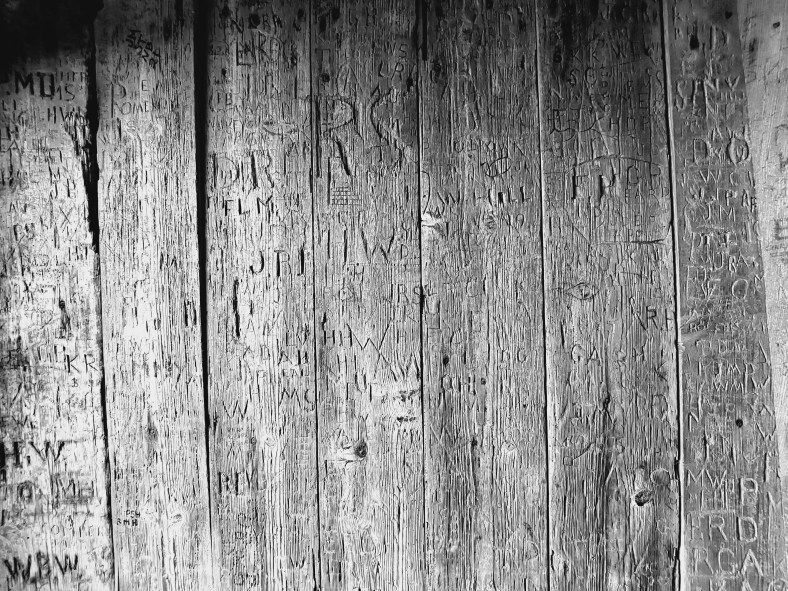
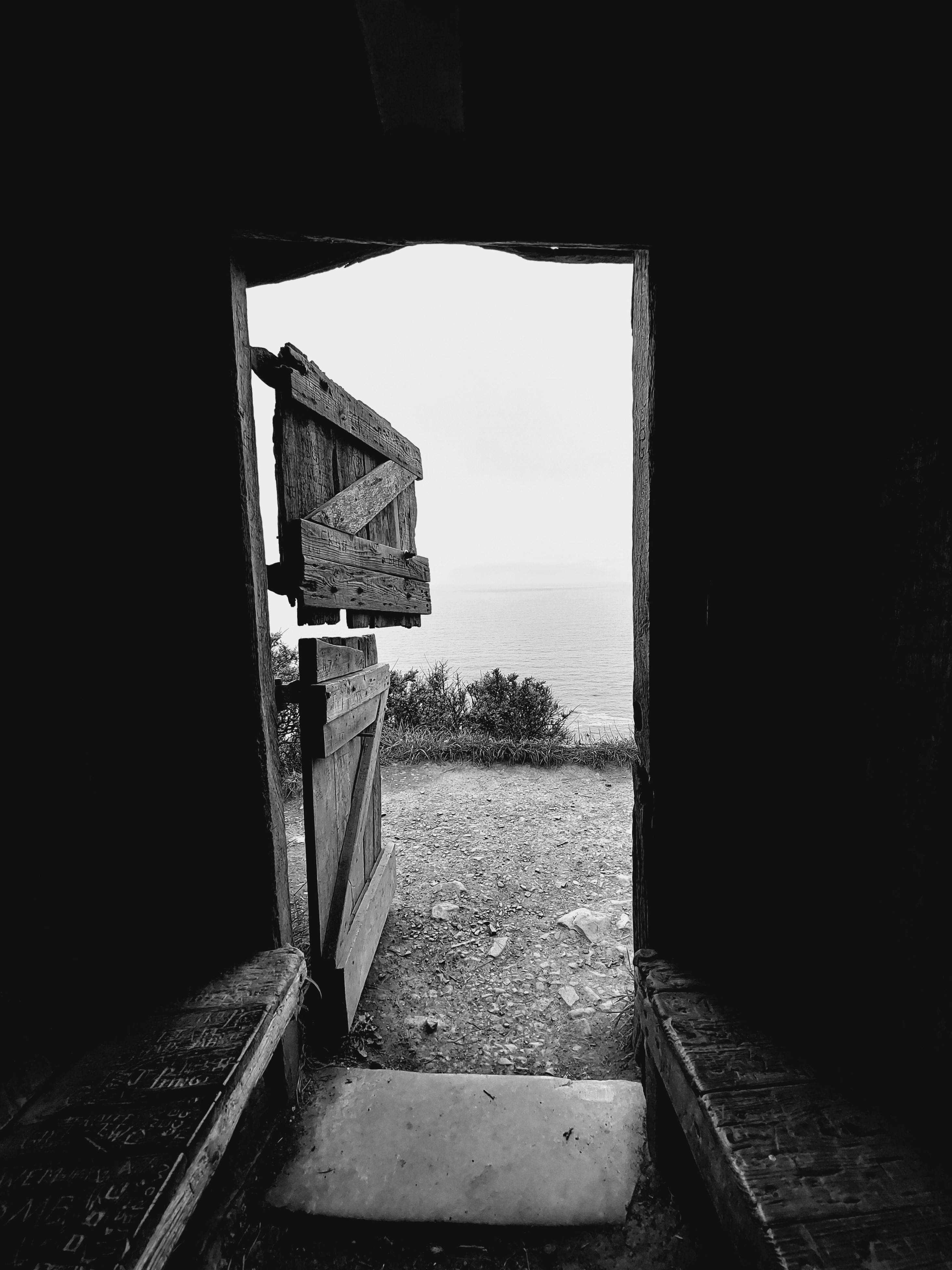
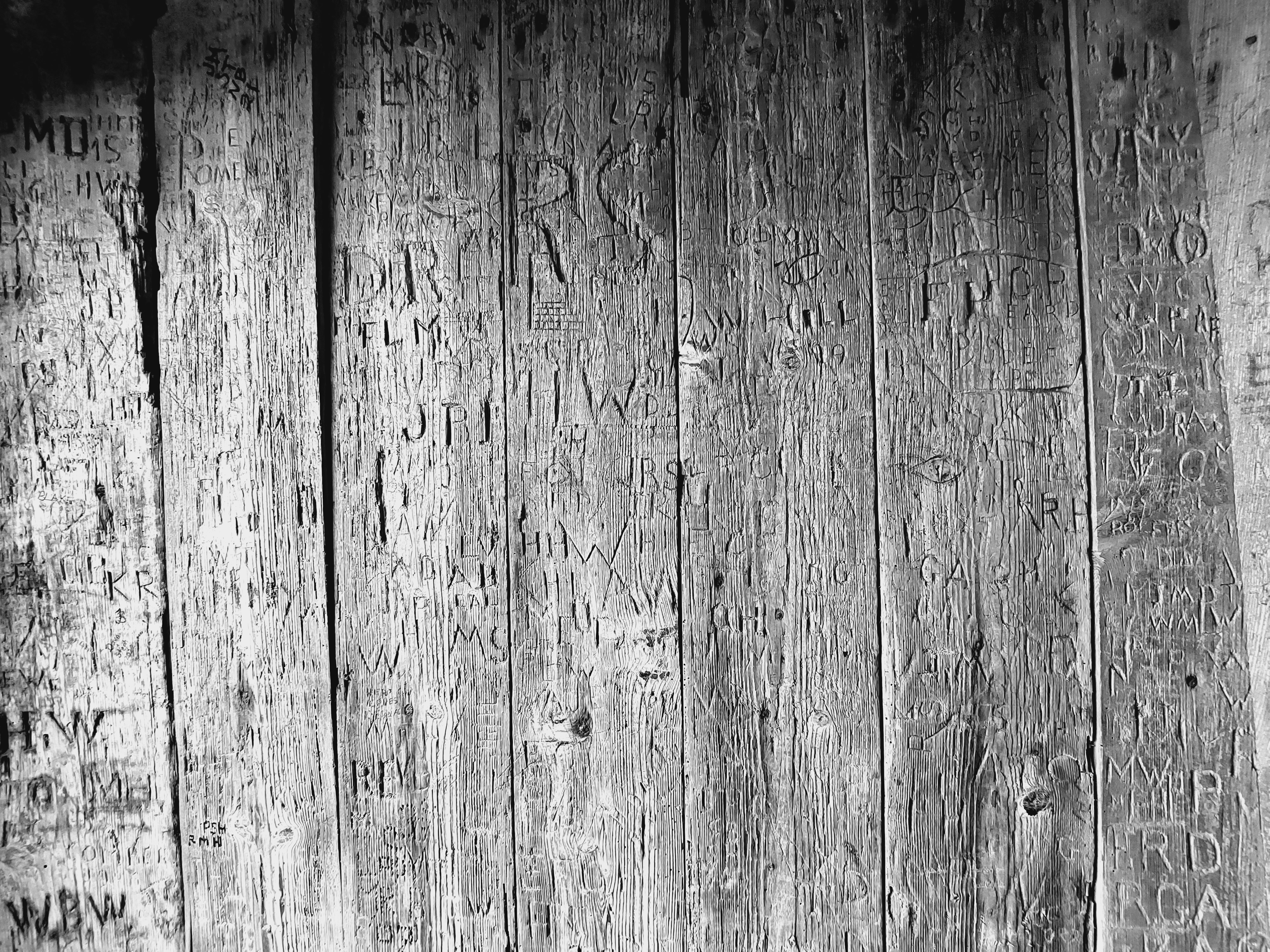
Much of Hawker’s poetry was written in his hut, set into the cliff face a mile or so from the church, constructed from driftwood and roofed with turf.  It is now the smallest property in the care of the National Trust, its planks incised with graffiti and worn to a smooth, mellow patina.  It would be easy to think of it merely as a den, a playhouse, or a man-cave, but we were lucky enough to have the place to ourselves and time to pause and try to see it through Hawker’s eyes.  The stable door opens onto infinity – the Atlantic, the sky, the sea mist.  The view is as unlimited as the human imagination.  What does looking out on infinity do to a person?  To a writer?  Does it stretch the boundaries of the mind, of the possible?

Sixty miles to the north across the Bristol Channel is another shrine to a dead poet – Dylan Thomas’ writing shed at Laugharne.  Decades apart, two men gazing out on infinity and writing poetry.  Infinity + alcohol = Thomas.  Infinity + opium = Hawker.

Maybe it’s not just the window on infinity, or even the stimulants, that are significant here.  Maybe it’s the access to a place to write, uninterrupted by the demands of other, domestic roles.  Jane Austen famously wrote her entire oeuvre at a little side table, using a writing box which had been a present from her father.  Her father couldn’t give her a space to write, or financial independence, but he could give her a writing box, a microcosm of the writer’s world which she could take with her wherever she went.  Virginia Woolf wrote an entire book about A Room of One’s Own, in which her analysis was that women writers were handicapped by the lack of their own space in a domestic context.  Neither Hawker in his hut, nor Thomas in his shed, had that problem.  Both had the luxury of private space – physical space, and headspace away from the demands of domesticity.  And, as a bonus, those private spaces had a window on infinity.

I started this by musing on the relationship between where we are and who we are, and whether, or how, where we are affects what we write.  Perhaps it’s less that a place affects who we are and what we write, but rather that where we are affects what we see from there.  Writers, including Alfred Lord Tennyson and Charles Kingsley, were inspired by Hawker’s hut.  Thousands of literature students and aspiring writers make the pilgrimage to Thomas’ shed.  Maybe the inspiration lies, not in looking into the writer’s space, but looking out of it – seeing what they saw, especially when that is infinity.  Alcohol and laudanum are optional.

I am committed to making this blog freely available, and not putting material behind a paywall. As a writer, I am doing what I love – but I still have to make a living. If you have enjoyed this post, and if you are able to do so, perhaps you would consider supporting my work by making a small contribution via the Buy Me A Coffee button. Thank you!

Buy Me a Coffee at ko-fi.com

In other words – writing, reading and literary translation

I have recently been working on a translation into English of a short story in Dutch.  It’s part of an ongoing project, and I am finding the process fascinating.  As a writer who is also a translator, there are a number of things going on at the same time when I undertake literary translation, and although the temptation is to say that much of it is instinctive, in fact there are layers of practice at work which I find it helpful to analyse and articulate.

Any translation has elements of decoding meaning from the source language (which in my case is Dutch) and encoding it in the target language (in my case, English).  Sound straightforward enough?  Well, not really, because the differences between how languages work, the building blocks that make up meaning – things like word order – mean that it’s not simply a case of grabbing a dictionary and swapping one word for another.  Also, you can’t just translate expressions and idioms literally, because the same idea may be expressed completely differently in the two languages.  For example, iets kennen als zijn broekzak literally translates as ‘knowing something like his trouser pocket’ – which makes no sense whatsoever in English.  The equivalent idiom in English would be ‘knowing something like the back of his hand’.

But what if the meaning of the text is made up, not only of dictionary words, or even idioms and colloquial phrases, but of subtle nuances of tone, sound, repetition, alliteration, rhythm, pace, and so on.  This is most obvious in translating poetry, of course, but any literary text is more than the sum of its words, and my challenge is to extract a sense of those extra layers of meaning and to convey that into English.  It is my job to write the short story in English which the original author would have written if they had been a native speaker of English.

This is, of course, impossible, but the best translations get so close to this ideal that the reader forgets that they are reading a translation.  This is what I am aiming for.  I need to identify and isolate the quirks, style and individual voice of the author and find a way of distilling that into an equivalent voice in English.  If the story reads as if I wrote it, then I’ve failed.

Ironically, I believe that it is the fact that I am a writer which equips me to do literary translation.  Finding my own voice, using all those tools of tone, sound, repetition, alliteration, rhythm, pace, and so on in my own writing, enables me to put that toolbox at the disposal of the author whose words I am translating.  Because I am a writer, I am well-placed to see the workings behind the scenes of the original text, to recognise what the author is doing, and to do what is necessary to create the corresponding effect in English.

It can be a slow process.  This is not like translating an online article about a new archaeological discovery, or even like translating a piece of academic writing.  Those kinds of texts are mainly about conveying the content.  The voice of the original author is rarely the main feature of the translation, and the task is to convey the information in appropriate, equivalent English.  It may take time to do the necessary research to find that appropriate equivalence – especially where there is specialised vocabulary involved – but it is not an especially lengthy process.  With literary translation, by contrast, I need to live with the text for a while before attempting to start translating it.  In the case of this short story, I first read it more than six months ago, and have gone back to it many times since.  I have it read straight through; read it for structure; for style; for vocabulary; for geographically-specific references (the author is Flemish, and the story is set in Antwerp).  I have marked up ‘problems’, passages where it is not immediately apparent how I should translate the text.  One particular phrase occupied me for a long time – in the end I decided to take a risk and move quite a long way from the literal meaning of the original Dutch word in order to create the same shock-value and controversy in English.  Re-reading my translation now, I am really pleased with the ‘solution’ to that particular ‘problem’.

There is a campaign ongoing in the translation and publishing industries at the moment to put ‘translators on the cover’ – in the vast majority of cases, literary translators are not named on the covers of the books they translate, even when these translations go on to win major book  prizes.  Often – in Anglophone markets, anyway – it is hard to know that the book you are reading is a translation.  At best, you might find the translator mentioned on the title page, but usually they will merely get a credit tucked away on the copyright page, which only the most nerdy amongst readers ever actually reads (I do – but I’m an ex-librarian and back in the day, when cataloguing was done manually, this was where you found the information you needed in order to catalogue a book).  If you live in an English-speaking country, you have probably read the work of literary translators without even realising it.  It is my hope that, having read this post, you may seek out the work of literary translators and enjoy the results of the process that I have described.  There is a whole world of books out there, and literary translators are the people who make it possible for you to read them in your own language.

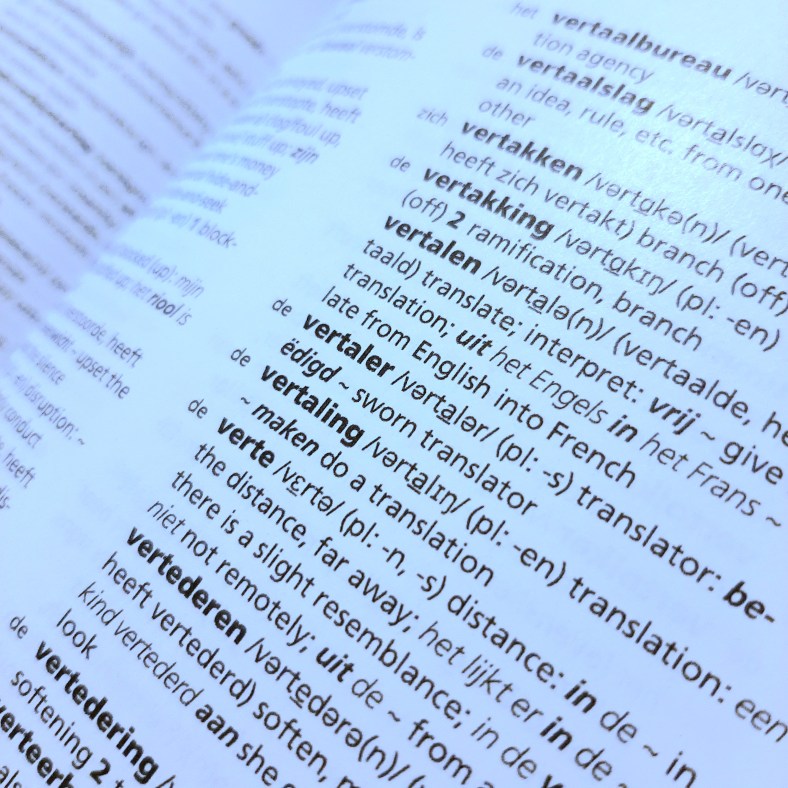
Photograph of part of a page from a Dutch/English dictionary, showing the entries for 'vertalen' (to translate), 'vertaler' (translator) and 'vertaling' (translation).

I am committed to making this blog freely available, and not putting material behind a paywall. As a writer, I am doing what I love – but I still have to make a living. If you have enjoyed this post, and if you are able to do so, perhaps you would consider supporting my work by making a small contribution via the Buy Me A Coffee button. Thank you!

Buy Me a Coffee at ko-fi.com

2021 – My Year In Books

2021 – My Year In Books

New Year’s Eve has come upon me suddenly – in the limbo between the public festivals of Christmas and New Year, the days seem to merge into each other, especially this year when the grey skies touch the ground (alternating occasionally with thick fog) and it never seems to get properly light.  There have been a lot of ‘best books of 2021’ posted on social media over the past few weeks, and it set me thinking about what I have read this year.  Some I have reviewed on this blog or in other publications, but others I have read simply for pleasure or out of curiosity.  Here, in roughly chronological order, are my top 10 books of 2021.

Mudlarking: Lost and Found on the River Thames by Lara Maiklem.  I originally bought this for my beachcombing mother-in-law, but it looked so interesting that I got a copy for myself too.  The author posts prolifically on Twitter, Facebook and Instagram, so the book is very much a starting point for an ongoing engagement with the finds that emerge from the Thames, and the stories and history behind them.  Maiklem moves down the river, from the tidal head at Teddington to the estuary at Southend-on-Sea, telling the story of the riverbank, the characters who inhabit(ed) it, and her own experience of mudlarking along the shore and the artefacts she has discovered.  The book sits between travel writing, social history, and memoir, and is accompanied by photographs of some of the finds she refers to.  I am always entranced by the humble objects, sometimes lost for centuries, which give a glimpse into people’s everyday lives, so for me this book was a treasure trove.

Ghost Town: a Liverpool Shadowplay, by Jeff Young was another book which was originally a gift which I ended up reading myself.  This had a personal resonance for me, as the streets which Young describes so evocatively were trodden by my own father, half a century earlier.  Many of the places are familiar to me from tracing my family history.  In Young’s luminous memoir, he walks through his ‘ghost town’, and explores themes of metamorphosis – his own, and that of the city of Liverpool –and loss, remembering and mis-remembering.  A compelling narrative, highly recommended for anyone interested in place writing.

Next up was The Screaming Sky by Charles Foster, illustrated by Jonathan Pomroy.  I read this just a few days before the swifts arrived from Africa, perfect timing for this love song to the marvel of nature that is the swift.  Born of a passion bordering on the obsessional, Foster’s book describes the bird’s life-cycle, its mind-boggling feats of aerobatics and endurance, its biology, and the history of humans’ relationship with the species.  I wrote a full review on this blog here.

Where? Life and death in the Shropshire hills by Simon Moreton was a new departure for me – I have no experience of the graphic novel/zine genre which Moreton specializes in, and this innovative book combines text with illustration and collage in a way I’ve not seen done before.  Where? is a memoir, in which Moreton juxtaposes the narrative of his father’s illness and death with memories of a childhood in rural Shropshire, in a landscape dominated by the presence of Titterstone Clee which looms over the surrounding countryside, and near the summit of which is a radar station where Moreton’s father worked.  Again, this is place writing about somewhere I know slightly, and I enjoyed reading it, admiring the weaving together of the two strands.  I am aware, though, that there were aspects I didn’t ‘get’ because I don’t have the visual lexicon to understand the artwork which is such a large component of this book.

A Still Life: A Memoir by Josie George.  I have followed Josie George on Twitter for a long time, and pre-ordered this book when she announced its publication.  However, it took me a long time to summon up the courage to read it.  In a year where so many themes were dark and hopeless, it seemed perverse to read an account of disability and chronic illness.  I was wrong.  George’s account of her life with a condition which long defied diagnosis and which continues to deliver twists and turns of challenge and disability, is full of light, hope and love.  Not that there is any false cheeriness here – she pulls no punches about the pain and hardships of her situation – nor is there any of the ‘disabled person as an inspiration to us all’ nonsense.  This is an exceptional person, taking life one moment at a time, doing what she can, not doing what she can’t, refusing to get frustrated, determined to continue loving, convinced that the world is good, that life is good, that being alive is the most amazingly wonderful thing, to be savoured and celebrated in whatever way we can in that moment.  It is heartwarming, not in an It’s A Wonderful Life kind of way, but in a way that stays with you, challenging the way you look at the world, at each small moment of our small lives.

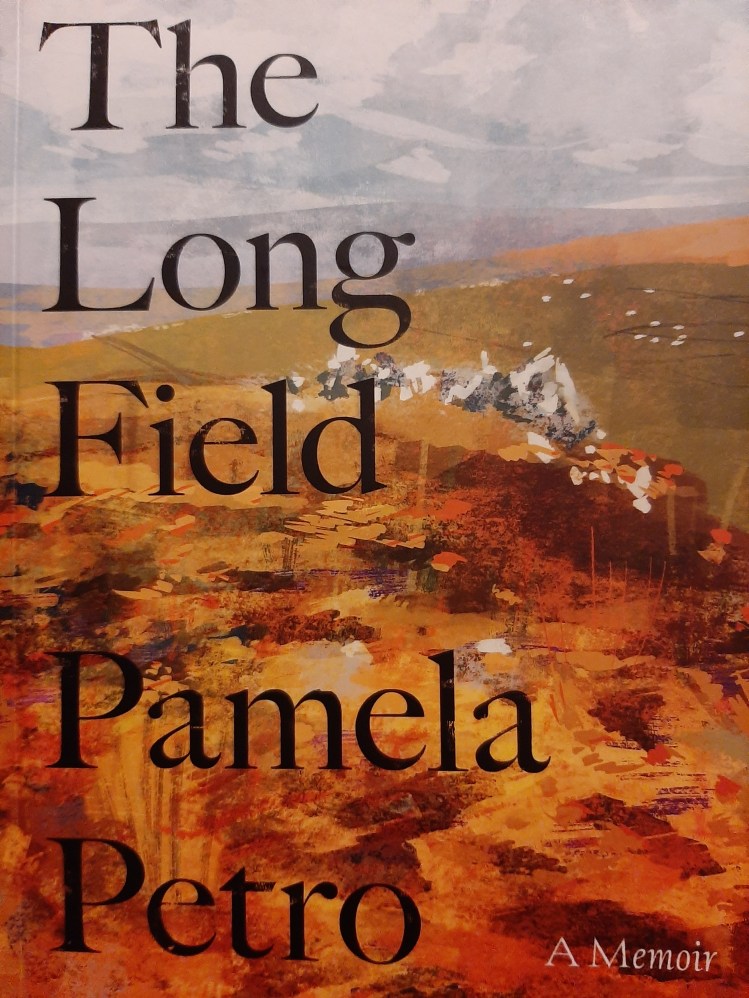
The Long Field by Pamela Petro is again memoir/place writing about somewhere I know – in this case, Petro’s love affair with rural Wales started in Lampeter, at the university we both attended.  I reviewed The Long Field here.

Fifty Sounds by Polly Barton was initially quite a challenging read (I don’t do philosophy, which dominates the opening chapters) but my persistence was rewarded by an insightful exploration of how language and culture influence and shape each other.  Barton tells of her experiences as an English teacher in Japan, and the fifty sounds of the title (which form the chapter headings) are onomatopoeic words in Japanese which she unpacks in her journey into Japanese language and culture, and into her own personality.  I wrote a full review for the Cardiff Review.

You will have noticed that all the titles in this list are non-fiction.  I have struggled with reading fiction since the beginning of the pandemic, but The Listeners by Edward Parnell may have rehabilitated me.  This clever, taut, beautifully written delight gave me more reading pleasure than anything else this year, and I reviewed it joyfully here on this blog.

Finally, two books which I am still reading.  Light Rains Sometimes Fall: a British Year Through Japan’s 72 Seasons by Lev Parikian is arranged in short chapters covering 5 or six days each, in which Parikian closely observes the natural world around him, partly through pandemic lockdowns, noticing details of the changing seasons.  I am a big fan of Parikian’s nature writing, and as I’m consciously attempting to live more in the present (rather than the past or the future) I liked the idea of reading this in ‘real time’, a chapter at a time for a whole year.  The current ‘season’ is called ‘Storms Sometimes Blow,’ which seems about right! 

As an utter map nerd, and a fan of his other writing, it was inevitable that I would eventually read Map Addict by Mike Parker.  At the time of writing, I am halfway through this blend of memoir, cartographical history, and celebration of the glorious Ordnance Survey map, and it’s so nice to connect with a fellow map addict! (I’ve written about the origins of my own map obsession here).

And, on this last day of 2021, I bring you good news – I have a whole lot more books lined up to read in 2022!  My ‘To Be Read’ pile includes poetry, a lot of exciting non-fiction, and even (tentatively) a bit of fiction.  I can’t wait!

Wishing you a Happy New Year.

Photograph of the books referred to in this blog post.

I am committed to making this blog freely available, and not putting material behind a paywall. As a writer, I am doing what I love – but I still have to make a living. If you have enjoyed this post, and if you are able to do so, perhaps you would consider supporting my work by making a small contribution via the Buy Me A Coffee button. Thank you!

Buy Me a Coffee at ko-fi.com

Book review – The Long Field by Pamela Petro

First, a confession.  Reading Pamela Petro’s The Long Field was an exercise in nostalgia for me.  I followed Petro to the university at Lampeter in West Wales (‘Probably the smallest university in the world,’ as the T-shirts in the Students’ Union shop proclaimed, Carlsberg advert-style) just four years later.  All her descriptions ring so very true for me, were part of the landscape of my own young life.  Even the cottage she lived in is well known to me, as a friend of mine rented it in my first year – I can picture myself back in that kitchen, drinking tea, watching my friend making jelly for dessert.  My challenge in writing this review has been to come to the book from the outside, as it were, rather than from that place of shared experience.

The Long Field is, fundamentally, about hiraeth, a complex Welsh word which encompasses elements of longing, nostalgia, distance, absence, homesickness.  It is famously untranslatable into English.  But the book is also a love story.  A love story on several levels, most obviously Petro’s sudden, unexpected, and deep passion for the landscape of rural Wales – again, something which resonates with me.  But it is also about her relationships with her partner and with her parents, and an exploration of the complexities of those relationships.  Perhaps it is an acknowledgement that love stories more nuanced than ‘boy meets girl and they live happily ever after’ are part of the lived experience of queer writers.

Although Petro is passionate about Wales – her Wales – she manages to stop short of being entirely rose-tinted about it.  She acknowledges some of the nuanced complexity of Welsh identity and history, some of the ways in which her adopted homeland’s sense of itself as a colonial victim of English occupation can hold it back.  As someone who has lived in Wales for a significant part of my adult life, it seems to me that Petro’s analysis of Wales is predominantly rural – the Wales of Ceredigion and the Cambrian Mountains – and intellectual and cultural.  She does nod at the life of the Valleys, especially as she was in Wales in 1984 during the miners’ strike, but the industrial and post-industrial conurbations of South and North-East Wales, the product of migration from within Wales and beyond, are not the Wales that she knows and loves.  Her Wales is that of the past etched into the landscape of the present.  Of people connected, umbilically, to the places that shaped the generations before them.  Of story made tangible in the land.  Landscape – not only the fields, the mountains, the hills, but also the cultural echoes, the resonance that they have – is what Petro loves.  Her inexplicable feeling of having ‘come home’ to that landscape when she, an American with no Welsh antecedents, arrived in Lampeter in 1983 is the starting point for the experiences that have shaped this book.

The Long Field is a remarkable book.  Although it self-identifies on the cover as ‘A Memoir,’ it draws together strands of history, travelogue, a whistle-stop tour of Welsh literary heritage, place writing, pronunciation notes for the Welsh place names, linguistic detours, a coming-out narrative, family saga, and an exploration of identity.  It is this last element, I think, which is the most important.  Can someone identify with a place which they are not ‘from’ but where they nevertheless felt a shock of recognition when they first encountered it?  Yes, says Petro – but is she is not claiming Welshness.  Rather like entering into a relationship with a lover from a different culture who speaks a different language, she seeks – respectfully, gently – to learn, to understand, to value what the beloved values.  What Petro found when she found her Wales filled a profound void in her psyche, provided a connectedness between the people of the present and the past which her upbringing in suburban America had not.  In an era when more people than ever are living where we are not from, The Long Field has much to say about place, identity, past, present – and future.

The Long Field by Pamela Petro is published by Little Toller Books.  ISBN 9781908213853

I am committed to making this blog freely available, and not putting material behind a paywall. As a writer, I am doing what I love – but I still have to make a living. If you have enjoyed this post, and if you are able to do so, perhaps you would consider supporting my work by making a small contribution via the Buy Me A Coffee button. Thank you!

Buy Me a Coffee at ko-fi.com

Guest blog post by Liza Achilles: 3 Lessons I Learned From Writing a Historical Novel

I am delighted to welcome Liza Achilles, a blogger based in Washington DC, USA, who has written a guest post for The Three Hares Blog.

Writing a historical novel was one of the most interesting activities I have done in my life. Unlike many other types of novel writing, historical novel writing requires a large amount of research. That research comes in several forms, as I will explain in this article. Below are 3 lessons I learned about writing a historical novel during my novel-writing journey. Perhaps these tips will help you if you tackle a historical novel project of your own.

#1 The Value of Visiting University Libraries

When I began researching my historical novel, I considered any book on my topic to be relevant. I stocked up on books from local bookstores and libraries. But I quickly discovered that not every book is of the same quality. Some books contain errors, unfair stereotyping, or generalities that gloss over key points. The books available at local bookstores and libraries were good for a cursory introduction to my subject; but to go deeper, I needed a university library.

I was fortunate that my husband (at the time) was affiliated (at the time) with first one university library and then another. Spouses were given, as a perk, a library card. I imagine that for some spouses, that wasn’t much of a boon. For me, it was a golden ticket to the stacks! (Many university libraries allow you to get a library card for a nominal fee if you don’t have a connection to the library.)

The excitement of browsing the stacks – there’s nothing like it. I would look up a subject on a computer and find a few call numbers. I would venture into some dark and crowded corner of some tower, and locate my book. I would then browse all of the nearby books, looking for something new and interesting. Often the book I took home would not be the book whose call number I found, but a book nearby in the stacks.

It was only with the help of these university books that I was able to correct errors, debunk stereotypes, and dig into important nitpicky details. All of this information was essential to crafting a novel that was as faithful as possible to the reality of what happened during my target time period.

#2 The Value of Visiting Historical Sites

No book about a location can replace a visit to that location. Books can and should supplement a visit. But there’s something powerful and special about experiencing a location in person – even if your visit does, of necessity, occur tens or hundreds of years after your target historical time.

Many historical sites have museums, plaques, monuments, grounds, or reenactments whereby you can immerse yourself in the history of the place. You can view some of the actual objects used by people during the historical period and walk on the actual terrain that was walked on back then. You can also talk with historical experts and read the extensive information provided at such sites.

I found immense value in visiting not just the site where my novel takes place, but also nearby and related sites. It’s always instructive to compare and contrast sites, to take in what is the same and consider what is different, and thus to better home in on your target historical location.

I also recommend touring public lands that aren’t part of any museum. Every place has its own flora and fauna, its own terrain and aura. Soak in the feel of the place, while being careful to distinguish between how things were during the historical time and how things are now. For example, invasive species might now inhabit the area, while other species might have gone extinct. Water levels and the climate might be different. (You can find this information through books and the Internet.)

#3 The Value of Using Primary and Secondary Sources

When researching a historical period, it’s important to distinguish between primary and secondary sources. Primary sources are writings done by people during the target time period. Secondary sources are writings done by people who came later, who wrote about the primary sources (or about other secondary sources).

Primary sources are a must-read because these are the people who were present when the action was happening. They are closest to your targeted time period and thus can be considered, in a way, most reliable. However, in another way, their reliability must be evaluated carefully, since being close to the action can result in all-too-human biases, mistakes, and sometimes even lies. This is where secondary sources come in.

Secondary sources are a must-read because these are the people who have carefully evaluated the quality of the primary sources and drawn conclusions not obvious in the primary sources. When well written, secondary sources are extremely reliable, and they may correct any factual errors, biases, or lies in the primary sources. However, when not well written, they may perpetuate errors, biases, or lies, or introduce new ones.

The bottom line is, dig into both primary and secondary sources, but read them critically and evaluate their reliability.

Conclusion

Research for a historical novel comes in several different forms. You might spend time visiting university libraries, touring historical sites, and consulting primary and secondary source materials. These activities helped me immensely while crafting my historical novel.

Are you working on a historical novel? What lessons are you learning from the experience?

Liza Achilles is a writer, editor, poet, and coach based in the Washington, D.C., area of the USA. She blogs about seeking wisdom through books and elsewhere at lizaachilles.com.

A writer’s desk – my working environment, coffee shops and the view from the window

It has been a bit difficult to concentrate on writing blog posts recently, for reasons which I will tell you about very soon, but it’s given me the chance to think about how and where I work best.  For one thing, I have been choosing a new desk, which proved to be a surprisingly fraught process.

My current workstation is a little computer desk on the large and sunny landing with a view over the fields.  The landing also has my reading chair, a compact 1920s armchair which nobody but me finds comfortable.  I love working here – but the desk itself is just too small to spread out my books and papers – things keep falling off the edge!

Over the years, in various work contexts, I have occupied a large open-plan office (my idea of hell), my own room (nice, but a bit isolating – I tend to get engrossed and forget about meal times), shared offices (the success of this depends on whom you are sharing the office with!), and dual-purpose space (desk in guestroom or dining room).  The common factor is having my own desk.  Having recently read about various free-ranging creatives who work anywhere, as long as they have their laptop with them, I toyed with the idea of giving up on a desk altogether and being a roaming writer.  I can see a few issues with this.  Firstly, the cost.  Most of these free-ranging creatives seem to work in coffee shops.  As it’s not reasonable to expect a retailer to provide a table for hours at a time without income from the sale of coffee, this would seem to be expensive compared to using one’s own home which one is paying for already.  Secondly, the effect on my waistline – the purchase of coffee is inevitably accompanied, at least some of the time, by the purchase of cake.  Thirdly, the effect on productivity – with the best will in the world, if I have editing to do, or a complex piece to research which involves not only internet searches but reading books, this requires a level of uninterrupted concentration which is not really possible when out and about.  (Fourthly, we have the current restrictions on visiting coffee shops etc because of the pandemic, but hopefully this is a time-limited problem).

Last but not least, I like my favourite resources within easy reach of my workstation. A diary (page to a day, so that I can write my to-do lists alongside appointments and deadlines), notebooks (one for each current project – see my recent blog post about my notebook obsession), pens and pencils, a mousepad and mouse (I have never been able to get on with the integrated ones on laptops), a coaster for drinks.  I also have at least one ‘to read’ stack, of books and papers relating to whatever I am currently working on.  It could be argued that I should tidy these away on a bookshelf and bring them out when required – except I know from experience that this would ensure I never get round to reading them!  Sometimes there’s a vase of flowers, or crystals (currently a big piece of fluorite), or an interesting pebble I’ve found on the beach.

In short, my working environment isn’t particularly portable.  I’m happy to spend the occasional few hours elsewhere with my laptop, but I am most settled, and concentrate best, at my desk.  As I’m now writing full-time, therefore, it seems not unreasonable to treat myself to a good desk that does what I need it to do and is aesthetically pleasing – I have to look at it all day, after all.  Simple, you might say, just go and buy one.  Yes – but which one?

I’ve had to work out how big I need a desk to be, in order to accommodate my laptop, all the stuff mentioned above, and have space to spread out books and papers when I’m researching.  I have learned the hard way that I need to get the height right, too, in order not to damage myself in the long term.  Also, what kind of desk do I want to look at every day?  I browsed a lot of office furniture catalogues and felt uninspired – I really don’t like the corporate, nine-to-five look of most of them.  My desk may be my work space, but it’s still in my home, and it would be nice if it was pleasant to look at.  What kind of ‘look’ does the rest of my furniture have?  A lot of it is quite industrial (for example, the coffee table is made out of reclaimed timbers from Indonesian fishing boats).  Something artisan-made from reclaimed wood, then?  Eventually, I found just the thing on Etsy – made to order, to my size specifications, using scaffolding planks and industrial steel.  It is being made as I write this.

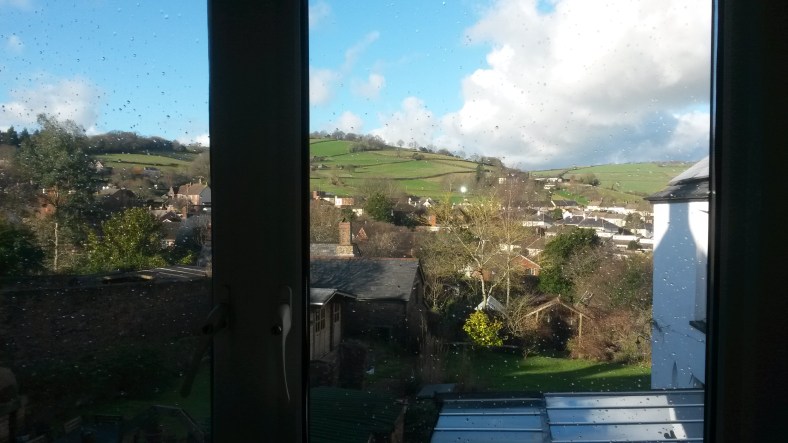
I mentioned earlier that the landing where my computer desk is situated has a view over the fields.  I have discovered that having a workplace with a view is something of a mixed blessing.  Some years ago I moved into a house and chose the larger bedroom as my office because it had stunning views across the rooftops to the hills beyond, complete with sheep (whose bleating was just audible with the window open).  It seemed a waste of the view to use that room as a bedroom.  I positioned my desk in front of the window, to get the full benefit of the view.

View from window, showing rooftops and distant grassy hills.

Reader, a week later I moved the desk.  I was getting precisely no work done.  I spent hours gazing out of the window, watching the sheep move around their fields, watching the birds in the gardens, watching the light and colours change on the hillside as the sun moved around during the day and the shifting clouds cast their shadows, watching the rain sweep through the valley, watching the flock of racing pigeons which went for a fly about at 3 o’clock every afternoon, watching the bats at dusk.  In order to get anything done at all, I had to move the desk to the side, and only allow myself gazing time when on a coffee break or having an eye rest.

Here, instead of sheep, there are a pair of muntjac deer, who graze the field and occasionally venture into the neighbour’s garden to drink from the pond; a barn owl who quarters the field on silent wings, hunting, at dusk and dawn; a kestrel who hovers, defying gravity, high above the field, occasionally dropping like a stone into the grass and emerging with whatever hapless rodent is his dinner for today; tinkling flocks of goldfinches; a pheasant, whose call reminds me of vintage car claxon, and his girlfriends; a pair of red-legged partridges, with their Egyptian eyeliner, who also visit next door’s garden; and an enormous hen buzzard who circles on thermals over the field before sliding off downwind beyond the oak trees.  It’s very distracting – but it’s a nice problem to have.

Noticing things differently – why creative nonfiction is like poetry

Apart from the occasional poem, most of what I write is nonfiction.  Creative nonfiction is a genre which is increasingly discussed – hard to define, but including narrative accounts, personal responses, place writing, reflection and imaginative explorations.  This is what I have written since long before I knew it had a name!

I have long thought that the two forms of writing I engage in – creative nonfiction and poetry – are two sides of the same coin.  That statement may make a bit more sense if I take you back to Wales in 1986, when I first started writing in an intentional way.

In a recent blog post I wrote about being fortunate to be part of a pilot for an A level creative writing course.  The exam board commissioned leading Welsh writers to run creative writing residentials for the students in the pilot because, as most teachers were used to delivering a traditional, Shakespeare-and-the-classics English Literature syllabus, teaching creative writing was something quite new to them.  Six of us from my school travelled with the Head of English, Liz Pugh, to Plas Tan y Bwlch (now the Snowdonia National Park Study Centre) for two days with, amongst others, Gillian Clarke.

A word here about Gillian Clarke.  Now aged 82 and something of a ‘national treasure’ in Welsh cultural life, she had at that point recently published her fourth collection, Selected Poems (although I didn’t read her work until later).  With decades of experience of teaching English and creative writing in schools and colleges, she was the perfect choice to encourage young people to explore the process of writing poetry.  From 2008-2016 she was the National Poet of Wales (the Welsh version of a Poet Laureate), and as well as her award-winning poetry she has created a fine legacy in the form of Ty Newydd, the national writing centre for Wales, which she co-founded in 1990.

Back in 1986, it’s a glorious spring day, with sunshine flooding into the big lecture room at Plas Tan y Bwlch. Huge windows offer panoramic views of the valley and the wooded hills beyond, but we aren’t paying much attention, because Gillian Clarke is speaking.  She has seated us – some 30-odd students aged 16-18 – in a large circle.  She has a basket beside her, and from this she takes a small object, about the size of an egg.  I’m going to pass this round the circle, she says.  Take as long as you like when it comes to you.  What I want you to do is notice.  What do you notice about this object?

The object passes slowly from hand to hand, as each student holds it, turns it over, gazes at it, frowns or nods in recognition, maybe runs a finger over a detail, passes it to their neighbour.  I watch them as the object makes its way to me, about two thirds of the way round the circle.  Then, it is in my hands – feather light, delicate yet curiously strong, like an eggshell.  The size of a small egg, and almost the same shape, with a hooked point at one end.  Smooth, with hollows divided by sharp, paper-thin membranes.  Notice, Gillian had said.  How should I notice?  I have looked at it.  I have turned it over and over and looked at it from all sides.  I have used touch to explore its textures and weight.  I’m not going to taste it!  But there are other senses I could use – maybe, if I hold it to my ear it will sing of the sea, like a shell?  No.  But how about smell?  Tentatively, I lift it to my nose – earthy, organic, and yet almost like stone.  I hear a soft hiss from Gillian – yesss.  I look at it one last time, and pass it to my neighbour.

Afterwards, Gillian tells us about the object – it’s a buzzard’s skull that she found on a walk, and she has written a poem about it.  But, she says, that’s not why she brought it today.  It’s just a way, she says, of getting us to notice things differently.  She mentions that one person went beyond looking and touching by listening and smelling (I squirm with embarrassment at this).  She’s delighted – this is what she was hoping we would do.  Now, she says, go away and write a poem.

As we move away, she calls me back, and we talk about the senses, and how important she thinks it is that a writer should notice differently – from a different angle, using different senses, and without what we think we know about the object getting in the way of our noticing.  She is enthusiastic, encouraging.  I take my notebook to a corner of the terrace and start to write – this is the poem.

The Buzzard’s Skull

This ritual is new, and yet
along the distance of my mind
I know that I remember.
The circle is held, spellbound;
the sacrament is passed from hand to hand:
a ceremony of initiation?

Blindfold and afraid, I hear
the holy word approach,
rhythmic, sinister,
along the chain.
The object is in my hands,
stirring a memory that
my fingers cannot grasp –
a forest or a beach?
My life,
or life that lingers in my mind,
beyond (my) memory?
My fingers’ eyes have been in the dark
so long,
they are blinded by this light,
and cannot see.

Although I never saw Gillian again after that residential, I followed her career and occasionally heard her on the radio.  I know that many writers were encouraged into writing by her, and I am always grateful to her for that hissed yesss that made me realise that I was on the right lines in how I observed the world around me, rather than just being weird.  She made me realise that I was starting to think like a writer.

And like a writer, rather than solely a poet – because the nonfiction I write is also about noticing things differently.   Poetry is about precisely that – a good poem leaves the reader thinking “wow, I never looked at it like that before” and can weave magic around the most familiar and mundane subject.  Creative nonfiction, I would suggest, has a similar role – to explore the homely as well as the exotic, looking with fresh eyes and an unexpected perspective, touching and listening and smelling and tasting, and telling the stories of people, places and objects with new voices.

Cover of Selected Poems Gillian Clarke


My notebook habit – confessions of a stationery addict

A few days ago, my friend Cath posted a photograph of a notebook on Twitter, with this caption: ”I know I’m not alone (I’m not, am I): just re-found this, which I bought at the Design Museum in January: it’s the MOST beautiful notebook I think I’ve ever seen…and I’m so terrified of ‘spoiling’ it that I’ve kept it in the bag it came in!”

Her next post included video of her turning the pages of this really rather wonderful notebook, intriguingly entitled Grids and Guides: a notebook for visual thinkers.   It set me thinking: no, Cath, you’re not alone!  I’ve always been ridiculously excited by stationery and I’m totally susceptible to a nice new notebook.

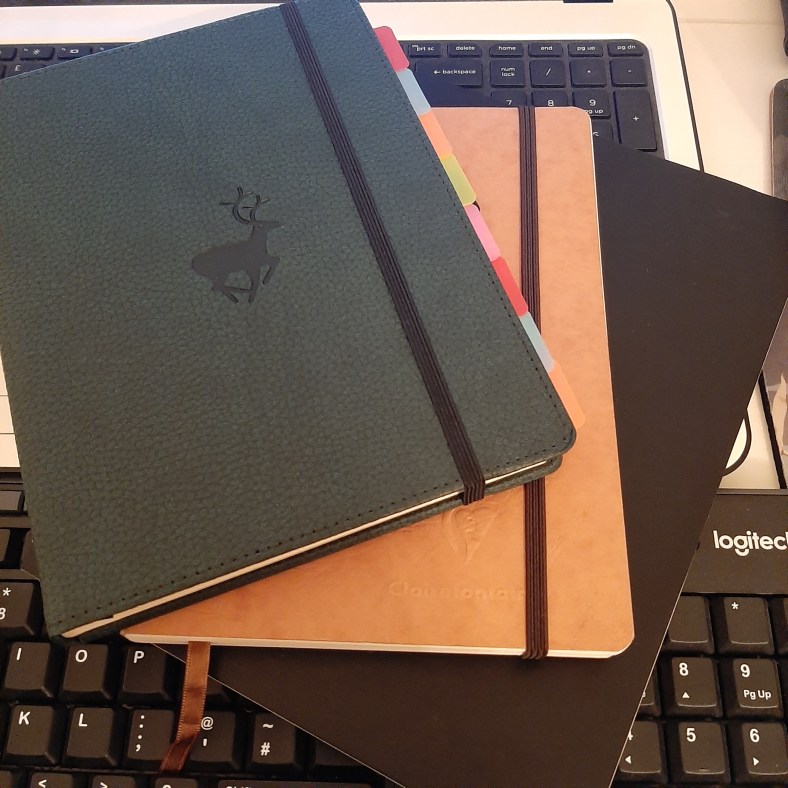
Writers have a particular ‘thing’ about notebooks, it seems.  I often see posts on Twitter about writers and their notebooks.  I recently attended a course at the National Centre for Writing where the joining notes included instructions to ‘bring a favourite notebook’.  The writer Tom Cox’s next book is actually entitled Notebook!  He encouraged people to tweet pictures of their current notebooks, and I responded with this picture.

Picture of three notebooks.

It shows the three notebooks I am currently using.  The dark green one with the coloured tabs is the one I am using for notes for my book.  Each tab relates to a chapter, which I’m hoping will help me to keep my research notes in some kind of order!  It’s made of vegan leather, by a company called Dingbats, and has an embossed deer on the front.  The paper is lovely: thick, cream, and lined, and the endpapers have a funky print of deer hoofprints.

The brown one is by Clairefontaine, a French company which I’d not heard of before I was given this notebook.  Its pages are cream and very smooth, a real pleasure to write on.  It has numbered pages and a contents page, which is very useful as I use this to write down my ideas for various articles and projects, and it’s good to be able to see at a glance where they are, rather than spending ages flicking through the book.  I used to be a Moleskine loyalist, but having tried Clairefontaine, I think I’ll be sourcing more of these in future.

This brings me to the black notebook – an extra large Moleskine soft cover with plain cream pages and a useful pocket in the back for cards and loose papers.  This one is used for ‘professional’ notes – notes from training courses and books on professional and commercial aspects of writing for a living.  Moleskine make nice large notebooks, and these soft cover ones stay flat and open when in use, which is great for making notes in meetings.

All three have elastic bands to keep them securely closed when not in use.  The Dingbats one also has an elastic loop to hold a pen.

Ah – don’t get me started on pens.   I adore pens.  And coloured marker pens for planning and mind mapping.  And fountain pens.  And my latest passion, which is propelling pencils.  I’ve always found them a bit scratchy, but I recently discovered a Pentel which has a 1.3mm lead (my previous one was 0.5mm) which makes a lovely soft, thick, dark mark and is comfortable for taking extended notes.  I’m now using that pencil far more than pens, and am more than a little in love!

And then of course there are notepads, and sticky notes in all the colours of the rainbow and all sizes from postage stamp to A5, and staplers, and paperclips, and polypockets, and folders, and subject dividers, and ring binders, and box files (did you know they come in A5 as well as A4 sizes?!), and index cards (plain and lined, white and coloured, standard and large), and envelopes, and good old-fashioned letter paper, and laid paper and wove paper and handmade paper and mulberry paper and…

OK, OK, you get the idea.  Let me loose in any stationers, or with an office supplies catalogue, and serious expenditure will result.  My name is Lisa Tulfer and I am a stationery addict.  I’m more restrained than I used to be, and I succumb to temptation less often – except when it comes to notebooks.  Granted, they are a tool of my trade.  This is how I justify buying them when I see them – I currently have an entire storage box full of notebooks waiting to be used.  The last twice we’ve been away for a few days I have returned with a new notebook – a gloriously purple one (it’s my favourite colour – how could I resist?) from the gift shop at Tintern Abbey, and a monastic garden themed one from the English Heritage gift shop at Rievaulx Abbey.  I have lined notebooks, plain notebooks, spiral bound notebooks, fabric covered notebooks.  Every new project gets a notebook, so a good supply of attractive notebooks ensures a good supply of new projects!

So, to get back to Cath, I can assure her that she isn’t alone.  Appreciation for a good notebook (and a tendency to buy them even if you haven’t a clue what you will use them for), is a ‘thing’ which many of us share.  And in these difficult times, if we can find pleasure in a simple notebook, that seems like a good thing.

Cath runs the most wonderful gift shop and gallery called Ginger Fig.  It’s in Bath Place, Taunton, Somerset, UK.  You can contact her on Twitter @gingerfig, on Instagram @gingerfig and on her website.


What do writers do all day?

What do writers do all day?  Well, obviously, we write.  But we also do a lot of other things in order to be able to write, and to make a living out of writing.

Reading

All writers read.  It’s inevitable.  Most of us are writers precisely because we love to read, because words are our ‘thing’.  It would be truly weird, therefore, if we didn’t devour words at every opportunity.  And if we are looking to be published, it helps to know what contemporary writing looks like.  While we all have our individual style or voice, it wouldn’t be helpful for our writing to sound like, for example, Chaucer or Austen or Wodehouse – every era has its language, and anachronisms don’t generally get published.  A 21st century writer needs to write like a 21st century writer.

Research

Most writing requires research.  At the very least, a writer needs to fact-check.  Fiction may originate in the mind of the writer, but in order for the reader to suspend disbelief and enter into the story, the facts need to be right because if they are wrong, it jars.  Journeys need to take the right amount of time.  Police procedures need to be correct.  Medical details must be accurate.  Characters need to speak and behave in a way that’s authentic to the time and place of the story.  The science needs to be right.

I mostly write non-fiction, so research is a major part of what I do.  Even when I am taking a creative, imaginative or whimsical approach, the facts have to be properly researched.  A lot of my topics are historical, so I am applying the academic research skills I acquired while studying history at postgraduate level, not only exploring the ‘facts’ but also how those facts have been interpreted through time.

Getting out there

The publishing industry – whether magazines or books, online or in print – is a mysterious world which any writer who wishes to make a living simply has to get to grips with.  As well as the necessary but tedious self-employment tasks of invoicing, accounts and tax returns, a writer has to learn the ins and outs of the industry: how to pitch, whom to pitch to, what the protocols are, which avenues are a waste of time and which are worth pursuing.  There are no short-cuts to learning this – it takes time and effort.

A significant part of being a writer (rather than someone who writes) is the publicity and networking which is part of the profession.  In practice, much of this now takes place online, and I need to spend some time every week keeping on top of this.  As well as this blog, I am active on Twitter (and to a much lesser extent on Instagram and Facebook).  I find Twitter is the place where I network with other writers, find out about events and opportunities, interact with literary agents and publishers, follow up research interests, and tell the world when I’ve posted a new blog post.  I have got several writing gigs as a direct result of being on Twitter, and it’s more than worth the 20-30 minutes I invest in it most days.

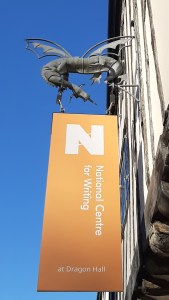
Yesterday, I attended a professional development event at the National Centre for Writing (which conveniently for me is located just down the road in Norwich).  It was led by Leena Norms, and was entitled ‘Creating an online presence for your writing’.  Whilst it might go against the grain for those writers who wish to practice their art in solitude in a garret or writing shed, aloof from the world and commercial concerns, the reality for a jobbing writer is that we have to be our own publicists in order to get, and sell, work, so it makes sense to learn how to do it as effectively as possible.  Leena’s approach is simple, effective and cuts through the mystique that surrounds social media in the creative industries, and although I was already doing much of what she suggested, I now feel better equipped for this aspect of my work.  After all, writing is all very well, but I want to get my writing out there and being read!

Writing

Ah, yes – writing!  This is, of course, what it’s all about, the one thing I really want to be doing with my life.  However, it will be apparent from everything I’ve just said that it’s not enough by itself.  The reading, the research, the social media work, and the engagement with the industry, and the self-employment tasks all underpin the writing itself.

I will post another time about the writing process itself – my writing process, because no two writers are the same.  But for now, I’ll just say this: I think a lot more than I write.  I call it ‘percolating’ because, like coffee, the slow process of ideas becoming infused with reading and research, and forming something new that is complex, nuanced and interesting, takes time.  I probably think for at least 2 hours for every hour spent actually writing.

The Three Hares Blog

If you would like to receive every new blog post direct into your inbox, why not sign up with your email address?  I usually blog every week to 10 days.