Wool gathering – what brings thousands of people to a barn in Mid Wales

On the last weekend in April, I re-connected with my tribe.  After a break of two years because of the pandemic, Wonderwool Wales was finally able to go ahead in its traditional slot of the last weekend in April, and nothing was going to keep me away.  The event at the Royal Welsh Showground near Builth Wells in rural Mid Wales has taken place since 2006, and whilst it started with the idea of raising the profile of Welsh wool and providing a showcase for craftspeople and small businesses using wool, it has developed into a gathering of the fibre-obsessed from all over the UK and beyond.

Colourful skeins of yarn.
Fivemoons yarn hand painted yarn from the Blackdown Hills, Devon. www.theslowwardrobe.co.uk/collections/fivemoons-yarns

Let me try to set the scene.  The venue is three large barns which, when used for agricultural shows, are full of pens containing trimmed and brushed sheep and cattle, the elites of their breeds.  During Wonderwool, however, the barns become like the inside of a kaleidoscope, a sensory overload of colour and texture with nearly two hundred stalls representing sheep breed societies, craft guilds, boutique textile mills, purveyors of equipment for knitters, spinners, weavers, dyers, feltmakers – but mainly yarn, more yarn in a dizzying rainbow of colours than I have ever seen in one place.  The choice is overwhelming.  The first time I came, I felt like I needed a lie down in a darkened room for the rest of the weekend.
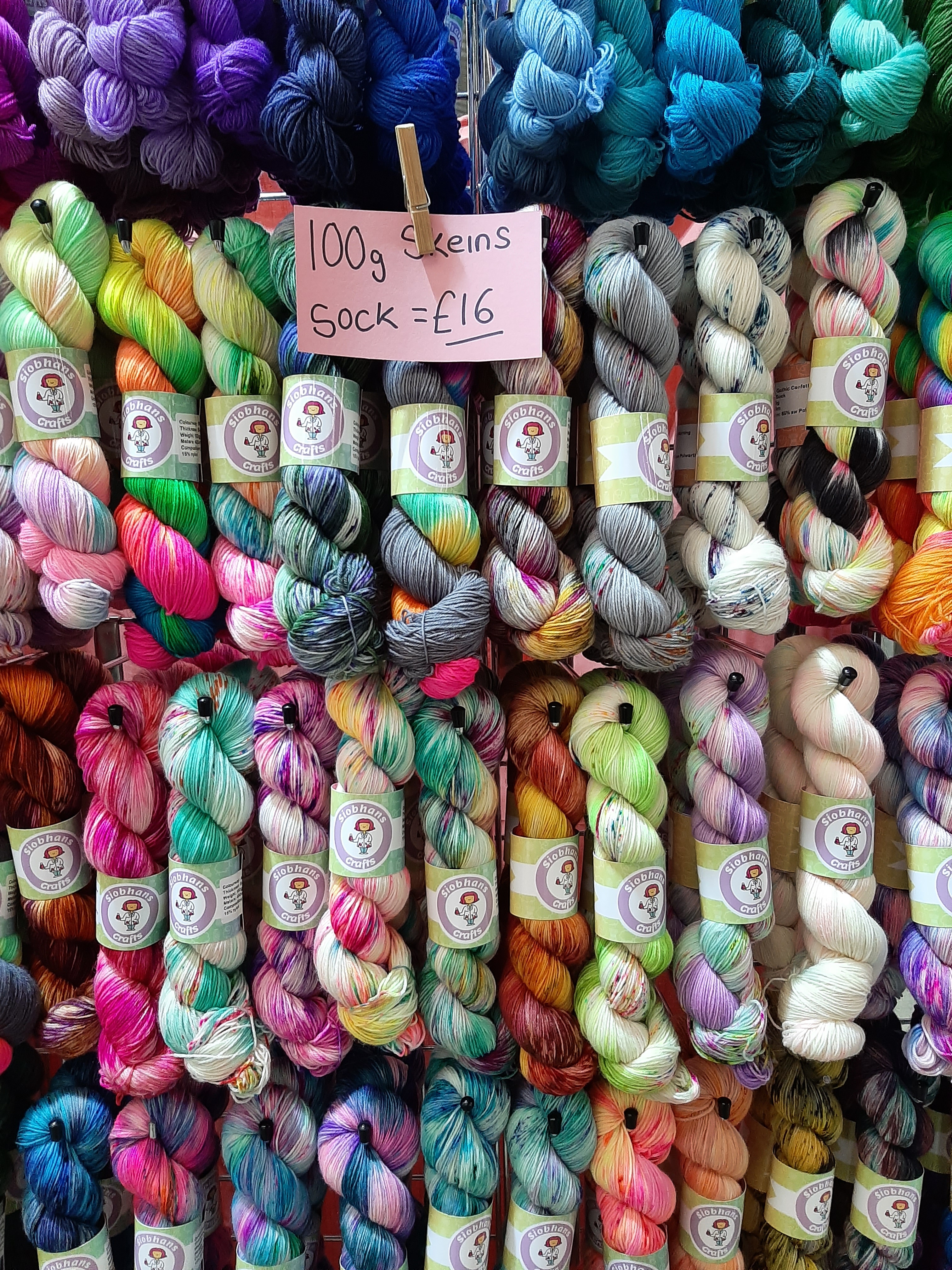
Dozens of skeins of brightly coloured yarn.
Sock yarn by Siobhans Crafts www.siobhanscrafts.co.uk

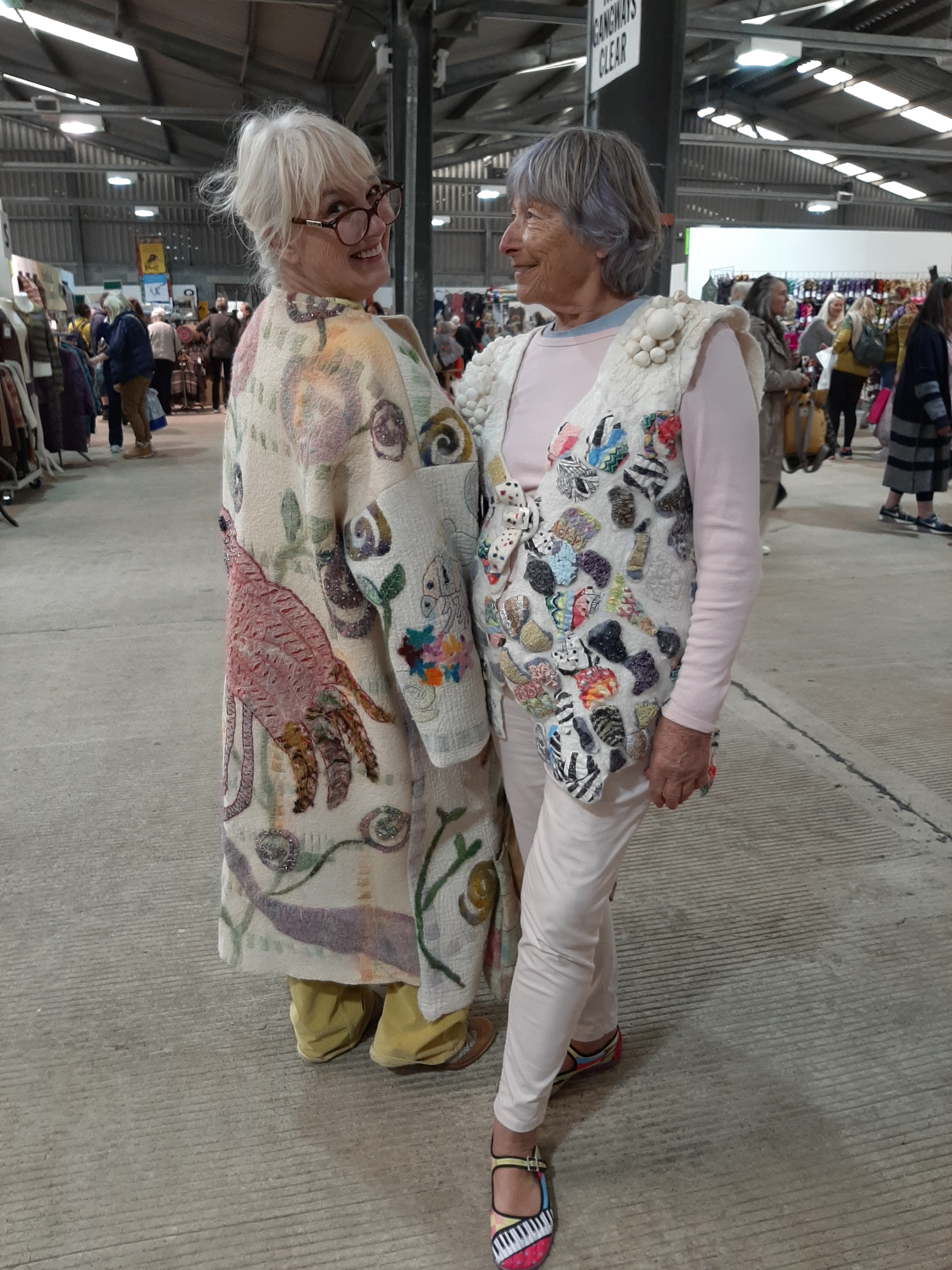
But it is not only the cornucopia of goods for sale which draw the eye.  Fibre events like this (similar gatherings in the UK include Yarn Fest in Yorkshire and Woolfest in Cumbria) are an opportunity for people to show off their creations.  There are several thousand people here, and seemingly every second person is wearing a handmade scarf, hat, sweater or dress.  I could have photographed dozens of examples at Wonderwool, but I settled on these two ladies who had travelled to Wonderwool from Cheshire, resplendent in their stunning, unique creations which incorporate felting and stitching techniques.  Fortunately, they were happy to pose for me!
Two smiling ladies modelling a coat and waistcoat.
Ali and Christine modelling their creations

Over the years that I have been coming to Wonderwool, I have noticed trends within the fibre crafts world.  For example, a few years ago there was a plethora of yarns made from hemp/linen, organic cotton, and nettle fibres.  This year, when I specifically wanted some cotton yarn for a project, there was none to be found, and remarkably little linen either.  Neither was there any sign this year of the giant knitting – with yarn as thick as rope, and broomsticks for needles – which was all the rage the last time I went.  The theme I could see this year was traceability – there was a strong emphasis on the provenance of the yarn on sale, with information on the flock that the fleece came from and the mill or hand-spinner that had processed it.  One vendor was even able to show a prospective customer a picture on her phone of the individual sheep whose fleeces had contributed to the balls of undyed knitting yarn on sale!

Sacks of sheep's fleeces in a range of natural colours.
Sacks of raw fleece. British Coloured Sheep Breeders’ Association www.bcsba.org.uk
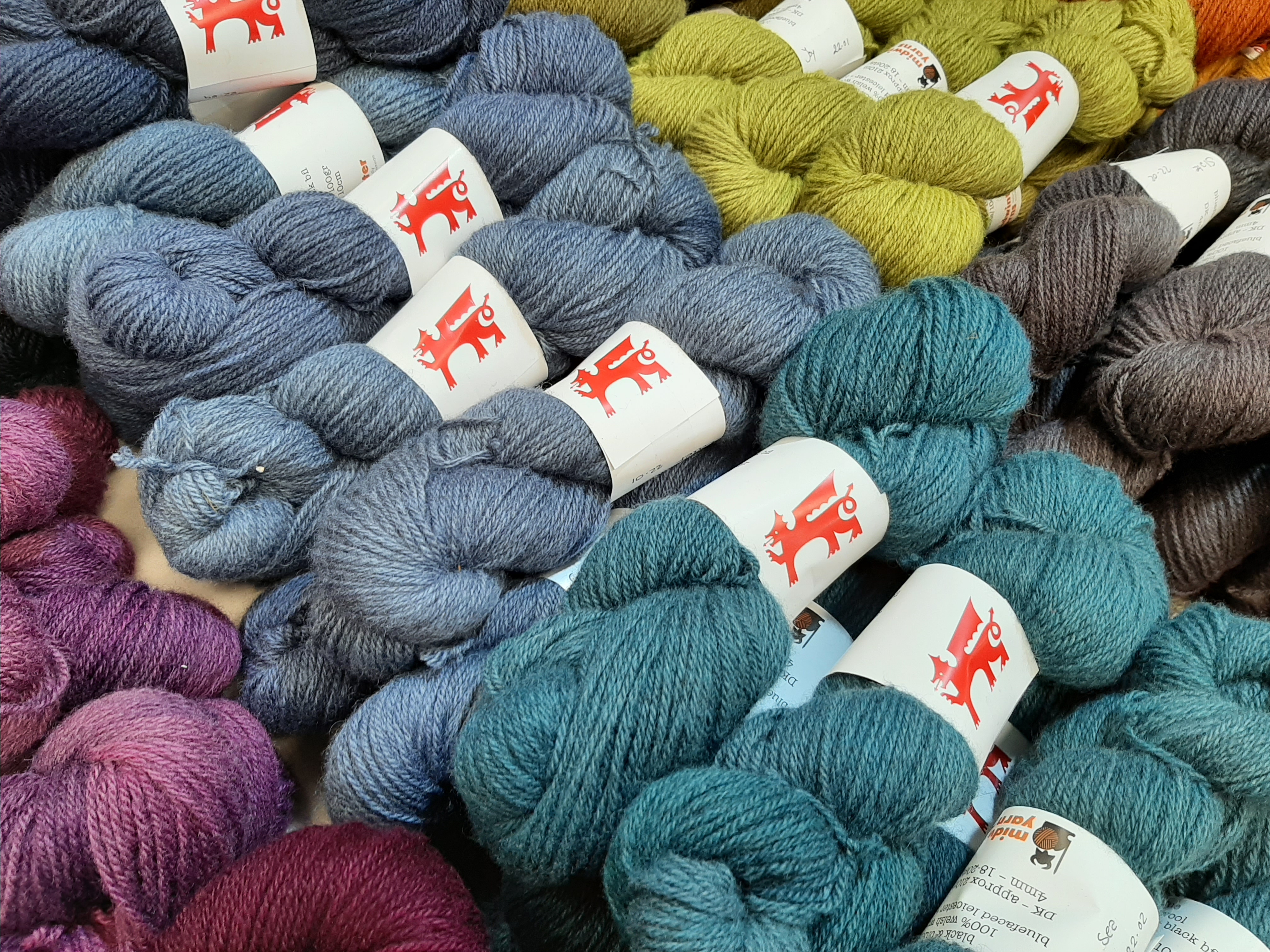
Skeins of coloured wool featuring the red Welsh dragon on the labels.
Yarn from Welsh flocks by Midwinter Yarns www.midwinteryarns.com

I was interested, too, to see an exhibit of natural dyestuffs – a range of plant products which have traditionally been used to dye yarn and fabric – together with the yarn that has been dyed with them.  There is increasing interest in natural dyes, with a number of how-to books now available (I have tried it myself, using onion skins to dye some silk fabric a vibrant, autumnal orange) and in view of the environmental impact of conventional (artificial) dyes it was good to see awareness of natural processes being raised in this way.

A selection of natural dyestuffs.
A selection of natural dyestuff from Allium Threads www.etsy.com/uk/shop/AlliumThreads
A selection of naturally-dyed yarns in shades of cream, wheat and green.
A selection of naturally-dyed yarns from Allium Threads www.etsy.com/uk/shop/AlliumThreads

Despite the name, it’s not all about the wool – one particularly eye-catching stall was selling yarn made from recycled saris.  The fabric is ripped into narrow strips, which can then be used to knit, crochet or weave.  The colours are luminous.

Photo of a woman winding a skein of bright orange recycled sari yarn.
Making a skein of recycled sari yarn at www.lalawithlove.co.uk
A display of recycled sari yarn in a range of bright colours.
Recycled sari yarns by www.lalawithlove.co.uk

Wonderwool sets out to showcase all the processes from sheep to finished article.  Some of the breed societies bring ewes, with their lambs, to the show, and these are always popular.  ‘Raw’ fleece – clipped from the sheep last summer – is available for those who like to process and spin their own fibre, as well as combed fibres for feltmakers and spinners who prefer a little less lanolin in their fibres!  And, of course, there is yarn – so much yarn.  Knitting patterns.  Spindles, carders, looms.  Knitting needles, crochet hooks, spinning wheels, buttons.  Embellishments, dyes, bags of dyed combed ‘tops’ for feltmakers.  Knitted toys.  Traditional ganseys.  Textile art.  Yarn.  And yet more yarn.
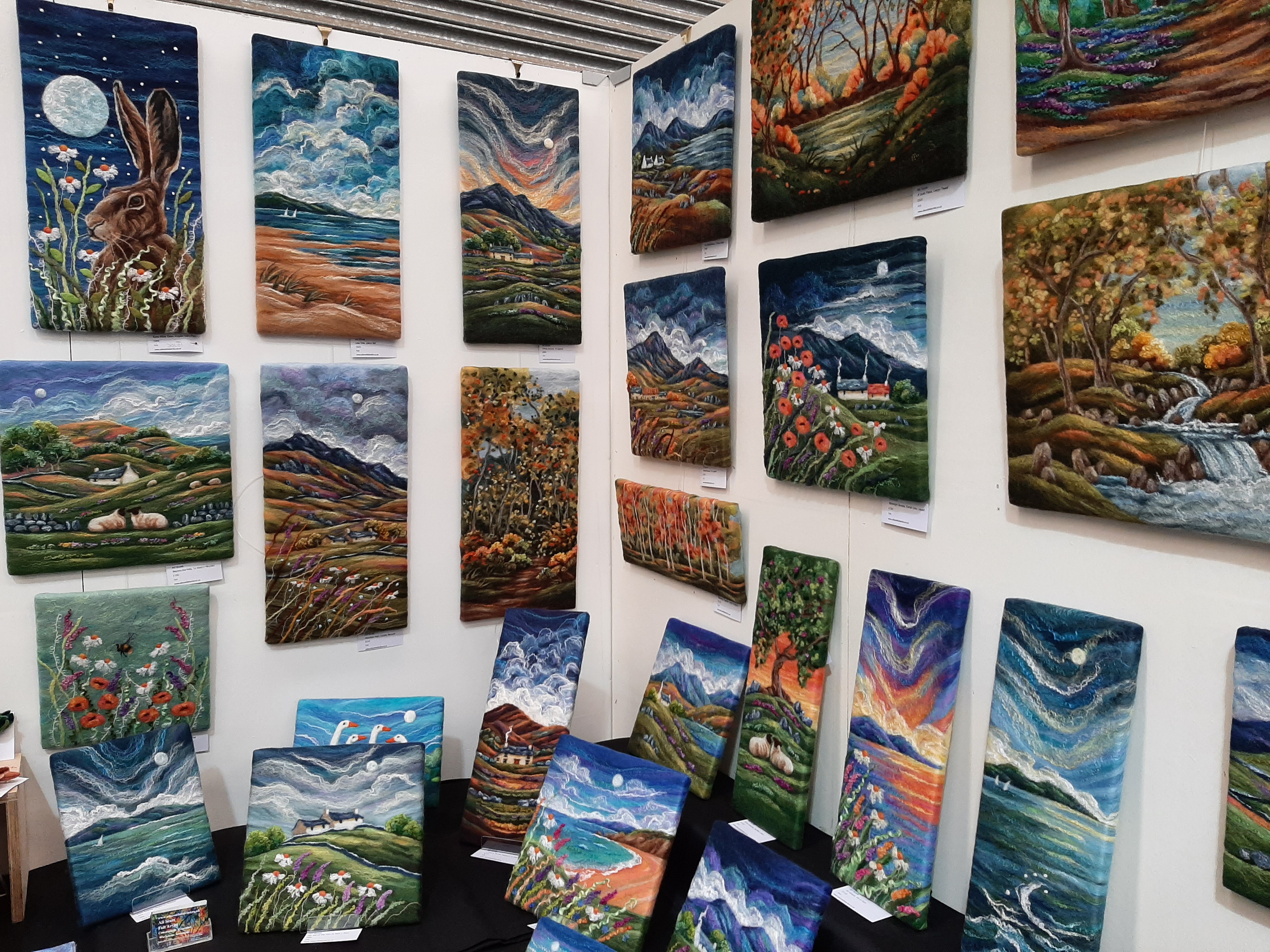
Felt art by Ali Scott www.aliscottfeltartist.co.uk
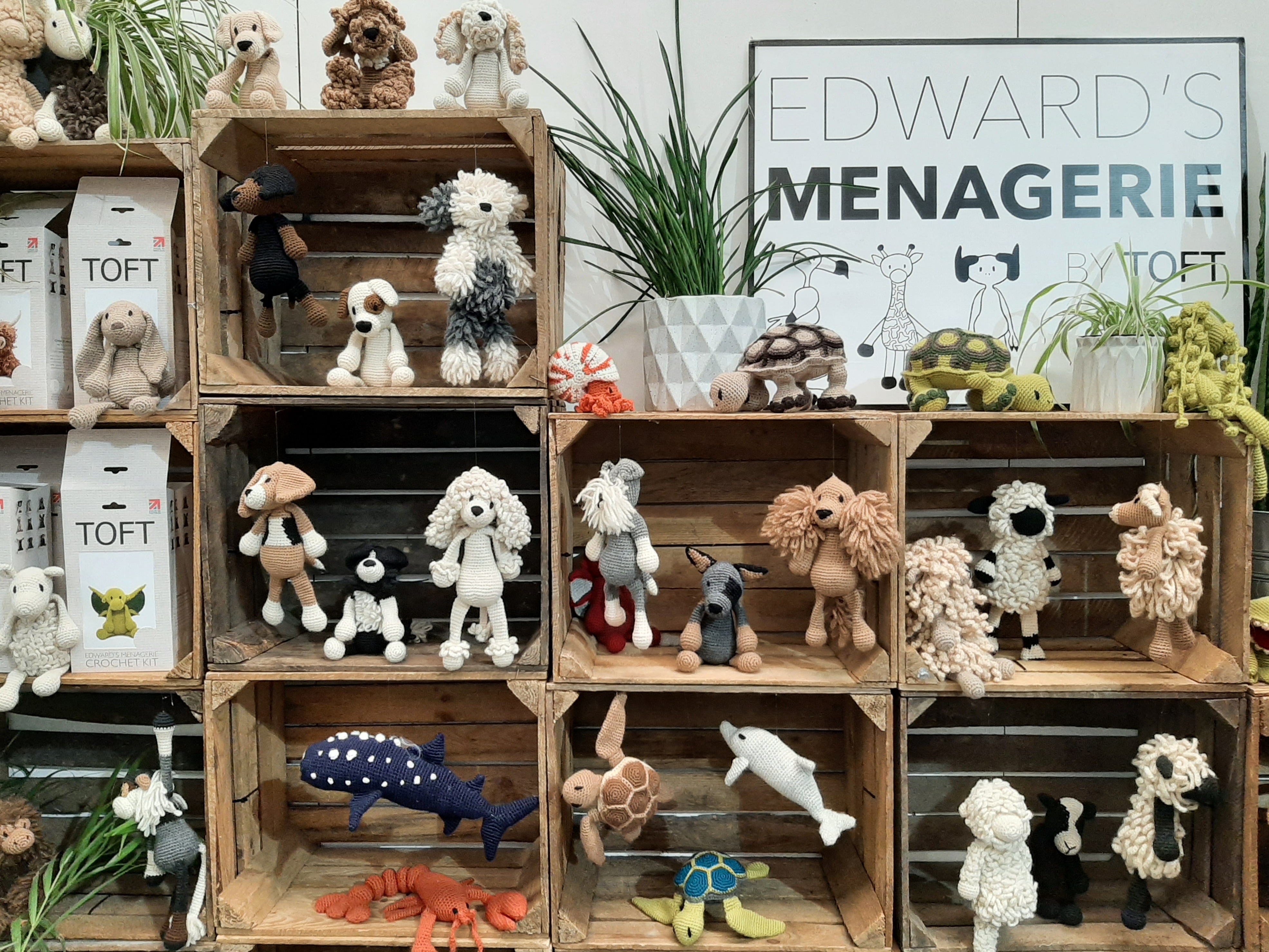
A display of knitted and crochet toy animals including a poodle, a whale and a lobster.
Kits for toys by Toft www.toftuk.com

For many of us, though, it isn’t only about the retail opportunity – although I very much doubt anyone leaves empty-handed!  There is an aspect of the event which is more like a pilgrimage, a gathering of like-minded people, an opportunity for people to connect around the passion for fibre crafts that unites us.  It serves an as annual reunion – in the weeks before Wonderwool, many of us were emailing each other to ask ‘are you going to Wonderwool?  Shall we meet up?’  Everywhere, there were greetings, especially enthusiastic this year because of the enforced separation of the pandemic which means it’s been several years since we’ve all got together like this.  I arranged to meet up with friends I haven’t seen since the last time I was at Wonderwool, texting ‘I’m here!  Where are you?’ and rendezvousing for coffee, where we compared purchases and recommended stalls as well as catching up on our lives.  And the world of wool is international – I encountered people from Sweden, Germany, and the USA, as well as from all over the UK.  Guilds and groups hire coaches to bus their members to Mid Wales.  Conversations start over a shared admiration for a yarn, a texture, a colour.  I know I’m not the only one to have made friends through casual meetings at Wonderwool.  Here, we all understand the enthusiasm for that amazing sock yarn, that beautiful spindle, the lustre of that fleece.  Here, we are amongst our own, our tribe.

A wall display of coloured yarns.
Yarns by John Arbon Textiles, Devon www.jarbon.com
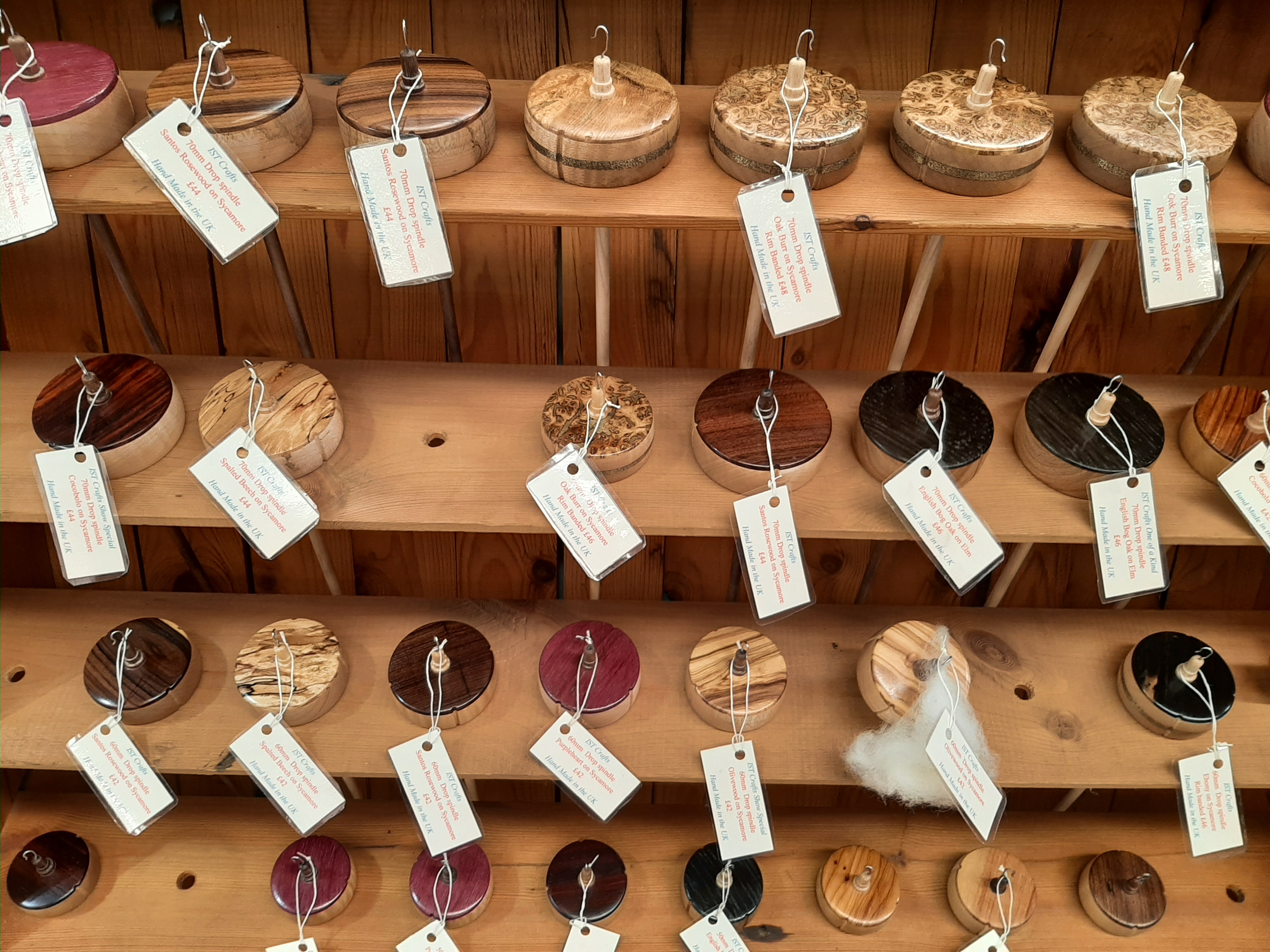
Display of hand-turned wooden spindles.
Spindles hand-turned by Ian Tait on the Isle of Wight www.thewoodemporium.co.uk

I am committed to making this blog freely available, and not putting material behind a paywall. As a writer, I am doing what I love – but I still have to make a living. If you have enjoyed this post, and if you are able to do so, perhaps you would consider supporting my work by making a small contribution via the Buy Me A Coffee button. Thank you!

Buy Me a Coffee at ko-fi.com

Judging a book by its cover – the book as art and artefact

I have always been fascinated by old books and their tooled and gilded bindings.  Years ago, when I worked at an academic library in Cambridge, a favourite part of my job was to carefully rub a special kind of polish into the leather covers to keep them fed and supple.  I would fetch the key to the climate-controlled, fireproof strong room in which the ‘special’ books were stored, select a volume which looked in need of attention, and get to work with a soft cloth.  As I worked, I would marvel at the intricate designs, and above all at the antiquity of these objects – we held books dating back to less than a century after Gutenberg’s revolutionary invention of printing with moveable type, most of them in their original bindings.  Whose hands had touched these covers and turned these pages before me?

Recently I was able to visit a remarkable exhibition at the National Library of Wales in Aberystwyth.  Entitled Beautiful Books, the exhibition consists of twenty-two books and an accompanying film which shows the bookbinding process.  Perhaps counterintuitively for a library, the emphasis is not on the content of the books, but on their bindings.  Created between 1849 and 1993, the books showcase the talents of remarkable bookbinders whose work goes far beyond simply making covers to protect the words within.

Colour photograph of the binding of Houses of Leaves, poems by Dafydd ap Gwylim, binding by Julian Thomas.  Image: Julian Thomas/National Library of Wales.
Houses of Leaves, poems by Dafydd ap Gwylim. Binding by Julian Thomas. Image: Julian Thomas/National Library of Wales

For a few years, I subscribed to the Folio Society, and a number of attractively-bound limited edition volumes were added to my bookshelves.  Apart from that, I have had little exposure to modern binding, and this exhibition was therefore quite an eye-opener for me.  As I worked my way around the glass cabinets, a few themes emerged.

These bindings are works of art, and not just in the way one says of something impressive, ‘wow, that’s a work of art!’  These fine bindings create pictures, images, in way that is reminiscent of textile art.  The use of blocks and lines of colour, gilding, texture, and motifs which respond to the subject of the book, combine to make artworks which stand in their own right.

Stylistically, they are very much of their time.  For example, the binding by Elizabeth Greenhill for Louis MacNeice’s The Burning Perch (1963) put me in mind of a tapestry by Graham Sutherland, and would not have looked out of place scaled up on the wall of a brutalist concrete building on the South Bank in London. 

In many cases, it really is possible to judge the book by its cover, as the binding gives a hint or preview of the contents.  For example, the cover created by Julian Thomas for Houses of Leaves, a translation of the work of fourteenth-century Welsh poet Dafydd ap Gwylim by Rachel Bromwich, published in 1993, takes its inspiration from the book’s title, and features lines based on the outlines of leaves and the tendrils of foliage which ornament medieval manuscripts.  And with the binding for Across the Straights by Kyffin Williams, Thomas’ collaboration with arguably Wales’ most famous artist results in Williams’ essential simplification of landscape being expressed on the book’s cover.

Colour photograph of the binding of Across the Straits by Kyffin Williams, binding by Julian Thomas.  Image: Julian Thomas/National Library of Wales
Across the Straits by Kyffin Williams, binding by Julian Thomas. Image: Julian Thomas/National Library of Wales

As a writer, it is a strange experience for me to be looking at books as artefacts as well as texts (or indeed as artefacts instead of texts – with the exhibits contained within glass cases, it is of course not possible to interact with the printed words within).  This has made me muse about the books I own.  Are some of these, too, artefacts rather than just texts?  Do I choose to have them because they symbolise my aspirations to be knowledgeable, cultured, or well-read (whether or not I’ve actually read them)?  Do some of them earn their place on the shelves because of the tactile quality of their bindings, or their attractive cover designs?  There are certainly some books I have bought because I was entranced by their covers, and others where I have been pleasantly surprised when their plain, worthy covers prove, on actually reading the book, to belie the fascinating content.  Book covers matter.

The exhibition Beautiful Books continues at the National Library of Wales until 9 December 2022- more details here: https://www.library.wales/visit/things-to-do/exhibitions/beautiful-books

Just upstairs from this exhibition is another, which also caused me to think about the significance of books.  Beibl i Bawb (A Bible for All) celebrates the four hundredth anniversary of the publication, in 1620, of the translation that became the standard text of the bible in Welsh until the 1980s.  The significance of the Welsh bible goes far beyond religion – as with many languages, the standard translation defined the language, providing a benchmark for written Welsh and a foundation for cultural and literary life to the present day.

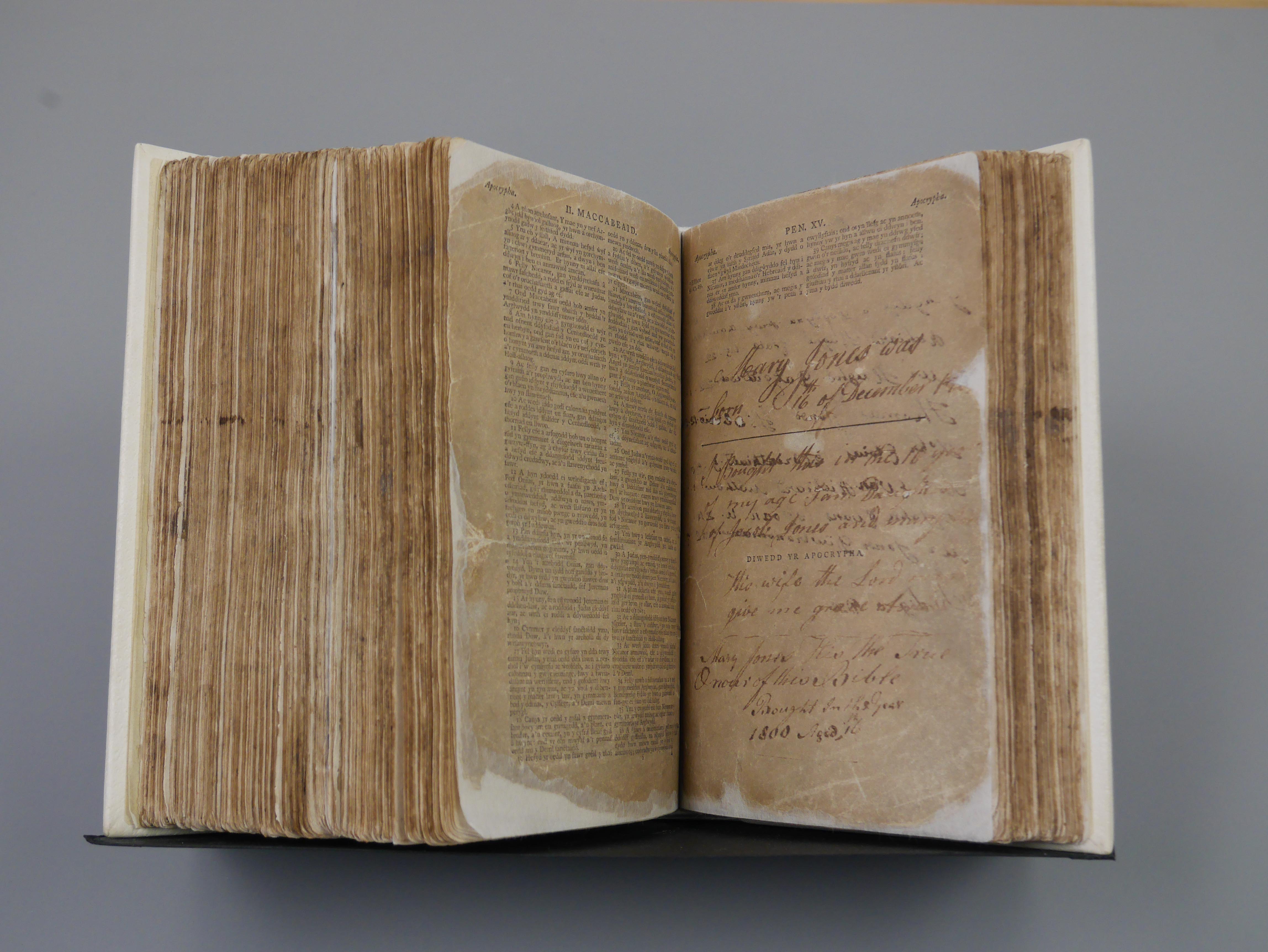
Colour photograph of Mary Jones' bible.  Image reproduced by kind permission of the Bible Society
Mary Jones’ bible. Image reproduced by kind permission of the Bible Society

Here, too, I am brought face to face with the book as artefact.  In this case, it is the bible owned by Mary Jones.  Her barefoot journey across North Wales in 1800 to buy her own copy of the bible in her own language has become a story that is told across the world.  This object – dark with use and age – is more than a book.  It connects us to an individual, a real person who held it and turned its pages, and also to a whole history of a language and the people who speak it.  And it tells the story of reading – at that time, Wales had one of the highest rates of literacy in the world thanks to the ‘circulating schools’ pioneered by Griffith Jones and his successors, which would come to a district for a while and teach people of all ages and genders to read, the aim being that they would be able to read the bible for themselves.  Literacy was perceived as what we still know it to be today – the gateway to knowledge and independent learning that can change lives.  Mary Jones’ bible is symbolic of the world of words and ideas that was opened up to her when she learned to read.  There can be few greater gifts than the ability to read.

The exhibition Beibl i Bawb (A Bible for All) is on until 2 April 2022 – more details here: https://www.library.wales/visit/things-to-do/beibl-i-bawb

I am committed to making this blog freely available, and not putting material behind a paywall. As a writer, I am doing what I love – but I still have to make a living. If you have enjoyed this post, and if you are able to do so, perhaps you would consider supporting my work by making a small contribution via the Buy Me A Coffee button. Thank you!

Buy Me a Coffee at ko-fi.com

The machine that changed the world – one stitch at a time

My pride and joy is a vintage Singer sewing machine.  It’s black and gold, is so heavy that I can hardly lift it, and celebrated its 90th birthday this year.  Built to last in an era when built-in obsolescence had not yet been invented, it is a design icon which truly changed the world, and every time I use it I am captivated again by its story.

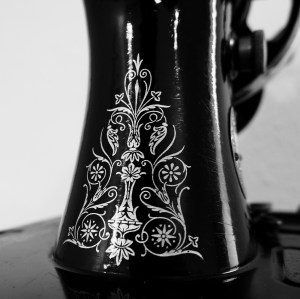
Black and white image of a Singer sewing machine

Up to the middle of the nineteenth century, all sewing was done by hand.  There was no alternative to hand-stitching – every seam of every garment made, ever, in all of human history, was hand stitched.  Then, a flurry of inventors created a variety of ‘sewing engines’, which could sew much faster than any human hand.  The most enduring of these designs was patented in 1851 by Isaac Merritt Singer of New York.  A gifted salesman, he created a network of showrooms where the machines were demonstrated, showing both that they were easy to use (‘so easy a woman could use it’ – not a slogan that would, one hopes, sell many products these days, but in its time very effective) and also that clothes sewn by machine were at least as good as those sewn by hand.

Black and white image of a Singer sewing machine

Singer’s two main markets were commercial – garment manufacturers – and domestic.  It was in domestic sales that the sewing machine created a revolution.  Diaries kept by American women in the 1860s showed that they were spending the equivalent of two days a week on making and repairing clothes for their families.  A sewing machine saved up to 90% of that time, giving them opportunities to earn money either through sewing for other people or by working outside the home.

Black and white image of a Singer sewing machine

It wasn’t just the machines themselves that changed the world – it was the way they were sold.  In the 1870s, these expensive pieces of kit were worth the equivalent of half a year’s salary for a typical worker.  Singer introduced the idea of hire purchase, where an initial deposit and regular payments would enable people to own and use a machine they would otherwise not be able to afford.  Sales boomed, and modern consumer spending was born.

Black and white image of a Singer sewing machine

Supported by a reputation for reliability and a good parts and maintenance network, by 1918 it was estimated that one in five households in the world had a Singer sewing machine.  Yes, you read that right – one in five households in the world, for it didn’t take long for the Singer company to realise that there was a market far beyond the USA.  It started its international expansion in the United Kingdom, initially manufacturing sewing machines in Glasgow, and 1882 construction started on a new factory at Kilbowie, on the banks of the River Clyde, where John Brown’s shipyard was already a major employer of skilled workers.  The Singer factory, which at the time was the largest factory of its kind in the world, was a catalyst for the development of the town of Clydebank, and it was in this factory that my Singer sewing machine was born.

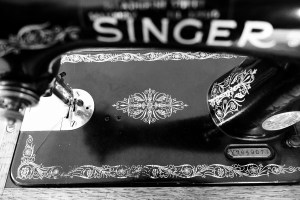
Black and white image showing the serial number of a Singer sewing machine

By tracing the serial number which each individual machine has, it is possible to find out exactly where and when a Singer was manufactured.  Serial number Y7649074 was part of a batch of 20,000 model 99K machines made in the Kilbowie factory in January, 1930.

Black and white image of a Singer sewing machine

In 1930, the Great Depression had taken hold following the Wall Street Crash of the previous year.  In January, Buzz Aldrin (one day to be the second man to walk on the moon) was born in New Jersey, and Mickey Mouse made his debut in a comic strip.  Over the next few months, the planet Pluto would be discovered, and elections in Germany would see Hitler’s National Socialists become the second largest party in the Reichstag.  Sliced bread would appear in British shops for the first time, Sellotape (Scotch tape) would be invented, and Clarence Birdseye would sell the first frozen food.  Against this backdrop, my sewing machine emerged from the last of the 56 departments in the Singer factory, its black japanned cast iron body gleaming, the gold leaf bright and fresh, its mechanism oiled and ready for action.  I would love to know who first owned it – who first excitedly turned the key to open the domed Deco-style box – whose hands first threaded the needle, wound the bobbin, turned the handle – who first proudly wore a garment created on this machine, what that garment was, what fabric, what colour.  I imagine children’s clothes, the curtains for a first home, a dress to wear to the dance, the changing fashions and fabrics of more than six decades.

Black and white image of a Singer sewing machine

My Singer came to me in the mid-1990s, in Salisbury, Wiltshire.  I had spotted it in the window of the sewing machine shop near where I worked, advertised as ‘refurbished’.  I was given it as a birthday present, and it’s one of the best presents I’ve ever had.  A quarter of a century later, it’s still in regular use.  It only has one stitch – a straight stitch – and it only stitches forwards (later machines had a reverse function), so modern stretch jerseys present it with some challenges, but for many years I made most of my own clothes.  I remember the first thing I made was a black velvet longline jacket, which I wore for years and years until it finally disintegrated.   These days, my Singer produces curtains and alters clothing, and it’s especially good – when fitted with the right needle – for shortening denim jeans.  Even though I neglect its maintenance, I have only once had to take it in for a service, because it was sticking – the guy who serviced it told me off for not cleaning the fluff out of the works more regularly!

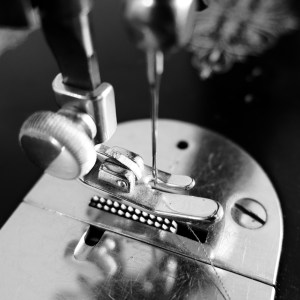
Black and white image of a Singer sewing machine

I said at the start that the Singer sewing machine was built to last.  Sadly, the affordable high street fashions of the mid-twentieth century and the advent of competition from Japanese, German and Italian manufacturers after WWII contributed to the end of Singer company’s success.  The Kilgowie factory closed in June 1980.  Together with the closure of the John Brown shipyard a few years earlier, this led to Clydebank becoming a post-industrial ghost town in the Thatcher era.  A recent (2019) BBC television documentary (The Singer Story: Made in Clydebank) interviewed a number of former employees of the Singer factory, reminiscing about its glory days.  Their pride in their work, and in the machines they produced, shone out, and I was especially struck by the words of Anna Stones, who worked in Department 55 (the parts department).  She said “You were proud to be making a small part, and to know that it was going to be a Singer sewing machine, and that it was going to give somebody so much pleasure, and was going to be sent all over the world.”  I hope Anna would be happy to know how much I love my machine.

Black and white image of a Singer sewing machine

The documentary also traced the continued use of the early twentieth-century manual and treadle (foot operated) machines into the present day all over the world, including through charities like Tools For Self Reliance who collect vintage machines, refurbish them, and send them to (often women’s) development projects around the world where they become the means for people to become economically independent.  The programme interviewed young women in Accra, Ghana who were excited to have the means to become self-employed as seamstresses, equipped with Singer sewing machines just like mine.  Here’s to the Singer sewing machine – the machine that changed the world, and still goes on changing it, one stitch at a time.