Where did my interest in historic buildings, and the way we use them today, first start? Well, it all started with a quote from Winston Churchill. I can pinpoint the exact moment: I was a second-year undergraduate, sitting in a seminar on the history of Christian liturgy, and the lecturer was getting us to think about how the layout of a building both affects, and is affected by, the activity taking place within it. He quoted Churchill’s words: “We shape our buildings, and afterwards our buildings shape us.”
In 1943, Churchill was advocating for the retention of the adversarial, rectangular layout in the re-building of the Commons Chamber of the Houses of Parliament in London, following bomb damage in the Blitz during WWII. He attributed the two-party system, which he saw as the essence of British parliamentary democracy, to this layout.
In that moment, I realised that Churchill’s principle applied not only to ecclesiastical architecture and the layout of parliamentary debating chambers, but to the buildings we live and work in. At that time, my home was a tiny eighteenth-century stone cottage in a small town in North Wales, which showed signs of having been altered a number of times to accommodate changes of use. During its lifetime, it had reputedly been a mead house, and more recently a café, as well as a living and working space for artisan households (as evidenced in more recent centuries by census records). Meanwhile, at the heart of my university campus was the original nineteenth-century building, itself a pastiche of a medieval Oxbridge college – a style reflecting the ambitions of the founders for their fledgling educational institution.
I went on to live in a series of 19th-century terraced cottages, including one that was built for the workers on the newly-constructed railway; two Edwardian townhouses, one of which had been built as a living and working space for a family of glove-makers; a number of 1960s and 1970s boxes, in various stages of dilapidation, with the sensible, regular-shaped rooms that were a hallmark of the period, but all of them a challenge to make homely; a faux-Georgian 1980s house, complete with Grecian columns beside the front door and plasterwork urns and garlands on the fire-surround, but leaky windows and a collapsing sewage drain; and a smart newbuild with four bathrooms but next to no storage (which gives an insight into how architects envisage how people will live in the houses they design), which nevertheless proved to be a nice place to live. I learned that the nicest-looking houses don’t necessarily make the nicest homes, and that each property influenced how I lived through layout, storage (or the lack of it), heating (or the lack of it), and how safe and at home I felt there. I learned that I generally have a preference for older properties, made of stone or brick, which have stood for a century or more and promise to carry on standing – and sheltering those who live there – for the foreseeable future. I learned that I don’t mind the ghosts and echoes of previous lives that have been lived in the buildings I call home, but that I do mind houses that are soulless and sterile, however well-designed they may be.
Some years after the Churchill epiphany, I went back to university to study medieval monasteries, focusing on the relationship between their architecture and infrastructure and the patterns of daily living this facilitated. I then studied vernacular architectural styles, in particular becoming fascinated by palimpsests as evidence of how the people who lived and worked in these buildings continued to shape the evolution of the buildings that had shaped them.
I worked as a consultant, enabling communities to imagine new ways to use their historic buildings, balancing the need for flexible, warm and accessible places with the need to conserve the character and historic significance of the building. And I now advise on appropriate and effective energy efficiency measures to ensure that traditional buildings and their occupants continue to survive and thrive in the 21st century and beyond. For me, it’s part of an ongoing dialogue between place and people: “We shape our buildings, and afterwards our buildings shape us.”
I am committed to making this blog freely available, and not putting material behind a paywall. As a writer, I am doing what I love – but I still have to make a living. If you have enjoyed this post, and if you are able to do so, perhaps you would consider supporting my work by making a small contribution via the Buy Me A Coffee button. Thank you!
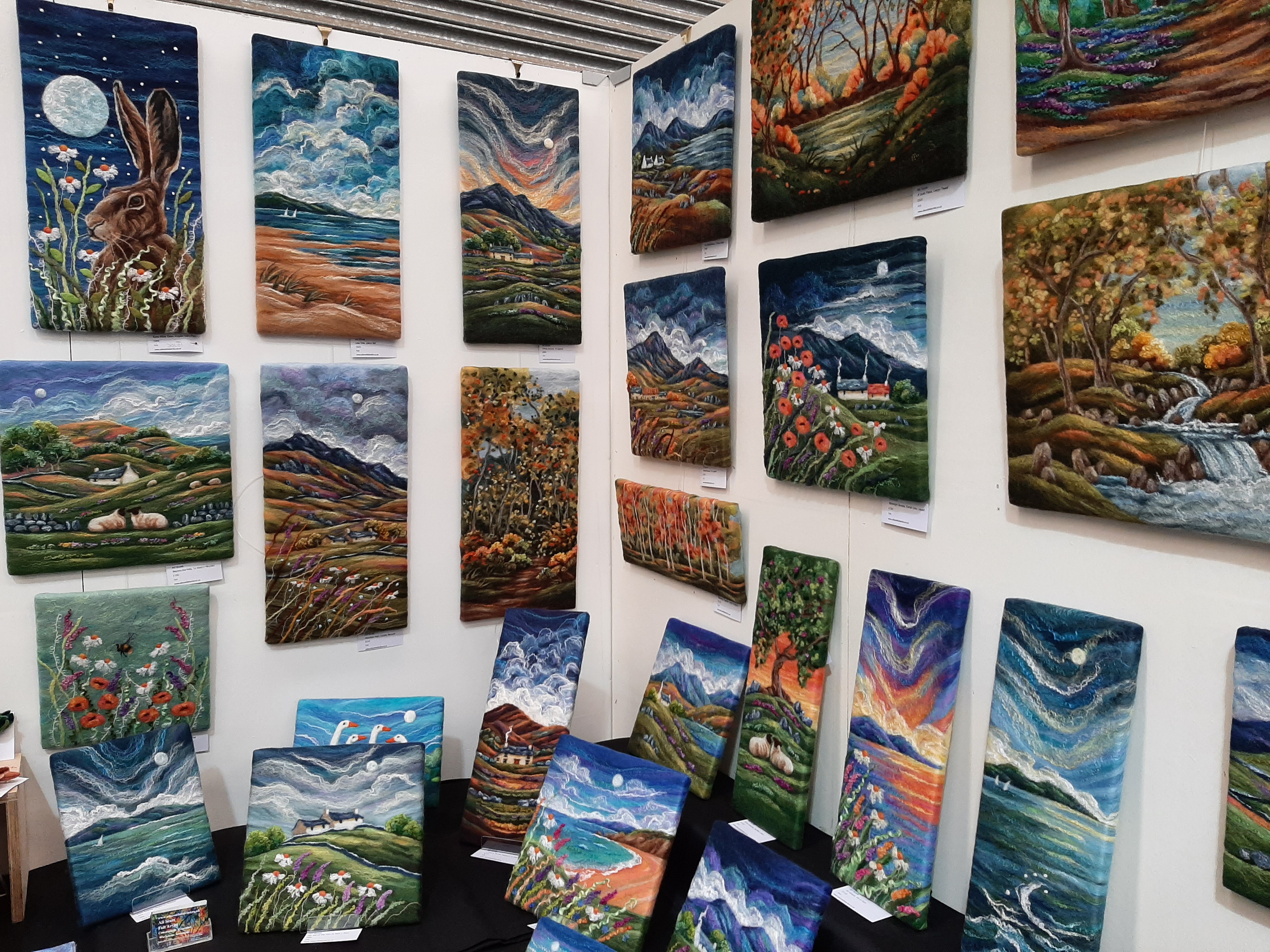
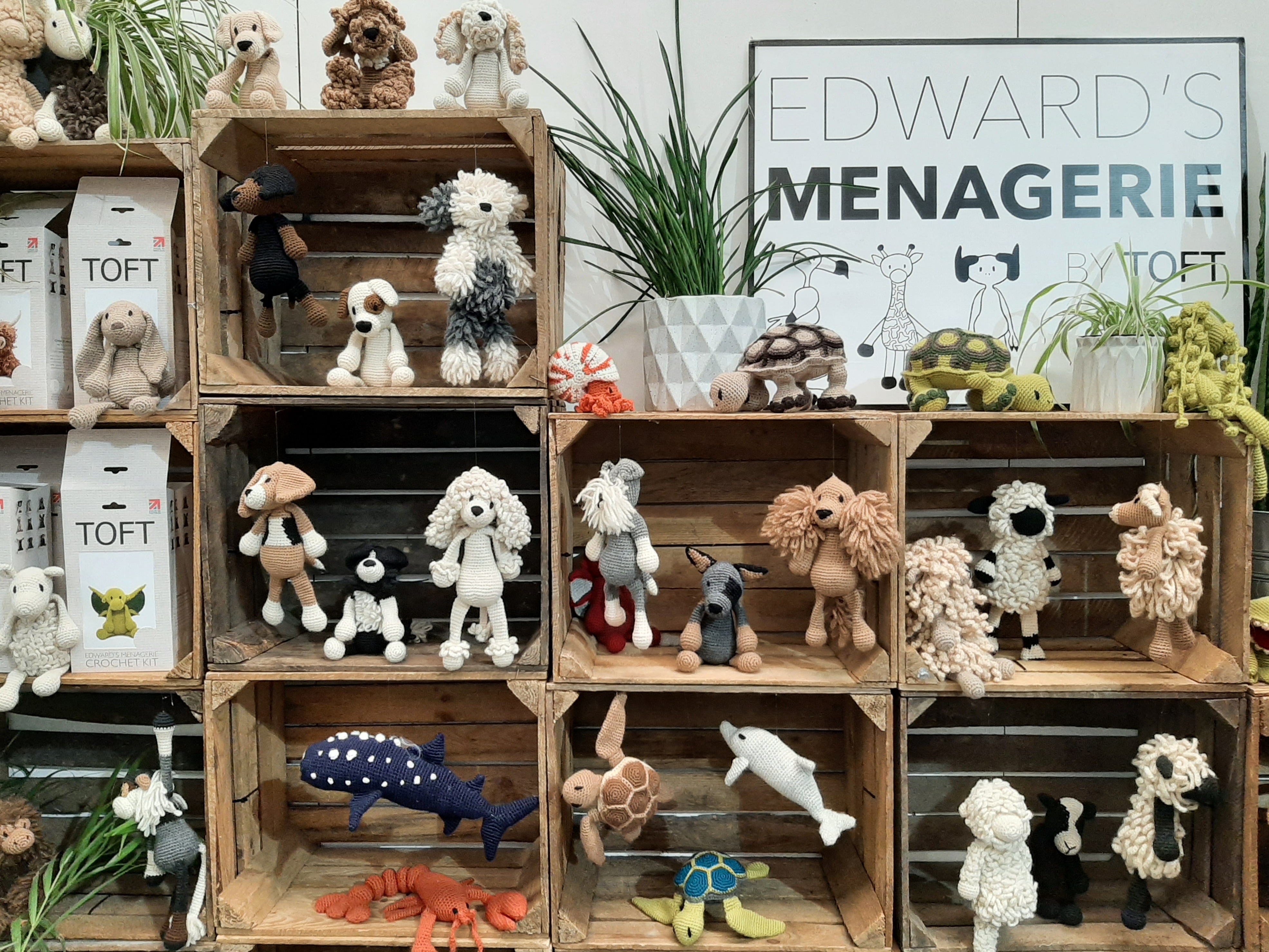
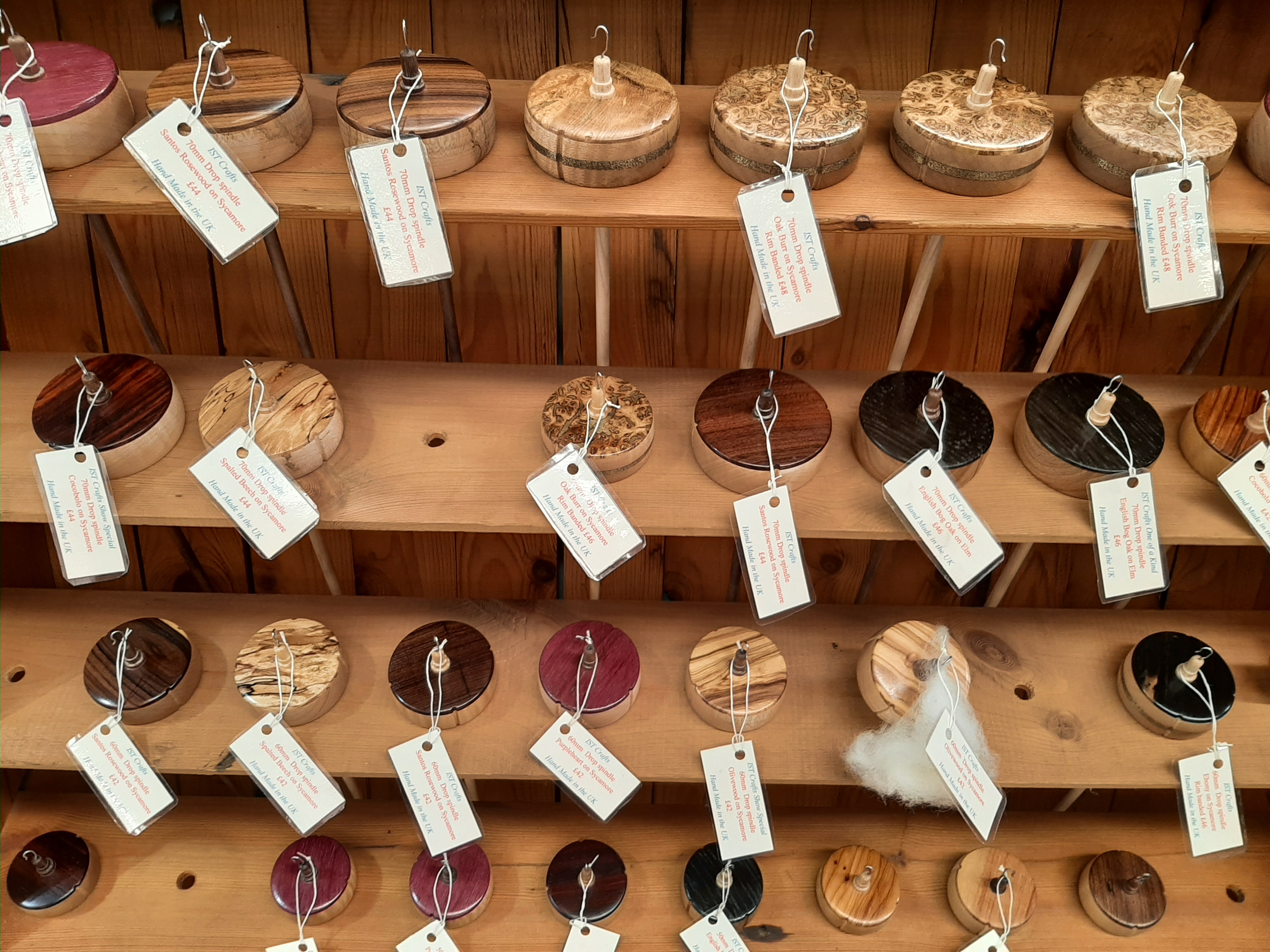
On the last weekend in April, I re-connected with my tribe. After a break of two years because of the pandemic, Wonderwool Wales was finally able to go ahead in its traditional slot of the last weekend in April, and nothing was going to keep me away. The event at the Royal Welsh Showground near Builth Wells in rural Mid Wales has taken place since 2006, and whilst it started with the idea of raising the profile of Welsh wool and providing a showcase for craftspeople and small businesses using wool, it has developed into a gathering of the fibre-obsessed from all over the UK and beyond.
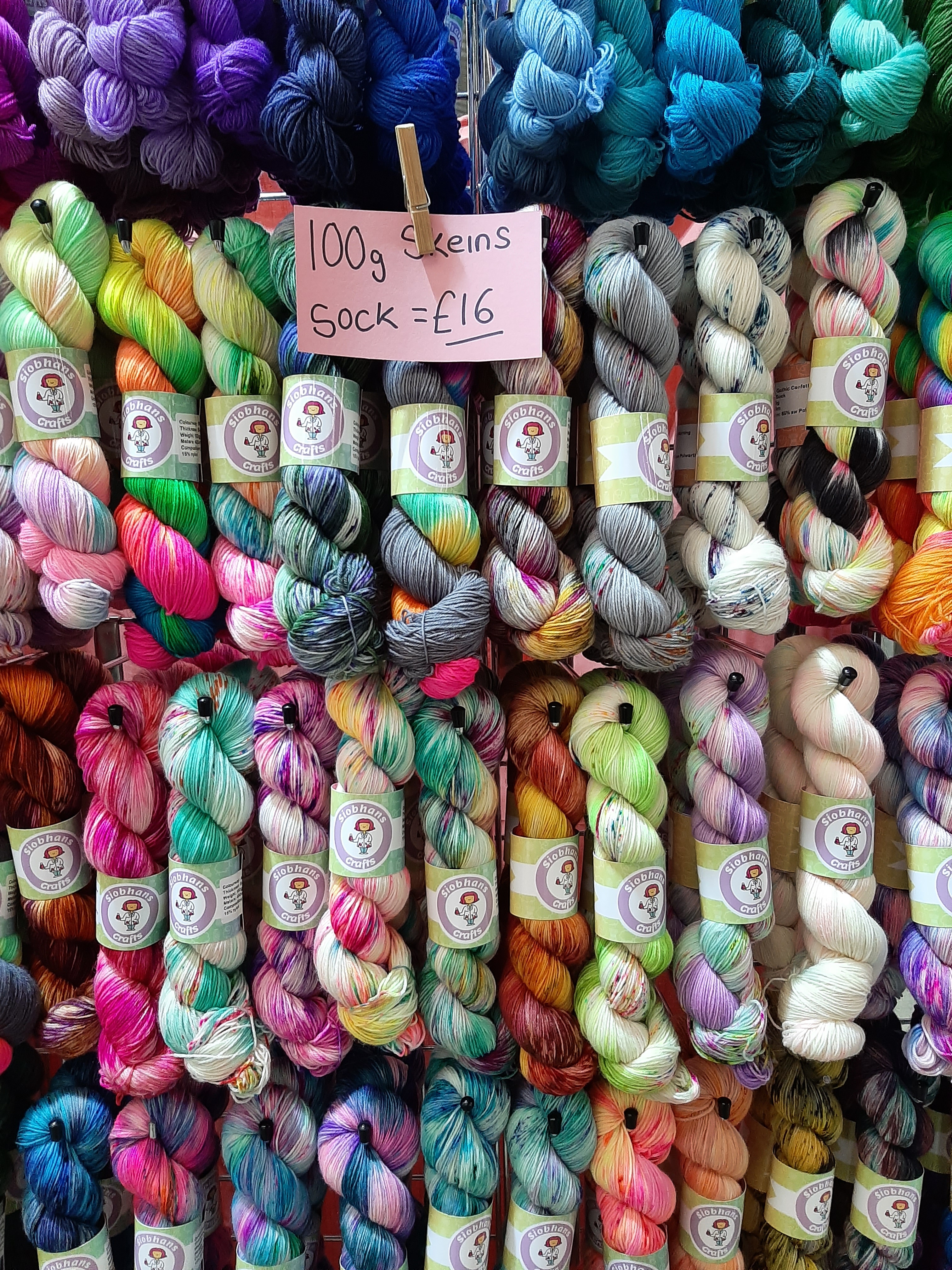
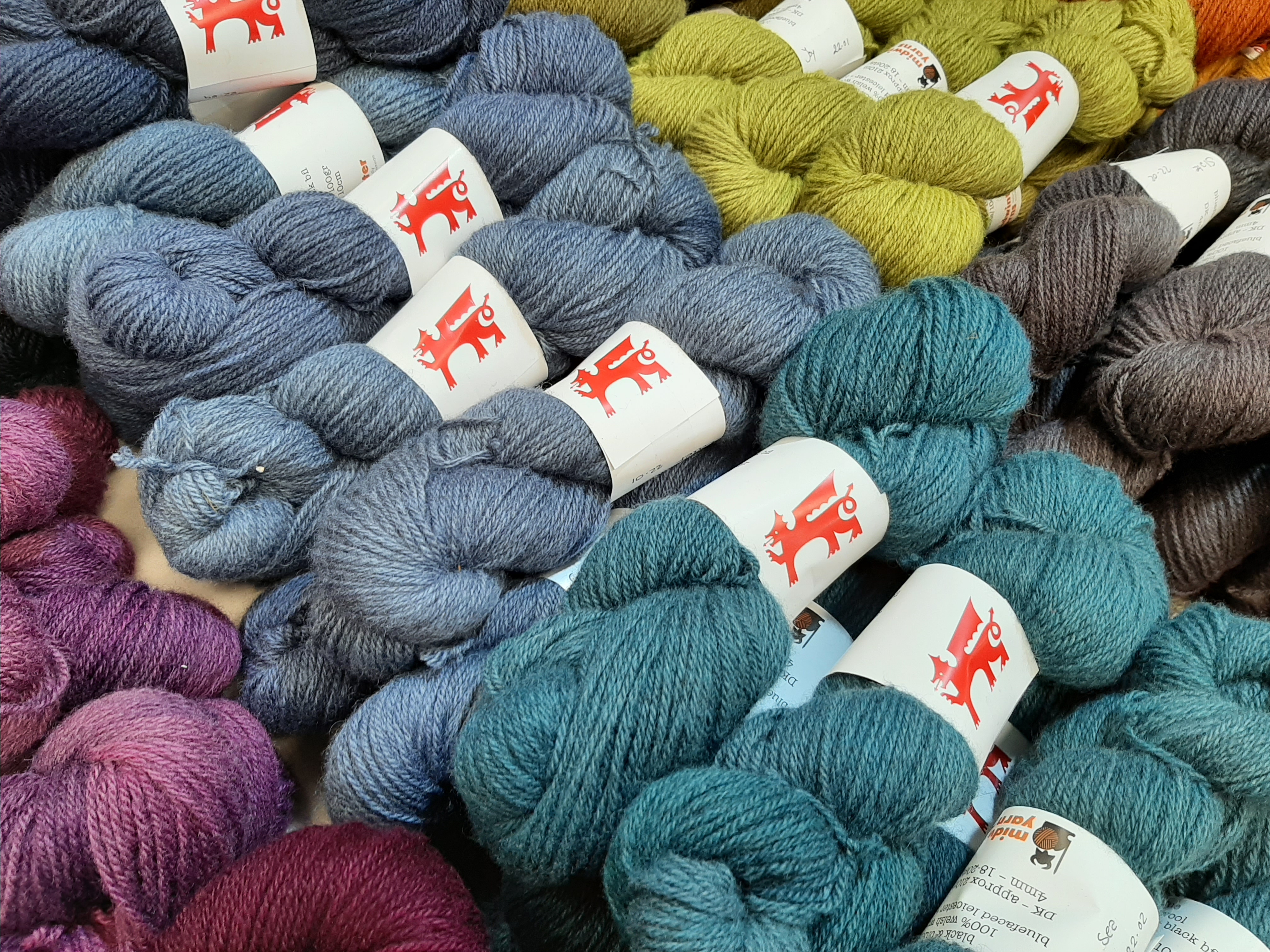
Let me try to set the scene. The venue is three large barns which, when used for agricultural shows, are full of pens containing trimmed and brushed sheep and cattle, the elites of their breeds. During Wonderwool, however, the barns become like the inside of a kaleidoscope, a sensory overload of colour and texture with nearly two hundred stalls representing sheep breed societies, craft guilds, boutique textile mills, purveyors of equipment for knitters, spinners, weavers, dyers, feltmakers – but mainly yarn, more yarn in a dizzying rainbow of colours than I have ever seen in one place. The choice is overwhelming. The first time I came, I felt like I needed a lie down in a darkened room for the rest of the weekend.
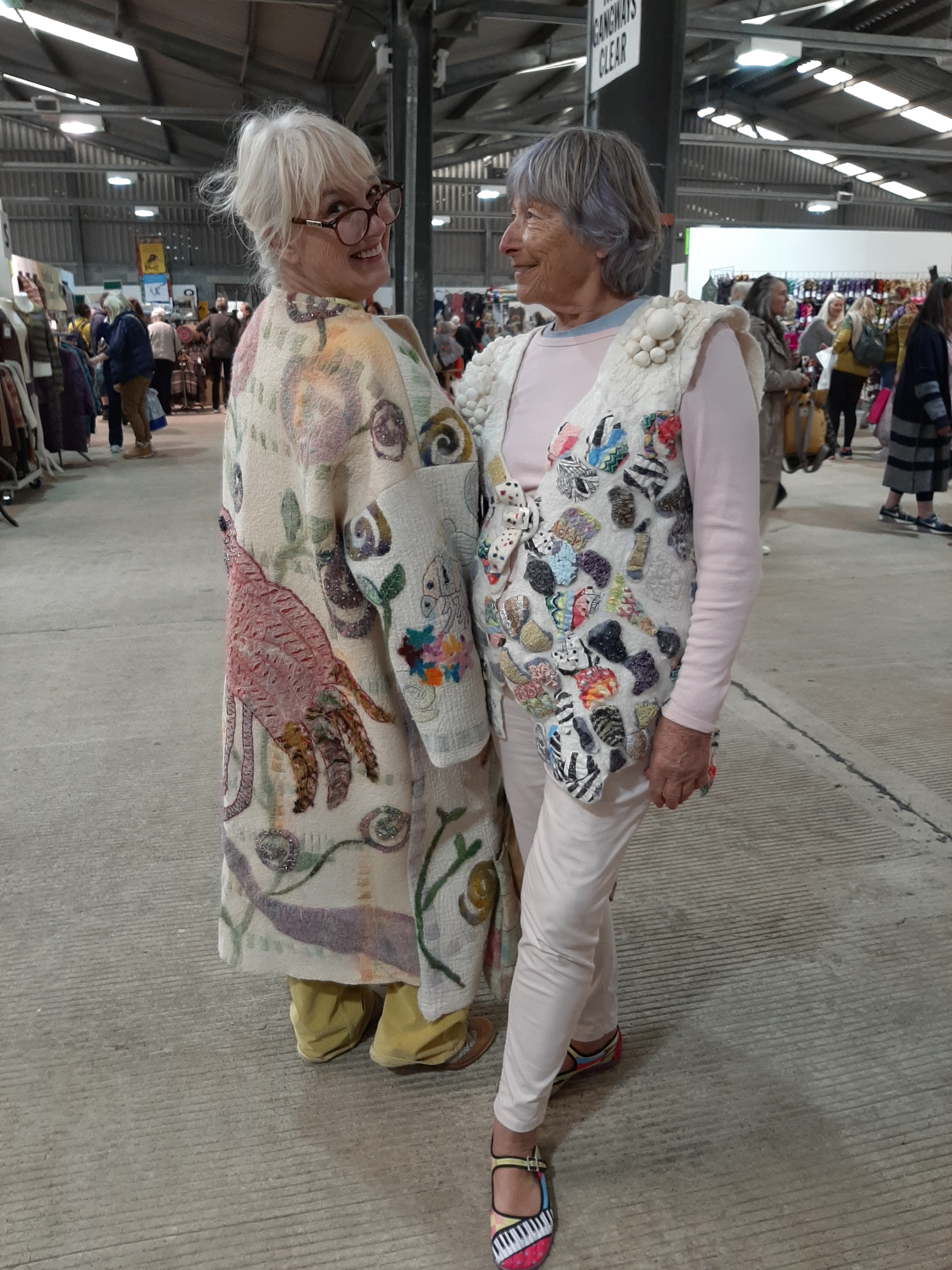
But it is not only the cornucopia of goods for sale which draw the eye. Fibre events like this (similar gatherings in the UK include Yarn Fest in Yorkshire and Woolfest in Cumbria) are an opportunity for people to show off their creations. There are several thousand people here, and seemingly every second person is wearing a handmade scarf, hat, sweater or dress. I could have photographed dozens of examples at Wonderwool, but I settled on these two ladies who had travelled to Wonderwool from Cheshire, resplendent in their stunning, unique creations which incorporate felting and stitching techniques. Fortunately, they were happy to pose for me!
Ali and Christine modelling their creations
Over the years that I have been coming to Wonderwool, I have noticed trends within the fibre crafts world. For example, a few years ago there was a plethora of yarns made from hemp/linen, organic cotton, and nettle fibres. This year, when I specifically wanted some cotton yarn for a project, there was none to be found, and remarkably little linen either. Neither was there any sign this year of the giant knitting – with yarn as thick as rope, and broomsticks for needles – which was all the rage the last time I went. The theme I could see this year was traceability – there was a strong emphasis on the provenance of the yarn on sale, with information on the flock that the fleece came from and the mill or hand-spinner that had processed it. One vendor was even able to show a prospective customer a picture on her phone of the individual sheep whose fleeces had contributed to the balls of undyed knitting yarn on sale!
I was interested, too, to see an exhibit of natural dyestuffs – a range of plant products which have traditionally been used to dye yarn and fabric – together with the yarn that has been dyed with them. There is increasing interest in natural dyes, with a number of how-to books now available (I have tried it myself, using onion skins to dye some silk fabric a vibrant, autumnal orange) and in view of the environmental impact of conventional (artificial) dyes it was good to see awareness of natural processes being raised in this way.
Despite the name, it’s not all about the wool – one particularly eye-catching stall was selling yarn made from recycled saris. The fabric is ripped into narrow strips, which can then be used to knit, crochet or weave. The colours are luminous.
Wonderwool sets out to showcase all the processes from sheep to finished article. Some of the breed societies bring ewes, with their lambs, to the show, and these are always popular. ‘Raw’ fleece – clipped from the sheep last summer – is available for those who like to process and spin their own fibre, as well as combed fibres for feltmakers and spinners who prefer a little less lanolin in their fibres! And, of course, there is yarn – so much yarn. Knitting patterns. Spindles, carders, looms. Knitting needles, crochet hooks, spinning wheels, buttons. Embellishments, dyes, bags of dyed combed ‘tops’ for feltmakers. Knitted toys. Traditional ganseys. Textile art. Yarn. And yet more yarn.
For many of us, though, it isn’t only about the retail opportunity – although I very much doubt anyone leaves empty-handed! There is an aspect of the event which is more like a pilgrimage, a gathering of like-minded people, an opportunity for people to connect around the passion for fibre crafts that unites us. It serves an as annual reunion – in the weeks before Wonderwool, many of us were emailing each other to ask ‘are you going to Wonderwool? Shall we meet up?’ Everywhere, there were greetings, especially enthusiastic this year because of the enforced separation of the pandemic which means it’s been several years since we’ve all got together like this. I arranged to meet up with friends I haven’t seen since the last time I was at Wonderwool, texting ‘I’m here! Where are you?’ and rendezvousing for coffee, where we compared purchases and recommended stalls as well as catching up on our lives. And the world of wool is international – I encountered people from Sweden, Germany, and the USA, as well as from all over the UK. Guilds and groups hire coaches to bus their members to Mid Wales. Conversations start over a shared admiration for a yarn, a texture, a colour. I know I’m not the only one to have made friends through casual meetings at Wonderwool. Here, we all understand the enthusiasm for that amazing sock yarn, that beautiful spindle, the lustre of that fleece. Here, we are amongst our own, our tribe.
I am committed to making this blog freely available, and not putting material behind a paywall. As a writer, I am doing what I love – but I still have to make a living. If you have enjoyed this post, and if you are able to do so, perhaps you would consider supporting my work by making a small contribution via the Buy Me A Coffee button. Thank you!
I am delighted to welcome Liza Achilles, a blogger based in Washington DC, USA, who has written a guest post for The Three Hares Blog.
Writing a historical novel was one of the most interesting activities I have done in my life. Unlike many other types of novel writing, historical novel writing requires a large amount of research. That research comes in several forms, as I will explain in this article. Below are 3 lessons I learned about writing a historical novel during my novel-writing journey. Perhaps these tips will help you if you tackle a historical novel project of your own.
#1 The Value of Visiting University Libraries
When I began researching my historical novel, I considered any book on my topic to be relevant. I stocked up on books from local bookstores and libraries. But I quickly discovered that not every book is of the same quality. Some books contain errors, unfair stereotyping, or generalities that gloss over key points. The books available at local bookstores and libraries were good for a cursory introduction to my subject; but to go deeper, I needed a university library.
I was fortunate that my husband (at the time) was affiliated (at the time) with first one university library and then another. Spouses were given, as a perk, a library card. I imagine that for some spouses, that wasn’t much of a boon. For me, it was a golden ticket to the stacks! (Many university libraries allow you to get a library card for a nominal fee if you don’t have a connection to the library.)
The excitement of browsing the stacks – there’s nothing like it. I would look up a subject on a computer and find a few call numbers. I would venture into some dark and crowded corner of some tower, and locate my book. I would then browse all of the nearby books, looking for something new and interesting. Often the book I took home would not be the book whose call number I found, but a book nearby in the stacks.
It was only with the help of these university books that I was able to correct errors, debunk stereotypes, and dig into important nitpicky details. All of this information was essential to crafting a novel that was as faithful as possible to the reality of what happened during my target time period.
#2 The Value of Visiting Historical Sites
No book about a location can replace a visit to that location. Books can and should supplement a visit. But there’s something powerful and special about experiencing a location in person – even if your visit does, of necessity, occur tens or hundreds of years after your target historical time.
Many historical sites have museums, plaques, monuments, grounds, or reenactments whereby you can immerse yourself in the history of the place. You can view some of the actual objects used by people during the historical period and walk on the actual terrain that was walked on back then. You can also talk with historical experts and read the extensive information provided at such sites.
I found immense value in visiting not just the site where my novel takes place, but also nearby and related sites. It’s always instructive to compare and contrast sites, to take in what is the same and consider what is different, and thus to better home in on your target historical location.
I also recommend touring public lands that aren’t part of any museum. Every place has its own flora and fauna, its own terrain and aura. Soak in the feel of the place, while being careful to distinguish between how things were during the historical time and how things are now. For example, invasive species might now inhabit the area, while other species might have gone extinct. Water levels and the climate might be different. (You can find this information through books and the Internet.)
#3 The Value of Using Primary and Secondary Sources
When researching a historical period, it’s important to distinguish between primary and secondary sources. Primary sources are writings done by people during the target time period. Secondary sources are writings done by people who came later, who wrote about the primary sources (or about other secondary sources).
Primary sources are a must-read because these are the people who were present when the action was happening. They are closest to your targeted time period and thus can be considered, in a way, most reliable. However, in another way, their reliability must be evaluated carefully, since being close to the action can result in all-too-human biases, mistakes, and sometimes even lies. This is where secondary sources come in.
Secondary sources are a must-read because these are the people who have carefully evaluated the quality of the primary sources and drawn conclusions not obvious in the primary sources. When well written, secondary sources are extremely reliable, and they may correct any factual errors, biases, or lies in the primary sources. However, when not well written, they may perpetuate errors, biases, or lies, or introduce new ones.
The bottom line is, dig into both primary and secondary sources, but read them critically and evaluate their reliability.
Conclusion
Research for a historical novel comes in several different forms. You might spend time visiting university libraries, touring historical sites, and consulting primary and secondary source materials. These activities helped me immensely while crafting my historical novel.
Are you working on a historical novel? What lessons are you learning from the experience?
Liza Achilles is a writer, editor, poet, and coach based in the Washington, D.C., area of the USA. She blogs about seeking wisdom through books and elsewhere at lizaachilles.com.
A few days ago I visited Presteigne, on the border of England and Wales (the counties of Herefordshire and Powys, to be precise). With a population of fewer than 3,000 people, Presteigne would be classed as a village in most parts of the country, but here in the remote and sparsely-populated hills it is a town, with shops and services drawing people from the surrounding hamlets and scattered dwellings. Sheep farming and tourism are the area’s main occupations, both capitalising on the sweeping hills and valleys of these unostentatiously beautiful borderlands, miles from anywhere.
Presteigne, which is called Llanandras in Welsh (loosely translating as ‘the enclosure around the Church of St Andrew’), is a historic town and was formerly the capital of the old county of Radnorshire (now subsumed into the administrative county of Powys). It still has the court house, now a museum, as a legacy from that era. The town is located beside the River Lugg, which forms the border between England and Wales. It has a long pedigree as a settlement, featuring in the Domesday Book of 1086 – however, it also has charging points for electric vehicles in the town car park, a trendy deli, a modern convenience store on the high street, and a Chinese take-away.
Modern features notwithstanding, what struck me most on my first visit to the town was how old it feels. In the centre, along the high street and the area around the church, the houses are hundreds of years old. Even where the facades appear newer, the buildings behind are constructed of traditional vernacular materials such as plaster and lath, half-timbering, cob, and stone. Some, like the building which is now a charity (thrift) shop and a barbershop, are adorned with pargetting (ornamental plaster). Centuries seep out of the walls of the buildings. Each is grounded, venerable, secure in its place, a survivor. Compared with the new-build boxes in the estates on the edge of town, which we drove past on the way in, these buildings are the ancestors which simply stayed, did not crumble and die, but remained rooted here in this community.
I find it interesting, though, that the town feels ‘old’ rather than ‘historic’. Although I’m sure there are ‘listed buildings’ here, and that there are conservation orders in place for many of the streets, it doesn’t feel like a historic theme park. Some places I’ve been – such as Holt in Norfolk, almost completely re-built in the Georgian period after a fire, or Stamford in Lincolnshire, with its picturesque stone buildings of homogenous limestone – are cohesive, visually harmonious, easy for the local tourist board to market as ‘historic’. Presteigne is different. Here, the buildings are jumbled together, built over centuries, fitted into gaps left by their predecessors, form following function. The have been re-worked over time to the needs of each successive generation of occupants, which storeys added, extensions built, windows and doors relocated or bricked up, cottages and workshops fitted into the back premises of the buildings that front onto the street. These aren’t picture-perfect ‘period homes’ – they are simply old houses, getting on with the business of living.
The contrast with the new houses on the estates is profound. It is, in essence, a contrast between convenience and character. These old houses are themselves – they have mass, substance, personality – they have their own stories. The new houses are just blank pages. Will the stories created there leave an imprint on the new buildings in the same way they have on the old? I doubt it somehow. The old buildings are not simply receptacles for living in. They are themselves protagonists, characters in their stories. They have adapted – with varying degrees of success – to the changes in society, in the way people live, and in technology, and the palimpsests of those changes are written upon them. Have the new houses been built to last enough centuries to gain their own palimpsests, their own ghosts, to be characters in their own stories? Looking at the neat estates of bungalows and semis, it’s hard to imagine. Yes, the new buildings are more economical to heat, have regular-shaped rooms, conform to modern building standards. But with little expectation that new-builds will last more than, perhaps, 60 years, issues of sustainability must be measured against the hundreds of years of service given by the timber frames and quarried stone walls of the old buildings. What does that difference in life expectancy say about our society’s attitude to homes, to permanence, to community?
Walking back through the high street to the car, I felt acutely aware of the long line of people who have come to Presteign in the last millennium and more, to live, to trade, to pause – as I was doing – on a journey. The buildings I passed have seen perhaps the last 20 generations of those people, who walked and shopped and greeted people on the street as I did that day. And in some indefinable way, the buildings are imprinted with their presence.
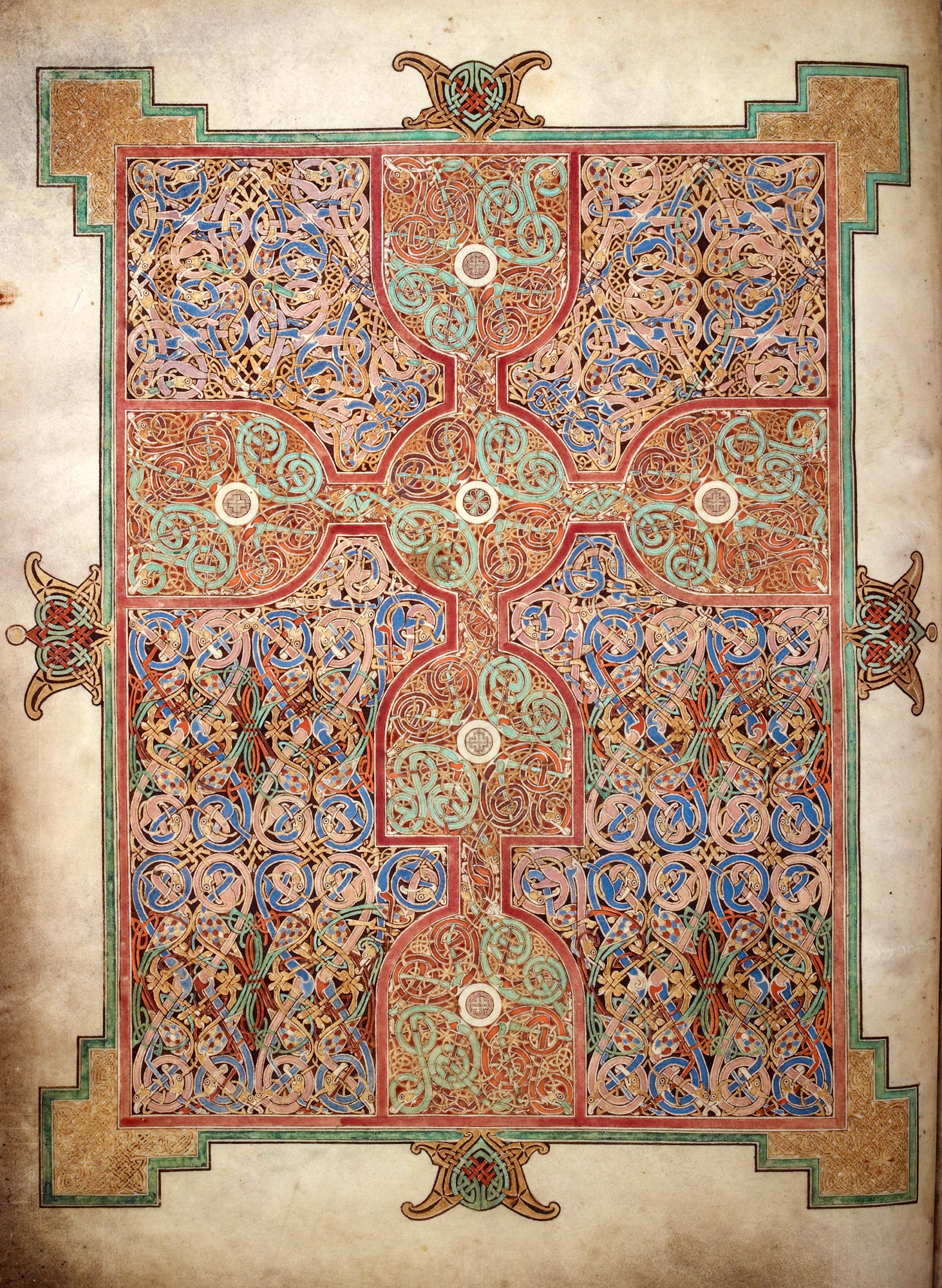
For the last few weeks I have been researching the Lindisfarne Gospels and writing an article about them for an e-magazine. For those of you not familiar with the Lindisfarne Gospels, they are a lavishly illuminated hand-written book of the four Gospels (Matthew, Mark, Luke and John) of the New Testament, in Latin, produced by a scribe-artist called Eadfrith around 700CE, in the monastic community on the island of Lindisfarne (aka Holy Island) off the coast of Northumberland in North East England. About 250 years later, a word by word translation (or ‘gloss’) in Old English was added above each line by a priest-scribe called Adred, at Chester-le-Street where the community was then living, having fled the island after raids by Vikings.
Incipit, Matthew’s gospel, Lindisfarne Gospels. British Library Cotton MS Nero D IV f.027r
The art of the Lindisfarne Gospels is quite widely known today – the manuscript has been digitised and is available on the British Library website, and its motifs are used on all manner of historically-inspired merchandise. But, though beautiful, the art is not what excites me about the Lindisfarne Gospels. What makes my heart beat faster is that sense of glimpsing into the distant past something which connects us physically with the individuals who created it more than a millennium ago.
Far from being dry and academic, my research has been a fascinating journey into the England of the early medieval period – what used to be called the Dark Ages, between the departure of the Romans in the 5th century CE and the Norman Conquest in 1066, during which time it was thought that culture, learning and civilisation were largely absent. Historians think differently now, in no small part due to the artefacts produced in this period which have been found in various excavated hoards, and probably most famously at the ship-burial at Sutton Hoo which was excavated on the eve of World War II and which was found to contain jewellery of breath-taking beauty and craftsmanship. The sophistication shown in the illuminated manuscripts of the time is now seen, not as an exception, but as representative of the high standards of creative skill on the part of the peoples of the time.
Carpet page, Matthew’s gospel, Lindisfarne Gospels. British Library Cotton MS Nero D IV f.026v
In an era before print, the production of a book – even the most plain and workaday one – was a major undertaking. First, the vellum which formed the pages had to be prepared from the skins of young animals – calves or lambs – and trimmed and pricked in preparation for the binding process (making the Lindisfarne Gospels required the skins of almost 150 calves). Lines had to be marked out on the page (Eadfrith invented the lead pencil, and the lightbox, to do this). Ink had to be prepared, using oak galls and iron. Feathers – ideally big sturdy ones like the flight feathers of swans – had to be trimmed into pens. Then the scribe had to copy the book painstakingly from an exemplar, without the benefit of electric light. It could take years to produce a book – years of dedication, focus, bad backs, cold, working in a scriptorium lit only by south-facing windows in the summer and candles in the winter. A number of scribes left notes in the books they produced, complaining about their discomforts – issues around health and safety at work and RSI are not new!
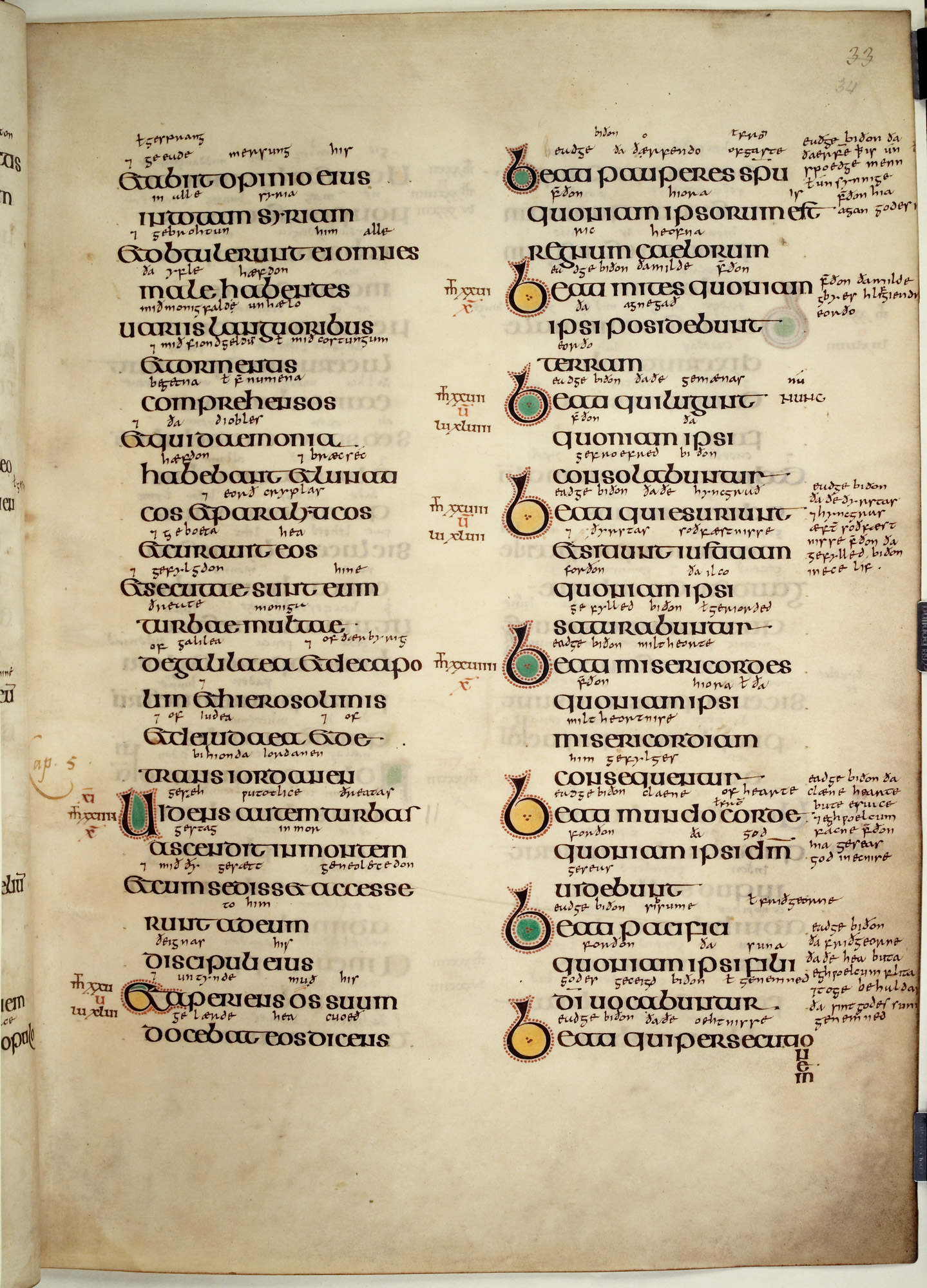
The Beatitudes, Matthew’s gospel, Lindisfarne Gospels. British Library Cotton MS Nero D IV f.034r
What I love about these documents, though, is the immediacy of something which was produced by hand. Just as our own handwriting is distinctive to each of us, it is possible to identify individual scribes by their handwriting. Often, teams of up to half a dozen scribes and artists would work on a book – the Lindisfarne Gospels are unusual in having been written by just one man. It is thought that it must have taken Eadfrith several years to produce the text and illustrations for this work. It can be a stretch of the imagination, in 21st century Britain, to imagine the life of a 7th century monk on a windswept island in the North Sea, toiling on this work of great beauty, to the glory – as he would have seen it – of God. Even as a visitor to Lindisfarne, it’s a challenge to look beyond the cafés and gift shops, the retreat centre and the museum, and the ruins of the later Norman priory, and picture this as a working monastery, its central work of prayer and worship buttressed by farming, fishery and the creation of high-quality books. Seeing the personal handwriting of one of those monks, the strokes made by his pen, the drawings and embellishments he drew in the colours he chose (and created himself from mineral and plant pigments), brings him within reach. Just as when, while researching your own family history you come across a 1911 census return in the handwriting of an ancestor you have never met and who died long before you were born, it makes them more real, so seeing Eadfrith’s handwriting brings him to life for us.
And in the Lindisfarne Gospels we are lucky enough to have the handwriting of two identified people. I mentioned earlier that an Old English word-for-word translation (or gloss) was added in the middle of the 10th century. We know that the man who did this was called Aldred, because he left us a note (a colophon) at the end of the Gospels to tell us so. He also names Eadfrith as the original scribe/artist, as well as crediting the people who bound the book and made a jewelled cover for it. By translating the text into English, Aldred was part of a movement championed by King Alfred (‘the Great’) in the late 9th century to make English a language not only of the people but also of learning and religion, alongside Latin. Here we not only have Aldred’s handwriting, we can also see him wrestling with language as he frequently offers several alternative translations of Latin worlds into Old English. Anyone who has ever attempted to translate from one language to another will relate to this!
Aldred’s colphon, Lindisfarne Gospels. British Library Cotton MS Nero D IV f.259r
In these times of emails, word-processing and SMS, handwriting is becoming a dying art. In one way, that doesn’t matter – as long as we are communicating with words, it’s irrelevant how they are produced – but in other ways we are maybe losing something. There is no digital equivalent of the personal, intimate legacy of someone’s handwriting – the notes and letters of past generations, which are often all we have left of our own families – and future generations will not experience the particular thrill of poring over a hand-written document produced by known, named people over a millennium ago. I wonder what ways they will have instead to connect to the human individuality of the people whose words they are reading?
My article on the Lindisfarne Gospels is published in Issue 7 of The Pilgrim, which is available online here.
I am committed to making this blog freely available, and not putting material behind a paywall. As a writer, I am doing what I love – but I still have to make a living. If you have enjoyed this post, and if you are able to do so, perhaps you would consider supporting my work by making a small contribution via the Buy Me A Coffee button. Thank you!
A couple of nights ago a lantern appeared in the window of a house round the corner, with banners wishing passers-by a ‘Happy Hanukkah.’ In my street, each evening sees more Christmas lights wrapped around shrubs or strung up in windows. A few weeks ago, millions of people celebrated Diwali, the festival of light. Very soon, we in the northern hemisphere will be rejoicing that the shortest day has come and that, with the Winter Solstice, the world is moving back towards the longer, lighter days.
Until recently, I wasn’t an enthusiast for festive lights – a pyrophobe since childhood, the risks of fire associated with strings of electric lights always put me off having them on the tree. But these days, lights are safer and the bulbs cooler, and there are even battery-powered ones available which don’t require power cables snaking across the room to trip up the unwary, and my partner has always liked lights, so for the last few years I have joined in quite happily, if passively. This year, though, has been different.
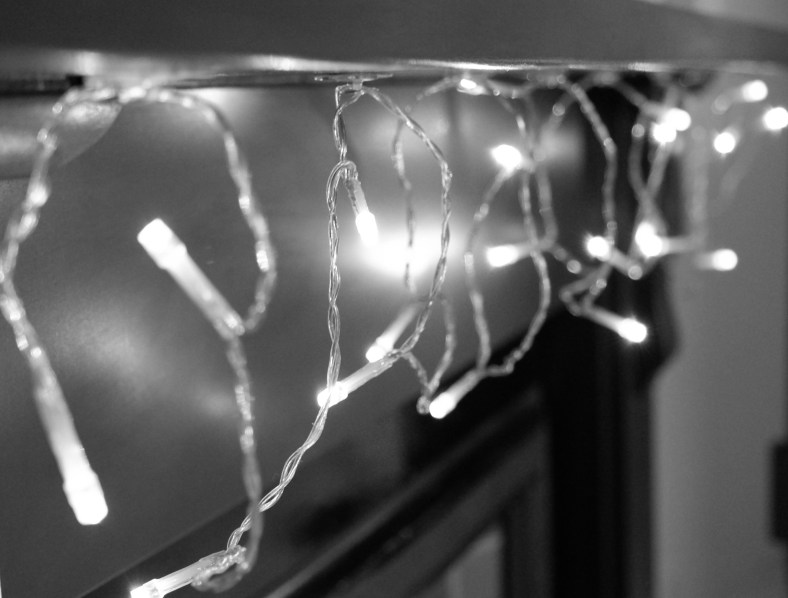
Not only have we used our ‘old’ lights but we have been out and bought three sets of new ones. We have lights in the Christmas tree. We have lights in the front window, and we make sure they are switched on as soon as dusk falls to cheer passers-by. There are five metres of lights draped around the fireplace. A glass vase has been filled with tiny LED lights. There’s a candle in the festive wreath on the coffee table. There’s a candle on the dinner table. There is sparkly tinsel everywhere to reflect the lights. The only reason that there are not more lights is that we have run out of sockets to plug them into! This year, it feels particularly important to participate in lighting the dark evenings of the last weeks of the year. Each evening, the switching on of the lights creates a glow of positivity and cosiness in our home, whatever is going on in the world outside.
I find it interesting that, over thousands of years, religions and cultures across the world have felt the need to develop customs and festivals associated with light in the darkest time of the year. In Judaism, Hanukkah commemorates the re-dedication of the Temple in Jerusalem, and the story of how one day’s supply of blessed oil miraculously lasted for eight days, so that the menorah (branched candlestick) could be kept lit until new oil could be prepared. Traditionally, a nine-branched menorah is lit during the festival (one light for each of the eight days of the miracle – the ninth branch holds the light from which the others are lit). Across the world, Jewish households place the menorah in windows which face the street, and it is a time of feasting.
Diwali is also known as the Festival of Light. Its name derives from the Sanskrit deepavali, meaning ‘row of lights’ and is celebrated as a religious festival by Hindus, Sikhs and Jains. It represents the triumph of light over darkness (and by extension the triumph of good over evil and knowledge over ignorance). Homes, temples and businesses are decorated with lights inside and out, and the skies are lit by fireworks. And there is, of course, feasting.
Christmas celebrates the birth of Jesus Christ, whom Christians call the Light of the World. Although the date of his birth is unknown, celebrating it around the time of the pagan midwinter festival has been the custom in the northern hemisphere for many hundreds of years, and a wealth of imagery in art, carols and literature places the Nativity in snowy scenes, with the Star of Bethlehem clearly visible over the stable in a dark, frosty sky. Candles figured largely, with real candles shown on the first Victorian Christmas trees when the custom was imported from Germany (allegedly introduced by Queen Victoria’s German husband, Prince Albert). As you can imagine, the idea of lighted candles amongst the resinous branches of fir trees is the stuff of nightmares for me! Christianity borrowed many of the midwinter customs of the peoples it converted, including – perhaps inevitably – feasting.
Here in Glastonbury, there are probably as many people preparing to celebrate the Winter Solstice, or Yule, as there are those who celebrate the Christian Christmas. Most of us will have a fusion of customs – lights will mark the ‘Light of all people’ who came into the world at Christmas, or the triumph of the sun as it defeats the darkness of the longest night. We sing the carols “Deck the Halls with Boughs of Holly” and “The Holly and the Ivy” and decorate our homes with the same evergreen branches which have been a staple of midwinter celebrations for millennia, symbolising the continuity of life even in the dark depths of winter. Normally, of course, there would be feasting – roast birds, Christmas pudding and mince pies all part of a rich heritage of midwinter jollification going back to before records began – but in this year of Covid-related restrictions there will probably be rather less feasting than usual. Certainly the family and community feasting of Diwali and Hanukkah have already had to be more subdued this year.
But in a year that feels dark, sad and fearful for many, it feels like an act of defiance to light the candles and switch on the lights. Our community celebrations may be muted, and our feasting limited to our own households, but we can still shine our lights into the darkness and say that we are still here, we are still celebrating, and that we know that light will overcome the darkness.
I am committed to making this blog freely available, and not putting material behind a paywall. As a writer, I am doing what I love – but I still have to make a living. If you have enjoyed this post, and if you are able to do so, perhaps you would consider supporting my work by making a small contribution via the Buy Me A Coffee button. Thank you!
I am again writing about place – places in the landscape which have a long tradition of spiritual significance. Looking beyond obvious places like Stonehenge, I’m interested in holy wells, hilltops and groves, and sites where, for example, a present church overlays earlier, even pre-Christian, places of worship. At a time when travel around the United Kingdom is constrained by regulations to control the pandemic, my early researches will mostly need to be limited to books and online, but there are a number of sites which I can get to easily from home, or which I know well, these seem like a good place to start.
Some years ago I lived in the neighbouring county of Dorset. Specifically, I lived at the foot of Hambledon Hill, and its green mass filled the view from my study window. In the summer, I would walk up to the top and lie flat on my back in the grass, squinting up into the blue sky and trying to spot the skylarks which I could always hear, but rarely see. If I was very lucky, I would be visited by an Adonis Blue butterfly, a rare species which likes the chalk grassland habitat where the grass is kept short by conservation grazing.
I never felt on my own up there. Even when there were no dog-walkers, butterfly enthusiasts or hikers, there was always a sense of people being present – as if at any moment I might glance up and see someone. The hill felt at once very peaceful and very busy, and also very, very old. Some places feel like that – as if the echoes of human footsteps and the shadows of their movements are left behind from the distant past, maybe even from before history as we know it. I notice it especially in places that have been inhabited longest – the landscape of barrows or stone circles, of hill forts or cave art. It is probably fanciful – but I think I’m not the only person who is sensitive to the fleeting impressions left by the people who were in a place long ago.
Hambledon Hill has drawn people to it for over five thousand years. The Neolithic peoples who had started to farm the land in the valleys below built an enclosure on the top of Hambledon Hill. It was a significant high point in the landscape, providing a good defensive position against both the east (the chalk uplands of Cranborne Chase) and the west (the fertile Blackmore Vale). There is archaeological evidence for at least seasonal occupation over several hundred years, with remains of goods originating as far away as Devon, and some of the earliest evidence of grape cultivation in Britain. These people buried their dead in the long barrows – burial mounds – on the crest of the hill. The site continued to be used by the Beaker People – early Bronze Ages arrivals – but the main impact on the hill as we see it today came in the Iron Age. Three rings of ramparts were built, changing the outline of the hill and creating an impressive defensive hill fort, complete with three staggered entrances. The enclosure created by the ramparts contained some hundreds of small roundhouses. Despite the scale of this endeavour, archaeologists believe that Hambledon Hill was eventually abandoned, probably about 300 BCE, possibly in favour of nearby Hod Hill, which was itself in turn appropriated by the invading Romans.
But Hambledon Hill continued to be a significant feature in the landscape, and when the Anglo-Saxons arrived in the area several hundred years later they adopted the hill as a cemetery site. Who knows whether their choice was influenced by an understanding that the long barrows were ancient burial sites? In any event, the Anglo-Saxons identified Hambledon Hill as a suitably exalted location for the burial of their own dead.
Nowadays, the dead of the village at the foot of the hill are buried in its churchyard, but people still come to Hambledon Hill. It is on a long-distance walking route, bringing many hikers to marvel at the view of Blackmore Vale, set out like a chessboard below. Locals walk their dogs here, naturalists come to study the rare species of plants and insects. And the ongoing significance of the hill, with its millennia of human history and its present role as a nature reserve, is reflected in its purchase in 2014 by the National Trust, the largest conservation charity in Europe.
Up on the hill, the skylark’s song seems timeless, connecting the stories of the people who have come to Hambledon Hill down the millennia. Sadly the skylark is on the Red List of endangered species, so it is unlikely that many more generations of visitors will be able to enjoy their ethereal trilling high in the summer sky. But the place has seen many species come and go, including humans, shaping it and leaving traces of their lives behind them. I wonder what relationship the humans of a thousand years from now will have with Hambledon Hill?
This weekend it’s Halloween – or the pagan festival of Samhain, depending on your preference. Here in Glastonbury it’s mostly the latter, and under normal circumstances it’s marked in a big way. For this small town, it’s not just about trick or treat, or carved pumpkins. The Samhain procession is one of the main events of the year, with dragons (dramatic), drummers (noisy) and Border Morris dancers (downright scary). Never mind the mass-produced fancy dress costumes of skeletons, ghosts and monsters – here it’s just as likely to be swathes of black and green velvet, horned headdresses, and real witches’ hats. Yes, it’s fun, but it’s also at least in part about serious beliefs.
The old Celtic festival of Samhain (pronounced something like ‘Sow-en’ – sow as in female pig, rather than sow as in seeds) was characterised by feasting – the beasts which would not make it through the winter were slaughtered, and the harvest was in, so this was a time of plenty. The spectre of death loomed, though – this was both the end of summer and the beginning of winter, with the leaves dying and the prospect of cold, hungry months ahead. Many of those who feasted at Samhain would not make it through to feast again at Beltane, on the other side of the wheel of the year.
With the arrival of Christianity, 1 November became the feast of All Saints – All Hallows – where all the holy who had died were commemorated. Until the Reformation, people were encouraged to pray for the souls of the dead, and especially their dead ancestors. In much of Europe, this remains the time when families visit the graves of their loved ones to leave flowers. Church services are held to remember those who have died. It’s not clear whether the Celtic festival had these connotations of communing with the dead too, but certainly modern pagans speak of this being a time when the veil between the material world and the world of the spirits is at its thinnest, and it is possible to move between the two. This links to folklore around Halloween (All Hallows’ Eve, the evening before the festival) when this is the night for ghostly apparitions, when the dead, witches and other supernatural beings walk abroad. And whilst many people, quite understandably, deplore the recent advent of ‘trick or treat’, with its element of threat and licence to misbehave, the history of going from house to house, often in costume, begging for food and playing pranks dates back at least a couple of hundred years in the British Isles. In some areas it even has the name ‘Mischief Night’. Carved pumpkin lanterns may be a recent import from across the Atlantic too, but in various parts of the country – and especially here in Somerset – turnips or mangel wurzels were hollowed out and made into lanterns, the carved faces said to represent the dead and intended to frighten.
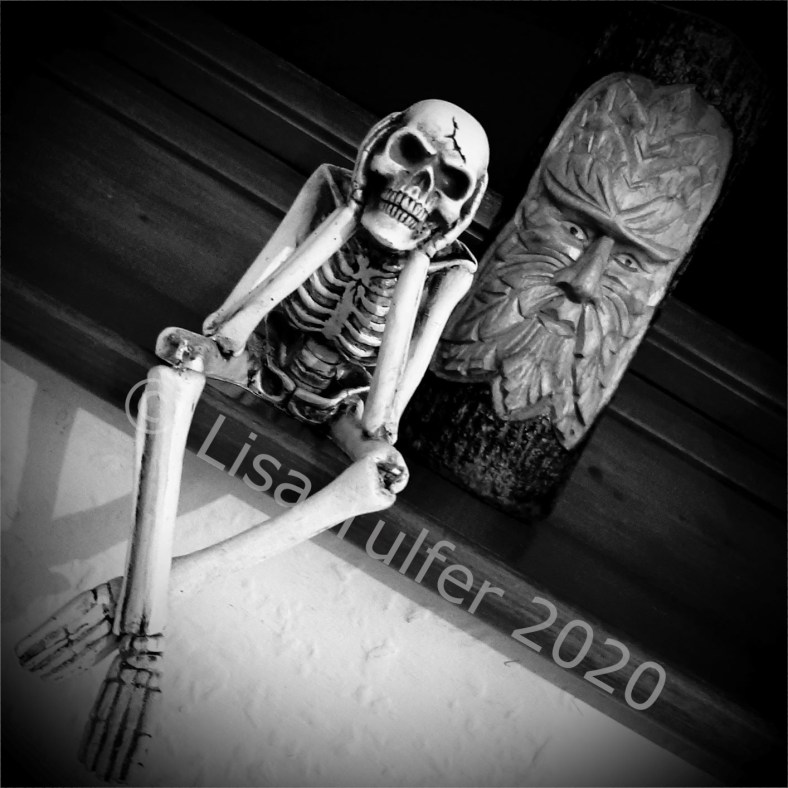
These characters live on the window sill in my study
Samhain in Glastonbury will be a rather tame affair this year – the rules preventing large groups gathering, intended to limit the spread of Covid 19, mean that no processions will take place. The dark-clad Border Morris dancers will not leap, roar and whoop, whacking their sticks and running into the crowd. The red and white dragons will not weave their way up the High Street, accompanied by drum beats as loud as fire-crackers. The revellers, many of them robed, cloaked, masked or sporting headdresses with horns or greenery, will not process behind them, calling out to the spectators and encouraging them to join in. The many visitors from all over the world who usually come to Glastonbury to celebrate Samhain will not be here, kept away by travel restrictions and quarantine regulations.
Death had become remote and sanitised in Western society, and the yearly round of festivals – Christmas, Valentine’s Day, Mothers’ Day, Easter and so on – resolutely upbeat, with no acknowledgement of a corresponding darker side to life. This year, the pandemic has meant that death has become part of public life again. Perhaps this year, more than ever, we need to use this festival to come to terms with fear and death, and shake a defiant fist in the face of approaching winter and darkness.
I am committed to making this blog freely available, and not putting material behind a paywall. As a writer, I am doing what I love – but I still have to make a living. If you have enjoyed this post, and if you are able to do so, perhaps you would consider supporting my work by making a small contribution via the Buy Me A Coffee button. Thank you!
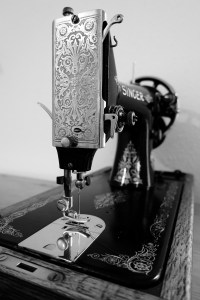
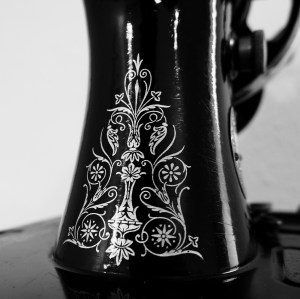
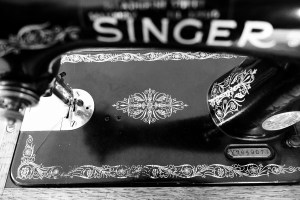
My pride and joy is a vintage Singer sewing machine. It’s black and gold, is so heavy that I can hardly lift it, and celebrated its 90th birthday this year. Built to last in an era when built-in obsolescence had not yet been invented, it is a design icon which truly changed the world, and every time I use it I am captivated again by its story.
Up to the middle of the nineteenth century, all sewing was done by hand. There was no alternative to hand-stitching – every seam of every garment made, ever, in all of human history, was hand stitched. Then, a flurry of inventors created a variety of ‘sewing engines’, which could sew much faster than any human hand. The most enduring of these designs was patented in 1851 by Isaac Merritt Singer of New York. A gifted salesman, he created a network of showrooms where the machines were demonstrated, showing both that they were easy to use (‘so easy a woman could use it’ – not a slogan that would, one hopes, sell many products these days, but in its time very effective) and also that clothes sewn by machine were at least as good as those sewn by hand.
Singer’s two main markets were commercial – garment manufacturers – and domestic. It was in domestic sales that the sewing machine created a revolution. Diaries kept by American women in the 1860s showed that they were spending the equivalent of two days a week on making and repairing clothes for their families. A sewing machine saved up to 90% of that time, giving them opportunities to earn money either through sewing for other people or by working outside the home.
It wasn’t just the machines themselves that changed the world – it was the way they were sold. In the 1870s, these expensive pieces of kit were worth the equivalent of half a year’s salary for a typical worker. Singer introduced the idea of hire purchase, where an initial deposit and regular payments would enable people to own and use a machine they would otherwise not be able to afford. Sales boomed, and modern consumer spending was born.
Supported by a reputation for reliability and a good parts and maintenance network, by 1918 it was estimated that one in five households in the world had a Singer sewing machine. Yes, you read that right – one in five households in the world, for it didn’t take long for the Singer company to realise that there was a market far beyond the USA. It started its international expansion in the United Kingdom, initially manufacturing sewing machines in Glasgow, and 1882 construction started on a new factory at Kilbowie, on the banks of the River Clyde, where John Brown’s shipyard was already a major employer of skilled workers. The Singer factory, which at the time was the largest factory of its kind in the world, was a catalyst for the development of the town of Clydebank, and it was in this factory that my Singer sewing machine was born.
By tracing the serial number which each individual machine has, it is possible to find out exactly where and when a Singer was manufactured. Serial number Y7649074 was part of a batch of 20,000 model 99K machines made in the Kilbowie factory in January, 1930.
In 1930, the Great Depression had taken hold following the Wall Street Crash of the previous year. In January, Buzz Aldrin (one day to be the second man to walk on the moon) was born in New Jersey, and Mickey Mouse made his debut in a comic strip. Over the next few months, the planet Pluto would be discovered, and elections in Germany would see Hitler’s National Socialists become the second largest party in the Reichstag. Sliced bread would appear in British shops for the first time, Sellotape (Scotch tape) would be invented, and Clarence Birdseye would sell the first frozen food. Against this backdrop, my sewing machine emerged from the last of the 56 departments in the Singer factory, its black japanned cast iron body gleaming, the gold leaf bright and fresh, its mechanism oiled and ready for action. I would love to know who first owned it – who first excitedly turned the key to open the domed Deco-style box – whose hands first threaded the needle, wound the bobbin, turned the handle – who first proudly wore a garment created on this machine, what that garment was, what fabric, what colour. I imagine children’s clothes, the curtains for a first home, a dress to wear to the dance, the changing fashions and fabrics of more than six decades.
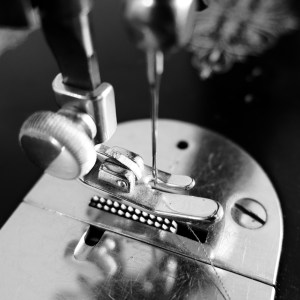
My Singer came to me in the mid-1990s, in Salisbury, Wiltshire. I had spotted it in the window of the sewing machine shop near where I worked, advertised as ‘refurbished’. I was given it as a birthday present, and it’s one of the best presents I’ve ever had. A quarter of a century later, it’s still in regular use. It only has one stitch – a straight stitch – and it only stitches forwards (later machines had a reverse function), so modern stretch jerseys present it with some challenges, but for many years I made most of my own clothes. I remember the first thing I made was a black velvet longline jacket, which I wore for years and years until it finally disintegrated. These days, my Singer produces curtains and alters clothing, and it’s especially good – when fitted with the right needle – for shortening denim jeans. Even though I neglect its maintenance, I have only once had to take it in for a service, because it was sticking – the guy who serviced it told me off for not cleaning the fluff out of the works more regularly!
I said at the start that the Singer sewing machine was built to last. Sadly, the affordable high street fashions of the mid-twentieth century and the advent of competition from Japanese, German and Italian manufacturers after WWII contributed to the end of Singer company’s success. The Kilgowie factory closed in June 1980. Together with the closure of the John Brown shipyard a few years earlier, this led to Clydebank becoming a post-industrial ghost town in the Thatcher era. A recent (2019) BBC television documentary (The Singer Story: Made in Clydebank) interviewed a number of former employees of the Singer factory, reminiscing about its glory days. Their pride in their work, and in the machines they produced, shone out, and I was especially struck by the words of Anna Stones, who worked in Department 55 (the parts department). She said “You were proud to be making a small part, and to know that it was going to be a Singer sewing machine, and that it was going to give somebody so much pleasure, and was going to be sent all over the world.” I hope Anna would be happy to know how much I love my machine.
The documentary also traced the continued use of the early twentieth-century manual and treadle (foot operated) machines into the present day all over the world, including through charities like Tools For Self Reliance who collect vintage machines, refurbish them, and send them to (often women’s) development projects around the world where they become the means for people to become economically independent. The programme interviewed young women in Accra, Ghana who were excited to have the means to become self-employed as seamstresses, equipped with Singer sewing machines just like mine. Here’s to the Singer sewing machine – the machine that changed the world, and still goes on changing it, one stitch at a time.
There are few sounds more magical than the sound of the sea. Whether it’s the slow, breathing cadence of the beach at Aldeburgh, with the North Sea washing the pebbles up and down the shoreline with each wave of the swell, or the thunder of the storm waves hitting the breakwater at the Cob in Lyme Regis, sending a plume of white into the air, I find the sound of the sea compelling. Sadly I am rarely successful at taking photographs of the sea – in the time it takes for my eye to see the image, by brain to send instructions to my finger to press the shutter release, and the camera to respond, the scene has moved on, and the moment is lost. Writing about the sea is hard too, with words often feeling too solid to convey something so mercurial and transient.
Paintings can be more successful at evoking the sea – I am especially admiring of Maggi Hambling’s sea paintings (there’s a video here where she speaks about ‘painting the sound of the sea’, with images from her exhibition at the Fitzwilliam Museum in Cambridge in 2010). Music can do it too, and for me the most moving examples are by Benjamin Britten (his Four Sea Interludes from the opera Peter Grimes) and his teacher Frank Bridge (his symphonic poem The Sea). Britten lived and worked in Aldeburgh, on Suffolk’s North Sea coast, and when I walk on the quiet beach there the soundrack in my head is his first sea interlude (On The Beach: Dawn).
My love of the sea is not sentimental. I was brought up on or near it, and I know all too well how its moods can change, and the destruction and death it can cause. It’s not all blue, bathing beaches and bobbing boats. The sea demands respect, and takes revenge on those who trifle with it. It’s also merciless to those who are in the wrong place at the wrong time, those who have to make their living on it and risk their lives doing so. For me, the heroes of the sea are the volunteer lifeboat crews who set to sea in the worst of conditions in order to rescue those for whom they are the last resort. Yes, the sea is beautiful, but it is also powerful and cannot be tamed by humankind.
The British coastline is shaped by that power. Breakwaters and sea defences notwithstanding, the sea has created – and continues to create – a dynamic coast. Erosion and encroachment by the sea (to stick with the North Sea examples, think of Happisburgh which is being ‘lost’ to the sea at a sometimes dramatic rate) is balanced by the creative forces of deposition (for example the giant and ever-growing shingle bank of Orford Ness).
There has been much concern, and rightly so, about the amount of plastic debris being washed up on our coastlines, and the effect of this on wildlife and the marine ecosystem. But there is something else which is regularly washed up on our beaches, which to my mind is a great example of the power of the sea at work to create something beautiful from the cast-offs of our past. I think of it as a kind of recycling, the forces of nature reworking the mundane into unintended gems. I’m talking about sea glass.
Sea glass is formed when pieces of waste glass are abraded by being tumbled in the sea for extended periods of time (sometimes decades or centuries), their sharp edges eventually ground down into a frosted smoothness and pleasing pebble shapes. I have collected sea glass for some years, and there is a vast network of collectors around the world – Instagram is a good place to see their finds.
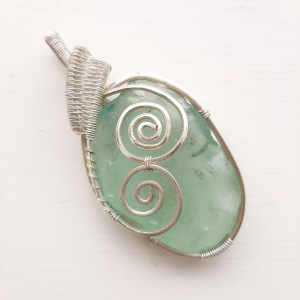
Sea glass can be found on beaches anywhere – as with any beachcombing, the best pickings are often to be found at the first low tide after a storm, when all manner of interesting things can be washed up. Some parts of the UK coastline, however, seem to yield more glass than others – I have found a lot in the North West, and also some on beaches in North Devon and East Anglia. I hear that the North East of England is a favourite location for collectors, due to the presence of several bottle works in the 19th and 20th centuries – the largest in the country was at Seaham – which dumped their waste glass into the North Sea. I have included a few photographs from my collection, most of which I display in a large glass vase, although the best way to see sea glass and the way it plays with light and colour is to handle it. The blue pendant is a gift from my partner, who found this unusual aqua-coloured and very large piece of sea glass at Lynmouth in North Devon (other people’s partners give them gemstones. Mine gives me sea glass. I am very lucky!).
Most sea glass is a magical pale aqua colour, but some is white, a lot is green, and other rare colours include amber, blue, orange and (most prized of all) red. As most sea glass originated as glass bottles, the abundance of any colour depends on how common the bottles were – blue, for example, started life as medicine or poison bottles, while amber bottles held spirits. Glass bottle tops are sometimes found too, as are the glass marbles which formed the stoppers of early carbonated drinks. Keen collectors have researched the origins of sea glass, which is in itself a social history and archaeology of glass. Occasionally I am lured into researching a piece – for example the reinforced glass incorporating rusting metal wire grids which occur on Crosby beach on Merseyside, which are part of the debris from buildings destroyed in WWII air raids on the city of Liverpool which was dumped there. Mostly, though, I collect it because I am enchanted by what the sea has made from our thoughtless waste. The power that destroys coastlines and wrecks ships has formed something which, in its colour and ever changing reaction to light, is a kind of echo of itself. Have nothing in your homes, said William Morris famously, that you do not know to be useful or believe to be beautiful. Sea glass, I believe, is the most beautiful thing in my home.
I am committed to making this blog freely available, and not putting material behind a paywall. As a writer, I am doing what I love – but I still have to make a living. If you have enjoyed this post, and if you are able to do so, perhaps you would consider supporting my work by making a small contribution via the Buy Me A Coffee button. Thank you!























 The Three Hares Blog