Where did my interest in historic buildings, and the way we use them today, first start? Well, it all started with a quote from Winston Churchill. I can pinpoint the exact moment: I was a second-year undergraduate, sitting in a seminar on the history of Christian liturgy, and the lecturer was getting us to think about how the layout of a building both affects, and is affected by, the activity taking place within it. He quoted Churchill’s words: “We shape our buildings, and afterwards our buildings shape us.”
In 1943, Churchill was advocating for the retention of the adversarial, rectangular layout in the re-building of the Commons Chamber of the Houses of Parliament in London, following bomb damage in the Blitz during WWII. He attributed the two-party system, which he saw as the essence of British parliamentary democracy, to this layout.
In that moment, I realised that Churchill’s principle applied not only to ecclesiastical architecture and the layout of parliamentary debating chambers, but to the buildings we live and work in. At that time, my home was a tiny eighteenth-century stone cottage in a small town in North Wales, which showed signs of having been altered a number of times to accommodate changes of use. During its lifetime, it had reputedly been a mead house, and more recently a café, as well as a living and working space for artisan households (as evidenced in more recent centuries by census records). Meanwhile, at the heart of my university campus was the original nineteenth-century building, itself a pastiche of a medieval Oxbridge college – a style reflecting the ambitions of the founders for their fledgling educational institution.
I went on to live in a series of 19th-century terraced cottages, including one that was built for the workers on the newly-constructed railway; two Edwardian townhouses, one of which had been built as a living and working space for a family of glove-makers; a number of 1960s and 1970s boxes, in various stages of dilapidation, with the sensible, regular-shaped rooms that were a hallmark of the period, but all of them a challenge to make homely; a faux-Georgian 1980s house, complete with Grecian columns beside the front door and plasterwork urns and garlands on the fire-surround, but leaky windows and a collapsing sewage drain; and a smart newbuild with four bathrooms but next to no storage (which gives an insight into how architects envisage how people will live in the houses they design), which nevertheless proved to be a nice place to live. I learned that the nicest-looking houses don’t necessarily make the nicest homes, and that each property influenced how I lived through layout, storage (or the lack of it), heating (or the lack of it), and how safe and at home I felt there. I learned that I generally have a preference for older properties, made of stone or brick, which have stood for a century or more and promise to carry on standing – and sheltering those who live there – for the foreseeable future. I learned that I don’t mind the ghosts and echoes of previous lives that have been lived in the buildings I call home, but that I do mind houses that are soulless and sterile, however well-designed they may be.
Some years after the Churchill epiphany, I went back to university to study medieval monasteries, focusing on the relationship between their architecture and infrastructure and the patterns of daily living this facilitated. I then studied vernacular architectural styles, in particular becoming fascinated by palimpsests as evidence of how the people who lived and worked in these buildings continued to shape the evolution of the buildings that had shaped them.
I worked as a consultant, enabling communities to imagine new ways to use their historic buildings, balancing the need for flexible, warm and accessible places with the need to conserve the character and historic significance of the building. And I now advise on appropriate and effective energy efficiency measures to ensure that traditional buildings and their occupants continue to survive and thrive in the 21st century and beyond. For me, it’s part of an ongoing dialogue between place and people: “We shape our buildings, and afterwards our buildings shape us.”
I am committed to making this blog freely available, and not putting material behind a paywall. As a writer, I am doing what I love – but I still have to make a living. If you have enjoyed this post, and if you are able to do so, perhaps you would consider supporting my work by making a small contribution via the Buy Me A Coffee button. Thank you!
I am thinking, and writing, a lot about place at the moment – geographical location, borders, and the relationship between where we are and who we are. As a tangent from this, I’ve been musing about whether, or how, where we are affects what we write. There are a few obvious connections; for example could Wuthering Heights have been conceived of and written anywhere other than the bleak uplands of the Brontë’s Haworth, or would Persuasion have been as persuasive in its evocation of the social banalities of Bath had not Jane Austen herself experienced the particular torment of the old maid in that context. But is it a general principle, I have been asking myself, that our location influences us as writers?
In the late spring of last year I tagged along with my wife on a study trip to north Cornwall, that enigmatic stretch of coastline between Bude and the Hartland peninsula where Cornwall becomes Devon, notorious for shipwrecks and (possibly apocryphal) tales of wreckers. It is less remote and unknown these days than when I first visited a couple of decades ago, and honeypots like Boscastle are now gridlocked, but off season, with the sea fog swirling round you, it can still feel like you’re standing at the edge of the world. It’s mainly vertiginous cliffs along here, with the South West Coast Path providing access on foot to places that tourists can’t drive to. My wife having finished at the museum, we went exploring.
Intrigued by the eccentricities of its nineteenth-century vicar, the Reverend Robert Hawker, we went to Morwenstow. The steep churchyard was knee-deep in wildflowers, framing the replica figurehead of the Caledonia which marks the burial of several of its sailors who drowned when she was shipwrecked on that treacherous coast in 1842. It is a kind of marker, too, for Parson Hawker’s affinity with the sea – he habitually wore a knitted fisherman’s gansey, was involved in a number of rescues, and took great pains to ensure the decent burial of shipwrecked sailors.
Hawker has other claims to fame. He was a poet, and as a young man published ‘The Song of the Western Men’ (more commonly known as ‘Trelawney’) which is the de facto national anthem of Cornwall. And he was the instigator of the modern Harvest Festival, celebrated in churches all over the world, and which was a re-imagining of the medieval practice of Lammas or First Fruits.
His eccentricities are well, although not perhaps always reliably, recorded, and include wearing random and colourful garb such as a poncho made from a yellow horse blanket; bringing his cats to church services (and excommunicating one of them for mousing on a Sunday!) and keeping a pet pig. He was also almost certainly addicted to laudanum – tincture of opium in alcohol – and this arguably fuelled both his eccentricity and his poetry.
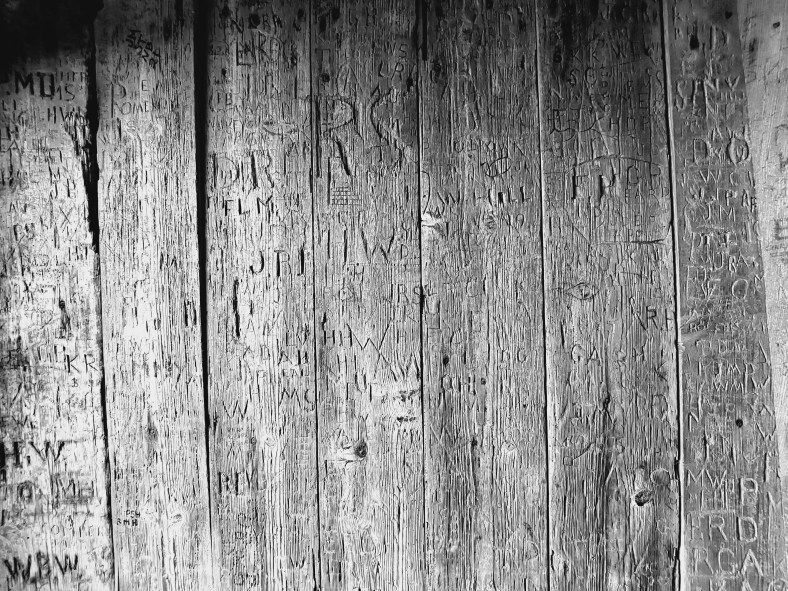
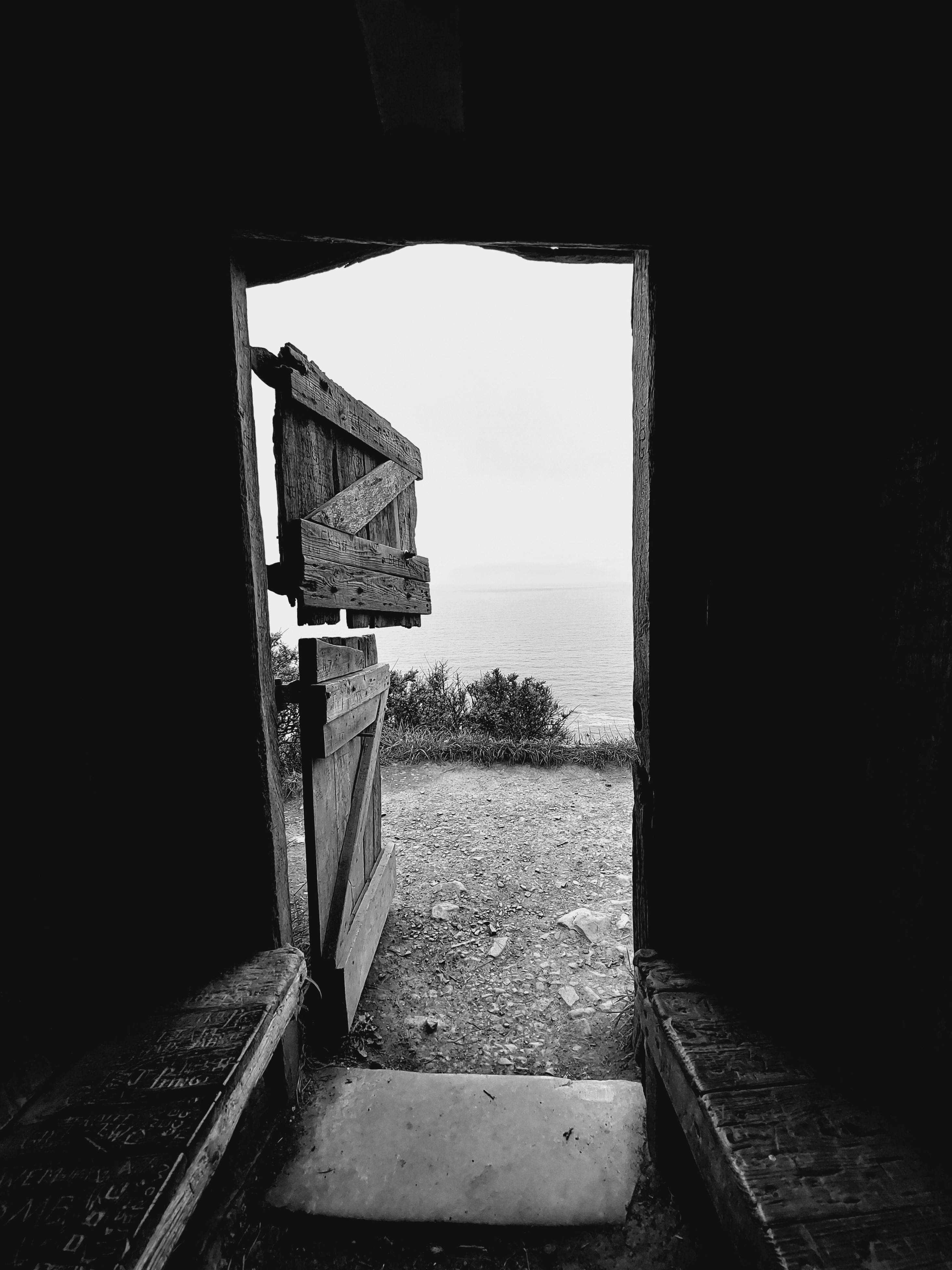
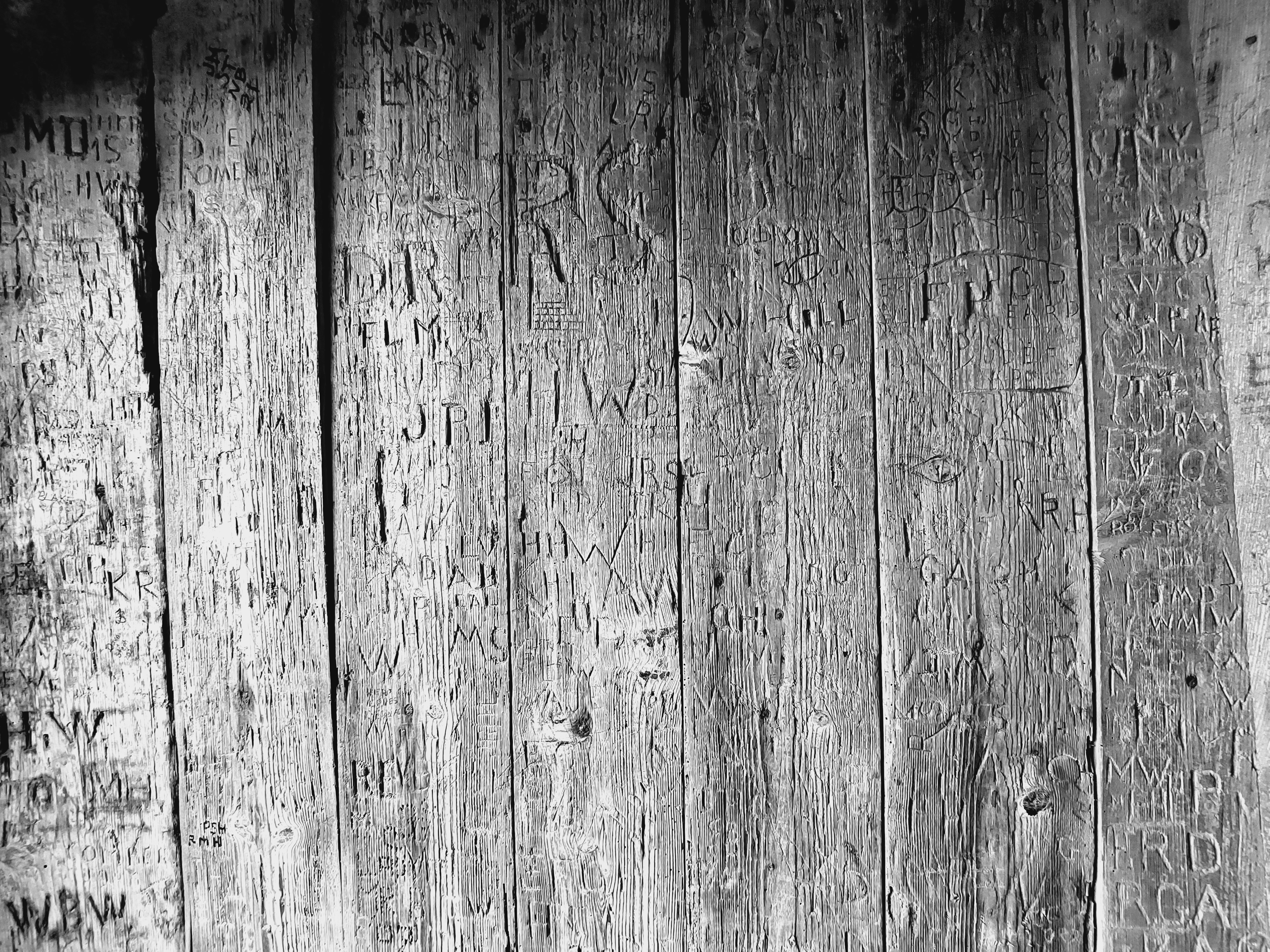
Much of Hawker’s poetry was written in his hut, set into the cliff face a mile or so from the church, constructed from driftwood and roofed with turf. It is now the smallest property in the care of the National Trust, its planks incised with graffiti and worn to a smooth, mellow patina. It would be easy to think of it merely as a den, a playhouse, or a man-cave, but we were lucky enough to have the place to ourselves and time to pause and try to see it through Hawker’s eyes. The stable door opens onto infinity – the Atlantic, the sky, the sea mist. The view is as unlimited as the human imagination. What does looking out on infinity do to a person? To a writer? Does it stretch the boundaries of the mind, of the possible?
Sixty miles to the north across the Bristol Channel is another shrine to a dead poet – Dylan Thomas’ writing shed at Laugharne. Decades apart, two men gazing out on infinity and writing poetry. Infinity + alcohol = Thomas. Infinity + opium = Hawker.
Maybe it’s not just the window on infinity, or even the stimulants, that are significant here. Maybe it’s the access to a place to write, uninterrupted by the demands of other, domestic roles. Jane Austen famously wrote her entire oeuvre at a little side table, using a writing box which had been a present from her father. Her father couldn’t give her a space to write, or financial independence, but he could give her a writing box, a microcosm of the writer’s world which she could take with her wherever she went. Virginia Woolf wrote an entire book about A Room of One’s Own, in which her analysis was that women writers were handicapped by the lack of their own space in a domestic context. Neither Hawker in his hut, nor Thomas in his shed, had that problem. Both had the luxury of private space – physical space, and headspace away from the demands of domesticity. And, as a bonus, those private spaces had a window on infinity.
I started this by musing on the relationship between where we are and who we are, and whether, or how, where we are affects what we write. Perhaps it’s less that a place affects who we are and what we write, but rather that where we are affects what we see from there. Writers, including Alfred Lord Tennyson and Charles Kingsley, were inspired by Hawker’s hut. Thousands of literature students and aspiring writers make the pilgrimage to Thomas’ shed. Maybe the inspiration lies, not in looking into the writer’s space, but looking out of it – seeing what they saw, especially when that is infinity. Alcohol and laudanum are optional.
I am committed to making this blog freely available, and not putting material behind a paywall. As a writer, I am doing what I love – but I still have to make a living. If you have enjoyed this post, and if you are able to do so, perhaps you would consider supporting my work by making a small contribution via the Buy Me A Coffee button. Thank you!
I have always been fascinated by old books and their tooled and gilded bindings. Years ago, when I worked at an academic library in Cambridge, a favourite part of my job was to carefully rub a special kind of polish into the leather covers to keep them fed and supple. I would fetch the key to the climate-controlled, fireproof strong room in which the ‘special’ books were stored, select a volume which looked in need of attention, and get to work with a soft cloth. As I worked, I would marvel at the intricate designs, and above all at the antiquity of these objects – we held books dating back to less than a century after Gutenberg’s revolutionary invention of printing with moveable type, most of them in their original bindings. Whose hands had touched these covers and turned these pages before me?
Recently I was able to visit a remarkable exhibition at the National Library of Wales in Aberystwyth. Entitled Beautiful Books, the exhibition consists of twenty-two books and an accompanying film which shows the bookbinding process. Perhaps counterintuitively for a library, the emphasis is not on the content of the books, but on their bindings. Created between 1849 and 1993, the books showcase the talents of remarkable bookbinders whose work goes far beyond simply making covers to protect the words within.
Houses of Leaves, poems by Dafydd ap Gwylim. Binding by Julian Thomas. Image: Julian Thomas/National Library of Wales
For a few years, I subscribed to the Folio Society, and a number of attractively-bound limited edition volumes were added to my bookshelves. Apart from that, I have had little exposure to modern binding, and this exhibition was therefore quite an eye-opener for me. As I worked my way around the glass cabinets, a few themes emerged.
These bindings are works of art, and not just in the way one says of something impressive, ‘wow, that’s a work of art!’ These fine bindings create pictures, images, in way that is reminiscent of textile art. The use of blocks and lines of colour, gilding, texture, and motifs which respond to the subject of the book, combine to make artworks which stand in their own right.
Stylistically, they are very much of their time. For example, the binding by Elizabeth Greenhill for Louis MacNeice’s The Burning Perch (1963) put me in mind of a tapestry by Graham Sutherland, and would not have looked out of place scaled up on the wall of a brutalist concrete building on the South Bank in London.
In many cases, it really is possible to judge the book by its cover, as the binding gives a hint or preview of the contents. For example, the cover created by Julian Thomas for Houses of Leaves, a translation of the work of fourteenth-century Welsh poet Dafydd ap Gwylim by Rachel Bromwich, published in 1993, takes its inspiration from the book’s title, and features lines based on the outlines of leaves and the tendrils of foliage which ornament medieval manuscripts. And with the binding for Across the Straights by Kyffin Williams, Thomas’ collaboration with arguably Wales’ most famous artist results in Williams’ essential simplification of landscape being expressed on the book’s cover.
Across the Straits by Kyffin Williams, binding by Julian Thomas. Image: Julian Thomas/National Library of Wales
As a writer, it is a strange experience for me to be looking at books as artefacts as well as texts (or indeed as artefacts instead of texts – with the exhibits contained within glass cases, it is of course not possible to interact with the printed words within). This has made me muse about the books I own. Are some of these, too, artefacts rather than just texts? Do I choose to have them because they symbolise my aspirations to be knowledgeable, cultured, or well-read (whether or not I’ve actually read them)? Do some of them earn their place on the shelves because of the tactile quality of their bindings, or their attractive cover designs? There are certainly some books I have bought because I was entranced by their covers, and others where I have been pleasantly surprised when their plain, worthy covers prove, on actually reading the book, to belie the fascinating content. Book covers matter.
Just upstairs from this exhibition is another, which also caused me to think about the significance of books. Beibl i Bawb (A Bible for All) celebrates the four hundredth anniversary of the publication, in 1620, of the translation that became the standard text of the bible in Welsh until the 1980s. The significance of the Welsh bible goes far beyond religion – as with many languages, the standard translation defined the language, providing a benchmark for written Welsh and a foundation for cultural and literary life to the present day.
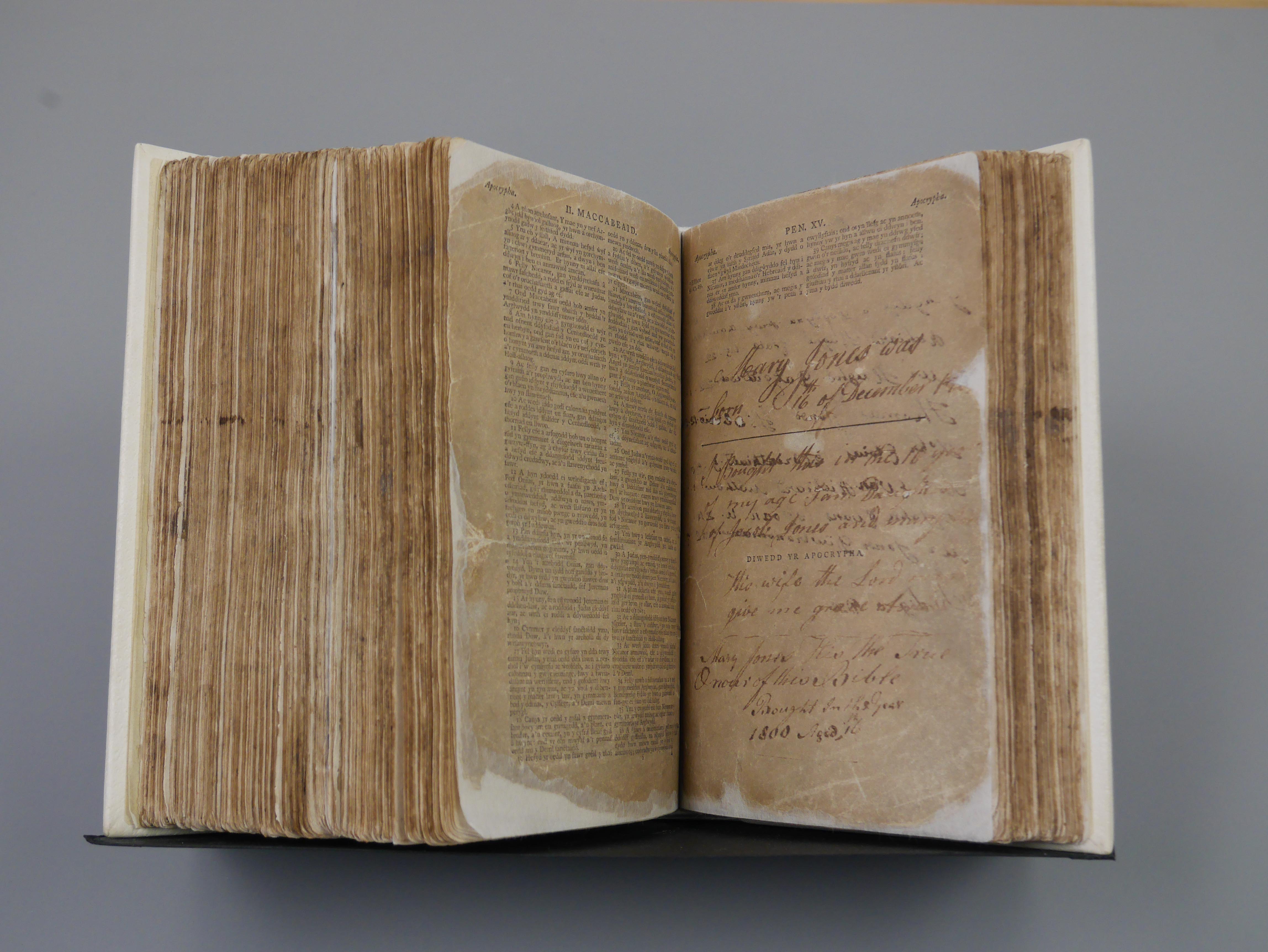
Mary Jones’ bible. Image reproduced by kind permission of the Bible Society
Here, too, I am brought face to face with the book as artefact. In this case, it is the bible owned by Mary Jones. Her barefoot journey across North Wales in 1800 to buy her own copy of the bible in her own language has become a story that is told across the world. This object – dark with use and age – is more than a book. It connects us to an individual, a real person who held it and turned its pages, and also to a whole history of a language and the people who speak it. And it tells the story of reading – at that time, Wales had one of the highest rates of literacy in the world thanks to the ‘circulating schools’ pioneered by Griffith Jones and his successors, which would come to a district for a while and teach people of all ages and genders to read, the aim being that they would be able to read the bible for themselves. Literacy was perceived as what we still know it to be today – the gateway to knowledge and independent learning that can change lives. Mary Jones’ bible is symbolic of the world of words and ideas that was opened up to her when she learned to read. There can be few greater gifts than the ability to read.
I am committed to making this blog freely available, and not putting material behind a paywall. As a writer, I am doing what I love – but I still have to make a living. If you have enjoyed this post, and if you are able to do so, perhaps you would consider supporting my work by making a small contribution via the Buy Me A Coffee button. Thank you!
New Year’s Eve has come upon me suddenly – in the limbo between the public festivals of Christmas and New Year, the days seem to merge into each other, especially this year when the grey skies touch the ground (alternating occasionally with thick fog) and it never seems to get properly light. There have been a lot of ‘best books of 2021’ posted on social media over the past few weeks, and it set me thinking about what I have read this year. Some I have reviewed on this blog or in other publications, but others I have read simply for pleasure or out of curiosity. Here, in roughly chronological order, are my top 10 books of 2021.
Mudlarking: Lost and Found on the River Thames by Lara Maiklem. I originally bought this for my beachcombing mother-in-law, but it looked so interesting that I got a copy for myself too. The author posts prolifically on Twitter, Facebook and Instagram, so the book is very much a starting point for an ongoing engagement with the finds that emerge from the Thames, and the stories and history behind them. Maiklem moves down the river, from the tidal head at Teddington to the estuary at Southend-on-Sea, telling the story of the riverbank, the characters who inhabit(ed) it, and her own experience of mudlarking along the shore and the artefacts she has discovered. The book sits between travel writing, social history, and memoir, and is accompanied by photographs of some of the finds she refers to. I am always entranced by the humble objects, sometimes lost for centuries, which give a glimpse into people’s everyday lives, so for me this book was a treasure trove.
Ghost Town: a Liverpool Shadowplay, by Jeff Young was another book which was originally a gift which I ended up reading myself. This had a personal resonance for me, as the streets which Young describes so evocatively were trodden by my own father, half a century earlier. Many of the places are familiar to me from tracing my family history. In Young’s luminous memoir, he walks through his ‘ghost town’, and explores themes of metamorphosis – his own, and that of the city of Liverpool –and loss, remembering and mis-remembering. A compelling narrative, highly recommended for anyone interested in place writing.
Next up was The Screaming Sky by Charles Foster, illustrated by Jonathan Pomroy. I read this just a few days before the swifts arrived from Africa, perfect timing for this love song to the marvel of nature that is the swift. Born of a passion bordering on the obsessional, Foster’s book describes the bird’s life-cycle, its mind-boggling feats of aerobatics and endurance, its biology, and the history of humans’ relationship with the species. I wrote a full review on this blog here.
Where? Life and death in the Shropshire hills by Simon Moreton was a new departure for me – I have no experience of the graphic novel/zine genre which Moreton specializes in, and this innovative book combines text with illustration and collage in a way I’ve not seen done before. Where? is a memoir, in which Moreton juxtaposes the narrative of his father’s illness and death with memories of a childhood in rural Shropshire, in a landscape dominated by the presence of Titterstone Clee which looms over the surrounding countryside, and near the summit of which is a radar station where Moreton’s father worked. Again, this is place writing about somewhere I know slightly, and I enjoyed reading it, admiring the weaving together of the two strands. I am aware, though, that there were aspects I didn’t ‘get’ because I don’t have the visual lexicon to understand the artwork which is such a large component of this book.
A Still Life: A Memoir by Josie George. I have followed Josie George on Twitter for a long time, and pre-ordered this book when she announced its publication. However, it took me a long time to summon up the courage to read it. In a year where so many themes were dark and hopeless, it seemed perverse to read an account of disability and chronic illness. I was wrong. George’s account of her life with a condition which long defied diagnosis and which continues to deliver twists and turns of challenge and disability, is full of light, hope and love. Not that there is any false cheeriness here – she pulls no punches about the pain and hardships of her situation – nor is there any of the ‘disabled person as an inspiration to us all’ nonsense. This is an exceptional person, taking life one moment at a time, doing what she can, not doing what she can’t, refusing to get frustrated, determined to continue loving, convinced that the world is good, that life is good, that being alive is the most amazingly wonderful thing, to be savoured and celebrated in whatever way we can in that moment. It is heartwarming, not in an It’s A Wonderful Life kind of way, but in a way that stays with you, challenging the way you look at the world, at each small moment of our small lives.
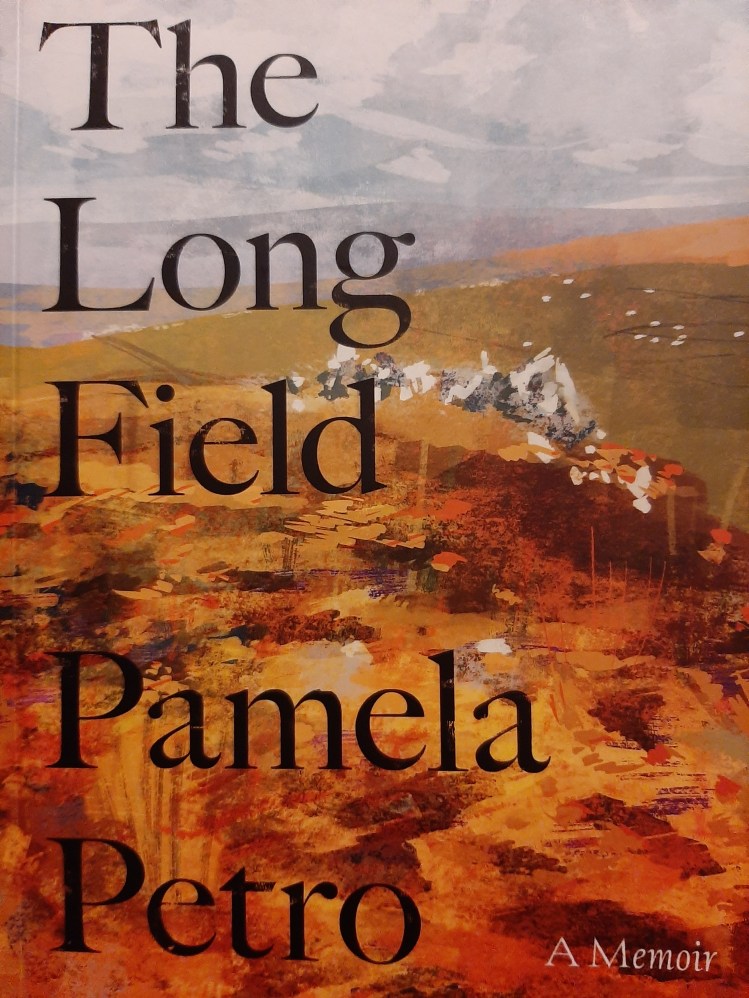
The Long Field by Pamela Petro is again memoir/place writing about somewhere I know – in this case, Petro’s love affair with rural Wales started in Lampeter, at the university we both attended. I reviewed The Long Field here.
Fifty Sounds by Polly Barton was initially quite a challenging read (I don’t do philosophy, which dominates the opening chapters) but my persistence was rewarded by an insightful exploration of how language and culture influence and shape each other. Barton tells of her experiences as an English teacher in Japan, and the fifty sounds of the title (which form the chapter headings) are onomatopoeic words in Japanese which she unpacks in her journey into Japanese language and culture, and into her own personality. I wrote a full review for the Cardiff Review.
You will have noticed that all the titles in this list are non-fiction. I have struggled with reading fiction since the beginning of the pandemic, but The Listeners by Edward Parnell may have rehabilitated me. This clever, taut, beautifully written delight gave me more reading pleasure than anything else this year, and I reviewed it joyfully here on this blog.
Finally, two books which I am still reading. Light Rains Sometimes Fall: a British Year Through Japan’s 72 Seasons by Lev Parikian is arranged in short chapters covering 5 or six days each, in which Parikian closely observes the natural world around him, partly through pandemic lockdowns, noticing details of the changing seasons. I am a big fan of Parikian’s nature writing, and as I’m consciously attempting to live more in the present (rather than the past or the future) I liked the idea of reading this in ‘real time’, a chapter at a time for a whole year. The current ‘season’ is called ‘Storms Sometimes Blow,’ which seems about right!
As an utter map nerd, and a fan of his other writing, it was inevitable that I would eventually read Map Addict by Mike Parker. At the time of writing, I am halfway through this blend of memoir, cartographical history, and celebration of the glorious Ordnance Survey map, and it’s so nice to connect with a fellow map addict! (I’ve written about the origins of my own map obsession here).
And, on this last day of 2021, I bring you good news – I have a whole lot more books lined up to read in 2022! My ‘To Be Read’ pile includes poetry, a lot of exciting non-fiction, and even (tentatively) a bit of fiction. I can’t wait!
Wishing you a Happy New Year.
I am committed to making this blog freely available, and not putting material behind a paywall. As a writer, I am doing what I love – but I still have to make a living. If you have enjoyed this post, and if you are able to do so, perhaps you would consider supporting my work by making a small contribution via the Buy Me A Coffee button. Thank you!
First, a confession. Reading Pamela Petro’s The Long Field was an exercise in nostalgia for me. I followed Petro to the university at Lampeter in West Wales (‘Probably the smallest university in the world,’ as the T-shirts in the Students’ Union shop proclaimed, Carlsberg advert-style) just four years later. All her descriptions ring so very true for me, were part of the landscape of my own young life. Even the cottage she lived in is well known to me, as a friend of mine rented it in my first year – I can picture myself back in that kitchen, drinking tea, watching my friend making jelly for dessert. My challenge in writing this review has been to come to the book from the outside, as it were, rather than from that place of shared experience.
The Long Field is, fundamentally, about hiraeth, a complex Welsh word which encompasses elements of longing, nostalgia, distance, absence, homesickness. It is famously untranslatable into English. But the book is also a love story. A love story on several levels, most obviously Petro’s sudden, unexpected, and deep passion for the landscape of rural Wales – again, something which resonates with me. But it is also about her relationships with her partner and with her parents, and an exploration of the complexities of those relationships. Perhaps it is an acknowledgement that love stories more nuanced than ‘boy meets girl and they live happily ever after’ are part of the lived experience of queer writers.
Although Petro is passionate about Wales – her Wales – she manages to stop short of being entirely rose-tinted about it. She acknowledges some of the nuanced complexity of Welsh identity and history, some of the ways in which her adopted homeland’s sense of itself as a colonial victim of English occupation can hold it back. As someone who has lived in Wales for a significant part of my adult life, it seems to me that Petro’s analysis of Wales is predominantly rural – the Wales of Ceredigion and the Cambrian Mountains – and intellectual and cultural. She does nod at the life of the Valleys, especially as she was in Wales in 1984 during the miners’ strike, but the industrial and post-industrial conurbations of South and North-East Wales, the product of migration from within Wales and beyond, are not the Wales that she knows and loves. Her Wales is that of the past etched into the landscape of the present. Of people connected, umbilically, to the places that shaped the generations before them. Of story made tangible in the land. Landscape – not only the fields, the mountains, the hills, but also the cultural echoes, the resonance that they have – is what Petro loves. Her inexplicable feeling of having ‘come home’ to that landscape when she, an American with no Welsh antecedents, arrived in Lampeter in 1983 is the starting point for the experiences that have shaped this book.
The Long Field is a remarkable book. Although it self-identifies on the cover as ‘A Memoir,’ it draws together strands of history, travelogue, a whistle-stop tour of Welsh literary heritage, place writing, pronunciation notes for the Welsh place names, linguistic detours, a coming-out narrative, family saga, and an exploration of identity. It is this last element, I think, which is the most important. Can someone identify with a place which they are not ‘from’ but where they nevertheless felt a shock of recognition when they first encountered it? Yes, says Petro – but is she is not claiming Welshness. Rather like entering into a relationship with a lover from a different culture who speaks a different language, she seeks – respectfully, gently – to learn, to understand, to value what the beloved values. What Petro found when she found her Wales filled a profound void in her psyche, provided a connectedness between the people of the present and the past which her upbringing in suburban America had not. In an era when more people than ever are living where we are not from, The Long Field has much to say about place, identity, past, present – and future.
The Long Field by Pamela Petro is published by Little Toller Books. ISBN 9781908213853
I am committed to making this blog freely available, and not putting material behind a paywall. As a writer, I am doing what I love – but I still have to make a living. If you have enjoyed this post, and if you are able to do so, perhaps you would consider supporting my work by making a small contribution via the Buy Me A Coffee button. Thank you!
I am delighted to welcome Liza Achilles, a blogger based in Washington DC, USA, who has written a guest post for The Three Hares Blog.
Writing a historical novel was one of the most interesting activities I have done in my life. Unlike many other types of novel writing, historical novel writing requires a large amount of research. That research comes in several forms, as I will explain in this article. Below are 3 lessons I learned about writing a historical novel during my novel-writing journey. Perhaps these tips will help you if you tackle a historical novel project of your own.
#1 The Value of Visiting University Libraries
When I began researching my historical novel, I considered any book on my topic to be relevant. I stocked up on books from local bookstores and libraries. But I quickly discovered that not every book is of the same quality. Some books contain errors, unfair stereotyping, or generalities that gloss over key points. The books available at local bookstores and libraries were good for a cursory introduction to my subject; but to go deeper, I needed a university library.
I was fortunate that my husband (at the time) was affiliated (at the time) with first one university library and then another. Spouses were given, as a perk, a library card. I imagine that for some spouses, that wasn’t much of a boon. For me, it was a golden ticket to the stacks! (Many university libraries allow you to get a library card for a nominal fee if you don’t have a connection to the library.)
The excitement of browsing the stacks – there’s nothing like it. I would look up a subject on a computer and find a few call numbers. I would venture into some dark and crowded corner of some tower, and locate my book. I would then browse all of the nearby books, looking for something new and interesting. Often the book I took home would not be the book whose call number I found, but a book nearby in the stacks.
It was only with the help of these university books that I was able to correct errors, debunk stereotypes, and dig into important nitpicky details. All of this information was essential to crafting a novel that was as faithful as possible to the reality of what happened during my target time period.
#2 The Value of Visiting Historical Sites
No book about a location can replace a visit to that location. Books can and should supplement a visit. But there’s something powerful and special about experiencing a location in person – even if your visit does, of necessity, occur tens or hundreds of years after your target historical time.
Many historical sites have museums, plaques, monuments, grounds, or reenactments whereby you can immerse yourself in the history of the place. You can view some of the actual objects used by people during the historical period and walk on the actual terrain that was walked on back then. You can also talk with historical experts and read the extensive information provided at such sites.
I found immense value in visiting not just the site where my novel takes place, but also nearby and related sites. It’s always instructive to compare and contrast sites, to take in what is the same and consider what is different, and thus to better home in on your target historical location.
I also recommend touring public lands that aren’t part of any museum. Every place has its own flora and fauna, its own terrain and aura. Soak in the feel of the place, while being careful to distinguish between how things were during the historical time and how things are now. For example, invasive species might now inhabit the area, while other species might have gone extinct. Water levels and the climate might be different. (You can find this information through books and the Internet.)
#3 The Value of Using Primary and Secondary Sources
When researching a historical period, it’s important to distinguish between primary and secondary sources. Primary sources are writings done by people during the target time period. Secondary sources are writings done by people who came later, who wrote about the primary sources (or about other secondary sources).
Primary sources are a must-read because these are the people who were present when the action was happening. They are closest to your targeted time period and thus can be considered, in a way, most reliable. However, in another way, their reliability must be evaluated carefully, since being close to the action can result in all-too-human biases, mistakes, and sometimes even lies. This is where secondary sources come in.
Secondary sources are a must-read because these are the people who have carefully evaluated the quality of the primary sources and drawn conclusions not obvious in the primary sources. When well written, secondary sources are extremely reliable, and they may correct any factual errors, biases, or lies in the primary sources. However, when not well written, they may perpetuate errors, biases, or lies, or introduce new ones.
The bottom line is, dig into both primary and secondary sources, but read them critically and evaluate their reliability.
Conclusion
Research for a historical novel comes in several different forms. You might spend time visiting university libraries, touring historical sites, and consulting primary and secondary source materials. These activities helped me immensely while crafting my historical novel.
Are you working on a historical novel? What lessons are you learning from the experience?
Liza Achilles is a writer, editor, poet, and coach based in the Washington, D.C., area of the USA. She blogs about seeking wisdom through books and elsewhere at lizaachilles.com.
A few days ago I visited Presteigne, on the border of England and Wales (the counties of Herefordshire and Powys, to be precise). With a population of fewer than 3,000 people, Presteigne would be classed as a village in most parts of the country, but here in the remote and sparsely-populated hills it is a town, with shops and services drawing people from the surrounding hamlets and scattered dwellings. Sheep farming and tourism are the area’s main occupations, both capitalising on the sweeping hills and valleys of these unostentatiously beautiful borderlands, miles from anywhere.
Presteigne, which is called Llanandras in Welsh (loosely translating as ‘the enclosure around the Church of St Andrew’), is a historic town and was formerly the capital of the old county of Radnorshire (now subsumed into the administrative county of Powys). It still has the court house, now a museum, as a legacy from that era. The town is located beside the River Lugg, which forms the border between England and Wales. It has a long pedigree as a settlement, featuring in the Domesday Book of 1086 – however, it also has charging points for electric vehicles in the town car park, a trendy deli, a modern convenience store on the high street, and a Chinese take-away.
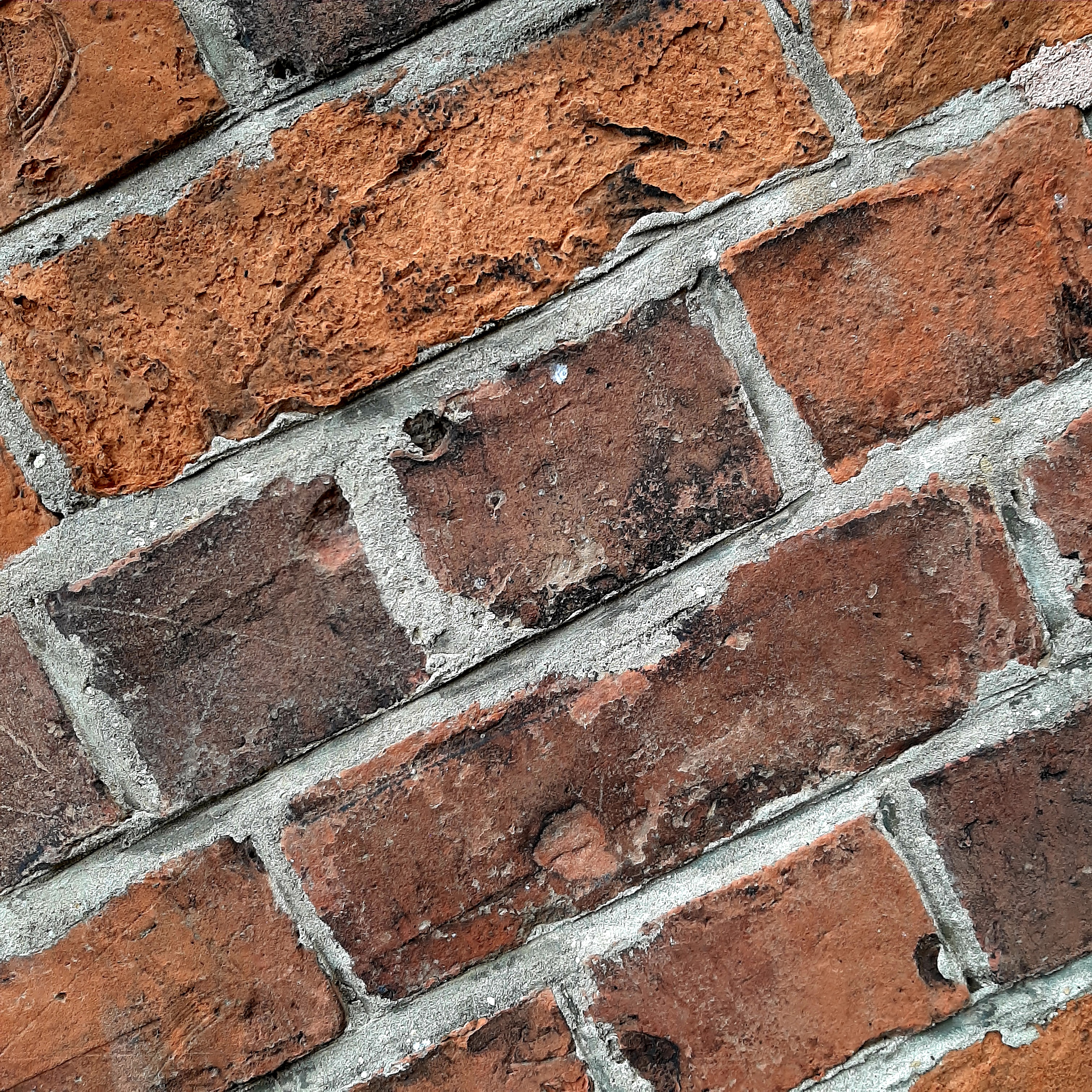
Modern features notwithstanding, what struck me most on my first visit to the town was how old it feels. In the centre, along the high street and the area around the church, the houses are hundreds of years old. Even where the facades appear newer, the buildings behind are constructed of traditional vernacular materials such as plaster and lath, half-timbering, cob, and stone. Some, like the building which is now a charity (thrift) shop and a barbershop, are adorned with pargetting (ornamental plaster). Centuries seep out of the walls of the buildings. Each is grounded, venerable, secure in its place, a survivor. Compared with the new-build boxes in the estates on the edge of town, which we drove past on the way in, these buildings are the ancestors which simply stayed, did not crumble and die, but remained rooted here in this community.
I find it interesting, though, that the town feels ‘old’ rather than ‘historic’. Although I’m sure there are ‘listed buildings’ here, and that there are conservation orders in place for many of the streets, it doesn’t feel like a historic theme park. Some places I’ve been – such as Holt in Norfolk, almost completely re-built in the Georgian period after a fire, or Stamford in Lincolnshire, with its picturesque stone buildings of homogenous limestone – are cohesive, visually harmonious, easy for the local tourist board to market as ‘historic’. Presteigne is different. Here, the buildings are jumbled together, built over centuries, fitted into gaps left by their predecessors, form following function. The have been re-worked over time to the needs of each successive generation of occupants, which storeys added, extensions built, windows and doors relocated or bricked up, cottages and workshops fitted into the back premises of the buildings that front onto the street. These aren’t picture-perfect ‘period homes’ – they are simply old houses, getting on with the business of living.
The contrast with the new houses on the estates is profound. It is, in essence, a contrast between convenience and character. These old houses are themselves – they have mass, substance, personality – they have their own stories. The new houses are just blank pages. Will the stories created there leave an imprint on the new buildings in the same way they have on the old? I doubt it somehow. The old buildings are not simply receptacles for living in. They are themselves protagonists, characters in their stories. They have adapted – with varying degrees of success – to the changes in society, in the way people live, and in technology, and the palimpsests of those changes are written upon them. Have the new houses been built to last enough centuries to gain their own palimpsests, their own ghosts, to be characters in their own stories? Looking at the neat estates of bungalows and semis, it’s hard to imagine. Yes, the new buildings are more economical to heat, have regular-shaped rooms, conform to modern building standards. But with little expectation that new-builds will last more than, perhaps, 60 years, issues of sustainability must be measured against the hundreds of years of service given by the timber frames and quarried stone walls of the old buildings. What does that difference in life expectancy say about our society’s attitude to homes, to permanence, to community?
Walking back through the high street to the car, I felt acutely aware of the long line of people who have come to Presteign in the last millennium and more, to live, to trade, to pause – as I was doing – on a journey. The buildings I passed have seen perhaps the last 20 generations of those people, who walked and shopped and greeted people on the street as I did that day. And in some indefinable way, the buildings are imprinted with their presence.
Recently I have been spending time in 1950. No, this isn’t some weird Lockdown experiment. Nor is it one of those popular history programmes on television, where a family pretends to go back in time to another era, where they invariably find that a) everything is much harder work than they are used to, b) the food is boring, bland and monotonous, and c) women have a considerably worse time of it than in the 21st century suburbia they are used to. My time travel is altogether more personal.
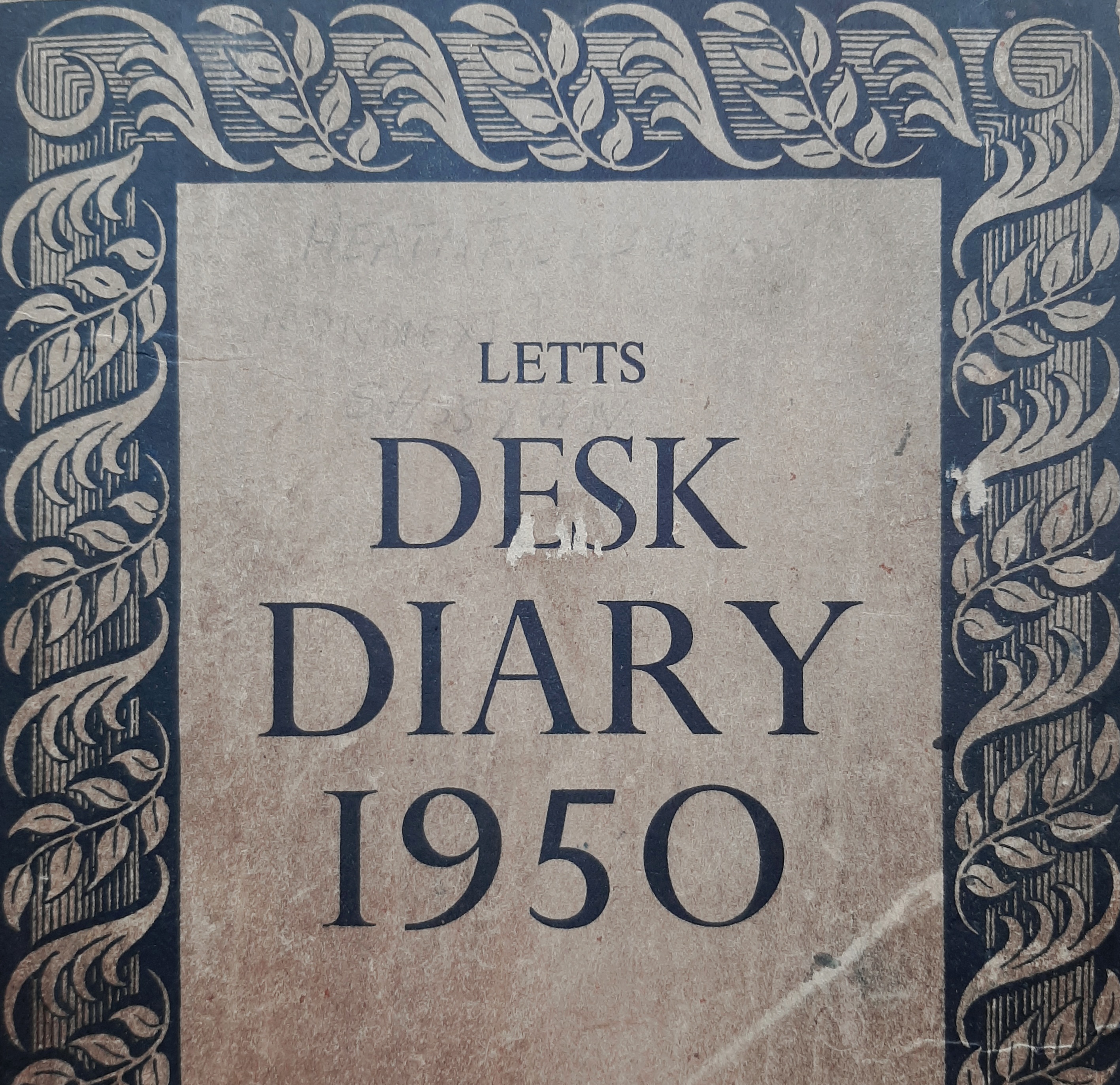
I have blogged before about the cache of family photographs and papers I inherited a while ago. Most of them relate to the maternal, Dutch side of my family. But there are just a few items from the paternal side, including, for some unknown reason, my grandfather’s diary from 1950.
This side of the family were Liverpool Welsh, part of the large community of immigrants from Wales which was a significant part of the population in the great port city of Liverpool, in the North West of England, from the middle of the 19th century. A large proportion of the Liverpool Welsh originated from the island of Anglesey, off North Wales, probably due at least in part to the island’s tradition of fishing and seafaring which would give them plenty of relevant skills for working in the docks. My grandfather was born on Anglesey into a seafaring family – he was just five years old when his father died when the ship he was skippering went down with all hands in Bardsey Sound in the 1880s. Although the details I was told by my father are a little hazy, there is documentary evidence that my grandfather was in the Merchant Navy at some point in his life, and also that he was the captain of a tug boat based in Bootle docks. I wonder how it felt to be able to see Anglesey across the water from the banks of the Mersey?
I never knew either of my paternal grandparents as they died long before I was born. Neither did I ever meet most of the cast of characters whose names are familiar to me from my father’s stories and from Christmas cards – aunts, uncles, cousins. But in this diary I get a snapshot of their lives, their preoccupations, their daily activities and their holidays, and little details such as my grandfather’s birthday presents (socks, a muffler and a neck tie). Several weeks of the diary are devoted to the business of getting electricity installed in the house, and frustration with Mr Jones, the electrician (presumably another member of the Liverpool Welsh community), who doesn’t turn up when he’s supposed to, and goes off for days at a time to work on other houses, leaving the place a mess and the job half done. It seems some things don’t change!
From my grandfather’s diary, I learn a lot of things I either didn’t know, or wasn’t sure about. One of my uncles is a coal merchant, and he and his wife and young son are obviously going up in the world as they are the proud new owners of a motorcar, a pre-war Rover 10. This same uncle upgrades his coal lorry, only to have an accident when his shiny new purchase collides with a tram cart on Derby Road, in the docks area, and has to be ignominiously towed back to the coal yard for repairs. One of my aunts, disabled by polio as a child and still living at home aged 43, goes on holiday to London and while there marries her pen-friend (a precursor of internet dating?). This event warrants only a couple of lines, and none of the family seems to have attended. Did she elope? It’s a possibility, but there is an intriguing sentence a month earlier, when the pen-friend is staying with them in Liverpool: “hoping for the best.”
There are some things which seem inconsistent to me. His world seems very small – every day consists of shopping and housework for my grandmother, a walk for my grandfather, various uncles, aunts and cousins visiting every day to do things like help carry the shopping home, scrub the doorstep or bring round the evening paper, taking it in turns to keep them company in the evenings. More than half of each day’s entry is pretty much a verbatim repeat of the previous day, and his life seems a far cry from the active 71-year-olds I know these days. But the family also travel extensively – I know from photographs that my grandmother visited London on holiday in 1948, and according to the diary in 1950 various family members have vacations in North Wales, the Isle of Man, and London (in the latter case, lodging with other members of the Welsh diaspora). They have a daytrip to see the Flower Show at Ruthin in North Wales (my grandmother’s home town). My father at this time is living in the South West, and my other uncle is at college near Sheffield, with placements all over England and even Ireland.
My grandfather’s spelling is positively Shakespearian at times, often phonetic, with a level of literacy which suggests he was not educated beyond elementary school. However, he reads the newspaper every day (including newspapers sent by relatives in other parts of the UK), and engaging with the written word through keeping a diary is obviously important to him. There are hints too that it is my grandfather who deals with the business correspondence for the uncle with the coal yard.
I find the nature of his Welsh identity enigmatic, too. For example, I know from my father that my grandfather was a first language Welsh speaker, but he chose to write his diary – that most personal document – in English. Where he does use Welsh, for example in place names, his spelling is every bit as erratic as it is in English! As with so many in the Liverpool Welsh community of the time, much of the family’s social life is based around Welsh-language churches and chapels, although by his own account my grandfather attends less than the rest of the family – he prefers to listen to Sunday morning services in Welsh, from chapels in Wales, on the radio.
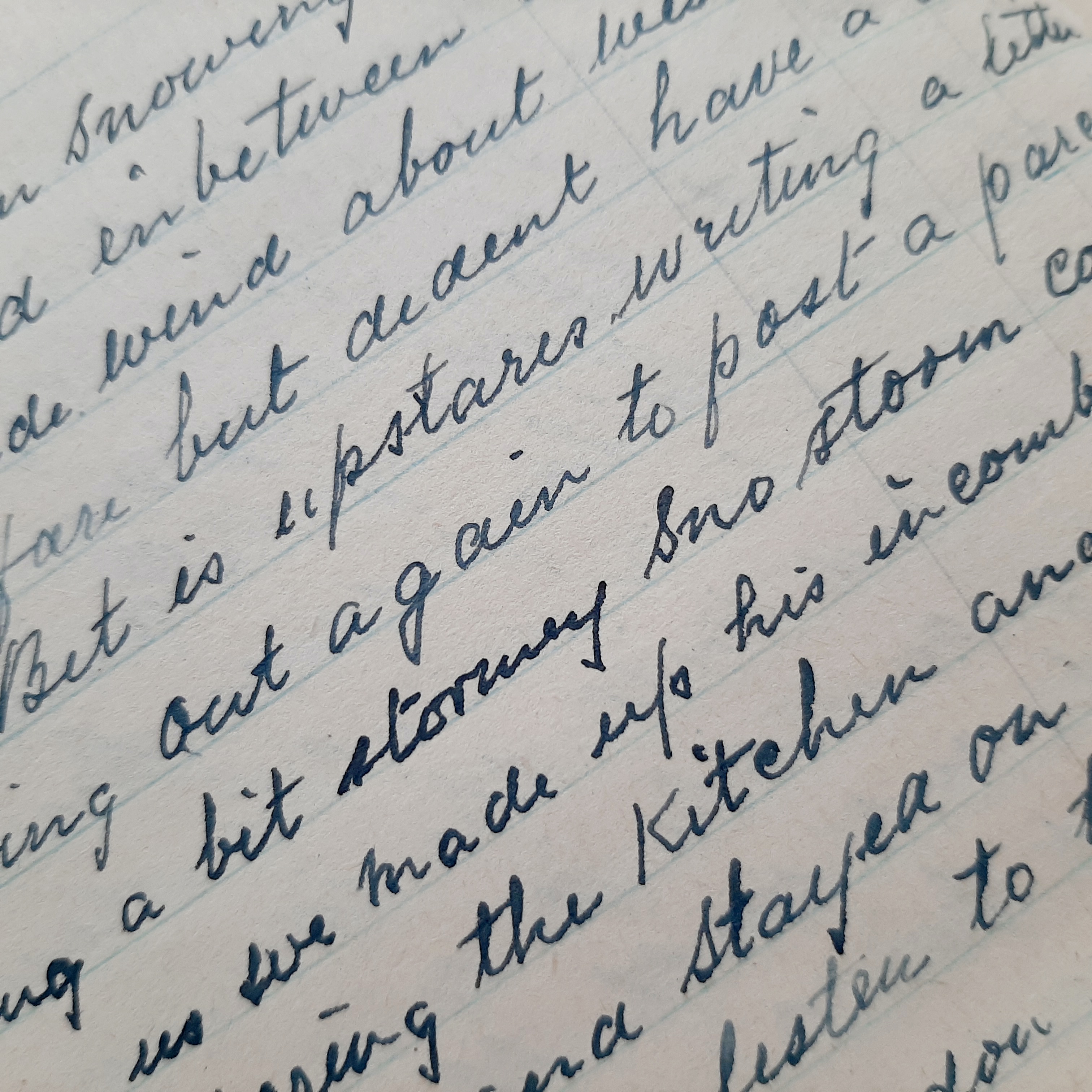
Each day’s entry starts with a report on the weather: “Very nice morning nice and clear not too cold, wind South West light” or “rather dull at first then rained hard, stoped [sic] some sunshine then more heavy showers and more sunshine. Wind about South West by South.” Along with occasional references to going to sign for his Seamen’s Pension, it’s the only clue to his years aboard ship, where the state of the weather – and the wind in particular – would have been of utmost importance.
I have written about the personal nature of handwriting, which gives an immediacy and intimacy that cannot be replicated by the typed or printed word. Through this diary I have spent time with someone who is at once both familiar and a stranger. I know of him, but almost everything I knew before reading this was mediated through my father, who was a fairly unreliable narrator. I never knew my grandfather – but although I never met him in person, I have here in my hand a book which he held, every day of the year. I have his words, written with a fountain pen, the quality of his handwriting reflecting his state of health on any given day. I can see where he has gone back and added in an afterthought, or corrected a mistake in the day’s chronology. This man is responsible for a quarter of my genes, and this is the first time I have had any physical contact with him. When I turn the pages, I am touching his fingerprints. This is the closest I will ever get to him.
The last full entry in the diary is for Boxing Day, Tuesday 26 December 1950. He writes:
“In the afternoon R and B came up for us all to go to there [sic] house for a party, but owing to the coughing and spitting I stayed at home. I hope that they will have a good time there.”
The following day he writes only “Nice day” – not even a weather report. Within a fortnight, just a few days before his 72nd birthday, he is dead.
I am committed to making this blog freely available, and not putting material behind a paywall. As a writer, I am doing what I love – but I still have to make a living. If you have enjoyed this post, and if you are able to do so, perhaps you would consider supporting my work by making a small contribution via the Buy Me A Coffee button. Thank you!
Today, the first day of February, is the festival of Imbolc (the ‘b’ is usually silent). A pre-Christian festival celebrating the end of winter and the beginning of spring, it marks the point in the year when, although some of the worst weather might still be to come, nevertheless the first signs of hope and life are emerging. Days are noticeably longer, trees are budding and the catkins are out (though as a hay fever sufferer with a particular sensitivity to tree pollen, I’m less thrilled about this last development). The plump, green shoots of flowering bulbs have nosed their way out of the cold earth, and the first of them – aconites, snowdrops, crocuses, even the occasional daffodil – are blooming. Their splashes of yellow, white and purple are the first colour after the monochrome months of winter.
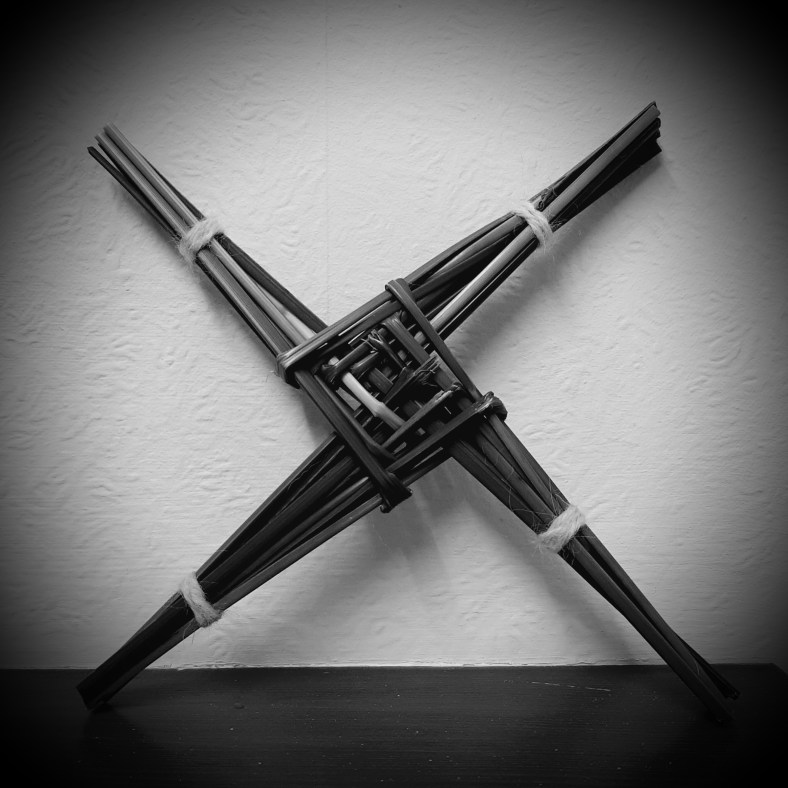
The beginning of February has been a popular time for festivals. In the Christian era in Ireland, the date became associated with St Bridget (Brigid, Bride, Brighde, etc), second only to St Patrick as the country’s principal saint. She in turn was conflated with the great pagan goddess of the same name. St Bridget was invoked by metalworkers, in healing, and in warfare, as well as in connection with fire and thunderstorms. By the 18th century it was believed that Bridget would visit the homes of the virtuous on the night before her feast, and bless the inhabitants. In some places, offerings of food – cakes or bread – would be left on window sills for her, but more usually a cross would be woven out of rushes or straw, and hung near a door or window to welcome her. This custom has been widely adopted well beyond Ireland, and is popular in the neo-pagan community as a way of marking Imbolc. There are even tutorials on YouTube to teach you how to make a St Bridget’s cross. I made mine yesterday, although as I didn’t have any rushes or straw to hand I raided the garden and used the dried stems of a large ornamental grass instead. Traditionally, the crosses are left up all year, the old cross being burned when the new one is made.
The second day of February is the Christian festival of Candlemas, also known as the Feast of the Purification of the Virgin Mary, or the Presentation of Christ in the Temple. In the Gospel of Luke, the baby Jesus is taken to the Temple in Jerusalem by his parents, for his mother to make the traditional Jewish offering to purify herself. Under Jewish law, this happened 40 days after childbirth, so once the Church had fixed the birth of Jesus to 25 December, this festival took place on 2 February. Little is known about how it was celebrated in the early Church, but by the end of the seventh century it had reached Britain, and a couple of decades later the Venerable Bede described rituals including candlelit processions. Maybe the candles harked back to the words of Simeon, the old man at the Temple, who recognised in the baby Jesus as the Messiah who would be ‘a light to lighten the Gentiles’?
As well as giving their name to the festival, candles were a major part of the customs that marked it, with candles being blessed and used in procession. They were then either burned in front of a statue of the Virgin Mary, or taken home to be lit to protect the household against illness or storms. The Reformation saw the end of these customs, the blessing of candles being seen as superstitious and the making of magical objects, and the customs of Candlemas lay dormant until the nineteenth century, with the revival of interest in the pre-Reformation Church and medievalism.
Candlemas is traditionally the very end of the season of Christmas, and in some places the evergreen decorations are not taken down on Twelfth Night but kept up until Candlemas – an echo, perhaps, of the Imbolc celebration of the end of winter. Those shy harbingers of spring, snowdrops, are also known as Candlemas Bells, because they flower at this time.
February festivals have a long and varied history – to the Romans, February was a month of rituals of cleansing and purification, in preparation for the new life of spring. Those of us who still practice ‘spring cleaning’ are following in a very long tradition! Next time you wash your curtains, go down to the recycling centre or take your unwanted clothes to the charity/thrift shop, you can remind yourself that you are taking part in a spring ritual which has being going on for over two thousand years. Like the Romans, we can start to think beyond nesting, hibernating, snuggling down in our homes and look ahead to longer days, open windows, warm sunshine.
This is the point in the year when we can feel a shift from passive winter to active spring. No longer are we hunkered down, waiting for the dark and cold to pass – now we are looking forward to new life, new growth, warmth and light. Next stop, spring flowers and baby birds everywhere! There may still be snow and storms and dark days to come, but psychologically the worst of winter is behind us. This is a time of promise. Spring is coming.
If you would like to know more about the festivals of the year, their origins and traditions, I highly recommend the following books. The Stations of the Sun: a History of the Ritual Year in Britain by Ronald Hutton provides an academic but very readable introduction, while Glennie Kindred’s Sacred Earth Celebrations is the best guide I have found to the festivals of the Wheel of the Year as celebrated by the pagan community today.
I am committed to making this blog freely available, and not putting material behind a paywall. As a writer, I am doing what I love – but I still have to make a living. If you have enjoyed this post, and if you are able to do so, perhaps you would consider supporting my work by making a small contribution via the Buy Me A Coffee button. Thank you!
For the last few weeks I have been researching the Lindisfarne Gospels and writing an article about them for an e-magazine. For those of you not familiar with the Lindisfarne Gospels, they are a lavishly illuminated hand-written book of the four Gospels (Matthew, Mark, Luke and John) of the New Testament, in Latin, produced by a scribe-artist called Eadfrith around 700CE, in the monastic community on the island of Lindisfarne (aka Holy Island) off the coast of Northumberland in North East England. About 250 years later, a word by word translation (or ‘gloss’) in Old English was added above each line by a priest-scribe called Adred, at Chester-le-Street where the community was then living, having fled the island after raids by Vikings.
Incipit, Matthew’s gospel, Lindisfarne Gospels. British Library Cotton MS Nero D IV f.027r
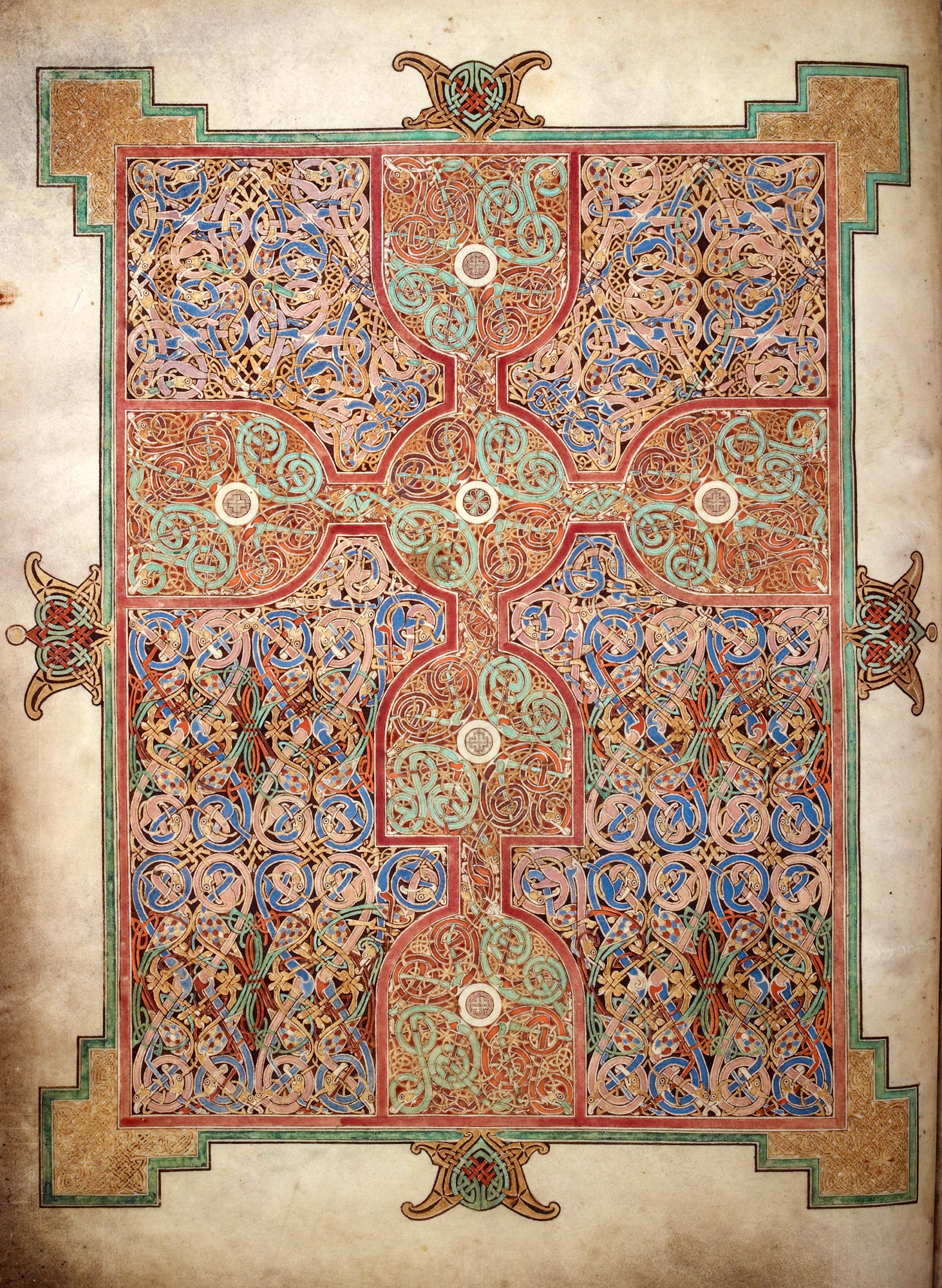
The art of the Lindisfarne Gospels is quite widely known today – the manuscript has been digitised and is available on the British Library website, and its motifs are used on all manner of historically-inspired merchandise. But, though beautiful, the art is not what excites me about the Lindisfarne Gospels. What makes my heart beat faster is that sense of glimpsing into the distant past something which connects us physically with the individuals who created it more than a millennium ago.
Far from being dry and academic, my research has been a fascinating journey into the England of the early medieval period – what used to be called the Dark Ages, between the departure of the Romans in the 5th century CE and the Norman Conquest in 1066, during which time it was thought that culture, learning and civilisation were largely absent. Historians think differently now, in no small part due to the artefacts produced in this period which have been found in various excavated hoards, and probably most famously at the ship-burial at Sutton Hoo which was excavated on the eve of World War II and which was found to contain jewellery of breath-taking beauty and craftsmanship. The sophistication shown in the illuminated manuscripts of the time is now seen, not as an exception, but as representative of the high standards of creative skill on the part of the peoples of the time.
Carpet page, Matthew’s gospel, Lindisfarne Gospels. British Library Cotton MS Nero D IV f.026v
In an era before print, the production of a book – even the most plain and workaday one – was a major undertaking. First, the vellum which formed the pages had to be prepared from the skins of young animals – calves or lambs – and trimmed and pricked in preparation for the binding process (making the Lindisfarne Gospels required the skins of almost 150 calves). Lines had to be marked out on the page (Eadfrith invented the lead pencil, and the lightbox, to do this). Ink had to be prepared, using oak galls and iron. Feathers – ideally big sturdy ones like the flight feathers of swans – had to be trimmed into pens. Then the scribe had to copy the book painstakingly from an exemplar, without the benefit of electric light. It could take years to produce a book – years of dedication, focus, bad backs, cold, working in a scriptorium lit only by south-facing windows in the summer and candles in the winter. A number of scribes left notes in the books they produced, complaining about their discomforts – issues around health and safety at work and RSI are not new!
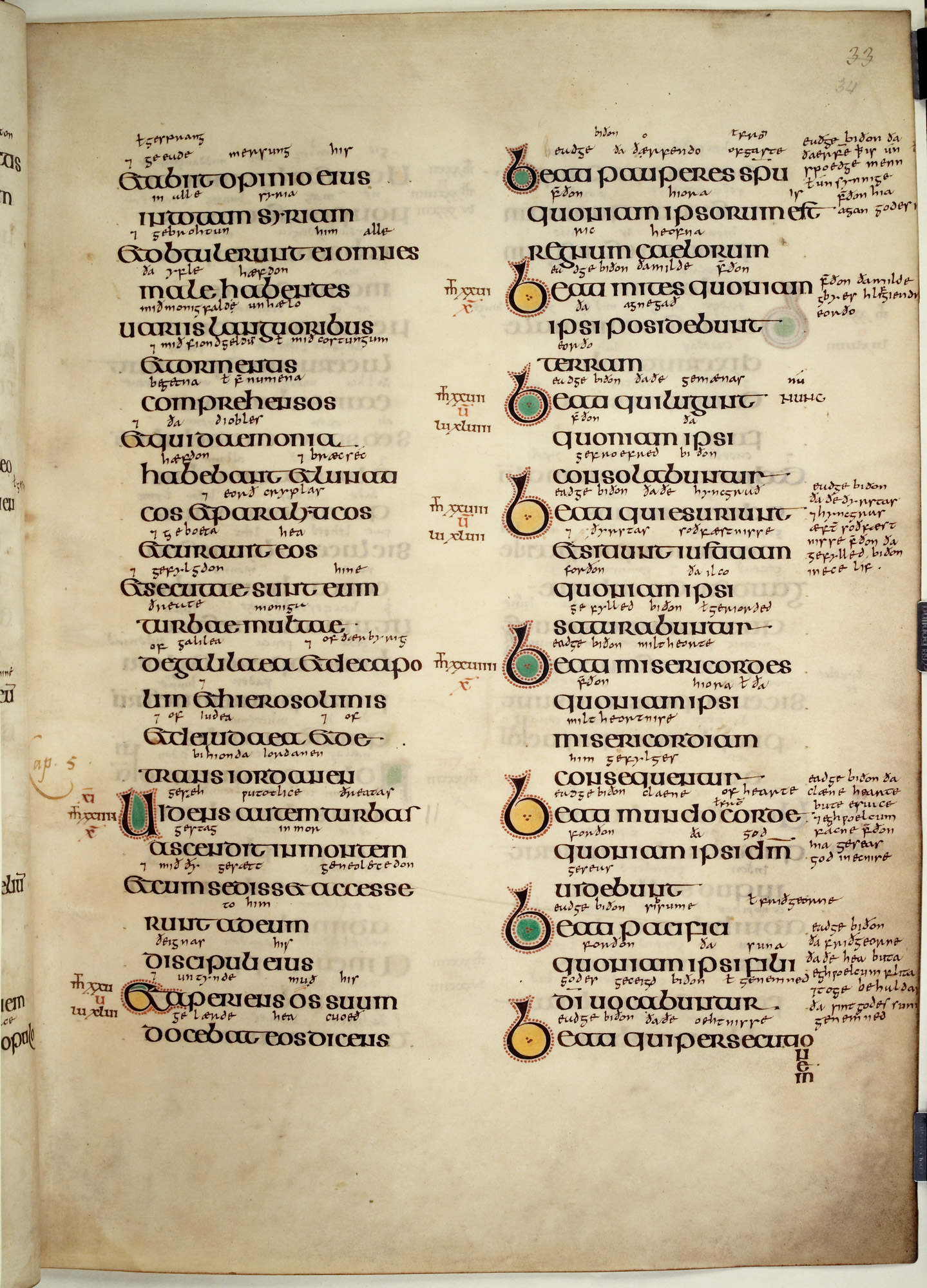
The Beatitudes, Matthew’s gospel, Lindisfarne Gospels. British Library Cotton MS Nero D IV f.034r
What I love about these documents, though, is the immediacy of something which was produced by hand. Just as our own handwriting is distinctive to each of us, it is possible to identify individual scribes by their handwriting. Often, teams of up to half a dozen scribes and artists would work on a book – the Lindisfarne Gospels are unusual in having been written by just one man. It is thought that it must have taken Eadfrith several years to produce the text and illustrations for this work. It can be a stretch of the imagination, in 21st century Britain, to imagine the life of a 7th century monk on a windswept island in the North Sea, toiling on this work of great beauty, to the glory – as he would have seen it – of God. Even as a visitor to Lindisfarne, it’s a challenge to look beyond the cafés and gift shops, the retreat centre and the museum, and the ruins of the later Norman priory, and picture this as a working monastery, its central work of prayer and worship buttressed by farming, fishery and the creation of high-quality books. Seeing the personal handwriting of one of those monks, the strokes made by his pen, the drawings and embellishments he drew in the colours he chose (and created himself from mineral and plant pigments), brings him within reach. Just as when, while researching your own family history you come across a 1911 census return in the handwriting of an ancestor you have never met and who died long before you were born, it makes them more real, so seeing Eadfrith’s handwriting brings him to life for us.
And in the Lindisfarne Gospels we are lucky enough to have the handwriting of two identified people. I mentioned earlier that an Old English word-for-word translation (or gloss) was added in the middle of the 10th century. We know that the man who did this was called Aldred, because he left us a note (a colophon) at the end of the Gospels to tell us so. He also names Eadfrith as the original scribe/artist, as well as crediting the people who bound the book and made a jewelled cover for it. By translating the text into English, Aldred was part of a movement championed by King Alfred (‘the Great’) in the late 9th century to make English a language not only of the people but also of learning and religion, alongside Latin. Here we not only have Aldred’s handwriting, we can also see him wrestling with language as he frequently offers several alternative translations of Latin worlds into Old English. Anyone who has ever attempted to translate from one language to another will relate to this!
Aldred’s colphon, Lindisfarne Gospels. British Library Cotton MS Nero D IV f.259r
In these times of emails, word-processing and SMS, handwriting is becoming a dying art. In one way, that doesn’t matter – as long as we are communicating with words, it’s irrelevant how they are produced – but in other ways we are maybe losing something. There is no digital equivalent of the personal, intimate legacy of someone’s handwriting – the notes and letters of past generations, which are often all we have left of our own families – and future generations will not experience the particular thrill of poring over a hand-written document produced by known, named people over a millennium ago. I wonder what ways they will have instead to connect to the human individuality of the people whose words they are reading?
My article on the Lindisfarne Gospels is published in Issue 7 of The Pilgrim, which is available online here.
I am committed to making this blog freely available, and not putting material behind a paywall. As a writer, I am doing what I love – but I still have to make a living. If you have enjoyed this post, and if you are able to do so, perhaps you would consider supporting my work by making a small contribution via the Buy Me A Coffee button. Thank you!

















 The Three Hares Blog