Portraits of the past – my family history in photographs

Last year I came into possession of a large collection of family photographs.  I am the last person standing on that side of the family, so on the death of the last of the previous generation is all passed to me.  We’re not talking a few albums here – the collection completely filled the back of an SUV!  Most of the albums were in poor condition and had been stored in damp or dusty places, so a priority was to remove all the photographs (copying the annotations onto the back of the photos where appropriate) and throw away the wreckage of the albums.  There were also a lot of loose photographs, as well as some in frames (many with broken glass).

Eventually, I was able to group them into rough families, eras and locations.  There were a huge number of duplicates, so the first edit was to choose the best of the duplicates, again copying any annotations, and put aside duplicates for cousins in America if they were likely to be of any interest to them.  Then, I went through each group of photographs, weeding out any which were of no particular family history interest, or where the features were blurred, or choosing one from a series of almost identical shots (there were lots of these, especially 1950s landscapes.  It was apparently a thing in Scandinavia to take many photographs of the back of people standing in a field gazing at distant hills…).

After many evenings and weekends of going through photographs, peering through a magnifying glass at blurry faces, and getting very dusty, I have now whittled the collection down to a single crate, all divided into acid-free archival envelopes labelled with details of the contents (pre-war Holland, Helsinki Olympics 1952, holiday to Wales July 1961, etc).  I also started a notebook, with a page for each year, so that I could track the events and movements relating to the various strands of the family.  One wet Sunday afternoon this winter I plan to create a timeline from the notebook, which colour coding for each branch of the family, for the whole of the 20th century (and also scanning the most interesting ones of shared ancestors to send to my American cousins).

This side of my family is Dutch (via military service in the Dutch East Indies and internment in Japanese camps during WWII), with various members emigrating to America, Finland and Britain.  It has been a fascinating – and occasionally harrowing – exercise to follow individuals from newborns, through rites of passage, family memories, pets and holidays, to ageing, and in one case, death (it seems it was the fashion to take open casket photographs in 1940s America).

I have glimpsed the interiors of Dutch colonial houses of the 1930s, Scandinavian holiday shacks in the 1950s, and American ranches in the 1970s.  I have found that some of the stories I was told as a child were true, and others were not, while still others have got garbled in the telling.  I have been saddened by the toll that WWII took on my grandfather (he was in his 60s when I was born, so I never knew him as anything other than old).  I have been moved by how much my teenage grandparents were obviously in love, in photographs from their courting days which I had never seen.  I have seen my own features and expressions looking out at me from the faces of long-dead relatives.  And I now have a much clearer sense of who I am, and where I have come from.

Why Three Hares?

Why, you may well be asking, have I chosen ‘The Three Hares’ as the title for this blog?  I confess, it’s a bit of a self-indulgence.  It has to be called something, so it may as well be something I’m passionate about!

The motif of the three hares has fascinated me ever since I first encountered it, and I have been intrigued by its mysterious history and ambiguous meaning.  The motif consists of three hares (or possibly rabbits, in some cases) running in a circle, either clockwise or anti-clockwise, with each hare having two ears – but there are only three ears in total.  The ears form a triangle at the centre of the design (very occasionally, there are four hares sharing four ears, which form a square at the centre).

I first came across them in Devon, where there are nearly 20 examples of medieval roof bosses featuring the three hares in churches across the county.  (They are sometimes called “Tinners’ Rabbits” in the Dartmoor area, but this seems to be a bit of a red herring, as the origins of the motif are much older).

So, first, the history:  the earliest examples have been found in caves in China, which are believed to be early 6th century.  The theory is that the motif travelled west along the Silk Road, appearing in southern Russia, Iran, eastern Europe, Germany, France, Switzerland, and finally crossing the Channel to England and Wales in the early 14th century.  The hares transcend religious traditions, from Buddhism, through the Islamic world (where the motif appears on metalwork, glass, ceramics and textiles), Judaism (18th century synagogues in Germany have the motif, alongside the riddle “Three hares sharing three ears, yet every one of them has two”) to Christianity (they feature in churches across Western Europe).

The meaning is much more mysterious than the history.  Hares have had many associations, including as a symbol for resurrection in Chinese mythology.  The hare was the animal associated with the pagan goddess Oestara, along with the moon, possibly because the hare was believed (erroneously!) to have a gestation period of 28 days.  This association may account for the naming of the female cycle (oestrus) and the principal female hormone (oestrogen).  This female imagery may be the reason that the three hares are often found juxtaposed with the Green Man in English examples.  In another legend, the hare was believed to have laid the Cosmic Egg, which may be the precursor of the idea of the Easter Bunny, and Easter eggs!  And latterly, the three hares were believed to be a symbol of the Christian Trinity.

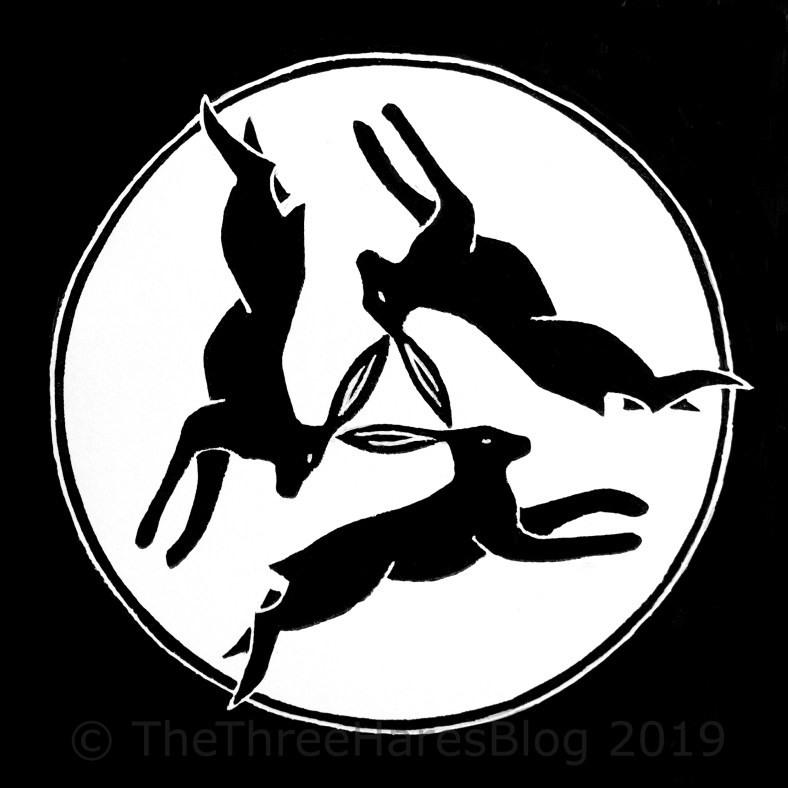
I leave you with my own interpretation, in a linocut print, of the three hares and moon motif, which is the logo for this blog, and some links to articles which have informed my understanding of the three hares and which you may find interesting.  If you are really lucky, you may manage to track down a copy of The Three Hares: A curiosity worth regarding by Tom Greeves, Chris Chapman and Sue Andrew, published by Skerryvore Productions but now sadly out of print – if you do, can I please borrow it?!

20190722_100029 classic - Copy - edited and watermarked

The Three Hares Project

Legendary Dartmoor

Wikipedia article

New Scientist article

The Three Hares Trail, Dartmoor

An artist’s blog about the three hares

The three hares as a Chines puzzle

A culture of fear? Consumerism, education and global politics in 2014

I recently read somewhere that the sale of SUVs and other large, bulky and ‘safe’ vehicles had increased sharply in the USA immediately after 9/11.  The analysis was that people, rendered fearful of everyday activities by events over which they had no control, were subconsciously choosing to fortify and protect their families in ways they could control, e.g. the kind of family car they bought.

Then I watched a documentary about the advertising industry, and how the whole basis of consumerism is based on fear – fear of being left behind, fear of social ostracism (e.g. the Listerine campaign which suggested that unless you used their product, you would have bad breath which might even prevent you marrying), fear of germs, etc etc etc.

I began to think about fear, and began to see other signs of how pervasive it is.  Maybe it always has been; but when I was a student 20-odd years ago, we had no tens of thousands of pounds of debt looming over us.  No one I knew had a job during term time.  Our grants were enough to live on (albeit frugally).  We got involved in protests – marched – joined Greenpeace – protested against the Poll Tax.  Worried about the state of the world, and looked for ways to change it.  It never occurred to any of us that these activities would be a hindrance in finding jobs in the future.  Very few of us were desperate about our grades – all work and no play seemed a poor way to make the most of a university education.  At some point in the final year, it began to dawn on some that they might have to start looking for a job.  But for most, this was the first time we had seriously thought about it.  Most decisions about O levels or the new GCSEs, and A levels, had been made on the basis of what subjects we were good at, and enjoyed, rather than with analytical care to ensure those choices got us into the courses which would ensure a career path.  There were exceptions, of course, for example my sixth-form friend who was thinking about medicine and who therefore made sure she did biology, rather than physics, at A level.  But I recall little fear about the future.  Something would turn up.  Even for oddballs like me with a particularly esoteric humanities degree.

I listen sadly to the 18 year olds of today, and their parents, worrying about fees, debt, finding part-time work in term time as well as in the holidays, juggling workloads, choosing student clubs and societies according to what they think will look good on their CVs, and for the most part doing degree subjects selected for their future employability, rather than interest, passion or a thirst for knowledge.  What happened to learning?  What happened to impassioned debate over 3am coffee about historiography or philosophy?  What happened to the ideal of a university education for the sake of broadening the mind and producing a generation of people who could think, use their critical faculties, make cogent arguments, be analytical?  I grieve for that – education (even at school) seems now to be utilitarian, geared to passing exams and gaining qualifications which seem to be of less and less value with every year that passes.  And fear is now in the education system pretty much from the reception class onwards.  How can this be making the world a better place?

The whole consumer culture seems to be based on fear, too – I must buy this or that or my children won’t love me/my friends will think I’m tight-fisted/people will laugh at me/I’ll be a failure because I don’t have the latest thing.  Even the housing sector is fuelled by fear: if I don’t own my own house (even if the mortgage company actually owns most of it) I will be at the mercy of my landlord, and have no security for my family.  That’s quite apart from the concept of consumption, and home-ownership, as a mark of status.

And then of course, there is Gaza.  And Syria.  And Ukraine.  And the ebola virus.  Everything becomes something to be afraid of – the flight to see far-flung family or to go on holiday.  The person at the airport who looks unwell.  Where will the next war flare up?  Is there anywhere left that is safe?  What is our personal equivalent of buying an SUV after 9/11?

My challenge to myself is simple (but not easy).  Will I too live fearfully, the safe space I occupy becoming smaller and smaller with each new danger?  Or attempt to see the world around me not as threat, but as gift and opportunity?  To ask myself what really makes me safe (not much – most big things are beyond my control in this globalised world) and what is instead just a waste of money, time and energy?  To attempt to live a life that is about growth, not the shrinkage of fear?

Live simply, so that others may simply live

I have been – again – mulling over the whole issue of living simply.  The quotation from Gandhi which is the title of this post is quite a challenge.  I know there are no easy, glib answers, and no doubt many readers of this blog will take issue with my views and those of the blogs I link to.  The catalyst for my current musings was the pointless deaths of hundreds of textile workers at the Rana Plaza factory in Bangladesh, who died, it would seem, as a direct result of our insatiable desire for cheap stuff.  I do wonder whether any of the clothes I have worn over the years which bore the label ‘Made in Bangladesh’ were  made by those workers.

Thanks to a re-tweet by @scrapiana (www.scrapiana.com) I found this blog post from Toft’s Nummulite http://toftsnummulite.blogspot.co.uk/2013/05/the-high-price-of-cheap-stuff-what-we.html and it makes for interesting reading.  The links within it are worth following up too – the short film on The Story of Stuff http://www.storyofstuff.org/movies-all/story-of-stuff/ is about a coffee-break long and although it is American, with increased globalisation and related issues, it’s certainly relevant to us in the UK 6 years after the film was originally made.  The graphics are very cool too!

From the point of view of fashion, and the buying choices we in the West might make, there is a link to another blog post, http://www.oranges-and-apples.com/2012/01/untangling-ethical-fashion.html which is one analysis of the criteria for purchasing clothing.  There has been a huge amount written about this in the past few years, but this is quite a good introduction.  I appreciate the acknowledgement that there isn’t one ‘right way’ to prioritise factors when making a purchasing decision – but it is helpful to have an overview of the issues, and the possible unintended consequences of our actions.  My own priorities include other factors – I try to buy  British-made (well-nigh impossible at my price point) to support the local/regional/national economy but also so that I can be sure that the workers who made it had some rights, healthcare, education etc – or at least made on this continent to reduce the distance it’s transported.  I try to buy wool, cotton, linen or (at a pinch) viscose to reduce petrochemical use and allow for composting when eventually at the end of their useful life (I also think wearing natural fibres is healthier).  I try to buy clothes I know I will be able to maintain (no dry clean only) and repair (I am reasonably skillful with a needle).  Badly-made clothes, with skimpy seam allowances and badly-finished stitching, will not last and are not worth the investment of resources in making them, let alone buying them.   I know I need to research more about the impact of dyes and the dyeing process.  I buy a lot of clothes in charity, second-hand and vintage shops (although, being quite tall, and also a larger size than was common before the last couple of decades, means that most older clothing does not fit me) and eBay, and I have more relaxed views about the country of origin of clothes which I am not buying new – after all, they are getting a second use for their sea-miles.  I don’t always succeed in buying the way I would like to, partly because the sourcing of clothing which would meet these and other ethical criteria is enormously time-consuming, and also because I do have limited means (not that buying something expensive necessarily means it has not been made in a sweatshop, but simply because buying a UK made cashmere jumper, say, although it will last for many years if looked after carefully, nevertheless represents an initial outlay not far short of a week’s salary).

The Story of Stuff quotes Victor Lebow’s article for the Spring 1955 issue of The Journal of Retailing, and I find it chilling that the foundations of the consumerist treadmill that has had such a huge impact on the world could have been laid with such calculation:

“Our enormously productive economy demands that we make consumption our way of life, that we convert the buying and use of goods into rituals, that we seek our spiritual satisfaction, our ego satisfaction, in consumption…we need things consumed, burned up, replaced and discarded at an ever-accelerating rate.”

What price living simply, so that others may simply live?

Musings on farming and food, in the light of recent weather-related disasters in the UK

All views in this blog are my own.  Some people will, no doubt, disagree strongly with some or all of them.

As I write this, farmers in parts of the UK are still digging animals, many of them dead, out of snowdrifts.  Carcasses cannot be disposed of, because the roads are still impassable.  In at least one case the RSPCA has now become involved, apparently  because walkers are complaining about seeing dead animals.  I must admit this incenses me  – having lived in North Wales, where tourists in flip-flops used regularly to venture up Cader Idris, which is really suitable only for experienced hill walkers with specialist equipment and clothing, and then have to be air-lifted off the mountain when they got into difficulties, at vast expense to the taxpayer and personal risk to the helicopter crews, I have no patience at all with walkers who go out in hazardous conditions.  It is selfish and arrogant.  I have even less patience with those who want the pretty scenery but come over all indignant when they are brought face to face with the harsh reality of life and death in the country.  Surely it cannot have escaped their attention that in the last couple of weeks parts of the farming community have experienced an almost unprecedented  crisis, on top of 18 months of  weather related misery?  And that this has resulted in the death of thousands of animals?  Presumably these are the same kind of people who let their dogs run loose near pregnant sheep, refusing to believe that, to a sheep, dear little Bonzo is a wolf, and that their precious leisure activity can cause ewes to abort, threatening the farmer’s already precarious livelihood (not to mention the welfare of the sheep).  That’s always assuming Bonzo doesn’t actually savage the sheep, which is a very common occurrence.

The attitude of wider society, and civil authority such as the Welsh Assembly Government, to the recent snow crisis, seems to me to be part of an at best ambivalent attitude to farming and farmers which is, I feel, a significant threat to our national future.  Figures seem to vary enormously, but it is safe to say that in the UK we only produce about half the food we eat.  Therefore, should we be involved in a war, or should international transportation be interrupted through energy supply problems, industrial action, terrorism etc we would be in a poor position to feed ourselves, and the shelves of our shops and supermarkets would soon be very empty indeed.  However, addressing this does not seem to be a priority for government, nor does it seem to figure in our national security policy.  It should.

Not only are we, collectively, content to make ourselves hostages of fortune in this way, but we also have a very negative attitude to those farmers who are providing the food that is still produced in the UK.  Farmers are,  variously, regarded as rich, moaners, getting fat on handouts from the EU, preventing free access to the countryside (I sometimes wonder if the people who moan about this would be happy for complete strangers to come wandering through their gardens, leaving the gates open and dropping litter everywhere?), and (the greatest sin in this country of ‘animal lovers’) being cruel to animals.  The recent thread on BBC Radio 2’s Facebook page brought the latter element out in force.  Apparently it is cruel to raise animals for meat, and also cruel to let them get caught in freak unseasonal blizzards, and no sense of these being mutually contradictory.  Farmers can’t win.

The reality of farming life is very mixed.  Yes, there are prosperous farmers.  Generally in the east of England, with large arable farms where economies of scale help.  But even they are not immune to 18 months of relentless wet, leaving their land underwater and their crops rotting in the fields.  In the north and west, farms are generally smaller, more livestock based, and rural poverty is a reality.  Yes, they own large chunks of land with big houses on them.  Yes, they drive 4wds.  But the value of the land is tied up, the houses are unheatable, and the 4wds are not a status symbol but a necessity for getting around off-road (which is where the animals will be, obviously).  Diversification (adding value eg ice cream, or B&B’s), farmers markets and farmers wives working off the farm to bring in some money have become a necessity for survival, not a choice.  Foodbanks, ironically, are a lifeline in many farming communities.

I don’t begin to understand the complexities of EU farming payments.  Fortunately, farmers have learned to, although the amount of time and energy this (and other paperwork) takes diverts them from the core business of raising crops and livestock.  None of this would be necessary if we had not, as a society, bought into the idea (some time post-WWII) that food should be cheap.  The supermarkets seem to have become effectively the Ministry of Food, telling us what we can have and at what price, and keeping farm gate prices so low (eg milk) that any connection between the cost of production and the cost to the consumer has been lost.  We have been terrorised into thinking that it’s only the benevolence of the supermarkets which prevents the UK consumer from starving, as local shops and producers are all hideously expensive.  Well, it simply isn’t true.  Readers of this blog will remember my own fears about moving to the country, away from supermarkets, at a time when we were moving from two incomes to one.  In fact my food expenditure is down at least 30%, and my food miles are down more as I shop locally.  I appreciate that those who live in the middle of London, say, may have fewer local producers than here in Somerset, but towns have markets!  Food shoppers of the UK, you have CHOICES – you don’t have to believe everything the supermarkets tell you.  Explore the alternatives.  Yes, if you work 9-5 you may have to work a bit harder at accessing other sources, but it can be done, and really, what is more important than the food we eat?  The cheap food culture has led, inevitably, to a devaluation of food, from something precious around which family life revolves, to processed fuel grazed on the move or in front of the telly.  The demise of the dining room, and the dining table, from the homes of the UK tells its own story.

It’s time to put food back into the place it deserves in our lives.  You are what you eat – on that basis most of us are Chorleywood ‘bread’ and processed meat, with lashings of fat and sugar.  Somehow, we have, as a nation, to re-learn to value what we eat, and the people who make it and bring it to us: the farmer, the butcher, the baker, the greengrocer, the farm shop, the deli.  The vet, the abattoir manager, the shearer, the AI technician, the scanner.  The milker, the mechanic, the cheesemaker, the brewer, the shepherd, the sheepdog.  The people working unsociable hours to get us fed, on the milkround, in the corner shop, in the milking parlour, in the lambing shed.  And in the last fortnight, out on the hill digging animals out of snowdrifts.

The government isn’t going to make that change.  Left-wing governments tend to have it in for farmers, and the current one is too full of urban millionaires to be able to relate to what’s going on in the real world.  The supermarkets aren’t going to make that change.  Their entire business model depends on the status quo.  It’s down to you and me.  I fully appreciate that those living on benefits or the minimum wage won’t have the option to spend a little more time, energy or (sometimes) money on buying local and cooking from scratch.  Many people, raised on two generations of the supermarket and processed food, no longer know how to cook from raw ingredients, and since cooking is no longer on the school curriculum, I am hugely worried about that too, for the future health of the nation.

But just because some cannot, it doesn’t mean that the rest of us – middle class, middle income and above – shouldn’t be taking responsibility and doing our bit for change.  I am now no longer routinely doing food shopping in supermarkets.  If I really can’t get something locally, or in the village Co-Op, then I try Waitrose (those two chains have a slightly less awful record of dealing with the farming community).  But that’s only every 2 or 3 months.   I try not to eat out of season or imported fruit and veg – and as a result, this winter I have discovered swede, turnips and curly kale, none of which I had regularly eaten before.  I am buying all my meat from local butchers and farm shops, and trying out cuts which are simply not available in supermarkets.  I WON’T buy New Zealand lamb while we still produce UK lamb (as I write this, on Easter Sunday, this evening’s leg of Exmoor lamb is slow cooking with garlic and rosemary.  Bought from the farm shop, and cheaper than the NZ leg for sale in the Co-Op).  And I think we have eaten better this winter than ever before.

My small changes in buying and cooking habits may not, by themselves, make the difference to making UK farming viable, thriving and a valued part of the nation’s economy and life, but what if you did it too? And you?  And maybe you?

Buy local.  Failing that, buy regional or national.  Buy fresh and cook real food, not processed.  Enjoy seasonal treats (asparagus, strawberries, plums, apples) fresh when in season, don’t eat imported versions all year round.  Find your local farm shop, butcher, market.  Ask where the produce comes from.  Make it clear to your retailers that you value local produce.  Be prepared to make a bit more of an effort to get good, fresh food, produced in the UK (and ideally in your county) onto your dining table.  You are what you eat.

If we don’t, farming in the UK will continue to decline, and we will have no-one to blame but ourselves.  After 18 months of relentless wet, flooding, poor grass growth (grass=meat), rising feed prices, higher vet bills, and now, in many places, huge losses at what should have been the most optimistic part of the farming year, the question must be why on earth anyone stays in farming.  The rates of bankruptcy and suicide speak for themselves.  We simply have to take responsibility for supporting our farming industry, or we will all starve.