When I was little, I wanted to be a detective

When I was little, I wanted to be a detective.  Or a writer.  Or a writer of detective stories.  Indecisive from an early age, I was not quite sure which appealed most – or maybe it should be a combination?   

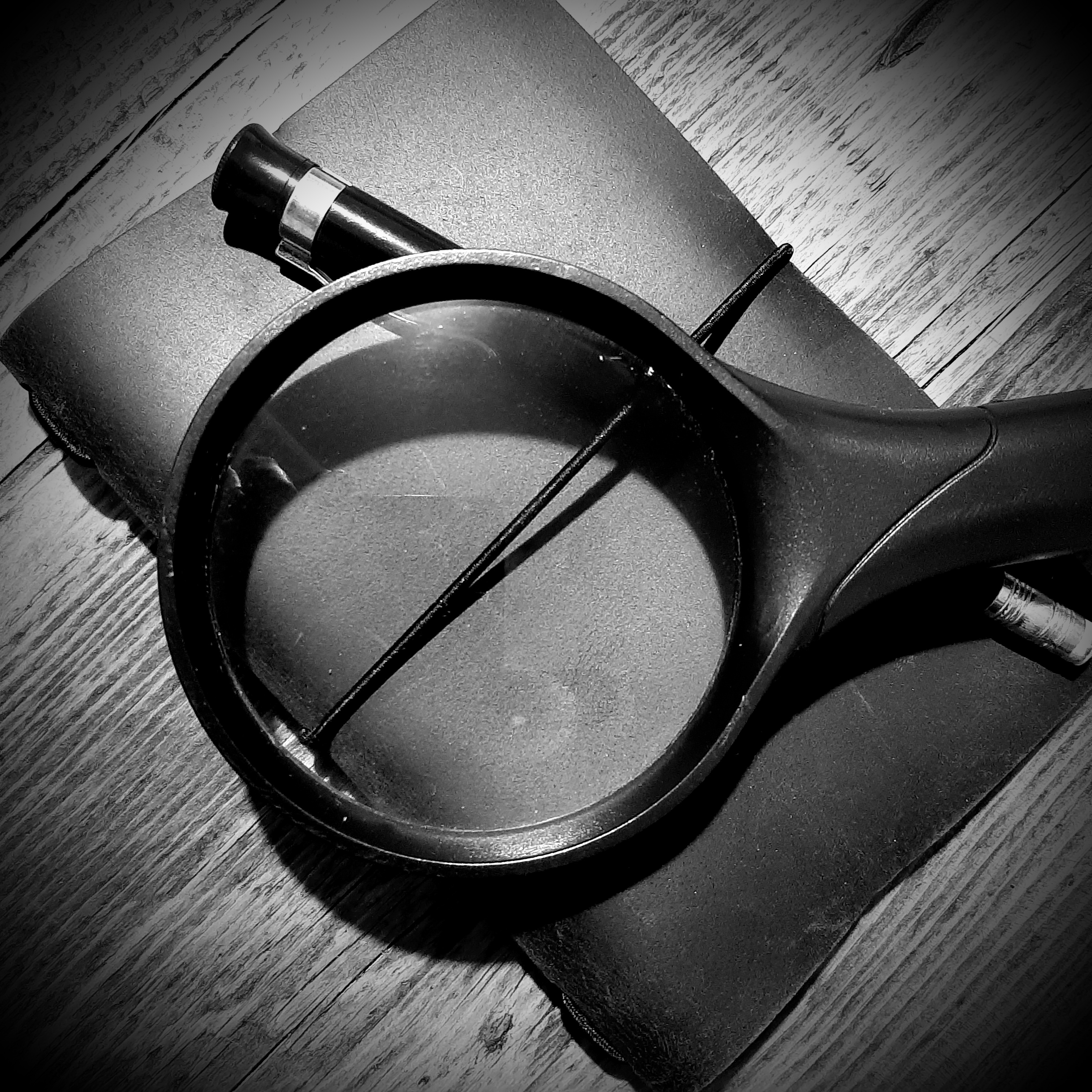
In any event, I was very clear about the kit required.  I had notebooks (always lots of notebooks!) for both professions.  For detection, I also had a magnifying glass (of course – I was an early acolyte of Sherlock Holmes) and a toy revolver (no doubt influenced by reading too much Raymond Chandler at too young an age).  I had a range of disguises, including spectacles, moustaches, and greasepaint.  I improvised a fingerprint set with sellotape and ground-up pencil graphite (with surprisingly clear results).  For writing, I had the Pocket Oxford Dictionary (single volume – a navy blue hardback way too chunky for anyone’s pocket), a selection of pens and pencils, and a modest library of books for inspiration.  I aspired to using a typewriter, because I knew that proper writers always typed their manuscripts, but my fingers were not yet strong enough to strike the keys of my father’s Remington Envoy.

Quite where these tropes came from, I’m really not sure.  I watched very little television (for most of my childhood we didn’t have one), and I was home-educated so there was not much in the way of popular culture influences.  There was, however, the BBC World Service, which was then a much more holistic broadcaster than its present incarnation as a rolling news station, and was responsible for much of my classical and jazz musical education as well as introducing me to Shakespeare (a production of Twelfth Night), Tolkein (The Hobbit, read by Bernard Cribbins), Douglas Adams (the original radio script, unsurpassed by subsequent books, films and television adaptations, of The Hitchhiker’s Guide to the Galaxy), and Dorothy L Sayers (courtesy of the peerless Ian Carmichael as Lord Peter Wimsey – when I subsequently read my grandmother’s copies of the books, it was Carmichael’s voice I heard).  The World Service also broadcast the sit-com The Small Intricate Life of Gerald C Potter, where the eponymous detective writer (again played by Ian Carmichael) and his wife Diana (a much more successful writer, creating breathless romances under the pseudonym of Magnolia Badminton) crashed amusingly through a more or less chaotic but never boring life, accompanied by the sound of a manual typewriter.  It did nothing to lessen the appeal of wordsmithing as a lifestyle.  The signature tune, Leroy Anderson’s The Typewriter, still makes me smile.

There was no shortage of role models for my future career as a detective.  My grandmother had a serious addiction to Golden Age crime fiction (in the original English, despite being an elderly Dutch lady) and I was exposed to Hercule Poirot, Jane Marple, Parker Pyne, Lord Peter Wimsey, Perry Mason, Philip Marlowe, and of course Sherlock Holmes, even before I graduated from reading Enid Blyton’s Secret Seven and The Five Find-Outers.

I have always believed that names are important.  Naturally, my detective alter ego needed a name, and for some reason which I have long since forgotten, I decided on Peggy Reynolds, Private Investigator.  As a nascent writer, my nom de plume was Mara McDonald, and I do know the origin of that – it was the result of a brief infatuation with all things Highland caused by overdosing on Robert Louis Stevenson and reading Kidnapped under the bedclothes with a torch.  I was more than a little in love with Alan Breck Stewart, self-aggrandising and infuriating as he was.  Looking back, it is interesting to see the association in my young mind between writing and romance.

Fast-forward nearly half a century.  What would that child, who responded to the tedious adult questioning about ‘what do you want to be when you grow up’ with such interesting ambitions, think of how life has turned out?  Well, I never did become a PI.  However, my insatiable curiosity, my obsession with collecting obscure facts, and the desire to find out how things work have stood me in good stead in a variety of jobs.  Detective instincts are especially useful for the writer of non-fiction, who inevitably needs to invest large amounts of research in every piece of writing – research is to writing what the base of the iceberg is to the visible tip.  And I am, indeed, a writer – even if not currently a full-time one – with a respectable clutch of publications in print and online (the latter something my young self could not have imagined), in non-fiction and poetry.  However, fiction has proved to be a genre I simply cannot write, and the dream of writing a detective novel remains just that – a dream.
2021 – My Year In Books

2021 – My Year In Books

New Year’s Eve has come upon me suddenly – in the limbo between the public festivals of Christmas and New Year, the days seem to merge into each other, especially this year when the grey skies touch the ground (alternating occasionally with thick fog) and it never seems to get properly light.  There have been a lot of ‘best books of 2021’ posted on social media over the past few weeks, and it set me thinking about what I have read this year.  Some I have reviewed on this blog or in other publications, but others I have read simply for pleasure or out of curiosity.  Here, in roughly chronological order, are my top 10 books of 2021.

Mudlarking: Lost and Found on the River Thames by Lara Maiklem.  I originally bought this for my beachcombing mother-in-law, but it looked so interesting that I got a copy for myself too.  The author posts prolifically on Twitter, Facebook and Instagram, so the book is very much a starting point for an ongoing engagement with the finds that emerge from the Thames, and the stories and history behind them.  Maiklem moves down the river, from the tidal head at Teddington to the estuary at Southend-on-Sea, telling the story of the riverbank, the characters who inhabit(ed) it, and her own experience of mudlarking along the shore and the artefacts she has discovered.  The book sits between travel writing, social history, and memoir, and is accompanied by photographs of some of the finds she refers to.  I am always entranced by the humble objects, sometimes lost for centuries, which give a glimpse into people’s everyday lives, so for me this book was a treasure trove.

Ghost Town: a Liverpool Shadowplay, by Jeff Young was another book which was originally a gift which I ended up reading myself.  This had a personal resonance for me, as the streets which Young describes so evocatively were trodden by my own father, half a century earlier.  Many of the places are familiar to me from tracing my family history.  In Young’s luminous memoir, he walks through his ‘ghost town’, and explores themes of metamorphosis – his own, and that of the city of Liverpool –and loss, remembering and mis-remembering.  A compelling narrative, highly recommended for anyone interested in place writing.

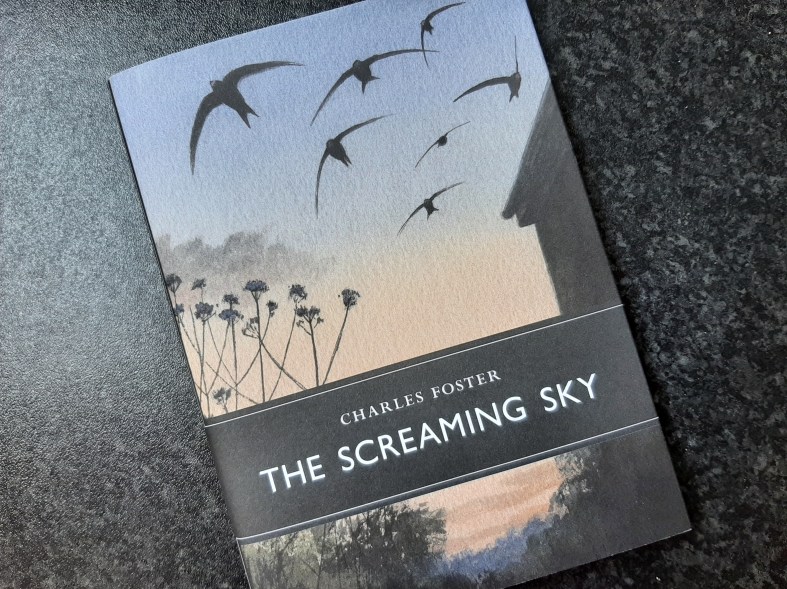
Next up was The Screaming Sky by Charles Foster, illustrated by Jonathan Pomroy.  I read this just a few days before the swifts arrived from Africa, perfect timing for this love song to the marvel of nature that is the swift.  Born of a passion bordering on the obsessional, Foster’s book describes the bird’s life-cycle, its mind-boggling feats of aerobatics and endurance, its biology, and the history of humans’ relationship with the species.  I wrote a full review on this blog here.

Where? Life and death in the Shropshire hills by Simon Moreton was a new departure for me – I have no experience of the graphic novel/zine genre which Moreton specializes in, and this innovative book combines text with illustration and collage in a way I’ve not seen done before.  Where? is a memoir, in which Moreton juxtaposes the narrative of his father’s illness and death with memories of a childhood in rural Shropshire, in a landscape dominated by the presence of Titterstone Clee which looms over the surrounding countryside, and near the summit of which is a radar station where Moreton’s father worked.  Again, this is place writing about somewhere I know slightly, and I enjoyed reading it, admiring the weaving together of the two strands.  I am aware, though, that there were aspects I didn’t ‘get’ because I don’t have the visual lexicon to understand the artwork which is such a large component of this book.

A Still Life: A Memoir by Josie George.  I have followed Josie George on Twitter for a long time, and pre-ordered this book when she announced its publication.  However, it took me a long time to summon up the courage to read it.  In a year where so many themes were dark and hopeless, it seemed perverse to read an account of disability and chronic illness.  I was wrong.  George’s account of her life with a condition which long defied diagnosis and which continues to deliver twists and turns of challenge and disability, is full of light, hope and love.  Not that there is any false cheeriness here – she pulls no punches about the pain and hardships of her situation – nor is there any of the ‘disabled person as an inspiration to us all’ nonsense.  This is an exceptional person, taking life one moment at a time, doing what she can, not doing what she can’t, refusing to get frustrated, determined to continue loving, convinced that the world is good, that life is good, that being alive is the most amazingly wonderful thing, to be savoured and celebrated in whatever way we can in that moment.  It is heartwarming, not in an It’s A Wonderful Life kind of way, but in a way that stays with you, challenging the way you look at the world, at each small moment of our small lives.

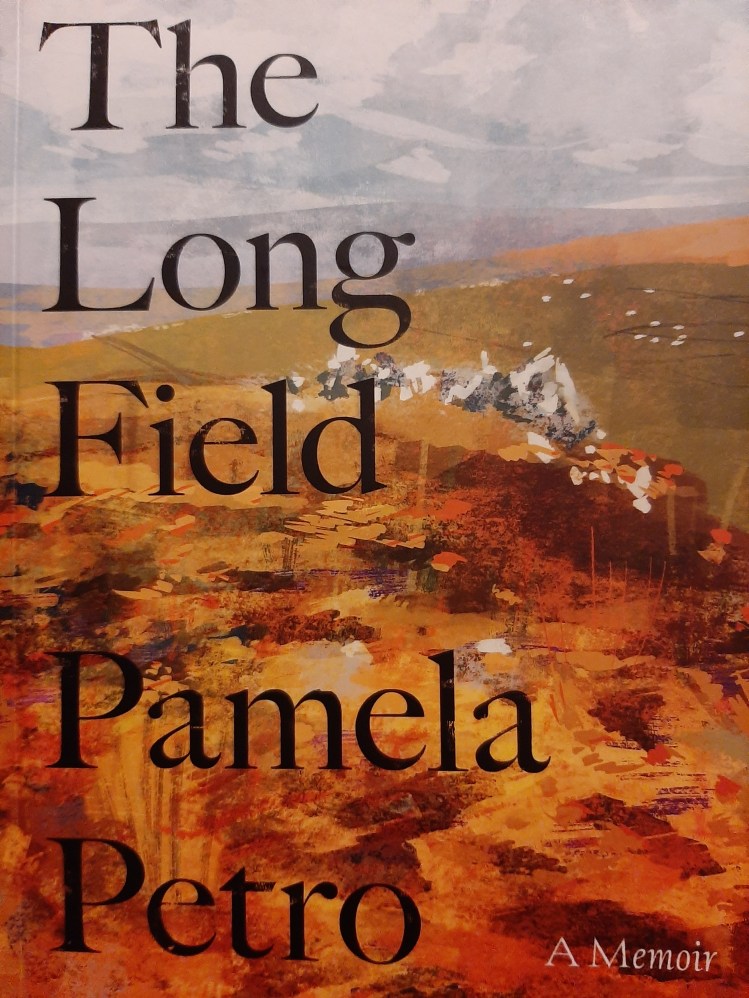
The Long Field by Pamela Petro is again memoir/place writing about somewhere I know – in this case, Petro’s love affair with rural Wales started in Lampeter, at the university we both attended.  I reviewed The Long Field here.

Fifty Sounds by Polly Barton was initially quite a challenging read (I don’t do philosophy, which dominates the opening chapters) but my persistence was rewarded by an insightful exploration of how language and culture influence and shape each other.  Barton tells of her experiences as an English teacher in Japan, and the fifty sounds of the title (which form the chapter headings) are onomatopoeic words in Japanese which she unpacks in her journey into Japanese language and culture, and into her own personality.  I wrote a full review for the Cardiff Review.

You will have noticed that all the titles in this list are non-fiction.  I have struggled with reading fiction since the beginning of the pandemic, but The Listeners by Edward Parnell may have rehabilitated me.  This clever, taut, beautifully written delight gave me more reading pleasure than anything else this year, and I reviewed it joyfully here on this blog.

Finally, two books which I am still reading.  Light Rains Sometimes Fall: a British Year Through Japan’s 72 Seasons by Lev Parikian is arranged in short chapters covering 5 or six days each, in which Parikian closely observes the natural world around him, partly through pandemic lockdowns, noticing details of the changing seasons.  I am a big fan of Parikian’s nature writing, and as I’m consciously attempting to live more in the present (rather than the past or the future) I liked the idea of reading this in ‘real time’, a chapter at a time for a whole year.  The current ‘season’ is called ‘Storms Sometimes Blow,’ which seems about right! 

As an utter map nerd, and a fan of his other writing, it was inevitable that I would eventually read Map Addict by Mike Parker.  At the time of writing, I am halfway through this blend of memoir, cartographical history, and celebration of the glorious Ordnance Survey map, and it’s so nice to connect with a fellow map addict! (I’ve written about the origins of my own map obsession here).

And, on this last day of 2021, I bring you good news – I have a whole lot more books lined up to read in 2022!  My ‘To Be Read’ pile includes poetry, a lot of exciting non-fiction, and even (tentatively) a bit of fiction.  I can’t wait!

Wishing you a Happy New Year.

Photograph of the books referred to in this blog post.

I am committed to making this blog freely available, and not putting material behind a paywall. As a writer, I am doing what I love – but I still have to make a living. If you have enjoyed this post, and if you are able to do so, perhaps you would consider supporting my work by making a small contribution via the Buy Me A Coffee button. Thank you!

Buy Me a Coffee at ko-fi.com

Book review – The Long Field by Pamela Petro

First, a confession.  Reading Pamela Petro’s The Long Field was an exercise in nostalgia for me.  I followed Petro to the university at Lampeter in West Wales (‘Probably the smallest university in the world,’ as the T-shirts in the Students’ Union shop proclaimed, Carlsberg advert-style) just four years later.  All her descriptions ring so very true for me, were part of the landscape of my own young life.  Even the cottage she lived in is well known to me, as a friend of mine rented it in my first year – I can picture myself back in that kitchen, drinking tea, watching my friend making jelly for dessert.  My challenge in writing this review has been to come to the book from the outside, as it were, rather than from that place of shared experience.

The Long Field is, fundamentally, about hiraeth, a complex Welsh word which encompasses elements of longing, nostalgia, distance, absence, homesickness.  It is famously untranslatable into English.  But the book is also a love story.  A love story on several levels, most obviously Petro’s sudden, unexpected, and deep passion for the landscape of rural Wales – again, something which resonates with me.  But it is also about her relationships with her partner and with her parents, and an exploration of the complexities of those relationships.  Perhaps it is an acknowledgement that love stories more nuanced than ‘boy meets girl and they live happily ever after’ are part of the lived experience of queer writers.

Although Petro is passionate about Wales – her Wales – she manages to stop short of being entirely rose-tinted about it.  She acknowledges some of the nuanced complexity of Welsh identity and history, some of the ways in which her adopted homeland’s sense of itself as a colonial victim of English occupation can hold it back.  As someone who has lived in Wales for a significant part of my adult life, it seems to me that Petro’s analysis of Wales is predominantly rural – the Wales of Ceredigion and the Cambrian Mountains – and intellectual and cultural.  She does nod at the life of the Valleys, especially as she was in Wales in 1984 during the miners’ strike, but the industrial and post-industrial conurbations of South and North-East Wales, the product of migration from within Wales and beyond, are not the Wales that she knows and loves.  Her Wales is that of the past etched into the landscape of the present.  Of people connected, umbilically, to the places that shaped the generations before them.  Of story made tangible in the land.  Landscape – not only the fields, the mountains, the hills, but also the cultural echoes, the resonance that they have – is what Petro loves.  Her inexplicable feeling of having ‘come home’ to that landscape when she, an American with no Welsh antecedents, arrived in Lampeter in 1983 is the starting point for the experiences that have shaped this book.

The Long Field is a remarkable book.  Although it self-identifies on the cover as ‘A Memoir,’ it draws together strands of history, travelogue, a whistle-stop tour of Welsh literary heritage, place writing, pronunciation notes for the Welsh place names, linguistic detours, a coming-out narrative, family saga, and an exploration of identity.  It is this last element, I think, which is the most important.  Can someone identify with a place which they are not ‘from’ but where they nevertheless felt a shock of recognition when they first encountered it?  Yes, says Petro – but is she is not claiming Welshness.  Rather like entering into a relationship with a lover from a different culture who speaks a different language, she seeks – respectfully, gently – to learn, to understand, to value what the beloved values.  What Petro found when she found her Wales filled a profound void in her psyche, provided a connectedness between the people of the present and the past which her upbringing in suburban America had not.  In an era when more people than ever are living where we are not from, The Long Field has much to say about place, identity, past, present – and future.

The Long Field by Pamela Petro is published by Little Toller Books.  ISBN 9781908213853

I am committed to making this blog freely available, and not putting material behind a paywall. As a writer, I am doing what I love – but I still have to make a living. If you have enjoyed this post, and if you are able to do so, perhaps you would consider supporting my work by making a small contribution via the Buy Me A Coffee button. Thank you!

Buy Me a Coffee at ko-fi.com

Book Review – The Screaming Sky by Charles Foster

This book arrived three days before the swifts returned to the skies above Somerset.  When I unwrapped the tissue-packed parcel, I was captivated by the cover – Jonathan Pomroy’s illustrations are so evocative of the drama and vertiginous speed of these remarkable, ancient birds.

The Screaming Sky is a book born of an obsession.  On his own admission, Charles Foster is obsessed with swifts – where others might be content to watch them in the skies over Oxford, and be blessed by their occupation of nest sites in the roof of his house, Foster travels on pilgrimage to see them in Spain, Greece and Israel, as well as in the tropical heat and humidity of their African winter homes.  He tracks the progress of their migrations via other obsessives on the internet, and the swifts’ presence or absence in the air above him is mirrored in the highs and lows of his mood.  It is as if he cannot live without them.

This gorgeously tactile little book is divided into monthly chapters, January to December.  In each chapter, Foster explores what the swifts are doing that month, and where, as well as delving into the history, biology and statistics of these enigmatic creatures.  We know quite a bit about Apus apus, the Common Swift.  For example, they spend most of their lives on the wing, landing only to breed and occasionally when encountering very bad weather during migration.  They sleep while flying – the two halves of the brain take it in turns to sleep.  Following the cornucopia of insect life (what Foster refers to as aerial plankton or krill), they migrate inconceivable distances – the swifts breeding in Foster’s summertime Oxford spend the winter months 6,000 miles south in Mozambique.   They lay up to four eggs, but the fourth hatchling (if there is one) never survives.  Young swifts set off for their winter homes within weeks, sometimes days, of fledging. 

We know that swifts are truly ancient, having evolved over 30 million years ago. Swifts are also long-lived – they can have a lifespan of 20+ years.  They return to the place where they were hatched, spending their first couple of summers screaming around the sky with their companions and generally, it seems, having a ball, maybe even tentatively pairing up, before scoping out a potential nest site for the serious business of claiming a nest and breeding.  We know that most of the birds which travel to western Europe for the summer breeding season spend a while over Liberia, gorging on the insect soup swirling in the air after the rains.  From there, the swifts I see in Somerset will have travelled some 3,100 miles, in as little as five days.

However, there is so much we don’t know about swifts.  There are myriad theories, for example, about how they navigate over these immense distances, how they decide that the time is right to start their migration, how they re-unite with their mate, and what accounts for the wide variations in how long it takes individual birds to make the journey.

Foster explores the place of the swift in literature, the emphasis on the bird’s speed (the clue is in the name) and its totemic role as the essence of the northern European summer.  He also rails against the appropriation of the swift as somehow the possession of the observer.  Swifts, he says, are not ‘yours’ or ‘mine’ or ‘his’.  They are their own selves, untameable, masters of the sky in a way that we can only dream of, and in no way reciprocating the sense of connectedness we feel with the swifts who condescend to make fleeting use of our roof-eaves and insect supplies.  It is this unconquerable wildness which, for Foster (and for me) makes swifts so compelling.

Perhaps more than anything, though, he is full of admiration for their mastery of their environment, the sky: ‘they inhabit the air as fish inhabit the sea’.  Their speed and seemingly effortless command of the tides of the air is not only functional (hunting insects) but also seems to have a powerful element of fun and joy: ‘not everything is about the algorithms of survival’ and the screaming parties of swifts hurtling through the sky are ‘colossal fun’.

I love this book.  The blend of facts and personal enthusiasm for the subject makes it an engaging read, and Jonathan Pomroy’s illustrations are perfect.  Of course, I loved it all the more – and was so excited when I heard that Little Toller Books were going to be publishing it – because of how I feel about swifts.  The sight of those exuberant little black sickles slicing through the late spring sky at the end of their epic migration is viscerally energising.  Shrieking squadrons, skimming just over my head between the red-brick cliffs of the town houses, sound so intensely full of life that they make me feel alive, too.  And the day in August when suddenly the sky is silent, empty of little black sickles as they follow the call of their African winter home, is the day the year turns towards winter for me, too.

The Screaming Sky by Charles Foster, illustrated by Jonathan Pomroy, is published by (and available from) Little Toller Books, 2021.  ISBN 9781908213846

Photograph of the front cover of The Screaming Sky by Charles Foster

Don’t go there – imagination, the weird, and why I haven’t written fiction

Recently, I have tentatively started writing short fiction again.  Apart from occasional poetry, most of what I write is nonfiction, often around history and place.  This is partly because nonfiction is my preferred genre (both as a reader and as a writer) but also because of something that happened when I was seventeen.

I have written before on this blog about the creative writing A level I did in the 1980s, which included both poetry and short fiction.  The poetry element was fine – I enjoyed it, was good at it (so much so that my work was published in a volume of examples by the examinations board) and I got a lot out of workshops with poets including Gillian Clarke.  Fiction, however, was another matter altogether.

Like most children, I had always written stories.  I was also an avid reader, often of books well beyond my age group.  The town where I was at school at the time also housed the county library, and I spent a lot of time browsing the shelves, often discovering books which had not seen the light of day for many years.  One particular find was a volume of ghost stories by M.R. James, which according to the date stamp had last been issued in the 1950s.  James was a revelation – obviously, I’d come across ghost stories before, but what I particularly liked about his work was the ambiguity.  His stories did not have tidy endings, they did not provide explanations for what the characters had experienced, they left possibilities open for the mind of the reader to pursue.

Fresh from reading M.R. James, then, I took on the challenge to write a short story for my portfolio.  My English class had recently gone on a field trip to the graveyard of a local chapel, which had resulted in my writing a poem (‘Churchyard on the Hill at Salem’).  It also gave me an idea for the end of my story.

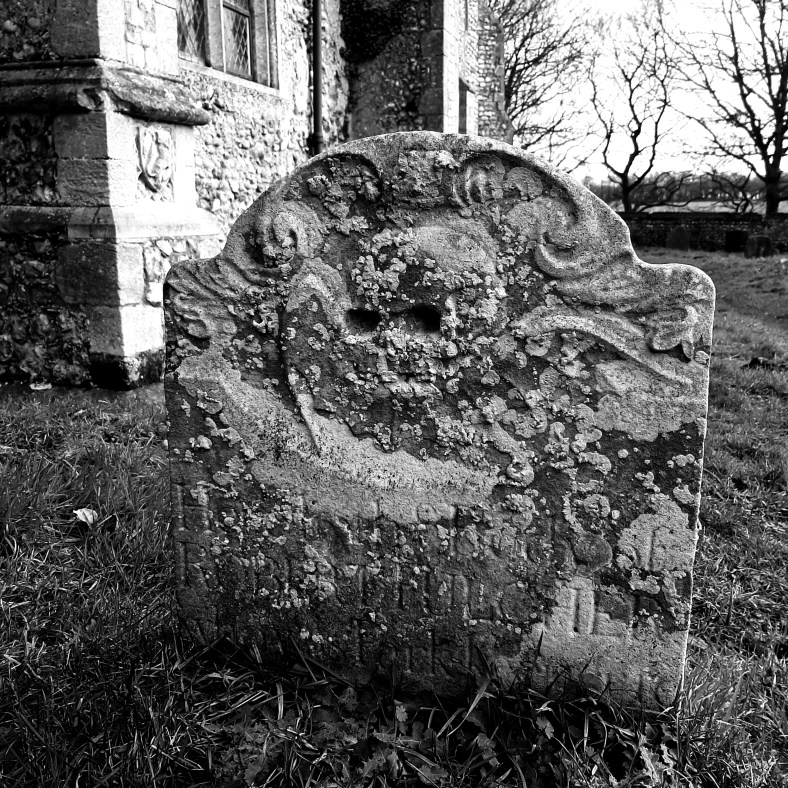
I no longer have the manuscript, but the story went something like this.  Told in the first person, it concerns a teenage girl who is gradually losing her ability to judge what is reality and what is her imagination.  Strange things appear to happen to her in her ordinary life of home and school.  She thinks that a procession of men visit her mother when her father is away on business, but as she becomes increasingly detached from her own life, she wonders how much she can trust her own judgment.  She plays truant, and find herself wandering through the churchyard.  Finding herself drawn to one particular headstone, she brushes away the ivy with her hand to reveal the inscription.  It is her own name, and the date of death is the following day.

Black and white photograph of an old headstone, carved with a winged skull at Felbrigg Hall (National Trust) Norfolk. Copyright Lisa Tulfer 2020
Headstone at Felbrigg Hall (National Trust), Norfolk. Copyright Lee Tulfer 2020

I was rather pleased with this story.  I felt I had managed to evoke a mood of dreamy unreality, create an unreliable narrator, and write an ending with supernatural overtones but with, to me, pleasing ambiguity.  I submitted it to my English teacher for comment.

Two days later, my teacher kept me behind after the lesson.  She had ‘concerns’, she said.  She had spoken to the deputy head with responsibility for student welfare, and they had decided to speak to me before referring the matter to the Social Services department of the County Council.   Was the story, she wanted to know, in any way autobiographical?  Was I having suicidal thoughts?  Was I living in a household that was, effectively, a brothel?

After a few seconds of stunned silence, my first reaction was to laugh – the idea was hilarious.  My mother had always made it quite clear that she didn’t like sex, that it was a necessary evil which had to be endured to have children, and that once the menopause precluded me having any siblings, sex was something she was relieved no longer to have to do.  The idea that she would have more sex than was essential for procreation was, frankly, hysterically funny.  I tried to explain this to my teacher, as delicately as possible.  She looked doubtful, but accepted my response.  My second reaction, though, was bewilderment.  The assignment was to write a short work of fiction.  I was using my imagination – both in terms of the home scenario, so different from my own, and also the supernatural element.  I was juxtaposing the mundane contexts of home and school, and weaving a story from the results of letting my brain freewheel.  Surely that was the nature of fiction – that it wasn’t a true story?  So why were they – the teachers – assuming that it was autobiographical?  Why did they think that my brain wouldn’t be capable of making that jump from what is to what might be?  Why was I getting into trouble for doing what I had been asked to do – using my imagination to create a fictional world with fictional characters and events?

Evidently what I said reassured the teachers, because Social Services were not brought in.  But the remaining short fiction I wrote for my portfolio was anodyne, tame, safe.  I made sure I didn’t give any cause for concern about my safety or my mental health.  A family goes on a daytrip to the beach, eats sandwiches, plays ball, swims, comes home.  Someone goes for a walk in the woods, sees some animal tracks and wonders what has made them.  The stories I wanted to write were very different – a family goes on a daytrip to the beach, and play with a lone child in an old-fashioned style swimming costume.  When the family swim, the child disappears.  They summon the lifeguard, there is a search.  The child isn’t found.  Cut to an Edwardian newspaper report of a drowned child on that very beach.  Or, someone goes for a walk in the woods.  They see animal tracks, and follow them.  Gradually the tracks morph into human footprints.  In a clearing, they come face to face with the creature they have been following.  But I didn’t write those stories – I played it safe.  Got a good grade.  The teachers stopped watching me.  I had learned that to write fiction that explored the possible, the unexplained, the dark places where the mundane meets the unthinkable, was a Bad Idea and would Get Me Into Trouble.  I never wrote fiction again.

Until this year.  Perhaps because I have felt unable to read fiction in the dystopian reality of Covid 19, I have started to think about writing it again.  I am dipping my toe into the dark pool of my imagination and am writing short stories set in the everyday, about the past, death, the unexplained, with supernatural elements and enigmatic endings.  What I didn’t know, aged seventeen in my provincial small-town school, was that an entire genre of weird writing has been around since the Victorian era – there is even a ‘thing’ called women’s weird – which nowadays is celebrated.  Three decades and more later, I know that having an imagination that enables me to dream up weird writing doesn’t make me weird, and this time round I hope that exploring my imagination will not Get Me Into Trouble.

In their own handwriting – connecting to the creators of the Lindisfarne Gospels

For the last few weeks I have been researching the Lindisfarne Gospels and writing an article about them for an e-magazine.  For those of you not familiar with the Lindisfarne Gospels, they are a lavishly illuminated hand-written book of the four Gospels (Matthew, Mark, Luke and John) of the New Testament, in Latin, produced by a scribe-artist called Eadfrith around 700CE, in the monastic community on the island of Lindisfarne (aka Holy Island) off the coast of Northumberland in North East England.  About 250 years later, a word by word translation (or ‘gloss’) in Old English was added above each line by a priest-scribe called Adred, at Chester-le-Street where the community was then living, having fled the island after raids by Vikings.

Incipit, Matthew’s gospel, Lindisfarne Gospels. British Library Cotton MS Nero D IV f.027r

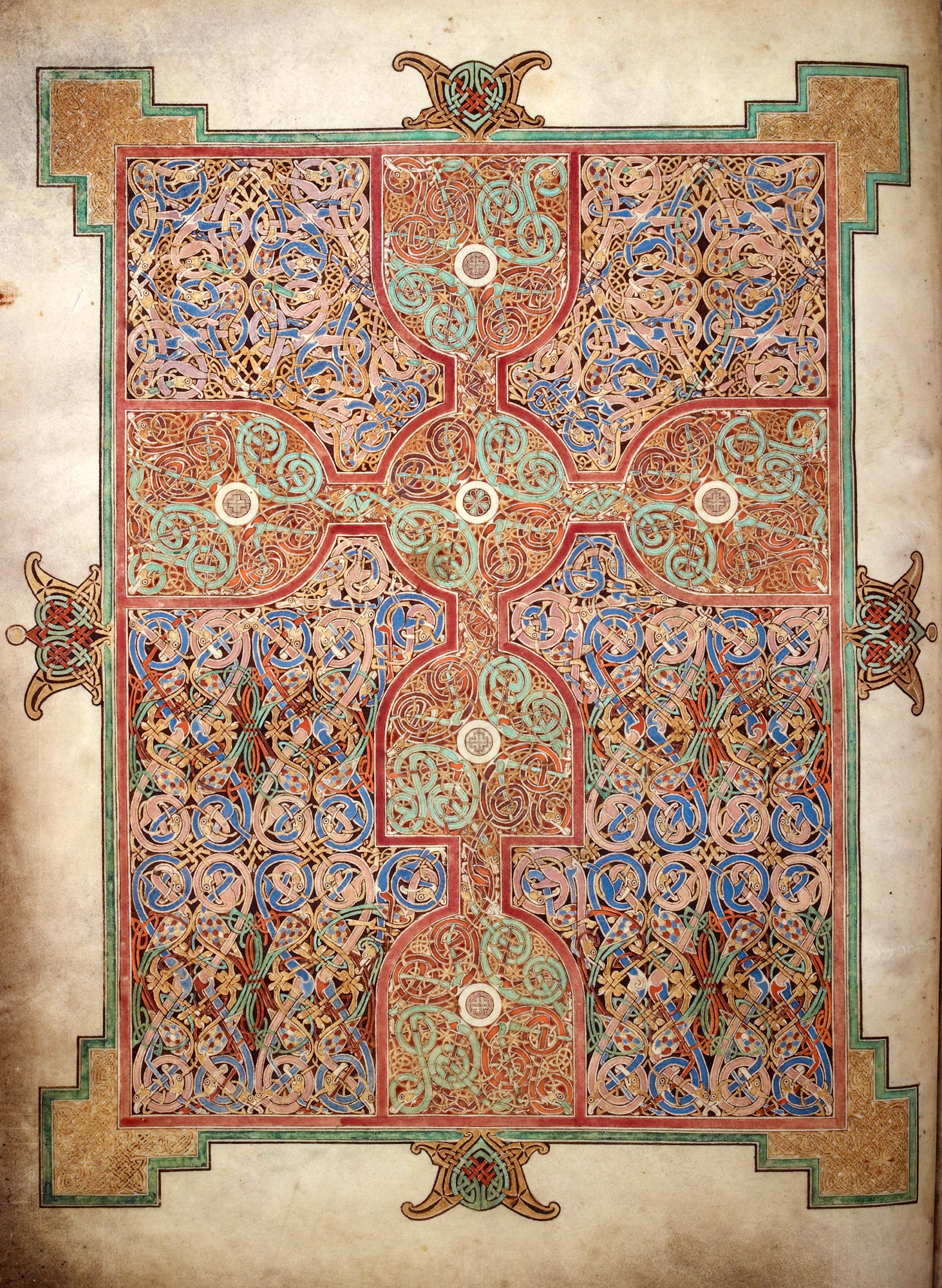
The art of the Lindisfarne Gospels is quite widely known today – the manuscript has been digitised and is available on the British Library website, and its motifs are used on all manner of historically-inspired merchandise.  But, though beautiful, the art is not what excites me about the Lindisfarne Gospels.  What makes my heart beat faster is that sense of glimpsing into the distant past something which connects us physically with the individuals who created it more than a millennium ago.

Far from being dry and academic, my research has been a fascinating journey into the England of the early medieval period – what used to be called the Dark Ages, between the departure of the Romans in the 5th century CE and the Norman Conquest in 1066, during which time it was thought that culture, learning and civilisation were largely absent.  Historians think differently now, in no small part due to the artefacts produced in this period which have been found in various excavated hoards, and probably most famously at the ship-burial at Sutton Hoo which was excavated on the eve of World War II and which was found to contain jewellery of breath-taking beauty and craftsmanship.  The sophistication shown in the illuminated manuscripts of the time is now seen, not as an exception, but as representative of the high standards of creative skill on the part of the peoples of the time.

Carpet page, Matthew’s gospel, Lindisfarne Gospels. British Library Cotton MS Nero D IV f.026v

In an era before print, the production of a book – even the most plain and workaday one – was a major undertaking.  First, the vellum which formed the pages had to be prepared from the skins of young animals – calves or lambs – and trimmed and pricked in preparation for the binding process (making the Lindisfarne Gospels required the skins of almost 150 calves).  Lines had to be marked out on the page (Eadfrith invented the lead pencil, and the lightbox, to do this).  Ink had to be prepared, using oak galls and iron.  Feathers – ideally big sturdy ones like the flight feathers of swans – had to be trimmed into pens.  Then the scribe had to copy the book painstakingly from an exemplar, without the benefit of electric light.  It could take years to produce a book – years of dedication, focus, bad backs, cold, working in a scriptorium lit only by south-facing windows in the summer and candles in the winter.  A number of scribes left notes in the books they produced, complaining about their discomforts – issues around health and safety at work and RSI are not new!

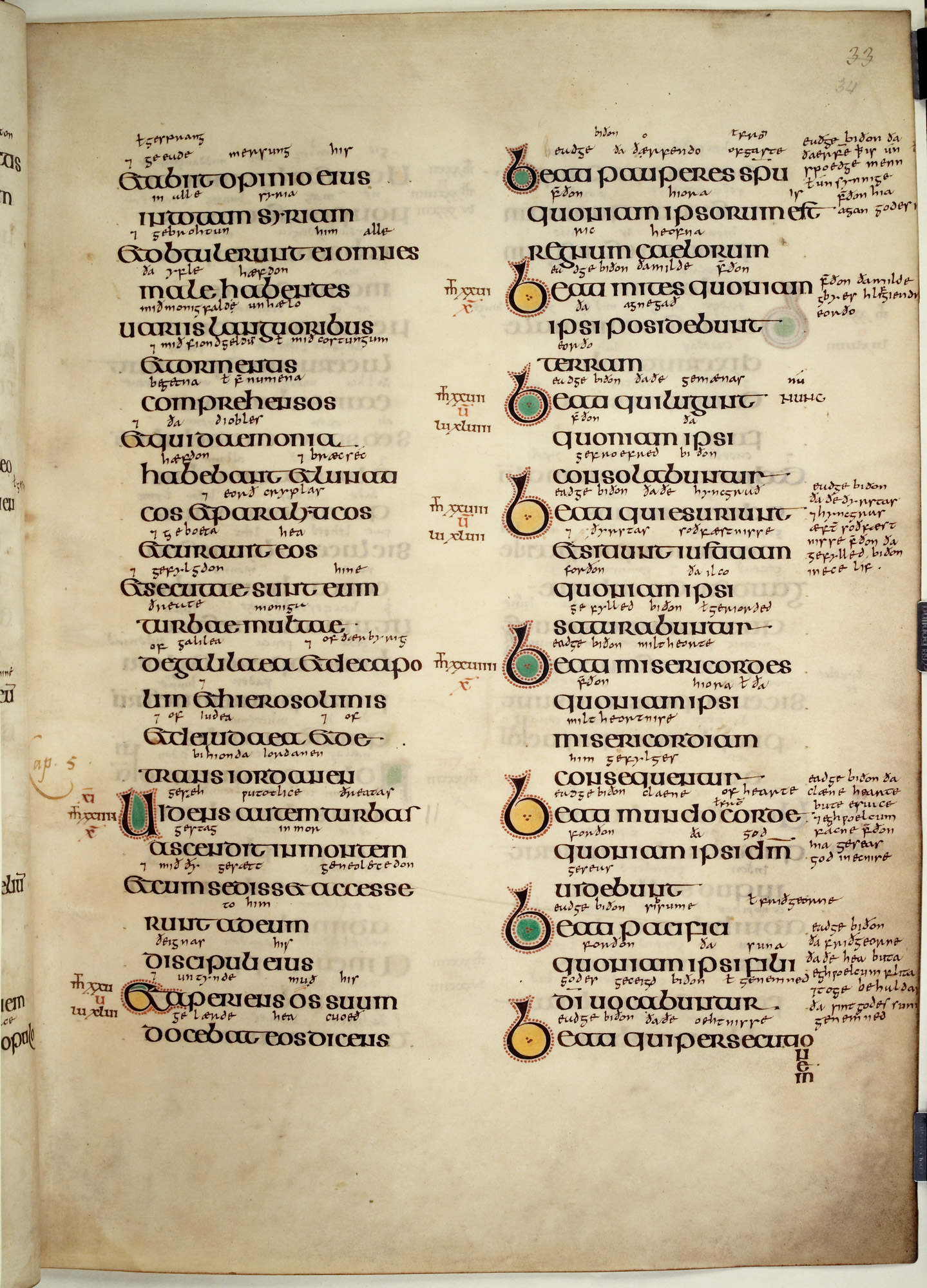
The Beatitudes, Matthew’s gospel, Lindisfarne Gospels. British Library Cotton MS Nero D IV f.034r

What I love about these documents, though, is the immediacy of something which was produced by hand.  Just as our own handwriting is distinctive to each of us, it is possible to identify individual scribes by their handwriting.  Often, teams of up to half a dozen scribes and artists would work on a book – the Lindisfarne Gospels are unusual in having been written by just one man.  It is thought that it must have taken Eadfrith several years to produce the text and illustrations for this work.  It can be a stretch of the imagination, in 21st century Britain, to imagine the life of a 7th century monk on a windswept island in the North Sea, toiling on this work of great beauty, to the glory – as he would have seen it – of God.  Even as a visitor to Lindisfarne, it’s a challenge to look beyond the cafés and gift shops, the retreat centre and the museum, and the ruins of the later Norman priory, and picture this as a working monastery, its central work of prayer and worship buttressed by farming, fishery and the creation of high-quality books.  Seeing the personal handwriting of one of those monks, the strokes made by his pen, the drawings and embellishments he drew in the colours he chose (and created himself from mineral and plant pigments), brings him within reach.  Just as when, while researching your own family history you come across a 1911 census return in the handwriting of an ancestor you have never met and who died long before you were born, it makes them more real, so seeing Eadfrith’s handwriting brings him to life for us.

And in the Lindisfarne Gospels we are lucky enough to have the handwriting of two identified people.  I mentioned earlier that an Old English word-for-word translation (or gloss) was added in the middle of the 10th century.  We know that the man who did this was called Aldred, because he left us a note (a colophon) at the end of the Gospels to tell us so.  He also names Eadfrith as the original scribe/artist, as well as crediting the people who bound the book and made a jewelled cover for it.  By translating the text into English, Aldred was part of a movement championed by King Alfred (‘the Great’) in the late 9th century to make English a language not only of the people but also of learning and religion, alongside Latin.  Here we not only have Aldred’s handwriting, we can also see him wrestling with language as he frequently offers several alternative translations of Latin worlds into Old English.  Anyone who has ever attempted to translate from one language to another will relate to this!

Aldred’s colphon, Lindisfarne Gospels. British Library Cotton MS Nero D IV f.259r

In these times of emails, word-processing and SMS, handwriting is becoming a dying art.  In one way, that doesn’t matter – as long as we are communicating with words, it’s irrelevant how they are produced – but in other ways we are maybe losing something.  There is no digital equivalent of the personal, intimate legacy of someone’s handwriting – the notes and letters of past generations, which are often all we have left of our own families – and future generations will not experience the particular thrill of poring over a hand-written document produced by known, named people over a millennium ago.  I wonder what ways they will have instead to connect to the human individuality of the people whose words they are reading?

My article on the Lindisfarne Gospels is published in Issue 7 of The Pilgrim, which is available online here.

I am committed to making this blog freely available, and not putting material behind a paywall. As a writer, I am doing what I love – but I still have to make a living. If you have enjoyed this post, and if you are able to do so, perhaps you would consider supporting my work by making a small contribution via the Buy Me A Coffee button. Thank you!

Buy Me a Coffee at ko-fi.com

Tools of my trade – techniques and technology for non-fiction writing

What image pops into your head when you think of a writer?  For many people, I gather it’s an image of a solitary figure, toiling for long hours in a shed or an attic, maybe even still writing in longhand or using a typewriter, surrounded by books and dust, and forgetting to eat.

Well, in my case, the image would be almost totally wrong.  Only almost, because I do actually work in the attic, or more accurately the top floor of an Edwardian town house (it’s not as grand as it sounds – the first occupants were glove makers, working from home, but more about that another time).  In my previous post, I write about the view from the windows.  But I am not solitary – my partner, who is a postgraduate researcher, and I share a study, with our desks facing each other across the floor of the room.  I do have quite a few books, but very little dust.  And I am keen on cooking and even more keen on eating.

Longstanding readers of this blog will know about my notebook habit, and I do write in longhand in my notebooks.  Often this is where initial ideas – or notes jotted down from reading or visits which may morph into a piece of writing later on – are recorded.  I have a general notebook, one for business-related notes, one each for the writing projects I am currently working on or planning, and one for courses I participate in.  Since I discovered the Pentel 1.3mm propelling pencil, most of my notes are written with that as I find it gentler on the hands than a pen.

If I am making notes from books – generally when I am researching historical topics, and referencing academic books – or from online sources, I use a narrow-ruled A4 student pad.  This makes it easier for me to file my notes in a ring binder if I need them for future reference.

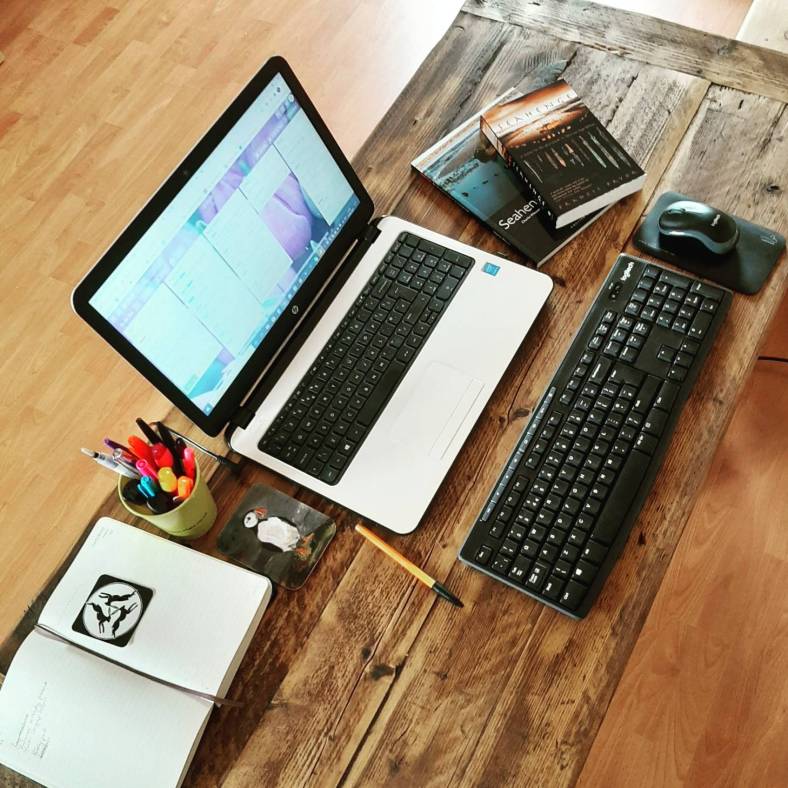
For the actual writing, I use my ancient laptop (I really must upgrade it sometime, as it’s getting slower and slower) which I back up regularly.  Mindful of the importance of an ergonomic workstation, I use a separate keyboard and mouse, and my chair and desk are at the right height for me.   I loathe conventional office chairs, so my chair is an early 20th-century ‘smoker’s bow’ which originated in Pembroke College, Oxford, until it was sold off when one of their buildings was re-built.  It has a pleasing patina of age and use, and is built for comfort.  And to celebrate my move to Somerset, I recently treated myself to a new desk, made from reclaimed timber by Pegasus Furniture.

Picture of a desk with laptop, keyboard, diary, pens and books.

Planning a new piece of work – and the steps involved in making it happen – is done in two stages.  The first involves a large sheet of paper, a lot of lovely coloured pens, and often my partner to act as scribe and to challenge my thinking and provide research tips.  The ensuing mind map is then transferred to Trello (my planning tool of choice) as a series of colour-coded lists.  The book I am currently writing has an introduction and 12 chapters.  Each has a Trello list, with the structure, visits, research, reading, interviews, photography etc required for each chapter listed, with notes to myself where appropriate.  I find that working with Trello helps me to keep on top of the various strands of research, and allows me to have an easy overview of what needs to be done – geographically, for example, while I am visiting Hadrian’s Wall to do research for one chapter, it makes sense on the same trip to schedule a visit to Lindisfarne for another chapter; and I see that three chapters will require expertise from the British Museum – maybe I can cover all three on one visit to London?

For each chapter, I first sketch out where I see the chapter going – what I want to include, what angle I am taking, why this chapter is in the book, who are the key people to interview and why, and insights from previous visits where relevant.  Then I do the research, do the site visits and interviews, take photographs were possible, and take lots of notes and voice recordings of my impressions.  Later, these are all collated and, once I have created a detailed structural plan of the chapter, written up into the first draft.  It’s a slow process but it allows for rigorous background research and fact checking, as well as giving me time for ideas to develop as I reflect on, and respond to, what I have experienced.

It may come as a surprise to some people that the actual writing is a relatively small part of the process.  Bear in mind that I write non-fiction, so although what I write is filtered through the lens of my own personal perspective, experience and personality, it is based on something external.  Most of what I write about involves history or place, or both, and therefore writing about it requires close reference to the place, object, event or person that is my subject, and to what is known about it.  For example, my personal reflections on the music of Benjamin Britten in a recent piece for Issue 5 of The Pilgrim are informed and enriched by studying his life and work, as well as by experiencing for myself the sights and sounds of the beach at Aldeburgh which is the setting for his opera Peter Grimes.

No two writers – not even two non-fiction writers – will approach their work in the same way, or use the same tools and technology in their writing, but this is how I work.  The process evolves, too – prior to my discovery of Trello, I used whiteboards and a lot of coloured maker pens and sticky notes.  Trello is essentially a digital version of this, which has the advantage of leaving my walls free for inspiring art!

I am committed to making this blog freely available, and not putting material behind a paywall. As a writer, I am doing what I love – but I still have to make a living. If you have enjoyed this post, and if you are able to do so, perhaps you would consider supporting my work by making a small contribution via the Buy Me A Coffee button. Thank you!

Buy Me a Coffee at ko-fi.com

Variety is the spice of life, or why I can’t read one book at a time


For years, I thought it was just me.  Everyone else I knew seemed to read a book from start to finish, and then move on to the next one.  If asked them ‘what are you reading?’ the answer would be quite simple – one title.  Students, of course, would be reading a lot of books for essays, but their leisure reading seemed always to be done one book at a time.

I have never managed this!  I have always read a lot, although the nature of what I read depends on how I am feeling and what I am doing by way of work.  The more tired and stressed I am, the less likely I am to read anything very demanding, and you know things are bad when I can only manage magazines.  Usually, though, I read books.  Plural.  It’s not that I have a grasshopper brain – I can become engrossed in things for hours, missing meals, completely losing track of time.  But when it comes to reading, I find it very hard to have only one book on the go.

‘But don’t you lose track?’ I have been asked.  I can honestly say I don’t.  Within a paragraph I’m right back in the heart of whatever I was reading.  It’s only a problem if for some reason it’s weeks or months before I return to a book, but that rarely happens.  I usually have at least two, sometimes as many as four or five ‘leisure’ books on the go at once – plus ones that I am reading for research purposes in ‘work time’.  I like to have a range of different genres, or subject matter, so that when I sit down to read I can match the book to my mood or how much concentration I can muster.   It’s such a treat to be able to make a cuppa and retreat to my reading chair on the sunny landing, or curl up on the sofa, or settle into bed, ask myself ‘which book shall I read now?’ and know I have an inviting selection to choose from.

Recently, I have found I don’t want to read fiction at all.  Even my beloved whodunits are failing to entice me – I now have three new ones by favourite authors waiting to be read, and I can’t quite bring myself to open them.  I don’t know why – I can only suppose that our current circumstances are so surreal that my brain recoils from engaging with further imaginary universes just now.

At the moment, I am reading the following books for ‘leisure’:

On the Red Hill, by Mike Parker.  An intriguing blend of place writing, memoir and queer history, this is set in the hills of mid Wales, in a landscape that’s very familiar to me.  Lyrical nonfiction with a large element of social history, I’m finding it totally beguiling (and Mike Parker has written a history of the Ordnance Survey, which I must read next – regular readers may remember my map obsession!).

Walled Gardens, by Jules Hudson.  I have coveted this beautifully illustrated and pleasingly square book for ages, and when I was having a melancholy phase recently my partner thought she would cheer me up by contacting the author and requesting a signed copy.  I was very moved – both by her loving gesture, and also by Jules Hudson taking the time and trouble to pen such thoughtful words from one writer to another.  The book is not only a guide to walled gardens in the care of the National Trust, but also an overview of garden history and a considered exploration of the social history which provides a wider context.

Ghostland: in Search of a Haunted Country, by Edward Parnell.  Nonfiction again, this is a quirky but effective weaving together of ghost story, place writing, gothic and memoir which defies categorisation.  I met Edward last year at an event at the National Centre for Writing, and on the strength of that and Ghostland I am about to start a 12-week creative nonfiction course for which he is the tutor.

Writing this post has made me think that it might perhaps be worth, every couple of months, writing about what I am currently reading, with a short review of each book.  Occasionally the books I read are a chance discovery, but the majority have been recommended by someone else, and it’s good to be able to pass it on!


I am committed to making this blog freely available, and not putting material behind a paywall.  As a writer, I am doing what I love – but I still have to make a living.  If you have enjoyed this post, and if you are able to do so, perhaps you would consider supporting my work by making a small contribution via the Buy Me A Coffee button.  Thank you!

Buy Me a Coffee at ko-fi.com

Noticing things differently – why creative nonfiction is like poetry

Apart from the occasional poem, most of what I write is nonfiction.  Creative nonfiction is a genre which is increasingly discussed – hard to define, but including narrative accounts, personal responses, place writing, reflection and imaginative explorations.  This is what I have written since long before I knew it had a name!

I have long thought that the two forms of writing I engage in – creative nonfiction and poetry – are two sides of the same coin.  That statement may make a bit more sense if I take you back to Wales in 1986, when I first started writing in an intentional way.

In a recent blog post I wrote about being fortunate to be part of a pilot for an A level creative writing course.  The exam board commissioned leading Welsh writers to run creative writing residentials for the students in the pilot because, as most teachers were used to delivering a traditional, Shakespeare-and-the-classics English Literature syllabus, teaching creative writing was something quite new to them.  Six of us from my school travelled with the Head of English, Liz Pugh, to Plas Tan y Bwlch (now the Snowdonia National Park Study Centre) for two days with, amongst others, Gillian Clarke.

A word here about Gillian Clarke.  Now aged 82 and something of a ‘national treasure’ in Welsh cultural life, she had at that point recently published her fourth collection, Selected Poems (although I didn’t read her work until later).  With decades of experience of teaching English and creative writing in schools and colleges, she was the perfect choice to encourage young people to explore the process of writing poetry.  From 2008-2016 she was the National Poet of Wales (the Welsh version of a Poet Laureate), and as well as her award-winning poetry she has created a fine legacy in the form of Ty Newydd, the national writing centre for Wales, which she co-founded in 1990.

Back in 1986, it’s a glorious spring day, with sunshine flooding into the big lecture room at Plas Tan y Bwlch. Huge windows offer panoramic views of the valley and the wooded hills beyond, but we aren’t paying much attention, because Gillian Clarke is speaking.  She has seated us – some 30-odd students aged 16-18 – in a large circle.  She has a basket beside her, and from this she takes a small object, about the size of an egg.  I’m going to pass this round the circle, she says.  Take as long as you like when it comes to you.  What I want you to do is notice.  What do you notice about this object?

The object passes slowly from hand to hand, as each student holds it, turns it over, gazes at it, frowns or nods in recognition, maybe runs a finger over a detail, passes it to their neighbour.  I watch them as the object makes its way to me, about two thirds of the way round the circle.  Then, it is in my hands – feather light, delicate yet curiously strong, like an eggshell.  The size of a small egg, and almost the same shape, with a hooked point at one end.  Smooth, with hollows divided by sharp, paper-thin membranes.  Notice, Gillian had said.  How should I notice?  I have looked at it.  I have turned it over and over and looked at it from all sides.  I have used touch to explore its textures and weight.  I’m not going to taste it!  But there are other senses I could use – maybe, if I hold it to my ear it will sing of the sea, like a shell?  No.  But how about smell?  Tentatively, I lift it to my nose – earthy, organic, and yet almost like stone.  I hear a soft hiss from Gillian – yesss.  I look at it one last time, and pass it to my neighbour.

Afterwards, Gillian tells us about the object – it’s a buzzard’s skull that she found on a walk, and she has written a poem about it.  But, she says, that’s not why she brought it today.  It’s just a way, she says, of getting us to notice things differently.  She mentions that one person went beyond looking and touching by listening and smelling (I squirm with embarrassment at this).  She’s delighted – this is what she was hoping we would do.  Now, she says, go away and write a poem.

As we move away, she calls me back, and we talk about the senses, and how important she thinks it is that a writer should notice differently – from a different angle, using different senses, and without what we think we know about the object getting in the way of our noticing.  She is enthusiastic, encouraging.  I take my notebook to a corner of the terrace and start to write – this is the poem.

The Buzzard’s Skull

This ritual is new, and yet
along the distance of my mind
I know that I remember.
The circle is held, spellbound;
the sacrament is passed from hand to hand:
a ceremony of initiation?

Blindfold and afraid, I hear
the holy word approach,
rhythmic, sinister,
along the chain.
The object is in my hands,
stirring a memory that
my fingers cannot grasp –
a forest or a beach?
My life,
or life that lingers in my mind,
beyond (my) memory?
My fingers’ eyes have been in the dark
so long,
they are blinded by this light,
and cannot see.

Although I never saw Gillian again after that residential, I followed her career and occasionally heard her on the radio.  I know that many writers were encouraged into writing by her, and I am always grateful to her for that hissed yesss that made me realise that I was on the right lines in how I observed the world around me, rather than just being weird.  She made me realise that I was starting to think like a writer.

And like a writer, rather than solely a poet – because the nonfiction I write is also about noticing things differently.   Poetry is about precisely that – a good poem leaves the reader thinking “wow, I never looked at it like that before” and can weave magic around the most familiar and mundane subject.  Creative nonfiction, I would suggest, has a similar role – to explore the homely as well as the exotic, looking with fresh eyes and an unexpected perspective, touching and listening and smelling and tasting, and telling the stories of people, places and objects with new voices.

Cover of Selected Poems Gillian Clarke