Belated book review – The Listeners by Edward Parnell

It grieves me that it took so long for me to get round to reading this book.  I know Ed Parnell, and have read his non-fiction Ghostland, so I knew his debut novel would be good.  But the arrival of my signed copy of The Listeners was followed closely by the arrival of Covid and the first lockdown, and I suddenly found it impossible to read fiction.  It was as if the surreality of real life, with everything we took for granted suddenly swept away into an unknowable and dystopian future, seemed to make my brain incapable of coping with imagined realities.  I had a large ‘to be read’ pile which included a number of fiction books by authors I knew I liked, but each one was closed and put aside after only a few pages.  I just couldn’t hack fiction. 

For a year and a half I read only non-fiction.  Then, last summer, I started re-reading the Golden Age crime fiction collection on my Kindle (Agatha Christie, Dorothy L Sayers, Margery Allingham).  These were safe, generally not graphically violent, with structures that were familiar and worlds which trundled along on their predictable tracks.  All very comforting.  Stella Gibbons’ Cold Comfort Farm, too.  But it has taken until last week for me to feel up to tacking new, more challenging fiction.  It was time to open The Listeners.

I love this book.  I’m sad I’ve finished it – I eked out the last few chapters over several days, to put off the moment when it would be over.  It is a treat, a gem, a perfectly-formed little treasure, like a beautifully crafted piece of work by a skilled artisan.  It is utterly beguiling.  And yes, I know that sounds hyperbolical, but I mean every word.

The Listeners is set in the wartime years of the 1940s in rural Norfolk – in an area near to where I used to live, so I recognize the descriptions of landscape and wildlife that provide the staging for the events of the book.  It is not so much the events that carry the reader forward, as the voices of the various narrators who take turns to give their perspectives.  It takes quite a while to work out which, if any, of the narrators are reliable.  Much of the action is in the shadow of events up to a generation earlier, events which are only hinted at.  The way those past events, and their implications for the present and the future, are gradually and subtly revealed to us is a masterclass in understated writing.  At several points in the narrative, I had a sudden, nauseating jolt as I realized what was actually being referred to, what it was that had happened and was not being talked about, or what was, with a sickening inevitability, going to happen next.

It is, in many ways, a dark book.  Anyone who has read Ghostland will know that Edward Parnell is an aficionado of the dark, the weird, of things hinted from the shadows.  The Listeners, which predates Ghostland, should really be depressing – I can’t tell you about all the motifs because it would spoil the plot for you, but let’s say that most kinds of violence, abuse, betrayal and grief feature in it – but the writing is so beautiful and the characters so deftly painted that it glows with chiaroscuro like the work of an Old Master.

The pace is measured – a pace appropriate to country folk who are, despite the upheavals of WWII, simply getting on with the necessary cycle of the agricultural year and domestic life – but the book never drags.  The change of voice with each chapter shifts our viewpoint, keeps the reader on their toes (and often doubting everything they’ve just read in the previous chapter).  And the ending – with the reader now knowing something which the protagonists do not – is genius.

The Listeners (the title is borrowed from the poem by Walter de la Mare, for reasons which will be come apparent) won the Rethink New Novels Competition in 2014 – this is another reason why I am calling this a ‘belated’ review.  The good news for those of us who are late to the party is that it is still available to buy (direct from the author at https://edwardparnell.com/buy-signed-copies/, or from Amazon as a print-on-demand book or on Kindle).  I have reviewed a lot of books this year which I have very much enjoyed but, for me, this is my book of 2021.  I just wish I could un-read it so that I could have the joy of reading it again for the first time.

I am committed to making this blog freely available, and not putting material behind a paywall. As a writer, I am doing what I love – but I still have to make a living. If you have enjoyed this post, and if you are able to do so, perhaps you would consider supporting my work by making a small contribution via the Buy Me A Coffee button. Thank you!

Buy Me a Coffee at ko-fi.com

Lost people, lost stories – the mystery of the silver locket

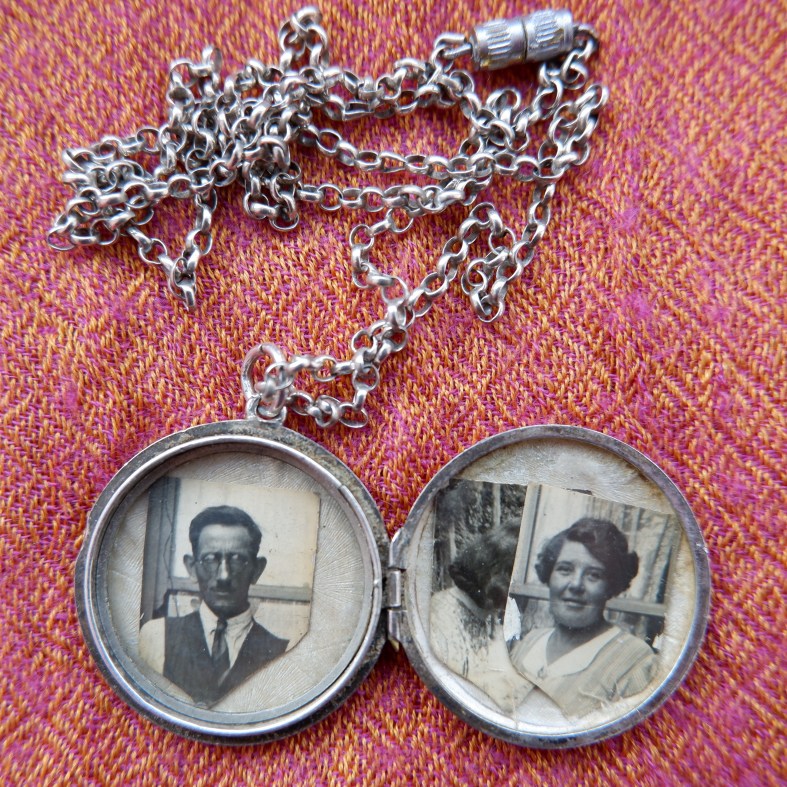
In the window of a local charity shop is a silver locket.  I walk past the shop most days, but today something catches my eye and makes me go back for another look.  The locket is priced at £8, and is battered, with a mismatched chain, but what attracts my attention is that it still has old photographs in it.  On a whim, I go into the charity shop and buy the locket.  The volunteer seems a bit bemused about why I am so sure I want this particular piece, but I feel that I can’t simply walk by and leave it there – this was someone’s life, someone’s loves, someone’s history, and it’s too sad to just let it go.  I decide to write about it.

Image of a silver locket, with three black and white photographs in it.

I like detective work, and my partner is an experienced researcher, so between us we should be able to find out a bit about the locket and its history.  First of all, I clean it up and repair the chain.  The locket is stamped ‘Silver’, not hallmarked or marked 925, but that’s perfectly usual for small 20th century British silver items and doesn’t help us much.  The chain is newer and not such good quality as the locket, which is machine engraved and quite heavy.

Image of a small black and white photograph of a middle aged woman with dark hair.

Inside, there are three photographs – a middle-aged man on the left, and a middle-aged woman on the right with another photograph half tucked behind it.  With the tip of a penknife I carefully prize the clear plastic cover off the right hand side, and take out the photographs.  The middle-aged woman (let’s call her Mum) is standing in front of a sash window, which has net curtains.  If this is her home, she probably cursed when she saw the photograph, because the curtains aren’t hanging straight!  She’s wearing a striped dress with a wide, white collar, fastened with a brooch, possibly a cameo (my partner tells me that the style is 1930s or 1940s, as is the man’s shirt collar).  She smiles gently, straight into the camera lens.

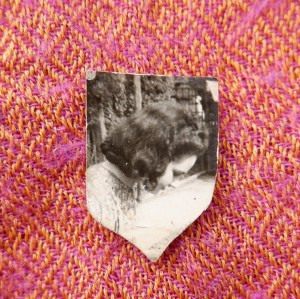
Image of a small black and white photograph of a teenage girl with dark hair.

The photograph which is tucked behind Mum is of a young woman, perhaps in her teens, with a dark wavy bob.  She is side on to the camera, and looking down – the photograph is cropped, so we can’t see what she’s looking at – something in her hands?  A book?  A kitten?  A flower that she has picked?  This one is also outdoors, but on a path beside an old building with trees and what looks like creeper.  The sun is shining.  Is this her home, or is she on a day out somewhere?

Image of a small black and white photograph of a middle aged man with dark hair and glasses.

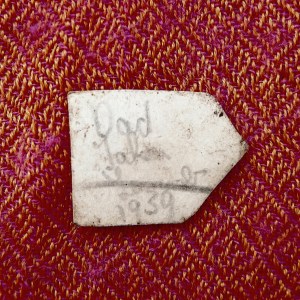
I wield the penknife blade again, this time on the left hand side, and remove the photograph.  I turn it over, and this time I’m in luck – there’s faint pencil writing on it.  ‘Dad Taken L……. 1939’.  My partner was right about the dating.  It’s really frustrating that the location is so faint and impossible to read, despite my efforts to digitally enhance my photograph – if you can make it out, please contact me!  Dad has a moustache and round spectacles.  He wears a white shirt, a tie with broad stripes, and a waistcoat.  Like Mum, he’s standing in front of a sash window, although it’s hard to tell if it’s the same location – the frames certainly look similar.  He is dark, too, much thinner than her, and with a serious expression.  The reflections in his glasses mean we can’t see his eyes.

Image of back of small photograph, with pencil writing.

Who were they?  Is the girl with the dark hair the owner of the locket, or maybe her sister?  Posing for the camera in his shirtsleeves in the summer of 1939, in the calm before the storm, little does Dad know that only a few weeks later the country will be at war again.  He is old enough to have served in WWI, but too old for active service in WWII – he will likely go into the Home Guard, or be an ARP warden.  Mum will have to grapple with rationing, clothing coupons, and making sure that not a chink of light shows through those net-curtained windows.  The girl will be old enough by the end of the war, if not at the beginning, to serve in the forces or the Land Army, or to do a job vacated by a man who is away fighting.  If the photographs are from near where I found the locket, in Norfolk, she may fall for one of the American airmen at a local base.  Did these people, and the house, make it through the war, or was this locket worn as a memorial when all that was left was the rubble of an air raid?  Was the locket loved and cherished, worn daily until arthritic hands could no longer manage the clasp?  How did it get so battered, almost as if it has been trodden underfoot?  And eight decades on, how did this precious memento of the summer of 1939 and three people’s lives end up, unloved and unwanted, in a charity shop in Norfolk?

If you know who the people in these photographs are, please get in touch!  And please share this post on social media, so that as many people as possible can see it and maybe we can solve this mystery together.

Image of silver locket.

Norwich’s Writing Quarter – a day at the National Centre for Writing and other explorations

I wonder how many of you regard a day’s professional development as a self-indulgence?  I suspect it may be something unique to writers and other creatives, but I was struck by the use of the words ‘self-indulgence’ no fewer than three times in the first hour of Saturday’s event at the National Centre for Writing.  It seems that a lot of us have difficultly permitting ourselves the investment of time and money into our development as writers.

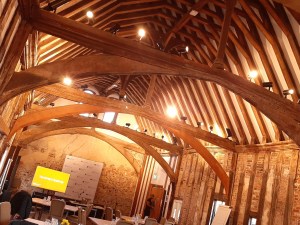
The National Centre for Writing (formerly the Writers’ Centre Norwich) is based at Dragon Hall on King Street in Norwich, and provides resources, mentoring and events for writers – both online and face to face.  Saturday’s event was entitled The Writer’s Roadmap, and took place in the great hall, upstairs at Dragon Hall.  The wonderful Florence Reynolds is the Programme Officer, and welcomed us to a superbly organised day in a unique venue.

I should warn you (if you haven’t already gathered from elsewhere in this blog) that I am something of a medieval history nerd, so spending a day in Dragon Hall was, frankly, distracting!  According to the Dragon Hall website, there has been a building on this site for more than a thousand years – Florence told me that there is evidence of a Saxon post hut beneath the undercroft.  The present building was built around 1430 by a merchant, Robert Toppes, although one of the outbuildings is believed to be a century older.  Originally a trading hall, it backed on to the River Wensum, which via the River Yare gave access to the North Sea at Great Yarmouth.  It was part of Norwich’s major role in the trading of wool and textiles, especially to and from the Low Countries, during the middle ages, on which the wealth of East Anglia was built.  Now a Grade I listed building, parts of it have at various points been houses, tenements (housing up to 150 people in the 19th century), a pub, a butchers, and the rectory for nearby St Julian’s Church (of which more later).

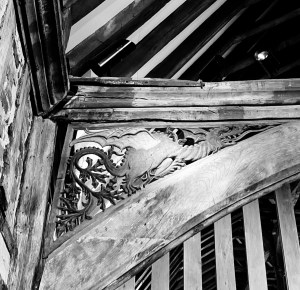
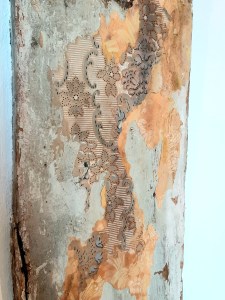
We were upstairs in the Great Hall, where the one remaining carved dragon (there were 14 originally) has been rescued from under a pile of rubbish in an outbuilding, restored, and put back where it belongs in the beams of the splendid roof.  Another treat was the remnants of Victorian wallpaper, which Florence pointed out.  It’s lovely that NCW are so evidently proud of the building, and great to see that it’s in daily use and living again.

The event was both enjoyable and very useful, an opportunity to meet with other writers (we tend to be a fairly solitary lot) and also to get some high-quality input from writers with a wide range of experience.  Molly Naylor, who described herself has having a portfolio career which includes poetry as well as writing for stage and screen, spoke about working across boundaries of genre, and the importance of finding our unique ‘voice’.  Victoria Adukwei Bulley spoke about opportunities for residencies and commissions, and showed us some of the output from her residency at the V&A.

But the highlight for me was Edward Parnell, who took us through his experiences with getting his first (prizewinning) novel published and then moving, almost by accident, into creative non-fiction.  As a writer of non-fiction, I often feel that writers’ events and courses aren’t really for me as they tend to focus on fiction and/or poetry (very occasionally scriptwriting) but never non-fiction.  It was a treat to be at something which was explicitly for writers like me – and as well as being an engaging speaker, Edward was generous with his time, staying around to chat afterwards (and signing a copy of his non-fiction book, Ghostland, for me!).

At lunchtime I went exploring.  The Church of St Julian is literally across the road from Dragon Hall, and I had intended visiting many times when in Norwich but never quite got around to it because it’s a little way from the city centre.  This is the place where the woman known as Mother Julian or Julian of Norwich lived as an anchoress (a hermit attached to a church) during the late 14th and early 15th centuries.  Her cell has not survived, but a chapel has been built on the presumed location, on the south side of St Julian’s Church, and there is a shrine to her there, as well as an information centre just up the hill from the church.  Julian (note – the name we know her by is the name of the church she was attached to; we don’t actually know what she was called) wrote the earliest surviving book in English by a woman, the Revelations of Divine Love.  This work was the result of a mystical experience when she was seriously ill and near death, and was revolutionary in its emphasis on God as ever-loving (not a concept the medieval church embraced).  It survived though convoluted channels of transmission in the UK and Europe, mostly treasured by nuns, and in the 20th century became a classic text of Christian spirituality.  Perhaps the most-quoted line is “All shall be well, and all shall be well, and all manner of things shall be well.”

This part of Norwich is becoming the Writing Quarter, with the National Centre for Writing now based here, and with the history of the first female author in English at St Julian’s.  And from 2020 the Norwich Printing Museum (formerly the John Jarrold Printing Museum) will be relocating to new premises in the restored St Peter Parmentergate Church on King Street.  The collection tells the story of the printed word since the middle of the 15th century when Johannes Gutenberg invented movable type for printing and the age of the printed book was born.  For anyone interested in the written word, a short walk around King Street in Norwich will take you from Julian’s quill, to the printed book, to the laptops of today’s writers.

Family life – the swans of Oxburgh Hall

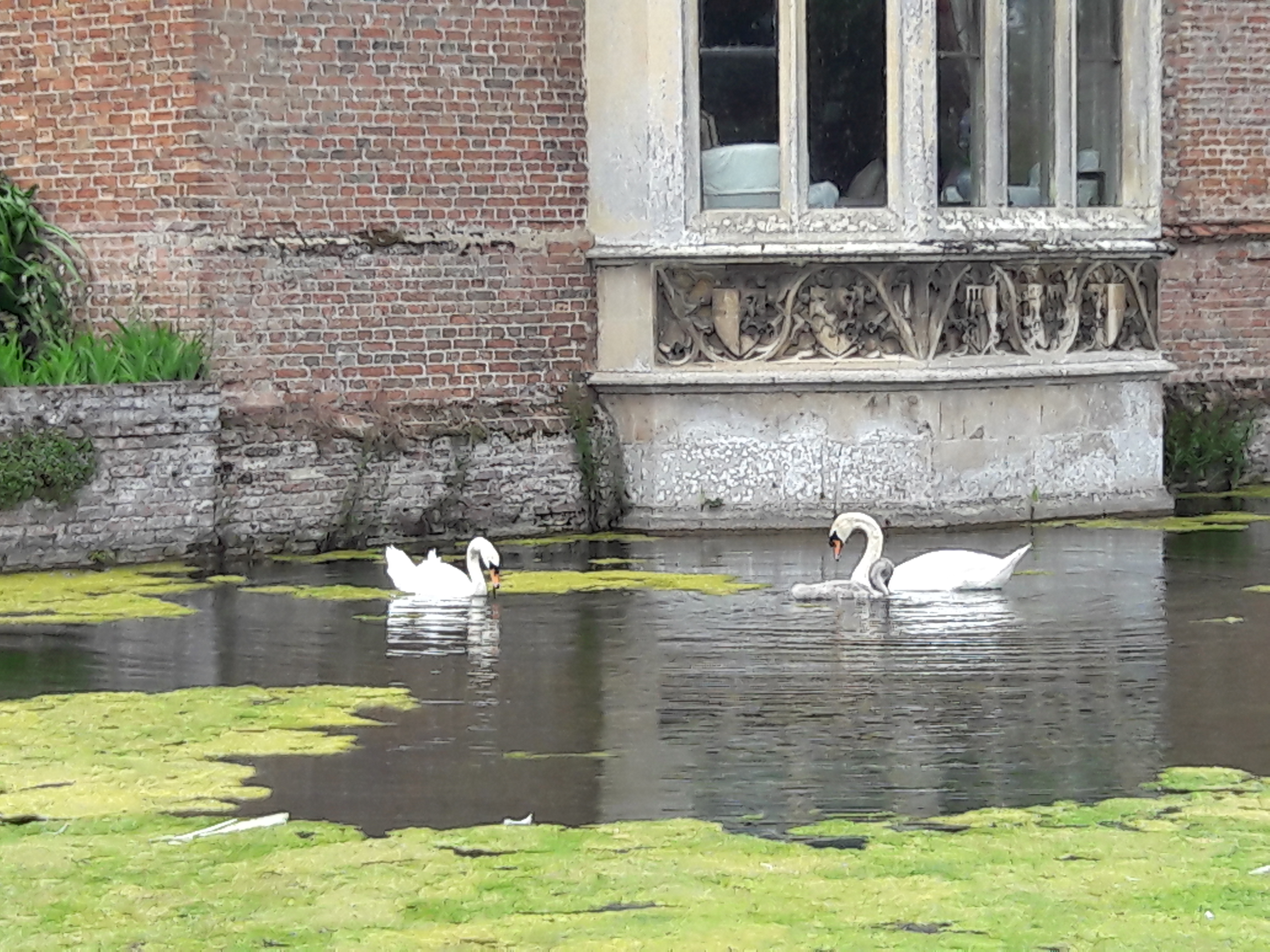
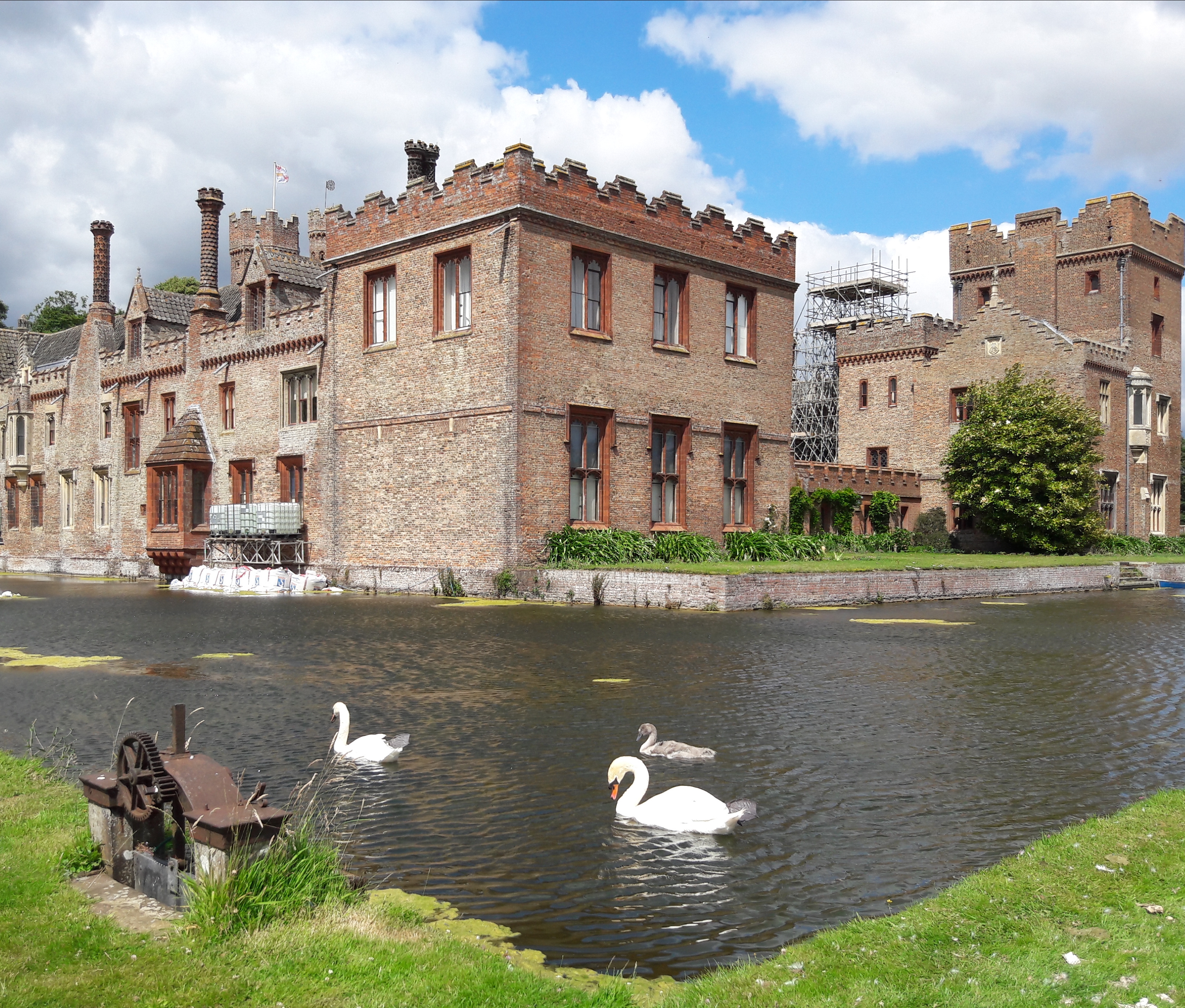
As the summer comes to a close, I’m sharing a family saga that’s been unfolding over the past few months.  I am fortunate to have Oxburgh Hall (National Trust) just down the road, and the fine moat is home to a pair of swans.  Last summer, while swan couples in the surrounding countryside reared their families, there were no little silver puffballs for the Oxburgh swans.

This year, however, they had more luck.  Back in June, they were proudly showing off their single baby.  Small, fluffy and grey, they guarded it fiercely.  Any visitor venturing too near was seen off by a hissing parent.  As an adult swan can easily break your arm if sufficiently cross, visitors wisely left well alone!  We got some nice pictures though.

Cygnets (baby swans) are quite vulnerable.  As well as having the usual youngsters’ talent for getting into life-threatening scrapes, when they are tiny they are also vulnerable to predators such as foxes, herons and raptors.  Prolonged wet periods can cause them to get waterlogged and chilled, and in hot weather they can easily overheat.  They can also be targeted by parasites, which weaken their system.  About a third of hatchlings don’t make it past the first two weeks of life.  They are not fed by their parents, but feed themselves from the start, so they have to learn quickly how to find enough suitable food to fuel their rapid growth.

On my next visit to Oxburgh, in July, I was thrilled to find that the lone cygnet was not only surviving, but thriving!  The parents were a little less protective now that the crucial first couple of weeks were past, and our little cygnet was growing well.

Much less fluffy, s/he (too early to tell if it’s a cob or a pen) is a sturdy little thing, and seems to have mastered the art of hoovering food up out of the moat.  It was actually quite hard to get a photograph, as the cygnet spent most of its time upended, feeding!  I got dozens of pictures of its backside, but not many of its head…

Fast forward to late August, and there was a heart-stopping moment as we couldn’t find the swan family.  We walked all round the moat, searched the fields, but there was no sign of them.   Just as we were about to go and find a member of staff to enquire what had happened to the swans, we spotted them in the river beyond the moat.  The cygnet is now HUGE!  It is rapidly growing to be as big as its mother, and is confidently swimming off by itself.

I stood on the little footbridge to take this photograph, but had to move aside when the flotilla headed my way, with the parents hissing loudly – they wanted to swim under the footbridge, and objected to my presence!  I obediently made way (I don’t argue with swans) and they ducked under the bridge and headed off downstream.

It’s been lovely to follow this youngster’s progress, and it’s great that the pair have finally managed to raise young – even if it is just the one.  Maybe they are an inexperienced pair and they’ll be more successful in future years – it’s a good excuse to keep going back to Oxburgh Hall to find out!

Norfolk Lavender – where farming meets fragrance

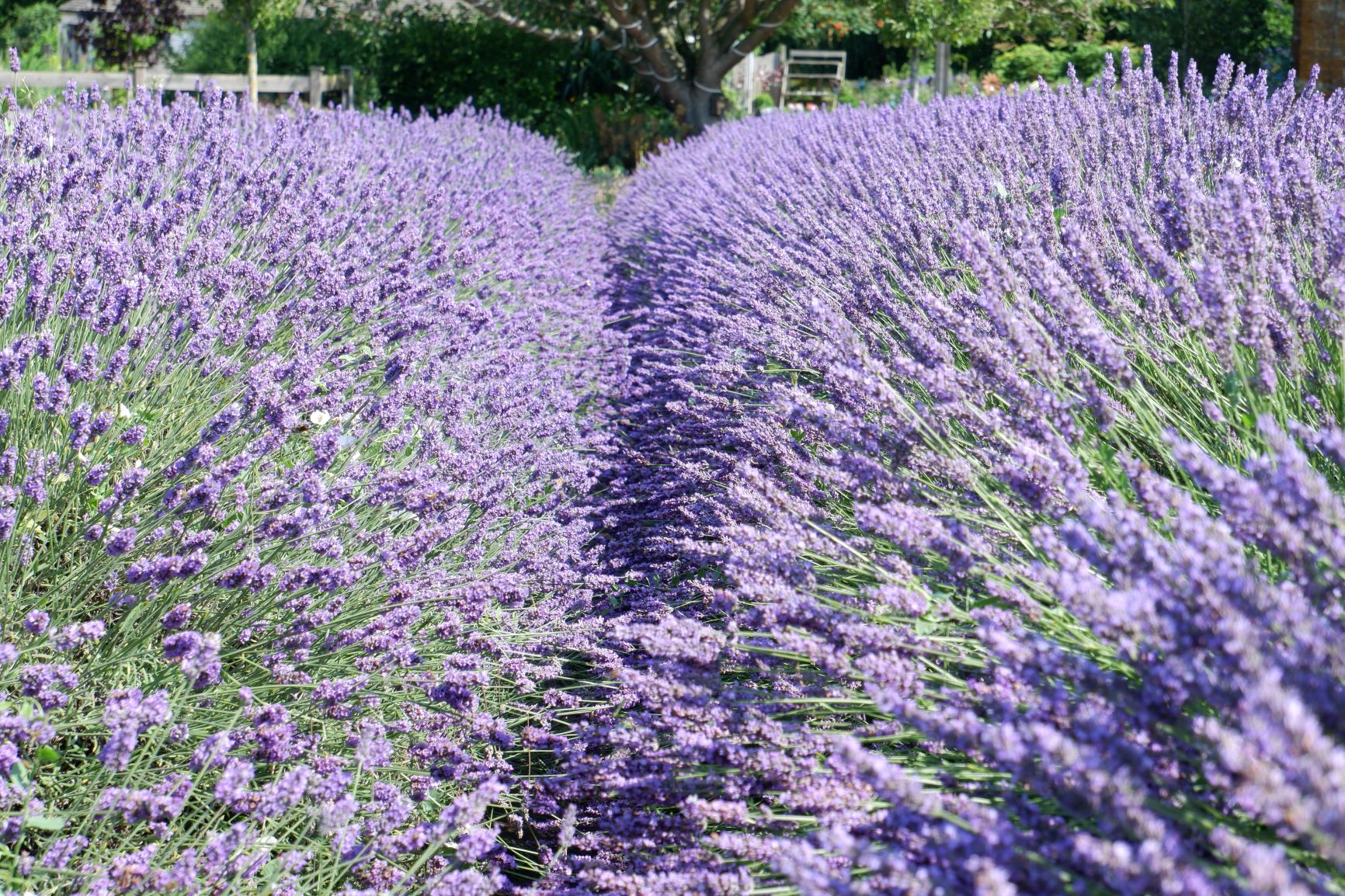
If you drive along the A149 near Heacham in north-west Norfolk during June and July, remember to wind down your windows as you approach the traffic lights.  Not only will you see row upon row, field upon field, of purple lavender, but the fragrance will fill your car and your senses.

DSCF5318 resized

You would be forgiven for thinking you’d been transported to the lavender fields of Grasse in France.  But here, amid the wheat of East Anglia, is Norfolk Lavender, the UK’s largest commercial lavender grower, with nearly 100 acres under production, and it’s been here since 1932.  Lavender growing had almost died out after the First World War, when demand had peaked due to the use of lavender oil in dressings because of its antiseptic properties.  Local nurseryman and florist Linn Chilvers had a dream to establish a lavender farm, and in partnership with landowner Francis Dusgate he planted the first six acres with 13,000 plants.  In 1936 they bought vintage French stills dating from 1874, and began to distil lavender oil.  Those same stills were in use until 2009!

DSCF5324 resized


When I visited earlier this week, I was shown how the current still is used to extract the oil from the lavender harvest.  Maurice, who has worked at Norfolk Lavender for six years, explained that the 2019 harvest is about a month late because of the wet June.

DSCF5345 (2) resized

Maurice talked me through the process.  First, the harvested lavender is loaded into the boiler.  The whole crop is used – stems as well as flower heads – in order to allow air pockets for the steam to circulate.  If only the flower heads are used, it becomes compacted and the steam wouldn’t be able to vaporise the oil.

The steam circulates through the lavender in the boiler, vaporising the oil and rising into the condenser.  At this stage, the steam/oil is cooled, turning into a liquid mixture of water and oil.  This goes into the separator, where the oil floats on the water, ready to tap off.

One boiler-full (roughly a ‘dumpy bag’ full) can yield between 100 and 700ml of lavender oil, depending on the variety.  On that day, Maurice was processing a variety called Maillette, which is high yielding and produces oil which is used in the company’s candle production.

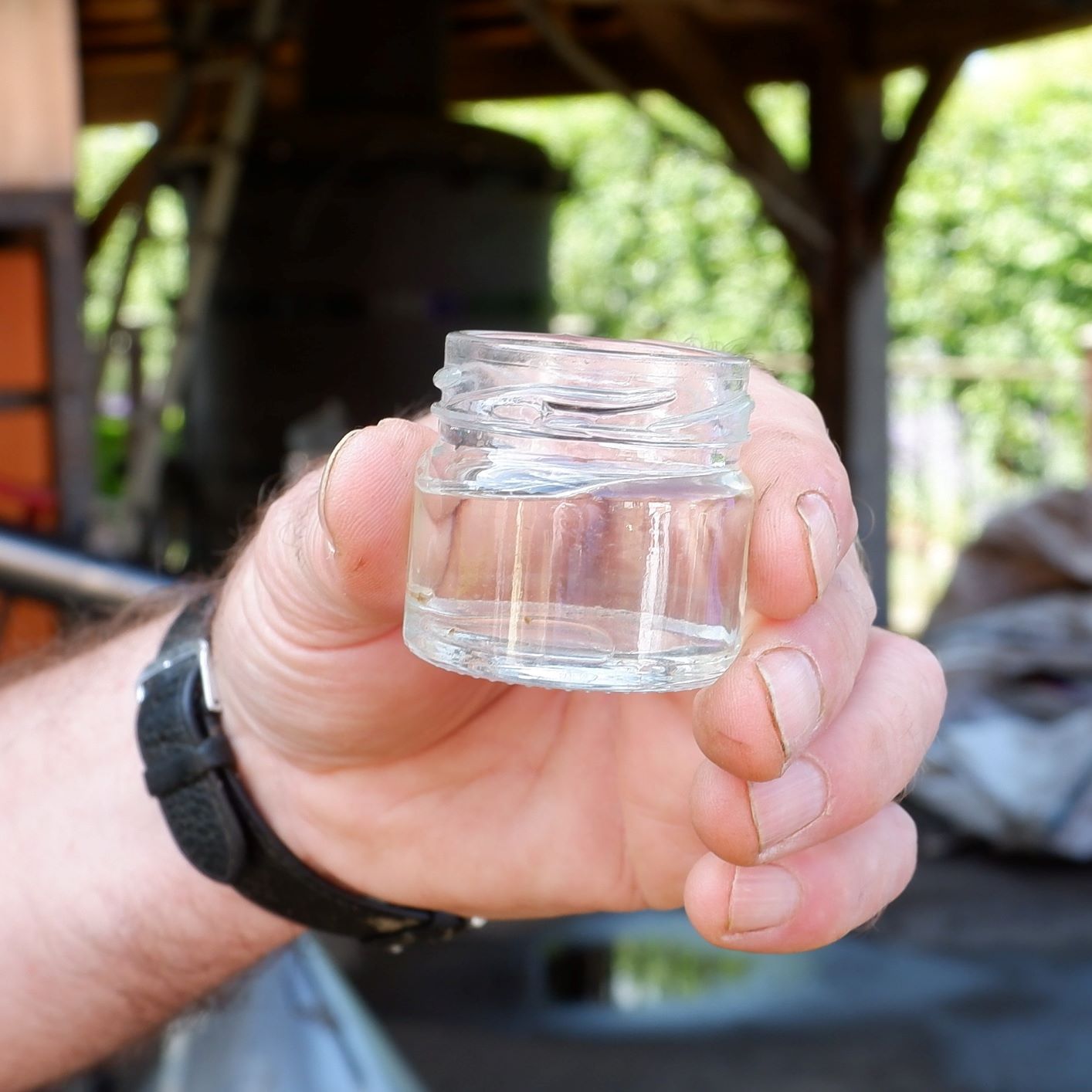
After distillation, the oil has to mature for up to two years – rather like fine wine or cheese!  Maurice handed me a sample of the freshly distilled oil to sniff.  It has a quite ‘green’ or ‘vegetable’ fragrance, with a suggestion of mown grass, definitely lavender but not the deep, warm fragrance we are used to in lavender essential oil.  This depth and complexity develops with maturation.

DSCF5349 (2) resized

Maurice told me that they have already sold out of the essential oil from the harvest two years ago.  Demand for lavender is increasing, especially amongst younger customers, as a new generation rediscovers the beneficial properties of lavender.

So, what’s so special about lavender?  Its use goes back to at least Roman times, when it was used medicinally, in massage, and in worship.  In fact, its name (lavandum) is associated with the Latin for ‘washing’, as lavender was used in the hot water of Roman baths.

DSCF5334 resized

Lavender was a staple of the medieval ‘physic garden’, where it was grown for its medicinal properties.  By the sixteenth century, it was being used as a moth repellent, air freshener and toothpaste (mixed with charcoal – maybe not to the taste of 21st century consumers).  It was also believed to help keep the plague at bay, and demand for it was therefore high!

By the nineteenth century, lavender’s appeal was mostly its fragrance, and it was widely used in perfumery.  Modern fans, however, also appreciate its reputed properties in reducing stress, inducing calm, and promoting sleep.  Lavender is widely used in aromatherapy, and in a wide range of products – many of which are made by Norfolk Lavender.

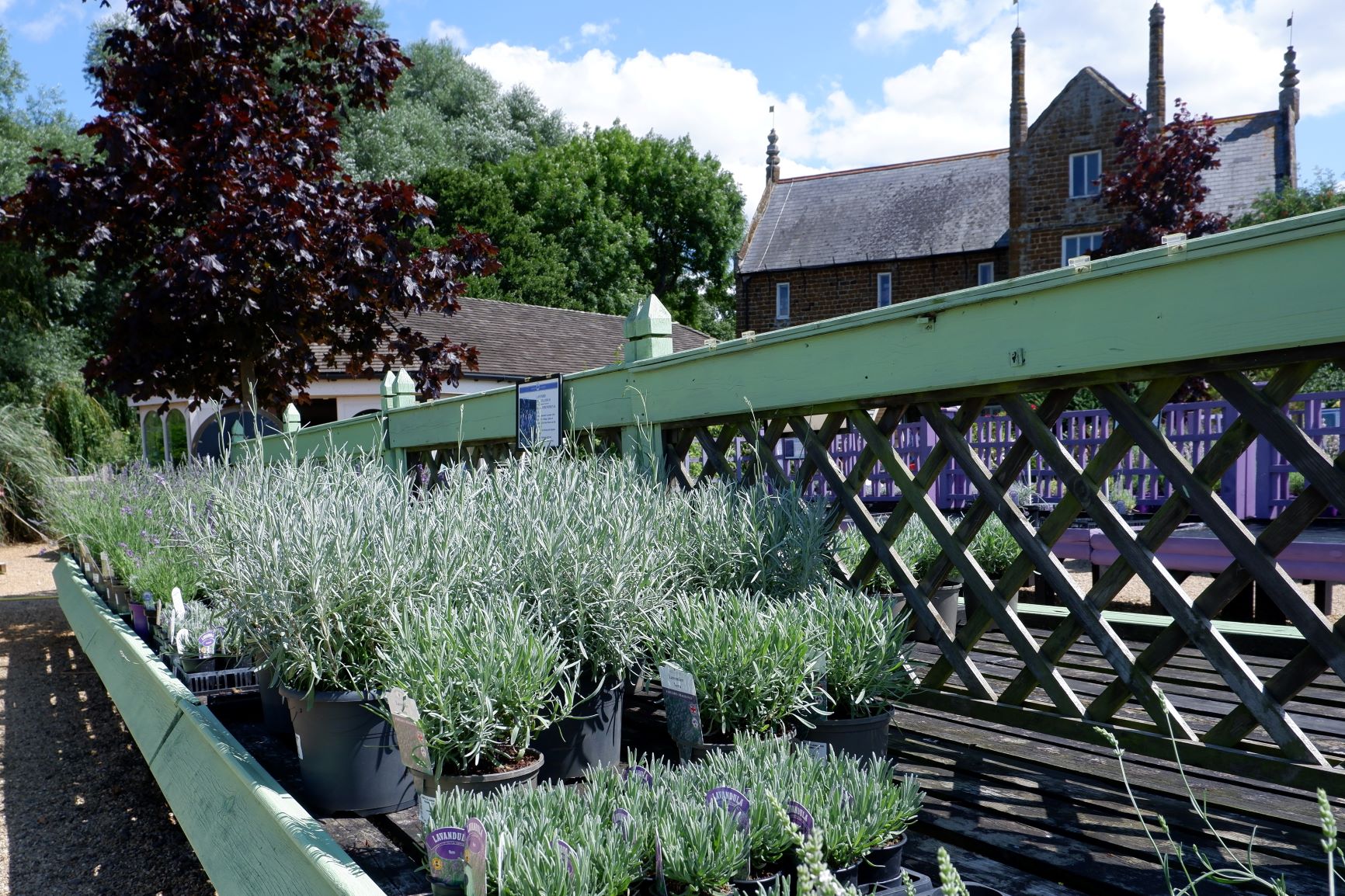
As part of its commitment to the continuity and heritage of lavender growing in the UK, Norfolk Lavender is also home to a National Collection of lavenders, with over a hundred varieties of lavender, many of which are available to buy in the Plant Centre.

DSCF5410 (2) resized

Norfolk Lavender is next to the traffic lights at Heacham.  At the heart of the site is Caley Mill, a watermill built in 1837, which ground flour right up to 1923.  Most of the building is now offices and stores for Norfolk Lavender, but the old miller’s cottage has been converted into an excellent tea room (The Lavender Lounge).  Don’t miss the truly amazing lavender cake (complete with lavender-coloured icing!).  And in case you were wondering, no, it doesn’t taste like soap – it’s just fragrant and delicious.

DSCF5330 resized

There’s also a large gift shop, which a seasonally changing selection of gifts as well as a large range of lavender-based products, including many of Norfolk Lavender’s own lines.   With the adjoining gardens to explore, and with Unique Gifts & Interiors, Walsingham Farm Shop, Farmer Fred’s Adventure Play Barn, and a rare breeds farm sharing the site, there’s something for everyone at Norfolk Lavender.  It’s good to see that this company, started from the vision of a local man with a dream, is thriving over 80 years later, providing a high quality visitor attraction and creating new generations of enthusiasts for lavender.

For more details of Norfolk Lavender, take a look at their website.