A very British memorial – public art in a nation of animal-lovers

I have recently written an article about Aldeburgh, in Suffolk, which will be published in the next issue of The Pilgrim.  In it, I write about The Scallop, the controversial but, in my opinion, wonderful sculpture by Maggi Hambling on Aldeburgh beach which is a memorial to the composer Benjamin Britten.
Colour photograph of The Scallop sculpture by Maggi Hambling on Aldeburgh beach

There is, however, another memorial on the seafront at Aldeburgh, much loved by the town.  Between the Tudor Moot Hall and the shacks selling fresh seafood, overlooking the boating lake, stands the statue of Snooks.  Measuring approximately two feet tall, the bronze figure sits on a stone plinth, head on one side, as if watching the model yachts on the boating lake.

‘Mrs Snooks Chip Winkler,’ as the inscription on her collar says, was the canine companion of two local doctors and used to accompany them on their rounds.  She got her name from the tinned fish, ‘snook’, which was imported from African waters during the Second World War.  Although her statue is popular with the people of Aldeburgh, its seems that in her lifetime they were perhaps not always so animal-loving – there is a story that, when wandering the seafront, she would have a notice on her collar which read “Please do not throw stones at this dog.”

Dr Robin Acheson and Dr Nora Acheson were doctors in the town from 1931.  Following Dr Robin’s death in 1959, a memorial was commissioned and the original Snooks statue was created by sculptor Gwynneth Holt.  It was unveiled in 1961 by the couple’s grandchildren.   Dr Nora continued to practice medicine, including teaching first aid to the crew of the Aldeburgh Lifeboat, until her death in 1981, when her name was added to the inscription.

Snooks

This memorial
was erected
by the people
of this borough
to Dr ‘Robin’
P.M. Acheson
who cared for
them from
1931 to 1959
and to Dr Nora
his wife
who died 1981
whilst still caring.

Snooks oversaw the fun at the boating lake until February 2003, when the statue was stolen.  The consternation in Aldeburgh was such that fundraising was started and a replica was cast, which was installed later that year.  However, that was not the end of the story, because in 2012 the original Snooks was discovered at an antiques fair by dealer John O’Connor, and was returned to the town.  This original Snooks now overlooks the pond in the garden of Aldeburgh Community Hospital, which the Achesons helped found, and ‘Snooks 2’ remains on her plinth.

At Christmas 2017 an anonymous well-wisher ‘yarnbombed’ the statue – apparently fearing that Snooks might be feeling the cold, exposed to the winter gales on the seafront, the knitter kitted her out with a jacket, a scarf, and a Tam o’ Shanter  hat.

Norfolk Lavender – where farming meets fragrance

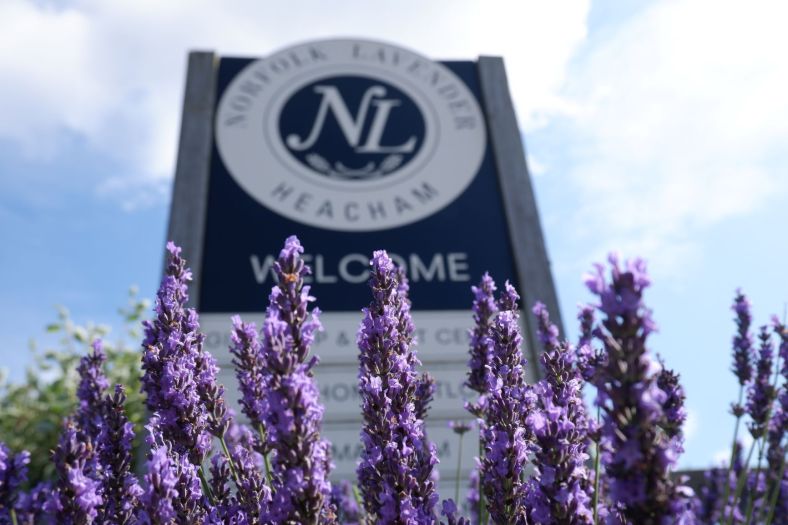
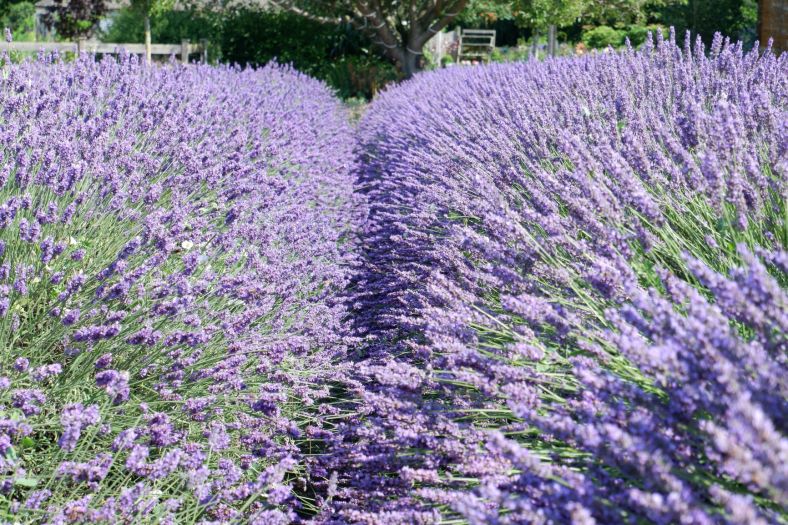
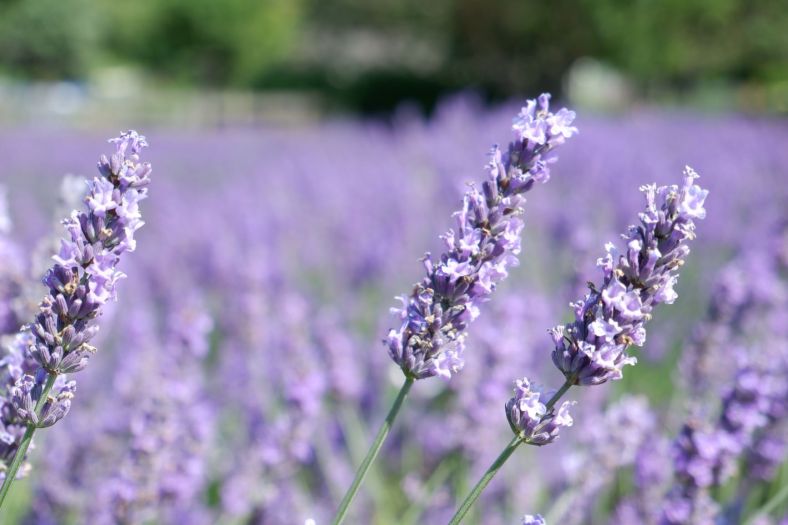
If you drive along the A149 near Heacham in north-west Norfolk during June and July, remember to wind down your windows as you approach the traffic lights.  Not only will you see row upon row, field upon field, of purple lavender, but the fragrance will fill your car and your senses.

DSCF5318 resized

You would be forgiven for thinking you’d been transported to the lavender fields of Grasse in France.  But here, amid the wheat of East Anglia, is Norfolk Lavender, the UK’s largest commercial lavender grower, with nearly 100 acres under production, and it’s been here since 1932.  Lavender growing had almost died out after the First World War, when demand had peaked due to the use of lavender oil in dressings because of its antiseptic properties.  Local nurseryman and florist Linn Chilvers had a dream to establish a lavender farm, and in partnership with landowner Francis Dusgate he planted the first six acres with 13,000 plants.  In 1936 they bought vintage French stills dating from 1874, and began to distil lavender oil.  Those same stills were in use until 2009!

DSCF5324 resized


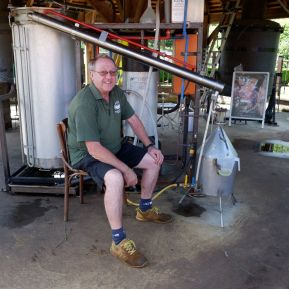
When I visited earlier this week, I was shown how the current still is used to extract the oil from the lavender harvest.  Maurice, who has worked at Norfolk Lavender for six years, explained that the 2019 harvest is about a month late because of the wet June.

DSCF5345 (2) resized

Maurice talked me through the process.  First, the harvested lavender is loaded into the boiler.  The whole crop is used – stems as well as flower heads – in order to allow air pockets for the steam to circulate.  If only the flower heads are used, it becomes compacted and the steam wouldn’t be able to vaporise the oil.

The steam circulates through the lavender in the boiler, vaporising the oil and rising into the condenser.  At this stage, the steam/oil is cooled, turning into a liquid mixture of water and oil.  This goes into the separator, where the oil floats on the water, ready to tap off.

One boiler-full (roughly a ‘dumpy bag’ full) can yield between 100 and 700ml of lavender oil, depending on the variety.  On that day, Maurice was processing a variety called Maillette, which is high yielding and produces oil which is used in the company’s candle production.

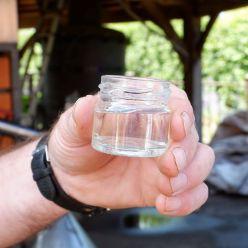
After distillation, the oil has to mature for up to two years – rather like fine wine or cheese!  Maurice handed me a sample of the freshly distilled oil to sniff.  It has a quite ‘green’ or ‘vegetable’ fragrance, with a suggestion of mown grass, definitely lavender but not the deep, warm fragrance we are used to in lavender essential oil.  This depth and complexity develops with maturation.

DSCF5349 (2) resized

Maurice told me that they have already sold out of the essential oil from the harvest two years ago.  Demand for lavender is increasing, especially amongst younger customers, as a new generation rediscovers the beneficial properties of lavender.

So, what’s so special about lavender?  Its use goes back to at least Roman times, when it was used medicinally, in massage, and in worship.  In fact, its name (lavandum) is associated with the Latin for ‘washing’, as lavender was used in the hot water of Roman baths.

DSCF5334 resized

Lavender was a staple of the medieval ‘physic garden’, where it was grown for its medicinal properties.  By the sixteenth century, it was being used as a moth repellent, air freshener and toothpaste (mixed with charcoal – maybe not to the taste of 21st century consumers).  It was also believed to help keep the plague at bay, and demand for it was therefore high!

By the nineteenth century, lavender’s appeal was mostly its fragrance, and it was widely used in perfumery.  Modern fans, however, also appreciate its reputed properties in reducing stress, inducing calm, and promoting sleep.  Lavender is widely used in aromatherapy, and in a wide range of products – many of which are made by Norfolk Lavender.

As part of its commitment to the continuity and heritage of lavender growing in the UK, Norfolk Lavender is also home to a National Collection of lavenders, with over a hundred varieties of lavender, many of which are available to buy in the Plant Centre.

DSCF5410 (2) resized

Norfolk Lavender is next to the traffic lights at Heacham.  At the heart of the site is Caley Mill, a watermill built in 1837, which ground flour right up to 1923.  Most of the building is now offices and stores for Norfolk Lavender, but the old miller’s cottage has been converted into an excellent tea room (The Lavender Lounge).  Don’t miss the truly amazing lavender cake (complete with lavender-coloured icing!).  And in case you were wondering, no, it doesn’t taste like soap – it’s just fragrant and delicious.

DSCF5330 resized

There’s also a large gift shop, which a seasonally changing selection of gifts as well as a large range of lavender-based products, including many of Norfolk Lavender’s own lines.   With the adjoining gardens to explore, and with Unique Gifts & Interiors, Walsingham Farm Shop, Farmer Fred’s Adventure Play Barn, and a rare breeds farm sharing the site, there’s something for everyone at Norfolk Lavender.  It’s good to see that this company, started from the vision of a local man with a dream, is thriving over 80 years later, providing a high quality visitor attraction and creating new generations of enthusiasts for lavender.

For more details of Norfolk Lavender, take a look at their website.

Why Three Hares?

Why, you may well be asking, have I chosen ‘The Three Hares’ as the title for this blog?  I confess, it’s a bit of a self-indulgence.  It has to be called something, so it may as well be something I’m passionate about!

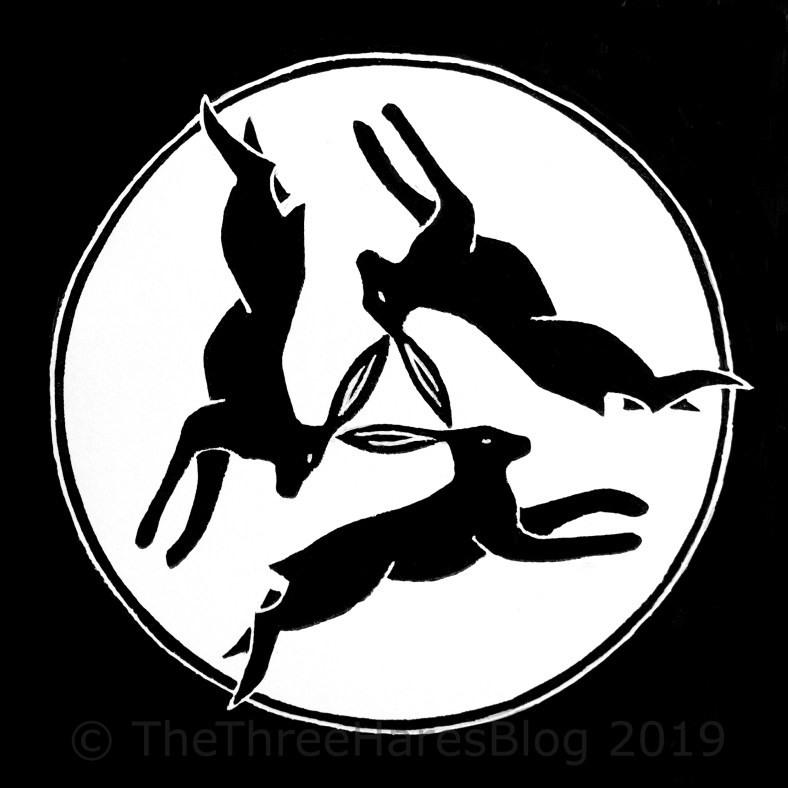
The motif of the three hares has fascinated me ever since I first encountered it, and I have been intrigued by its mysterious history and ambiguous meaning.  The motif consists of three hares (or possibly rabbits, in some cases) running in a circle, either clockwise or anti-clockwise, with each hare having two ears – but there are only three ears in total.  The ears form a triangle at the centre of the design (very occasionally, there are four hares sharing four ears, which form a square at the centre).

I first came across them in Devon, where there are nearly 20 examples of medieval roof bosses featuring the three hares in churches across the county.  (They are sometimes called “Tinners’ Rabbits” in the Dartmoor area, but this seems to be a bit of a red herring, as the origins of the motif are much older).

So, first, the history:  the earliest examples have been found in caves in China, which are believed to be early 6th century.  The theory is that the motif travelled west along the Silk Road, appearing in southern Russia, Iran, eastern Europe, Germany, France, Switzerland, and finally crossing the Channel to England and Wales in the early 14th century.  The hares transcend religious traditions, from Buddhism, through the Islamic world (where the motif appears on metalwork, glass, ceramics and textiles), Judaism (18th century synagogues in Germany have the motif, alongside the riddle “Three hares sharing three ears, yet every one of them has two”) to Christianity (they feature in churches across Western Europe).

The meaning is much more mysterious than the history.  Hares have had many associations, including as a symbol for resurrection in Chinese mythology.  The hare was the animal associated with the pagan goddess Oestara, along with the moon, possibly because the hare was believed (erroneously!) to have a gestation period of 28 days.  This association may account for the naming of the female cycle (oestrus) and the principal female hormone (oestrogen).  This female imagery may be the reason that the three hares are often found juxtaposed with the Green Man in English examples.  In another legend, the hare was believed to have laid the Cosmic Egg, which may be the precursor of the idea of the Easter Bunny, and Easter eggs!  And latterly, the three hares were believed to be a symbol of the Christian Trinity.

I leave you with my own interpretation, in a linocut print, of the three hares and moon motif, which is the logo for this blog, and some links to articles which have informed my understanding of the three hares and which you may find interesting.  If you are really lucky, you may manage to track down a copy of The Three Hares: A curiosity worth regarding by Tom Greeves, Chris Chapman and Sue Andrew, published by Skerryvore Productions but now sadly out of print – if you do, can I please borrow it?!

20190722_100029 classic - Copy - edited and watermarked

The Three Hares Project

Legendary Dartmoor

Wikipedia article

New Scientist article

The Three Hares Trail, Dartmoor

An artist’s blog about the three hares

The three hares as a Chines puzzle