The machine that changed the world – one stitch at a time

My pride and joy is a vintage Singer sewing machine.  It’s black and gold, is so heavy that I can hardly lift it, and celebrated its 90th birthday this year.  Built to last in an era when built-in obsolescence had not yet been invented, it is a design icon which truly changed the world, and every time I use it I am captivated again by its story.

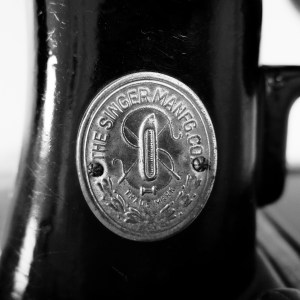
Black and white image of a Singer sewing machine

Up to the middle of the nineteenth century, all sewing was done by hand.  There was no alternative to hand-stitching – every seam of every garment made, ever, in all of human history, was hand stitched.  Then, a flurry of inventors created a variety of ‘sewing engines’, which could sew much faster than any human hand.  The most enduring of these designs was patented in 1851 by Isaac Merritt Singer of New York.  A gifted salesman, he created a network of showrooms where the machines were demonstrated, showing both that they were easy to use (‘so easy a woman could use it’ – not a slogan that would, one hopes, sell many products these days, but in its time very effective) and also that clothes sewn by machine were at least as good as those sewn by hand.
Black and white image of a Singer sewing machine

Singer’s two main markets were commercial – garment manufacturers – and domestic.  It was in domestic sales that the sewing machine created a revolution.  Diaries kept by American women in the 1860s showed that they were spending the equivalent of two days a week on making and repairing clothes for their families.  A sewing machine saved up to 90% of that time, giving them opportunities to earn money either through sewing for other people or by working outside the home.

Black and white image of a Singer sewing machine

It wasn’t just the machines themselves that changed the world – it was the way they were sold.  In the 1870s, these expensive pieces of kit were worth the equivalent of half a year’s salary for a typical worker.  Singer introduced the idea of hire purchase, where an initial deposit and regular payments would enable people to own and use a machine they would otherwise not be able to afford.  Sales boomed, and modern consumer spending was born.

Black and white image of a Singer sewing machine

Supported by a reputation for reliability and a good parts and maintenance network, by 1918 it was estimated that one in five households in the world had a Singer sewing machine.  Yes, you read that right – one in five households in the world, for it didn’t take long for the Singer company to realise that there was a market far beyond the USA.  It started its international expansion in the United Kingdom, initially manufacturing sewing machines in Glasgow, and 1882 construction started on a new factory at Kilbowie, on the banks of the River Clyde, where John Brown’s shipyard was already a major employer of skilled workers.  The Singer factory, which at the time was the largest factory of its kind in the world, was a catalyst for the development of the town of Clydebank, and it was in this factory that my Singer sewing machine was born.
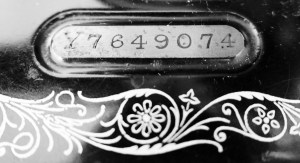
Black and white image showing the serial number of a Singer sewing machine

By tracing the serial number which each individual machine has, it is possible to find out exactly where and when a Singer was manufactured.  Serial number Y7649074 was part of a batch of 20,000 model 99K machines made in the Kilbowie factory in January, 1930.

Black and white image of a Singer sewing machine

In 1930, the Great Depression had taken hold following the Wall Street Crash of the previous year.  In January, Buzz Aldrin (one day to be the second man to walk on the moon) was born in New Jersey, and Mickey Mouse made his debut in a comic strip.  Over the next few months, the planet Pluto would be discovered, and elections in Germany would see Hitler’s National Socialists become the second largest party in the Reichstag.  Sliced bread would appear in British shops for the first time, Sellotape (Scotch tape) would be invented, and Clarence Birdseye would sell the first frozen food.  Against this backdrop, my sewing machine emerged from the last of the 56 departments in the Singer factory, its black japanned cast iron body gleaming, the gold leaf bright and fresh, its mechanism oiled and ready for action.  I would love to know who first owned it – who first excitedly turned the key to open the domed Deco-style box – whose hands first threaded the needle, wound the bobbin, turned the handle – who first proudly wore a garment created on this machine, what that garment was, what fabric, what colour.  I imagine children’s clothes, the curtains for a first home, a dress to wear to the dance, the changing fashions and fabrics of more than six decades.

Black and white image of a Singer sewing machine

My Singer came to me in the mid-1990s, in Salisbury, Wiltshire.  I had spotted it in the window of the sewing machine shop near where I worked, advertised as ‘refurbished’.  I was given it as a birthday present, and it’s one of the best presents I’ve ever had.  A quarter of a century later, it’s still in regular use.  It only has one stitch – a straight stitch – and it only stitches forwards (later machines had a reverse function), so modern stretch jerseys present it with some challenges, but for many years I made most of my own clothes.  I remember the first thing I made was a black velvet longline jacket, which I wore for years and years until it finally disintegrated.   These days, my Singer produces curtains and alters clothing, and it’s especially good – when fitted with the right needle – for shortening denim jeans.  Even though I neglect its maintenance, I have only once had to take it in for a service, because it was sticking – the guy who serviced it told me off for not cleaning the fluff out of the works more regularly!

Black and white image of a Singer sewing machine

I said at the start that the Singer sewing machine was built to last.  Sadly, the affordable high street fashions of the mid-twentieth century and the advent of competition from Japanese, German and Italian manufacturers after WWII contributed to the end of Singer company’s success.  The Kilgowie factory closed in June 1980.  Together with the closure of the John Brown shipyard a few years earlier, this led to Clydebank becoming a post-industrial ghost town in the Thatcher era.  A recent (2019) BBC television documentary (The Singer Story: Made in Clydebank) interviewed a number of former employees of the Singer factory, reminiscing about its glory days.  Their pride in their work, and in the machines they produced, shone out, and I was especially struck by the words of Anna Stones, who worked in Department 55 (the parts department).  She said “You were proud to be making a small part, and to know that it was going to be a Singer sewing machine, and that it was going to give somebody so much pleasure, and was going to be sent all over the world.”  I hope Anna would be happy to know how much I love my machine.
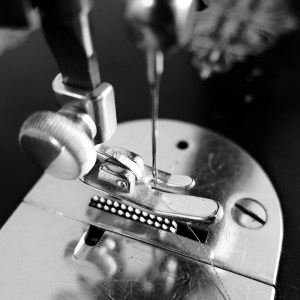
Black and white image of a Singer sewing machine

The documentary also traced the continued use of the early twentieth-century manual and treadle (foot operated) machines into the present day all over the world, including through charities like Tools For Self Reliance who collect vintage machines, refurbish them, and send them to (often women’s) development projects around the world where they become the means for people to become economically independent.  The programme interviewed young women in Accra, Ghana who were excited to have the means to become self-employed as seamstresses, equipped with Singer sewing machines just like mine.  Here’s to the Singer sewing machine – the machine that changed the world, and still goes on changing it, one stitch at a time.

Marking time

As regular readers of this blog will know, I am fascinated by history, and in particular ordinary people and how they lived their lives in the past.  I am especially drawn to explore and respond to objects and artefacts – the more domestic the better.   My friend Gina also knows this, and she told me the story of her clock.  I’m grateful to her for allowing me to write it up and share it with you.

Gina has a clock.  It’s a longcase clock, the kind that is usually called a Grandfather clock.  Nothing very unusual about that, you might think, except that the mechanism (and probably the case) of this particular clock is 200 years old – and for most if not all of that time it has belonged to generations of Gina’s family.

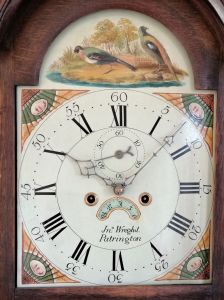
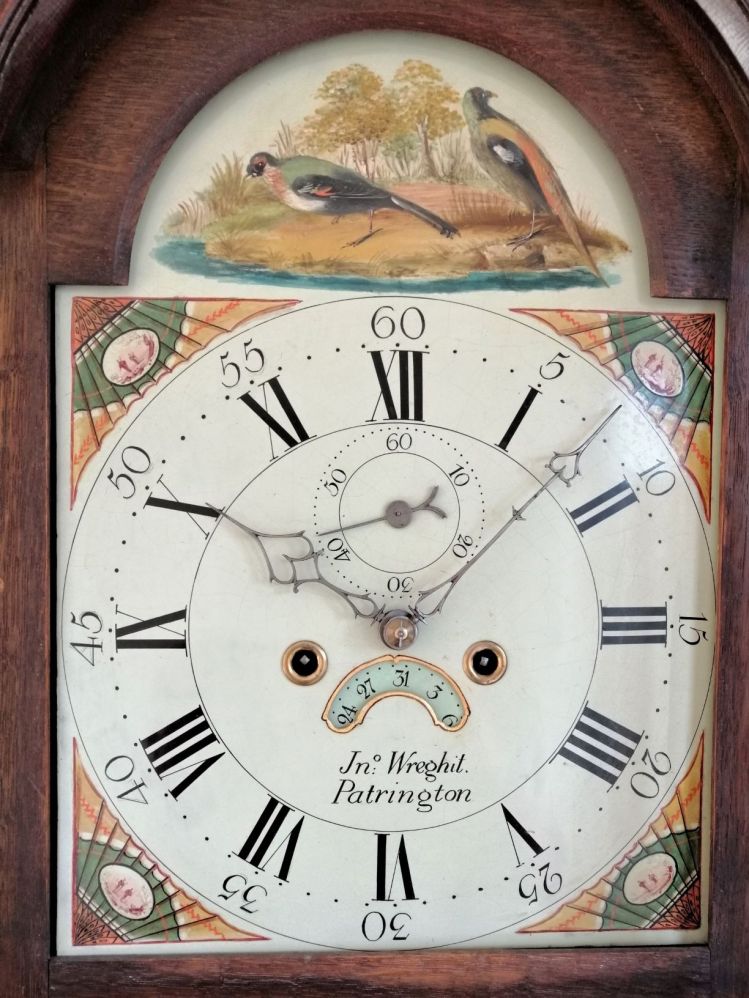
Image of clock face with roman numerals and fanciful birds above.

The family story, Gina tells me, is that they have owned it from when it was first made by John Wreghit of Patrington, Yorkshire.  I have done some research, and have found that John Wreghit (sometimes Wreghitt) was born around 1769 and died in 1845.  He is buried in the churchyard of St Patrick’s Church, Patrington.  He was apprenticed to Edward Hardy, clock and watchmaker of Kingston upon Hull, in December 1785, and in due course he himself took on an apprentice, John Potchit, in March 1801.  An apprenticeship lasted 7 years.  John Wreghit is listed as a watch and clock maker in trade directories between 1801 and 1841. In 1798 he married Ann Hopper.  It seems their son James followed his father into the clockmaking trade, before dying in 1831 at the young age of 29.  John and Ann had a number of children, not all of whom survived into adulthood – they reputedly had 9 daughters,   one of whom, Margaret, married a John Rank.  Margaret and John Rank’s grandson was Joseph Rank, who founded one of the largest flour milling and bakery companies in the UK in the 19th and 20th centuries, and which survived as part of Rank Hovis McDougall until 2007.  Joseph Rank was a significant philanthropist, and was father to the even more famous J Arthur Rank.

The early years of the clock’s life are not recorded, but it is known to have been in Gina’s family by the beginning of the 20th century.  Gina remembers the clock “when I was knee high”, when it was owned by her Great Aunt Ada (her grandmother’s sister) and Great Uncle Albert.  “He was an ancient and very grumpy old man in a chair when I knew him – he must have been in his eighties when I was tiny.  They lived in a prestigious street in Hull.”

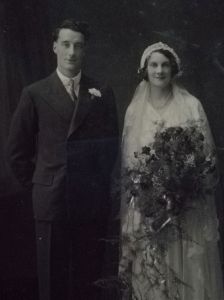
Early 20th century black and white wedding photograph

Ada and Albert’s wedding photograph has been handed down to Gina, and she now has it framed and displayed next to the clock.  The clock itself has been recently restored, and now ticks and chimes at the heart of Gina’s home.

Gina often thinks of what the clock has witnessed in the past two centuries.  It has marked births, and deaths.  Family members will have checked the time in trepidation, and in hope, as it measured the significant events and everyday rhythms of their lives.  Time will have seemed to crawl on dull days, or before some eagerly-awaited event, or flown by during family celebrations.  The clock will have made sure that children got to school, and grown-ups to work, on time.  The chimes will have counted down the hours during sleepless nights, and chivvied the tardy along by day.  The clock will have been the beating heart of a succession of family homes.

And now, each tick and chime connects Gina with the people, her kin, who stand behind her through those past two centuries.  I wonder if John Wreghit, as he crafted its mechanism in the days before Queen Victoria, could ever have imagined the significance and legacy his craftsmanship would have.

Lost people, lost stories – the mystery of the silver locket

In the window of a local charity shop is a silver locket.  I walk past the shop most days, but today something catches my eye and makes me go back for another look.  The locket is priced at £8, and is battered, with a mismatched chain, but what attracts my attention is that it still has old photographs in it.  On a whim, I go into the charity shop and buy the locket.  The volunteer seems a bit bemused about why I am so sure I want this particular piece, but I feel that I can’t simply walk by and leave it there – this was someone’s life, someone’s loves, someone’s history, and it’s too sad to just let it go.  I decide to write about it.

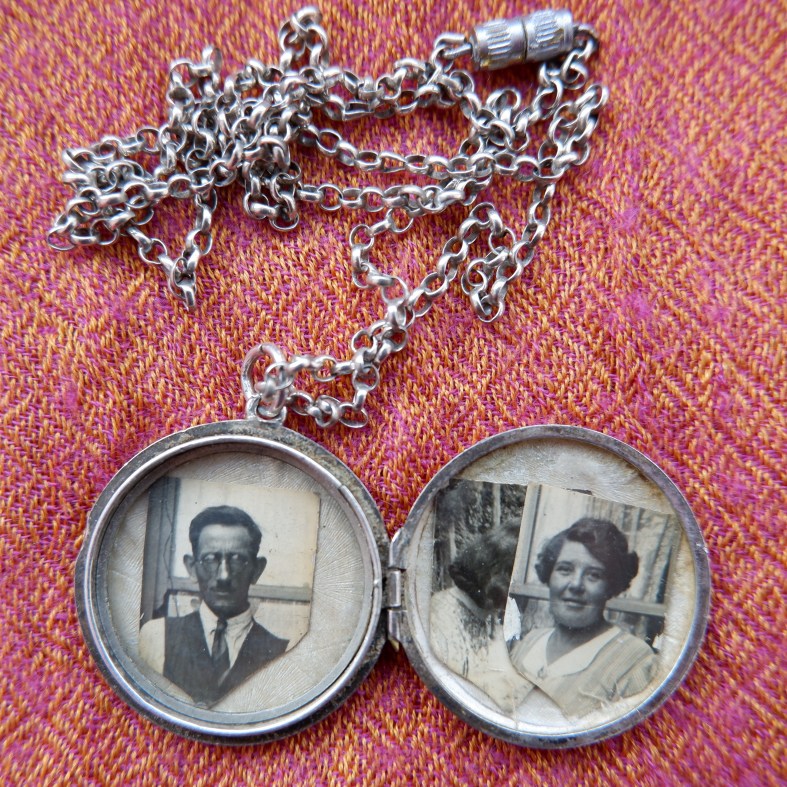
Image of a silver locket, with three black and white photographs in it.

I like detective work, and my partner is an experienced researcher, so between us we should be able to find out a bit about the locket and its history.  First of all, I clean it up and repair the chain.  The locket is stamped ‘Silver’, not hallmarked or marked 925, but that’s perfectly usual for small 20th century British silver items and doesn’t help us much.  The chain is newer and not such good quality as the locket, which is machine engraved and quite heavy.

Image of a small black and white photograph of a middle aged woman with dark hair.

Inside, there are three photographs – a middle-aged man on the left, and a middle-aged woman on the right with another photograph half tucked behind it.  With the tip of a penknife I carefully prize the clear plastic cover off the right hand side, and take out the photographs.  The middle-aged woman (let’s call her Mum) is standing in front of a sash window, which has net curtains.  If this is her home, she probably cursed when she saw the photograph, because the curtains aren’t hanging straight!  She’s wearing a striped dress with a wide, white collar, fastened with a brooch, possibly a cameo (my partner tells me that the style is 1930s or 1940s, as is the man’s shirt collar).  She smiles gently, straight into the camera lens.

Image of a small black and white photograph of a teenage girl with dark hair.

The photograph which is tucked behind Mum is of a young woman, perhaps in her teens, with a dark wavy bob.  She is side on to the camera, and looking down – the photograph is cropped, so we can’t see what she’s looking at – something in her hands?  A book?  A kitten?  A flower that she has picked?  This one is also outdoors, but on a path beside an old building with trees and what looks like creeper.  The sun is shining.  Is this her home, or is she on a day out somewhere?

Image of a small black and white photograph of a middle aged man with dark hair and glasses.

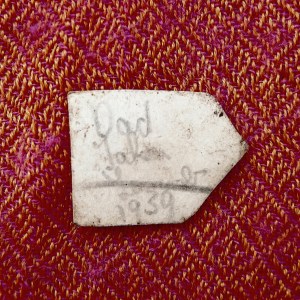
I wield the penknife blade again, this time on the left hand side, and remove the photograph.  I turn it over, and this time I’m in luck – there’s faint pencil writing on it.  ‘Dad Taken L……. 1939’.  My partner was right about the dating.  It’s really frustrating that the location is so faint and impossible to read, despite my efforts to digitally enhance my photograph – if you can make it out, please contact me!  Dad has a moustache and round spectacles.  He wears a white shirt, a tie with broad stripes, and a waistcoat.  Like Mum, he’s standing in front of a sash window, although it’s hard to tell if it’s the same location – the frames certainly look similar.  He is dark, too, much thinner than her, and with a serious expression.  The reflections in his glasses mean we can’t see his eyes.

Image of back of small photograph, with pencil writing.

Who were they?  Is the girl with the dark hair the owner of the locket, or maybe her sister?  Posing for the camera in his shirtsleeves in the summer of 1939, in the calm before the storm, little does Dad know that only a few weeks later the country will be at war again.  He is old enough to have served in WWI, but too old for active service in WWII – he will likely go into the Home Guard, or be an ARP warden.  Mum will have to grapple with rationing, clothing coupons, and making sure that not a chink of light shows through those net-curtained windows.  The girl will be old enough by the end of the war, if not at the beginning, to serve in the forces or the Land Army, or to do a job vacated by a man who is away fighting.  If the photographs are from near where I found the locket, in Norfolk, she may fall for one of the American airmen at a local base.  Did these people, and the house, make it through the war, or was this locket worn as a memorial when all that was left was the rubble of an air raid?  Was the locket loved and cherished, worn daily until arthritic hands could no longer manage the clasp?  How did it get so battered, almost as if it has been trodden underfoot?  And eight decades on, how did this precious memento of the summer of 1939 and three people’s lives end up, unloved and unwanted, in a charity shop in Norfolk?

If you know who the people in these photographs are, please get in touch!  And please share this post on social media, so that as many people as possible can see it and maybe we can solve this mystery together.

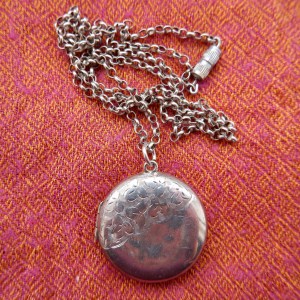
Image of silver locket.