An infinity of one’s own – Hawker’s Hut, poetry and place

I am thinking, and writing, a lot about place at the moment – geographical location, borders, and the relationship between where we are and who we are.  As a tangent from this, I’ve been musing about whether, or how, where we are affects what we write.  There are a few obvious connections; for example could Wuthering Heights have been conceived of and written anywhere other than the bleak uplands of the Brontë’s Haworth, or would Persuasion have been as persuasive in its evocation of the social banalities of Bath had not Jane Austen herself experienced the particular torment of the old maid in that context.  But is it a general principle, I have been asking myself, that our location influences us as writers?

In the late spring of last year I tagged along with my wife on a study trip to north Cornwall, that enigmatic stretch of coastline between Bude and the Hartland peninsula where Cornwall becomes Devon, notorious for shipwrecks and (possibly apocryphal) tales of wreckers.  It is less remote and unknown these days than when I first visited a couple of decades ago, and honeypots like Boscastle are now gridlocked, but off season, with the sea fog swirling round you, it can still feel like you’re standing at the edge of the world.  It’s mainly vertiginous cliffs along here, with the South West Coast Path providing access on foot to places that tourists can’t drive to.  My wife having finished at the museum, we went exploring.

Intrigued by the eccentricities of its nineteenth-century vicar, the Reverend Robert Hawker, we went to Morwenstow.  The steep churchyard was knee-deep in wildflowers, framing the replica figurehead of the Caledonia which marks the burial of several of its sailors who drowned when she was shipwrecked on that treacherous coast in 1842.  It is a kind of marker, too, for Parson Hawker’s affinity with the sea – he habitually wore a knitted fisherman’s gansey, was involved in a number of rescues, and took great pains to ensure the decent burial of shipwrecked sailors.

Hawker has other claims to fame.  He was a poet, and as a young man published ‘The Song of the Western Men’ (more commonly known as ‘Trelawney’) which is the de facto national anthem of Cornwall.  And he was the instigator of the modern Harvest Festival, celebrated in churches all over the world, and which was a re-imagining of the medieval practice of Lammas or First Fruits.

His eccentricities are well, although not perhaps always reliably, recorded, and include wearing random and colourful garb such as a poncho made from a yellow horse blanket; bringing his cats to church services (and excommunicating one of them for mousing on a Sunday!) and keeping a pet pig.  He was also almost certainly addicted to laudanum – tincture of opium in alcohol – and this arguably fuelled both his eccentricity and his poetry.

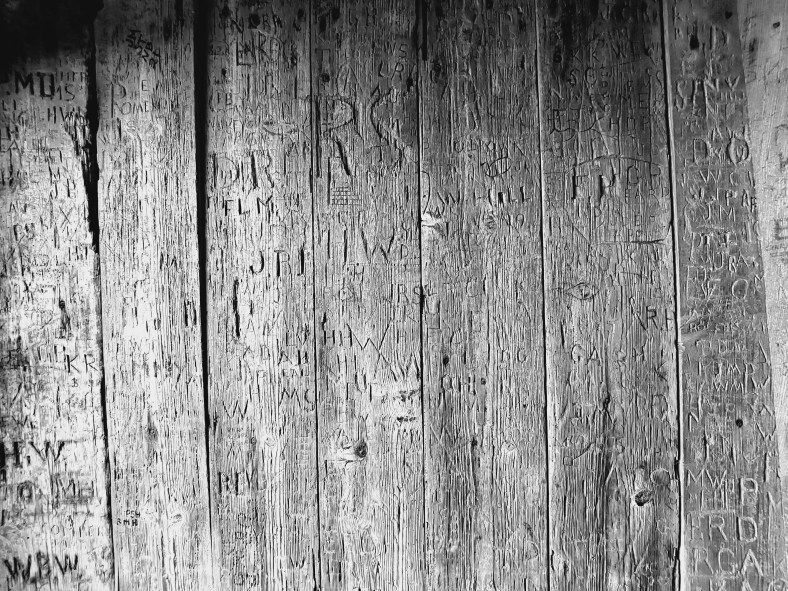
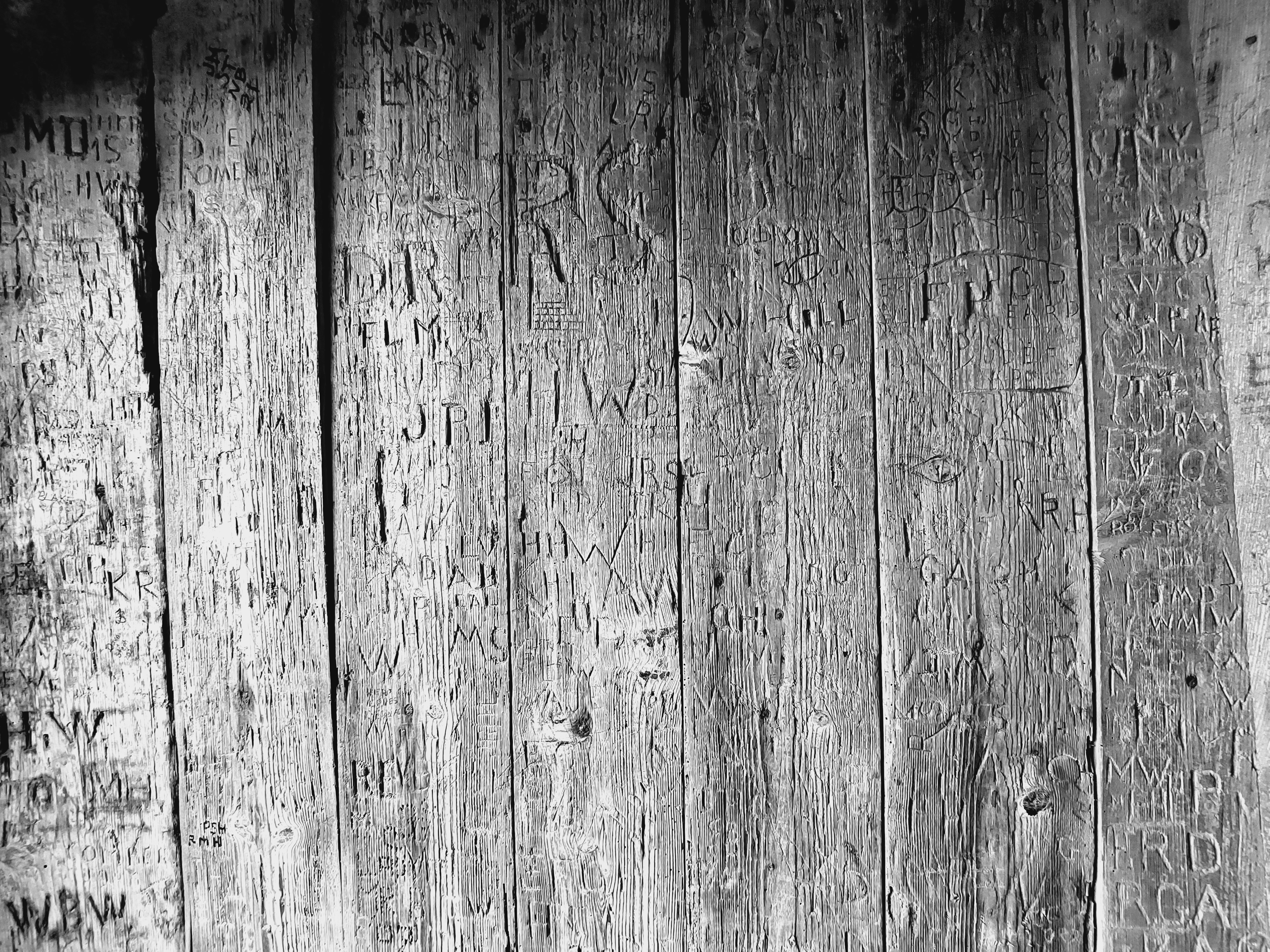
Much of Hawker’s poetry was written in his hut, set into the cliff face a mile or so from the church, constructed from driftwood and roofed with turf.  It is now the smallest property in the care of the National Trust, its planks incised with graffiti and worn to a smooth, mellow patina.  It would be easy to think of it merely as a den, a playhouse, or a man-cave, but we were lucky enough to have the place to ourselves and time to pause and try to see it through Hawker’s eyes.  The stable door opens onto infinity – the Atlantic, the sky, the sea mist.  The view is as unlimited as the human imagination.  What does looking out on infinity do to a person?  To a writer?  Does it stretch the boundaries of the mind, of the possible?

Sixty miles to the north across the Bristol Channel is another shrine to a dead poet – Dylan Thomas’ writing shed at Laugharne.  Decades apart, two men gazing out on infinity and writing poetry.  Infinity + alcohol = Thomas.  Infinity + opium = Hawker.
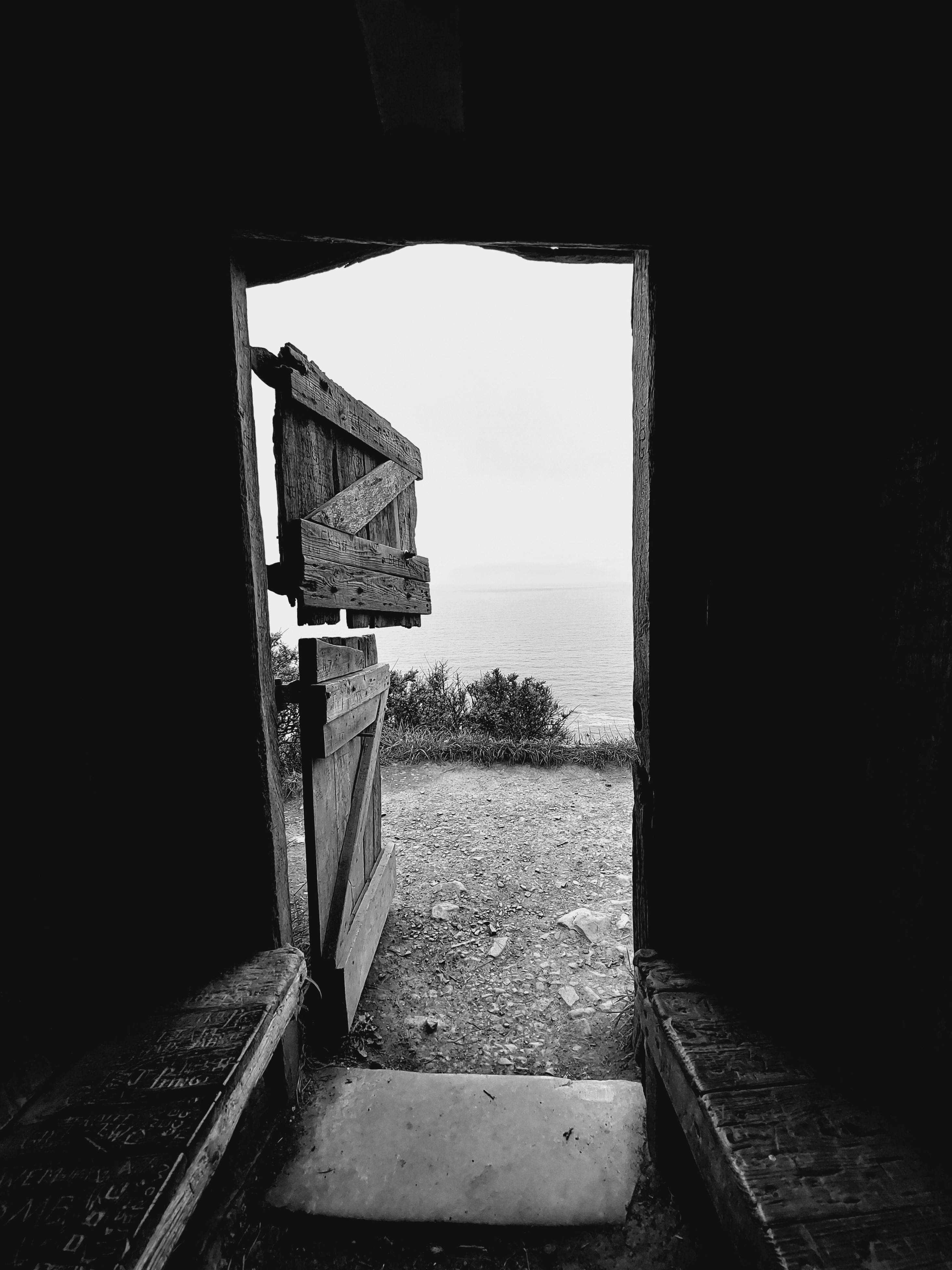
Maybe it’s not just the window on infinity, or even the stimulants, that are significant here.  Maybe it’s the access to a place to write, uninterrupted by the demands of other, domestic roles.  Jane Austen famously wrote her entire oeuvre at a little side table, using a writing box which had been a present from her father.  Her father couldn’t give her a space to write, or financial independence, but he could give her a writing box, a microcosm of the writer’s world which she could take with her wherever she went.  Virginia Woolf wrote an entire book about A Room of One’s Own, in which her analysis was that women writers were handicapped by the lack of their own space in a domestic context.  Neither Hawker in his hut, nor Thomas in his shed, had that problem.  Both had the luxury of private space – physical space, and headspace away from the demands of domesticity.  And, as a bonus, those private spaces had a window on infinity.

I started this by musing on the relationship between where we are and who we are, and whether, or how, where we are affects what we write.  Perhaps it’s less that a place affects who we are and what we write, but rather that where we are affects what we see from there.  Writers, including Alfred Lord Tennyson and Charles Kingsley, were inspired by Hawker’s hut.  Thousands of literature students and aspiring writers make the pilgrimage to Thomas’ shed.  Maybe the inspiration lies, not in looking into the writer’s space, but looking out of it – seeing what they saw, especially when that is infinity.  Alcohol and laudanum are optional.
I am committed to making this blog freely available, and not putting material behind a paywall. As a writer, I am doing what I love – but I still have to make a living. If you have enjoyed this post, and if you are able to do so, perhaps you would consider supporting my work by making a small contribution via the Buy Me A Coffee button. Thank you!

Buy Me a Coffee at ko-fi.com

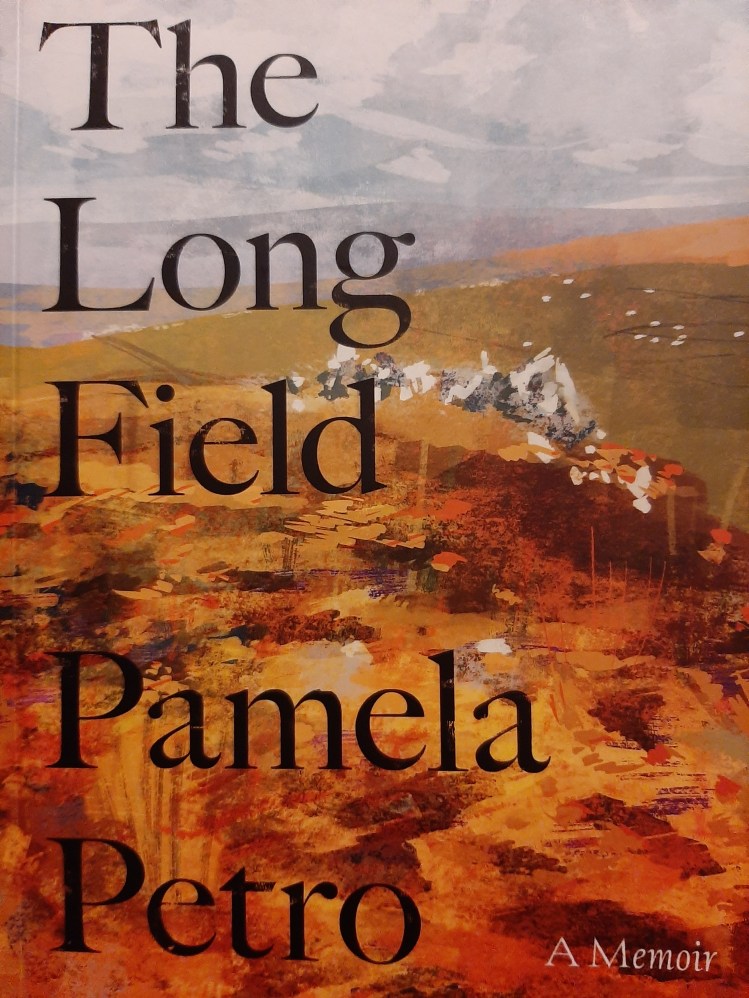
Book review – The Long Field by Pamela Petro

First, a confession.  Reading Pamela Petro’s The Long Field was an exercise in nostalgia for me.  I followed Petro to the university at Lampeter in West Wales (‘Probably the smallest university in the world,’ as the T-shirts in the Students’ Union shop proclaimed, Carlsberg advert-style) just four years later.  All her descriptions ring so very true for me, were part of the landscape of my own young life.  Even the cottage she lived in is well known to me, as a friend of mine rented it in my first year – I can picture myself back in that kitchen, drinking tea, watching my friend making jelly for dessert.  My challenge in writing this review has been to come to the book from the outside, as it were, rather than from that place of shared experience.

The Long Field is, fundamentally, about hiraeth, a complex Welsh word which encompasses elements of longing, nostalgia, distance, absence, homesickness.  It is famously untranslatable into English.  But the book is also a love story.  A love story on several levels, most obviously Petro’s sudden, unexpected, and deep passion for the landscape of rural Wales – again, something which resonates with me.  But it is also about her relationships with her partner and with her parents, and an exploration of the complexities of those relationships.  Perhaps it is an acknowledgement that love stories more nuanced than ‘boy meets girl and they live happily ever after’ are part of the lived experience of queer writers.

Although Petro is passionate about Wales – her Wales – she manages to stop short of being entirely rose-tinted about it.  She acknowledges some of the nuanced complexity of Welsh identity and history, some of the ways in which her adopted homeland’s sense of itself as a colonial victim of English occupation can hold it back.  As someone who has lived in Wales for a significant part of my adult life, it seems to me that Petro’s analysis of Wales is predominantly rural – the Wales of Ceredigion and the Cambrian Mountains – and intellectual and cultural.  She does nod at the life of the Valleys, especially as she was in Wales in 1984 during the miners’ strike, but the industrial and post-industrial conurbations of South and North-East Wales, the product of migration from within Wales and beyond, are not the Wales that she knows and loves.  Her Wales is that of the past etched into the landscape of the present.  Of people connected, umbilically, to the places that shaped the generations before them.  Of story made tangible in the land.  Landscape – not only the fields, the mountains, the hills, but also the cultural echoes, the resonance that they have – is what Petro loves.  Her inexplicable feeling of having ‘come home’ to that landscape when she, an American with no Welsh antecedents, arrived in Lampeter in 1983 is the starting point for the experiences that have shaped this book.

The Long Field is a remarkable book.  Although it self-identifies on the cover as ‘A Memoir,’ it draws together strands of history, travelogue, a whistle-stop tour of Welsh literary heritage, place writing, pronunciation notes for the Welsh place names, linguistic detours, a coming-out narrative, family saga, and an exploration of identity.  It is this last element, I think, which is the most important.  Can someone identify with a place which they are not ‘from’ but where they nevertheless felt a shock of recognition when they first encountered it?  Yes, says Petro – but is she is not claiming Welshness.  Rather like entering into a relationship with a lover from a different culture who speaks a different language, she seeks – respectfully, gently – to learn, to understand, to value what the beloved values.  What Petro found when she found her Wales filled a profound void in her psyche, provided a connectedness between the people of the present and the past which her upbringing in suburban America had not.  In an era when more people than ever are living where we are not from, The Long Field has much to say about place, identity, past, present – and future.

The Long Field by Pamela Petro is published by Little Toller Books.  ISBN 9781908213853

I am committed to making this blog freely available, and not putting material behind a paywall. As a writer, I am doing what I love – but I still have to make a living. If you have enjoyed this post, and if you are able to do so, perhaps you would consider supporting my work by making a small contribution via the Buy Me A Coffee button. Thank you!
Buy Me a Coffee at ko-fi.com

Guest blog post by Liza Achilles: 3 Lessons I Learned From Writing a Historical Novel

I am delighted to welcome Liza Achilles, a blogger based in Washington DC, USA, who has written a guest post for The Three Hares Blog.

Writing a historical novel was one of the most interesting activities I have done in my life. Unlike many other types of novel writing, historical novel writing requires a large amount of research. That research comes in several forms, as I will explain in this article. Below are 3 lessons I learned about writing a historical novel during my novel-writing journey. Perhaps these tips will help you if you tackle a historical novel project of your own.

#1 The Value of Visiting University Libraries

When I began researching my historical novel, I considered any book on my topic to be relevant. I stocked up on books from local bookstores and libraries. But I quickly discovered that not every book is of the same quality. Some books contain errors, unfair stereotyping, or generalities that gloss over key points. The books available at local bookstores and libraries were good for a cursory introduction to my subject; but to go deeper, I needed a university library.

I was fortunate that my husband (at the time) was affiliated (at the time) with first one university library and then another. Spouses were given, as a perk, a library card. I imagine that for some spouses, that wasn’t much of a boon. For me, it was a golden ticket to the stacks! (Many university libraries allow you to get a library card for a nominal fee if you don’t have a connection to the library.)

The excitement of browsing the stacks – there’s nothing like it. I would look up a subject on a computer and find a few call numbers. I would venture into some dark and crowded corner of some tower, and locate my book. I would then browse all of the nearby books, looking for something new and interesting. Often the book I took home would not be the book whose call number I found, but a book nearby in the stacks.

It was only with the help of these university books that I was able to correct errors, debunk stereotypes, and dig into important nitpicky details. All of this information was essential to crafting a novel that was as faithful as possible to the reality of what happened during my target time period.

#2 The Value of Visiting Historical Sites

No book about a location can replace a visit to that location. Books can and should supplement a visit. But there’s something powerful and special about experiencing a location in person – even if your visit does, of necessity, occur tens or hundreds of years after your target historical time.

Many historical sites have museums, plaques, monuments, grounds, or reenactments whereby you can immerse yourself in the history of the place. You can view some of the actual objects used by people during the historical period and walk on the actual terrain that was walked on back then. You can also talk with historical experts and read the extensive information provided at such sites.

I found immense value in visiting not just the site where my novel takes place, but also nearby and related sites. It’s always instructive to compare and contrast sites, to take in what is the same and consider what is different, and thus to better home in on your target historical location.

I also recommend touring public lands that aren’t part of any museum. Every place has its own flora and fauna, its own terrain and aura. Soak in the feel of the place, while being careful to distinguish between how things were during the historical time and how things are now. For example, invasive species might now inhabit the area, while other species might have gone extinct. Water levels and the climate might be different. (You can find this information through books and the Internet.)

#3 The Value of Using Primary and Secondary Sources

When researching a historical period, it’s important to distinguish between primary and secondary sources. Primary sources are writings done by people during the target time period. Secondary sources are writings done by people who came later, who wrote about the primary sources (or about other secondary sources).

Primary sources are a must-read because these are the people who were present when the action was happening. They are closest to your targeted time period and thus can be considered, in a way, most reliable. However, in another way, their reliability must be evaluated carefully, since being close to the action can result in all-too-human biases, mistakes, and sometimes even lies. This is where secondary sources come in.

Secondary sources are a must-read because these are the people who have carefully evaluated the quality of the primary sources and drawn conclusions not obvious in the primary sources. When well written, secondary sources are extremely reliable, and they may correct any factual errors, biases, or lies in the primary sources. However, when not well written, they may perpetuate errors, biases, or lies, or introduce new ones.

The bottom line is, dig into both primary and secondary sources, but read them critically and evaluate their reliability.

Conclusion

Research for a historical novel comes in several different forms. You might spend time visiting university libraries, touring historical sites, and consulting primary and secondary source materials. These activities helped me immensely while crafting my historical novel.

Are you working on a historical novel? What lessons are you learning from the experience?

Liza Achilles is a writer, editor, poet, and coach based in the Washington, D.C., area of the USA. She blogs about seeking wisdom through books and elsewhere at lizaachilles.com.

The machine that changed the world – one stitch at a time

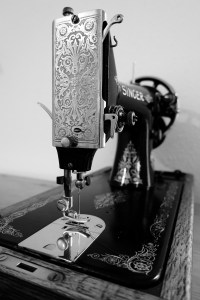
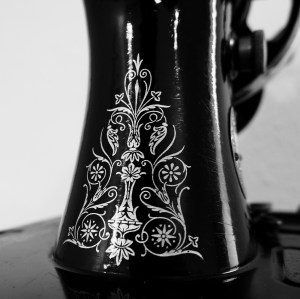
My pride and joy is a vintage Singer sewing machine.  It’s black and gold, is so heavy that I can hardly lift it, and celebrated its 90th birthday this year.  Built to last in an era when built-in obsolescence had not yet been invented, it is a design icon which truly changed the world, and every time I use it I am captivated again by its story.

Black and white image of a Singer sewing machine

Up to the middle of the nineteenth century, all sewing was done by hand.  There was no alternative to hand-stitching – every seam of every garment made, ever, in all of human history, was hand stitched.  Then, a flurry of inventors created a variety of ‘sewing engines’, which could sew much faster than any human hand.  The most enduring of these designs was patented in 1851 by Isaac Merritt Singer of New York.  A gifted salesman, he created a network of showrooms where the machines were demonstrated, showing both that they were easy to use (‘so easy a woman could use it’ – not a slogan that would, one hopes, sell many products these days, but in its time very effective) and also that clothes sewn by machine were at least as good as those sewn by hand.

Black and white image of a Singer sewing machine

Singer’s two main markets were commercial – garment manufacturers – and domestic.  It was in domestic sales that the sewing machine created a revolution.  Diaries kept by American women in the 1860s showed that they were spending the equivalent of two days a week on making and repairing clothes for their families.  A sewing machine saved up to 90% of that time, giving them opportunities to earn money either through sewing for other people or by working outside the home.

Black and white image of a Singer sewing machine

It wasn’t just the machines themselves that changed the world – it was the way they were sold.  In the 1870s, these expensive pieces of kit were worth the equivalent of half a year’s salary for a typical worker.  Singer introduced the idea of hire purchase, where an initial deposit and regular payments would enable people to own and use a machine they would otherwise not be able to afford.  Sales boomed, and modern consumer spending was born.

Black and white image of a Singer sewing machine

Supported by a reputation for reliability and a good parts and maintenance network, by 1918 it was estimated that one in five households in the world had a Singer sewing machine.  Yes, you read that right – one in five households in the world, for it didn’t take long for the Singer company to realise that there was a market far beyond the USA.  It started its international expansion in the United Kingdom, initially manufacturing sewing machines in Glasgow, and 1882 construction started on a new factory at Kilbowie, on the banks of the River Clyde, where John Brown’s shipyard was already a major employer of skilled workers.  The Singer factory, which at the time was the largest factory of its kind in the world, was a catalyst for the development of the town of Clydebank, and it was in this factory that my Singer sewing machine was born.

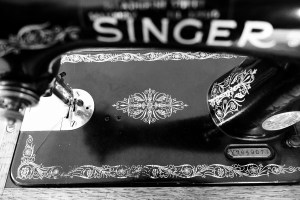
Black and white image showing the serial number of a Singer sewing machine

By tracing the serial number which each individual machine has, it is possible to find out exactly where and when a Singer was manufactured.  Serial number Y7649074 was part of a batch of 20,000 model 99K machines made in the Kilbowie factory in January, 1930.

Black and white image of a Singer sewing machine

In 1930, the Great Depression had taken hold following the Wall Street Crash of the previous year.  In January, Buzz Aldrin (one day to be the second man to walk on the moon) was born in New Jersey, and Mickey Mouse made his debut in a comic strip.  Over the next few months, the planet Pluto would be discovered, and elections in Germany would see Hitler’s National Socialists become the second largest party in the Reichstag.  Sliced bread would appear in British shops for the first time, Sellotape (Scotch tape) would be invented, and Clarence Birdseye would sell the first frozen food.  Against this backdrop, my sewing machine emerged from the last of the 56 departments in the Singer factory, its black japanned cast iron body gleaming, the gold leaf bright and fresh, its mechanism oiled and ready for action.  I would love to know who first owned it – who first excitedly turned the key to open the domed Deco-style box – whose hands first threaded the needle, wound the bobbin, turned the handle – who first proudly wore a garment created on this machine, what that garment was, what fabric, what colour.  I imagine children’s clothes, the curtains for a first home, a dress to wear to the dance, the changing fashions and fabrics of more than six decades.

Black and white image of a Singer sewing machine

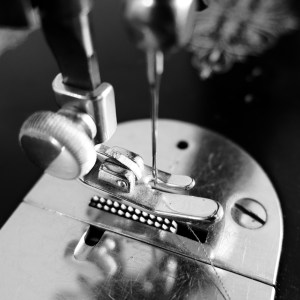
My Singer came to me in the mid-1990s, in Salisbury, Wiltshire.  I had spotted it in the window of the sewing machine shop near where I worked, advertised as ‘refurbished’.  I was given it as a birthday present, and it’s one of the best presents I’ve ever had.  A quarter of a century later, it’s still in regular use.  It only has one stitch – a straight stitch – and it only stitches forwards (later machines had a reverse function), so modern stretch jerseys present it with some challenges, but for many years I made most of my own clothes.  I remember the first thing I made was a black velvet longline jacket, which I wore for years and years until it finally disintegrated.   These days, my Singer produces curtains and alters clothing, and it’s especially good – when fitted with the right needle – for shortening denim jeans.  Even though I neglect its maintenance, I have only once had to take it in for a service, because it was sticking – the guy who serviced it told me off for not cleaning the fluff out of the works more regularly!

Black and white image of a Singer sewing machine

I said at the start that the Singer sewing machine was built to last.  Sadly, the affordable high street fashions of the mid-twentieth century and the advent of competition from Japanese, German and Italian manufacturers after WWII contributed to the end of Singer company’s success.  The Kilgowie factory closed in June 1980.  Together with the closure of the John Brown shipyard a few years earlier, this led to Clydebank becoming a post-industrial ghost town in the Thatcher era.  A recent (2019) BBC television documentary (The Singer Story: Made in Clydebank) interviewed a number of former employees of the Singer factory, reminiscing about its glory days.  Their pride in their work, and in the machines they produced, shone out, and I was especially struck by the words of Anna Stones, who worked in Department 55 (the parts department).  She said “You were proud to be making a small part, and to know that it was going to be a Singer sewing machine, and that it was going to give somebody so much pleasure, and was going to be sent all over the world.”  I hope Anna would be happy to know how much I love my machine.

Black and white image of a Singer sewing machine

The documentary also traced the continued use of the early twentieth-century manual and treadle (foot operated) machines into the present day all over the world, including through charities like Tools For Self Reliance who collect vintage machines, refurbish them, and send them to (often women’s) development projects around the world where they become the means for people to become economically independent.  The programme interviewed young women in Accra, Ghana who were excited to have the means to become self-employed as seamstresses, equipped with Singer sewing machines just like mine.  Here’s to the Singer sewing machine – the machine that changed the world, and still goes on changing it, one stitch at a time.