
December is always a struggle. I have found this year worse than most, with relentless rain, gloomy skies, and the lights on by 2.00pm. To be honest, here in the UK I find it increasingly difficult from late October, when the clocks go back and evening draws in when it’s still afternoon. I count down until the shortest day, 21 December, the Winter Solstice, when the days start to lengthen again.
Apparently, it’s not just me. This sense of the year dying around Samhain (the end of October) to be re-born with the lengthening days after the Solstice is a part of many pagan traditions. Festivals at midwinter seem to have been a part of human life in the north of Europe for as long as anyone knows. And of course there is Christmas! Curious to understand more about the origins of how we celebrate, and which of those traditions are truly ancient, I have spent the last few days reading The Stations of the Sun: A History of the Ritual Year in Britain by Ronald Hutton, professor at Bristol University and an expert on folklore and paganism.
Professor Hutton’s research methods are very thorough, and he explores traditions and what we think we know about their origins, teasing out what the evidence really is, and establishing when traditions were actually first recorded (often much later than I expected).
Of course, some of this is more widely known and I’d come across it already. For example, there is no biblical foundation for 25 December (or indeed any other date) for the birth of Jesus. Professor Hutton identifies the first mention of that date in a calendar of Christian feasts in 354 CE, probably in Rome, and finds an intriguing quote from the Scriptor Syrus in the late 4th century, who refers to it being the ‘custom of the pagans’ to celebrate the birthday of the sun on 25 December. This continued to cause confusion during the next couple of centuries at least, with church ‘fathers’ begging believers to remember that they should be worshipping Christ, not the sun, at these festivals! In the 5th century, one Maximus of Turin wrote delightedly about the appropriation of a pagan festival of sun worship for Christian use.
And of course there’s Saturnalia, the Roman midwinter feast, held on 17 December and the days following. It included, says Professor Hutton, a lot of the elements we still recognise: gifts, candles as symbols of light, the closure of shops, schools and law courts for the duration of the festivities, and (a precursor to the medieval custom) the usual order turned upside down, with masters and mistresses waiting on their servants. Kalendae – at the beginning of January, dedicated to the two-faced God, Janus, who looked both back at the old year and forwards into the new – saw more giving of gifts, this time figs, honey, pastries and coins.

Evergreen wreath
Professor Hutton points out that the with the spread of Christianity in Mediterranean countries, Easter became the principal festival of the year – but in northern Europe, the colder, darker winters meant there was still a need for merrymaking at midwinter. “The habits of a midwinter festivity had come by the dawn of history…to seem a natural one to the British,” he says.
The Christian calendar absorbed the idea of a season of festivities around midwinter, with the Nativity celebrated on 25 December, St Stephen (the first martyr) on the 26th, St John the Evangelist on the 27th, the Holy Innocents (the children massacred by King Herod in an attempt to eradicate the infant Jesus, mentioned in Matthew’s gospel) on the 28th, the Circumcision of Christ on 1 January, and Epiphany (originally the baptism of Christ, later eclipsed by the celebration of the visit of the wise men) on 6 January.
The Anglo Saxons didn’t use the word Christmas (‘Cristes Maessan’) until 1038 – before that it was simply ‘midwinter’. It was obviously important though, as a 12-day break from work for servants was enshrined in law by Alfred the Great in 877 CE. The word ‘Yule’ arrives with the invading Danes in the 11th century, although Professor Hutton says that the derivation of the word “has baffled linguists.”
However, he says, we know a fair bit about midwinter/Solstice/New Year revelries, because of the attacks of churchmen upon them – especially the various divination practices, to see what the new year would bring, some of which were still being recorded by 19th and 20th century folklorists.
Some practices which we may think of as ancient are, according to Professor Hutton’s researches, fairly recent (or in any event, there is no evidence for them, and they are not mentioned, before a relatively late date). For example, the use of a wassail bowl was first recorded in the 1320s; mummers and other kinds of ‘disguising’ were a medieval phenomenon, and mistletoe does not put in an appearance until the 17th century, with the association with kissing being a whole century later still. Yule logs were common from the 1600s to the late 1800s, and hobby horses were around from the late 15th century through the Tudor and Stuart periods, with other animal-head processions (including the Mari Lwyd in Wales) being mostly recorded in the 19th century. Although folklorists believed they were of pagan (i.e. pre-Christian) origin, Professor Hutton can find no evidence for their earlier existence.
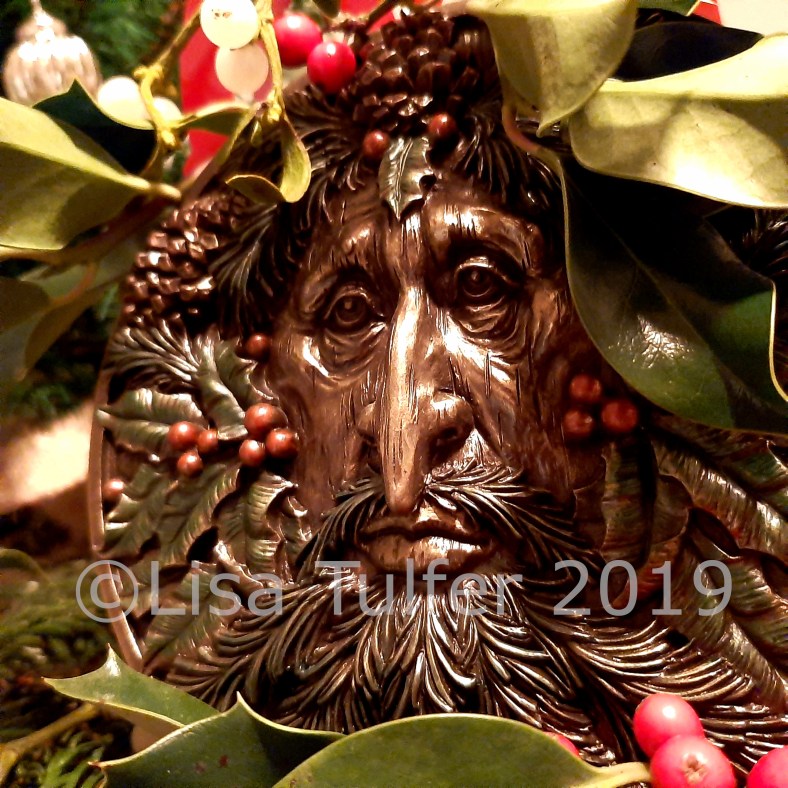
Yuletide Green Man
So, what customs have persisted which actually, possibly, genuinely are ancient pagan customs, which have survived by being adopted and adapted by Christianity after the church very cannily decided to celebrate the Nativity at the time of the pagan midwinter festivals?
- Evergreens. Greenery was used for festivals in pagan Europe, and its use was generally adopted by the Church, especially in England. Holly and ivy were originally favourites, with bay, rosemary, yew and box (and, in the 17th century, mistletoe) being added in over the centuries. Do remember, though, that most of these are poisonous, so keep them (and especially the berries) away from children and animals if you decorate your home with evergreens this midwinter.
- Lights and candles. On the shortest day of the year (or thereabouts!) it’s traditional to have lights and candles to symbolise the lengthening days to come, light overcoming the darkness, the start of the ascent to summer.
- Partying. The giving of feasts (especially by landowners/masters for their tenants/workers) has been a recurring theme for two millennia. So, when you are at the office party, remember that this tradition goes back to Roman times!
- Presents. The exchange of gifts has been a feature throughout much of the history of midwinter celebrations, although the exact timing (anywhere between 17 December and 6 January) has moved over time.
- Misrule. In Tudor times, the Lord of Misrule would preside over often riotous jollification, where the usual norms of behaviour were cast aside, often with the assistance of masks to aid anonymity – even at the royal court had a Lord of Misrule. The idea of turning the hierarchy of society upside down at midwinter has persisted since Roman times. Its medieval incarnation as the Feast of Fools, where junior clergy and choristers took over (and subverted) the liturgy, persists in the practice of electing a ‘Boy Bishop’ in some English cathedrals. And more generally in society there is a sense that anything goes at Christmas.
So, as the dark descends on the shortest day of the year, let us light candles and Christmas lights and affirm that the light will always triumph. Let’s deck the hall with boughs of holly, toast each other with ‘Wassail!’, exchange gifts, and generally let our hair down. Because in the ancient times when those customs originated, as now, in Professor Hutton’s words, “feasting and entertainment were in themselves fundamental responses to the tedium and melancholy which a northern winter could engender.”
This article is based on The Stations of the Sun: A History of the Ritual Year in Britain by Ronald Hutton, Oxford University Press 1996 (new edition 2001).



 The Three Hares Blog