Guest blog post by Liza Achilles: 3 Lessons I Learned From Writing a Historical Novel

I am delighted to welcome Liza Achilles, a blogger based in Washington DC, USA, who has written a guest post for The Three Hares Blog.

Writing a historical novel was one of the most interesting activities I have done in my life. Unlike many other types of novel writing, historical novel writing requires a large amount of research. That research comes in several forms, as I will explain in this article. Below are 3 lessons I learned about writing a historical novel during my novel-writing journey. Perhaps these tips will help you if you tackle a historical novel project of your own.

#1 The Value of Visiting University Libraries

When I began researching my historical novel, I considered any book on my topic to be relevant. I stocked up on books from local bookstores and libraries. But I quickly discovered that not every book is of the same quality. Some books contain errors, unfair stereotyping, or generalities that gloss over key points. The books available at local bookstores and libraries were good for a cursory introduction to my subject; but to go deeper, I needed a university library.

I was fortunate that my husband (at the time) was affiliated (at the time) with first one university library and then another. Spouses were given, as a perk, a library card. I imagine that for some spouses, that wasn’t much of a boon. For me, it was a golden ticket to the stacks! (Many university libraries allow you to get a library card for a nominal fee if you don’t have a connection to the library.)

The excitement of browsing the stacks – there’s nothing like it. I would look up a subject on a computer and find a few call numbers. I would venture into some dark and crowded corner of some tower, and locate my book. I would then browse all of the nearby books, looking for something new and interesting. Often the book I took home would not be the book whose call number I found, but a book nearby in the stacks.

It was only with the help of these university books that I was able to correct errors, debunk stereotypes, and dig into important nitpicky details. All of this information was essential to crafting a novel that was as faithful as possible to the reality of what happened during my target time period.

#2 The Value of Visiting Historical Sites

No book about a location can replace a visit to that location. Books can and should supplement a visit. But there’s something powerful and special about experiencing a location in person – even if your visit does, of necessity, occur tens or hundreds of years after your target historical time.

Many historical sites have museums, plaques, monuments, grounds, or reenactments whereby you can immerse yourself in the history of the place. You can view some of the actual objects used by people during the historical period and walk on the actual terrain that was walked on back then. You can also talk with historical experts and read the extensive information provided at such sites.

I found immense value in visiting not just the site where my novel takes place, but also nearby and related sites. It’s always instructive to compare and contrast sites, to take in what is the same and consider what is different, and thus to better home in on your target historical location.

I also recommend touring public lands that aren’t part of any museum. Every place has its own flora and fauna, its own terrain and aura. Soak in the feel of the place, while being careful to distinguish between how things were during the historical time and how things are now. For example, invasive species might now inhabit the area, while other species might have gone extinct. Water levels and the climate might be different. (You can find this information through books and the Internet.)

#3 The Value of Using Primary and Secondary Sources

When researching a historical period, it’s important to distinguish between primary and secondary sources. Primary sources are writings done by people during the target time period. Secondary sources are writings done by people who came later, who wrote about the primary sources (or about other secondary sources).

Primary sources are a must-read because these are the people who were present when the action was happening. They are closest to your targeted time period and thus can be considered, in a way, most reliable. However, in another way, their reliability must be evaluated carefully, since being close to the action can result in all-too-human biases, mistakes, and sometimes even lies. This is where secondary sources come in.

Secondary sources are a must-read because these are the people who have carefully evaluated the quality of the primary sources and drawn conclusions not obvious in the primary sources. When well written, secondary sources are extremely reliable, and they may correct any factual errors, biases, or lies in the primary sources. However, when not well written, they may perpetuate errors, biases, or lies, or introduce new ones.

The bottom line is, dig into both primary and secondary sources, but read them critically and evaluate their reliability.

Conclusion

Research for a historical novel comes in several different forms. You might spend time visiting university libraries, touring historical sites, and consulting primary and secondary source materials. These activities helped me immensely while crafting my historical novel.

Are you working on a historical novel? What lessons are you learning from the experience?

Liza Achilles is a writer, editor, poet, and coach based in the Washington, D.C., area of the USA. She blogs about seeking wisdom through books and elsewhere at lizaachilles.com.

The machine that changed the world – one stitch at a time

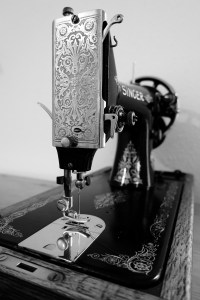
My pride and joy is a vintage Singer sewing machine.  It’s black and gold, is so heavy that I can hardly lift it, and celebrated its 90th birthday this year.  Built to last in an era when built-in obsolescence had not yet been invented, it is a design icon which truly changed the world, and every time I use it I am captivated again by its story.

Black and white image of a Singer sewing machine

Up to the middle of the nineteenth century, all sewing was done by hand.  There was no alternative to hand-stitching – every seam of every garment made, ever, in all of human history, was hand stitched.  Then, a flurry of inventors created a variety of ‘sewing engines’, which could sew much faster than any human hand.  The most enduring of these designs was patented in 1851 by Isaac Merritt Singer of New York.  A gifted salesman, he created a network of showrooms where the machines were demonstrated, showing both that they were easy to use (‘so easy a woman could use it’ – not a slogan that would, one hopes, sell many products these days, but in its time very effective) and also that clothes sewn by machine were at least as good as those sewn by hand.

Black and white image of a Singer sewing machine

Singer’s two main markets were commercial – garment manufacturers – and domestic.  It was in domestic sales that the sewing machine created a revolution.  Diaries kept by American women in the 1860s showed that they were spending the equivalent of two days a week on making and repairing clothes for their families.  A sewing machine saved up to 90% of that time, giving them opportunities to earn money either through sewing for other people or by working outside the home.

Black and white image of a Singer sewing machine

It wasn’t just the machines themselves that changed the world – it was the way they were sold.  In the 1870s, these expensive pieces of kit were worth the equivalent of half a year’s salary for a typical worker.  Singer introduced the idea of hire purchase, where an initial deposit and regular payments would enable people to own and use a machine they would otherwise not be able to afford.  Sales boomed, and modern consumer spending was born.

Black and white image of a Singer sewing machine

Supported by a reputation for reliability and a good parts and maintenance network, by 1918 it was estimated that one in five households in the world had a Singer sewing machine.  Yes, you read that right – one in five households in the world, for it didn’t take long for the Singer company to realise that there was a market far beyond the USA.  It started its international expansion in the United Kingdom, initially manufacturing sewing machines in Glasgow, and 1882 construction started on a new factory at Kilbowie, on the banks of the River Clyde, where John Brown’s shipyard was already a major employer of skilled workers.  The Singer factory, which at the time was the largest factory of its kind in the world, was a catalyst for the development of the town of Clydebank, and it was in this factory that my Singer sewing machine was born.

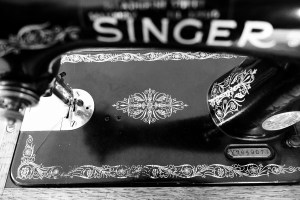
Black and white image showing the serial number of a Singer sewing machine

By tracing the serial number which each individual machine has, it is possible to find out exactly where and when a Singer was manufactured.  Serial number Y7649074 was part of a batch of 20,000 model 99K machines made in the Kilbowie factory in January, 1930.

Black and white image of a Singer sewing machine

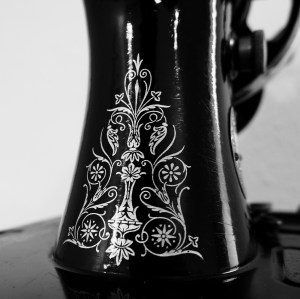
In 1930, the Great Depression had taken hold following the Wall Street Crash of the previous year.  In January, Buzz Aldrin (one day to be the second man to walk on the moon) was born in New Jersey, and Mickey Mouse made his debut in a comic strip.  Over the next few months, the planet Pluto would be discovered, and elections in Germany would see Hitler’s National Socialists become the second largest party in the Reichstag.  Sliced bread would appear in British shops for the first time, Sellotape (Scotch tape) would be invented, and Clarence Birdseye would sell the first frozen food.  Against this backdrop, my sewing machine emerged from the last of the 56 departments in the Singer factory, its black japanned cast iron body gleaming, the gold leaf bright and fresh, its mechanism oiled and ready for action.  I would love to know who first owned it – who first excitedly turned the key to open the domed Deco-style box – whose hands first threaded the needle, wound the bobbin, turned the handle – who first proudly wore a garment created on this machine, what that garment was, what fabric, what colour.  I imagine children’s clothes, the curtains for a first home, a dress to wear to the dance, the changing fashions and fabrics of more than six decades.

Black and white image of a Singer sewing machine

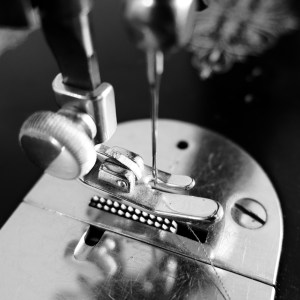
My Singer came to me in the mid-1990s, in Salisbury, Wiltshire.  I had spotted it in the window of the sewing machine shop near where I worked, advertised as ‘refurbished’.  I was given it as a birthday present, and it’s one of the best presents I’ve ever had.  A quarter of a century later, it’s still in regular use.  It only has one stitch – a straight stitch – and it only stitches forwards (later machines had a reverse function), so modern stretch jerseys present it with some challenges, but for many years I made most of my own clothes.  I remember the first thing I made was a black velvet longline jacket, which I wore for years and years until it finally disintegrated.   These days, my Singer produces curtains and alters clothing, and it’s especially good – when fitted with the right needle – for shortening denim jeans.  Even though I neglect its maintenance, I have only once had to take it in for a service, because it was sticking – the guy who serviced it told me off for not cleaning the fluff out of the works more regularly!

Black and white image of a Singer sewing machine

I said at the start that the Singer sewing machine was built to last.  Sadly, the affordable high street fashions of the mid-twentieth century and the advent of competition from Japanese, German and Italian manufacturers after WWII contributed to the end of Singer company’s success.  The Kilgowie factory closed in June 1980.  Together with the closure of the John Brown shipyard a few years earlier, this led to Clydebank becoming a post-industrial ghost town in the Thatcher era.  A recent (2019) BBC television documentary (The Singer Story: Made in Clydebank) interviewed a number of former employees of the Singer factory, reminiscing about its glory days.  Their pride in their work, and in the machines they produced, shone out, and I was especially struck by the words of Anna Stones, who worked in Department 55 (the parts department).  She said “You were proud to be making a small part, and to know that it was going to be a Singer sewing machine, and that it was going to give somebody so much pleasure, and was going to be sent all over the world.”  I hope Anna would be happy to know how much I love my machine.

Black and white image of a Singer sewing machine

The documentary also traced the continued use of the early twentieth-century manual and treadle (foot operated) machines into the present day all over the world, including through charities like Tools For Self Reliance who collect vintage machines, refurbish them, and send them to (often women’s) development projects around the world where they become the means for people to become economically independent.  The programme interviewed young women in Accra, Ghana who were excited to have the means to become self-employed as seamstresses, equipped with Singer sewing machines just like mine.  Here’s to the Singer sewing machine – the machine that changed the world, and still goes on changing it, one stitch at a time.

Today is not World Book Day

Yesterday was World Book Day.  For various reasons which I won’t bore you with, I managed not to realise this until the evening, by which time it was a bit late to blog about it/post #shelfie pictures on Twitter along with the rest of the reading and writing community.

But it set me thinking.  One of the commissioning editors for whom I write a lot often commissions articles about World/International Days, and the range of topics I’ve researched and written about over the past few years is amazing.  I thought I would share a few of them with you.

International Women’s Day (Sun 8 March 2020)

This day has been around for a long while – it was first marked in 1911, and initially focussed on women’s right to work without discrimination.  Inevitably, it soon also started to campaign for women’s right to vote.  Following the day’s adoption by the feminist movement in the 1960s, the United Nations declared it an International Day in the 1970s.  It continues to raise awareness of issues affecting women around the world, which we might have hoped would have been addressed by now: inequality and discrimination, the impact of war and displacement, sexual violence, and the lack of access to education.

World Day Against Child Labour (Fri 12 June 2020)

A more recent development is World Day Against Child Labour, which started in 2002.  Its focus is the global extent of child labour, and the campaign to eliminate it.  The 2015 Sustainable Development Goals include a global commitment to end “child labour in all its forms” by 2025, but currently over 200 million children around the world work, many full-time.  This matters, not only because it deprives them of the chance to be children and to play, but because it means that they are denied the opportunity to go to school, and traps them in a cycle of poverty.  In the West we probably think of child labour in terms of having a paper round, or being a child actor, with legal protections in place.  Worldwide, however, 70% or working children work in agriculture, often hard and dangerous work.

World Bee Day (Wed 20 May 2020)

With so much publicity for the pollinator crisis over the past few years, we can’t fail to be aware that there’s so much more to bees than honey.  Until I began researching for this article, though, I hadn’t appreciated that as much as a third of world food production depends on bees for pollination.  This makes it very worrying that 10% of bee species worldwide are facing extinction.  Although there is dispute about what is causing the decline in bees, with possible culprits being the varroa mite, other viruses, diseases and pests, climate change, and neonicotinoid pesticides, the statistics suggest that bee numbers are down by a third in the USA, with significant losses being reported elsewhere including Europe.

It’s not all doom and gloom though – this is one area of environmental crisis where ordinary people like you and I can make a difference.  Bee-friendly gardening, providing bees with flowers which yield plentiful and easily-accessed nectar, can help to boost the health and numbers of these essential creatures, whose future survival is so closely entwined with our own.

World Braille Day (Mon 4 January 2021)

On this day in 1809, Louis Braille was born in France.  He was blinded by a childhood accident, but applied his intellect to the problems he faced, and by the age of 15 had created a system for reading and writing.  A system of military night-writing had been developed by Charles Barbier, at Napoleon’s request, to provide a tactile way for soldiers to communicate silently and without a light source.  It consisted of sets of dots which encoded sound.  Louis adapted this into a matrix of ‘cells’ of raised dots, 3 high by 2 wide, which can be used to read (and, with the right equipment, to write) in any language.

World Braille Day was declared by the United Nations to celebrate the system’s role in giving independence to people who are blind and visually impaired, and to encourage its use.  Sadly, there is a world shortage of trained Braille teachers, and Braille writing equipment is expensive.  Some years ago I was able to get funding to produce a Braille version of an adult education programme I had developed, but was saddened that so many users said this was the first time they had been able to take part in learning on an equal basis with their sighted colleagues.  I found that public bodies and businesses rarely use Braille to make their premises and services independently accessible to blind and partially sighted users – often the only place you will encounter Braille is on the buttons in the lift.

World Toilet Day (Tues 19 November 2020)

This day is particularly dear to my heart – having had IBS for 30 years, I have a personal interest in the provision of toilet facilities, and am the proud owner of a RADAR key which has come to my rescue many times.  I know how lucky I am to live in a country where flush toilets are the norm, widely available, and safe.

However, despite the United Nations declaring in 2010 that access to sanitation and water is a human right, over a third of the world’s population still doesn’t have access to a safe toilet.  Over a billion have no toilet at all.  Amazingly, more people own a mobile phone than have access to a toilet.

This lack of safe toilets has enormous implications worldwide.  Firstly, there are the health implications, with diseases such a cholera and dysentery being spread because of inadequate sanitation, and untreated sewage contaminating the environment and the food chain.  Secondly, one fifth of schools have no toilet facilities, effectively preventing girls from attending once they start menstruating.  And thirdly, women who have no alternative but to engage in ‘open defecation’, especially after dark, are vulnerable to attack and rape.  World Toilet Day seeks to address a subject which can be taboo or socially unacceptable, but which is really about basic human rights.

A number of organisations are involved in providing toilets where they are most needed.  One which I have supported is WaterAid – see https://www.wateraid.org/uk/the-crisis/toilets for more details.