Wool gathering – what brings thousands of people to a barn in Mid Wales

On the last weekend in April, I re-connected with my tribe.  After a break of two years because of the pandemic, Wonderwool Wales was finally able to go ahead in its traditional slot of the last weekend in April, and nothing was going to keep me away.  The event at the Royal Welsh Showground near Builth Wells in rural Mid Wales has taken place since 2006, and whilst it started with the idea of raising the profile of Welsh wool and providing a showcase for craftspeople and small businesses using wool, it has developed into a gathering of the fibre-obsessed from all over the UK and beyond.

Colourful skeins of yarn.
Fivemoons yarn hand painted yarn from the Blackdown Hills, Devon. www.theslowwardrobe.co.uk/collections/fivemoons-yarns

Let me try to set the scene.  The venue is three large barns which, when used for agricultural shows, are full of pens containing trimmed and brushed sheep and cattle, the elites of their breeds.  During Wonderwool, however, the barns become like the inside of a kaleidoscope, a sensory overload of colour and texture with nearly two hundred stalls representing sheep breed societies, craft guilds, boutique textile mills, purveyors of equipment for knitters, spinners, weavers, dyers, feltmakers – but mainly yarn, more yarn in a dizzying rainbow of colours than I have ever seen in one place.  The choice is overwhelming.  The first time I came, I felt like I needed a lie down in a darkened room for the rest of the weekend.
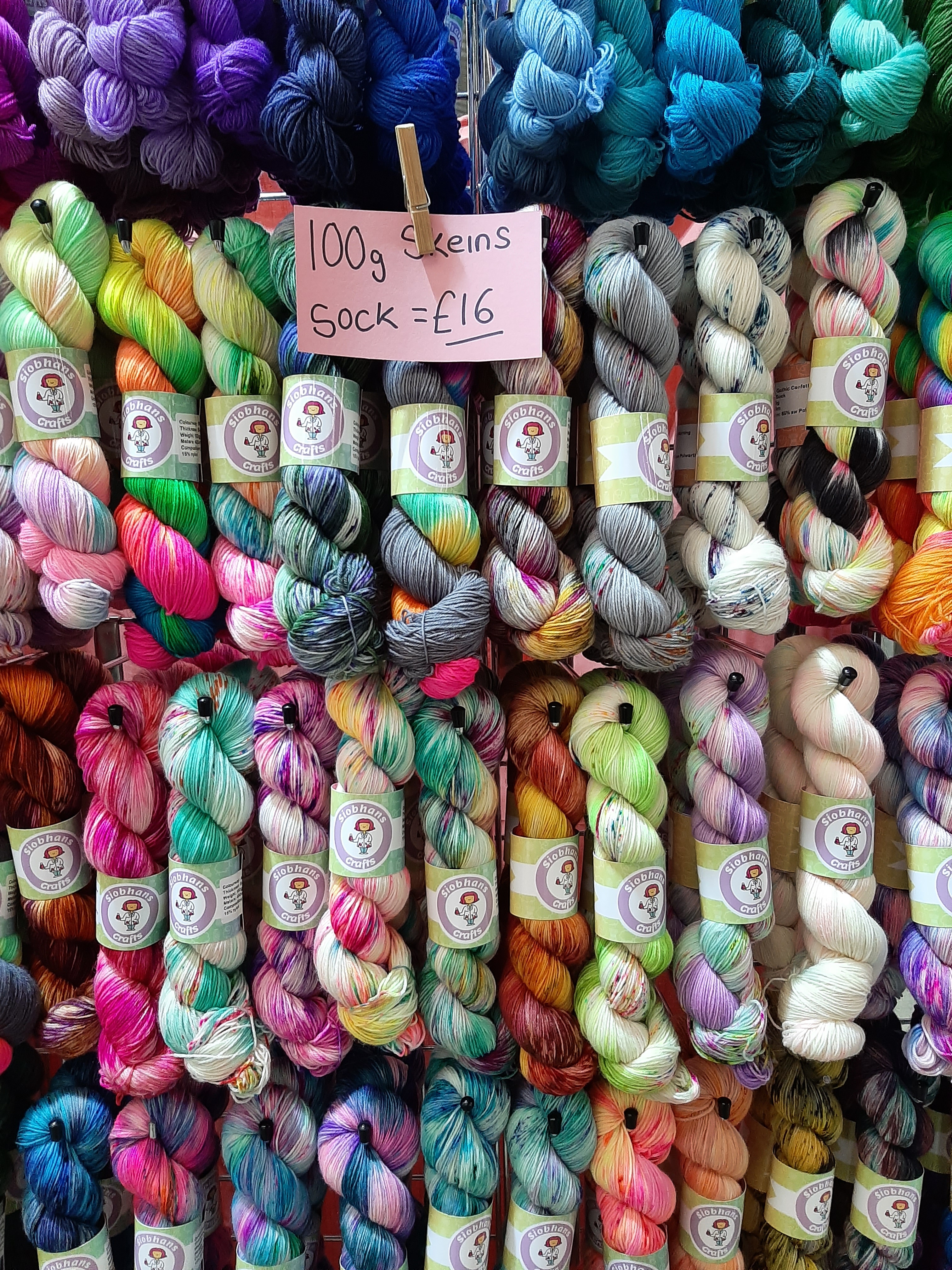
Dozens of skeins of brightly coloured yarn.
Sock yarn by Siobhans Crafts www.siobhanscrafts.co.uk

But it is not only the cornucopia of goods for sale which draw the eye.  Fibre events like this (similar gatherings in the UK include Yarn Fest in Yorkshire and Woolfest in Cumbria) are an opportunity for people to show off their creations.  There are several thousand people here, and seemingly every second person is wearing a handmade scarf, hat, sweater or dress.  I could have photographed dozens of examples at Wonderwool, but I settled on these two ladies who had travelled to Wonderwool from Cheshire, resplendent in their stunning, unique creations which incorporate felting and stitching techniques.  Fortunately, they were happy to pose for me!
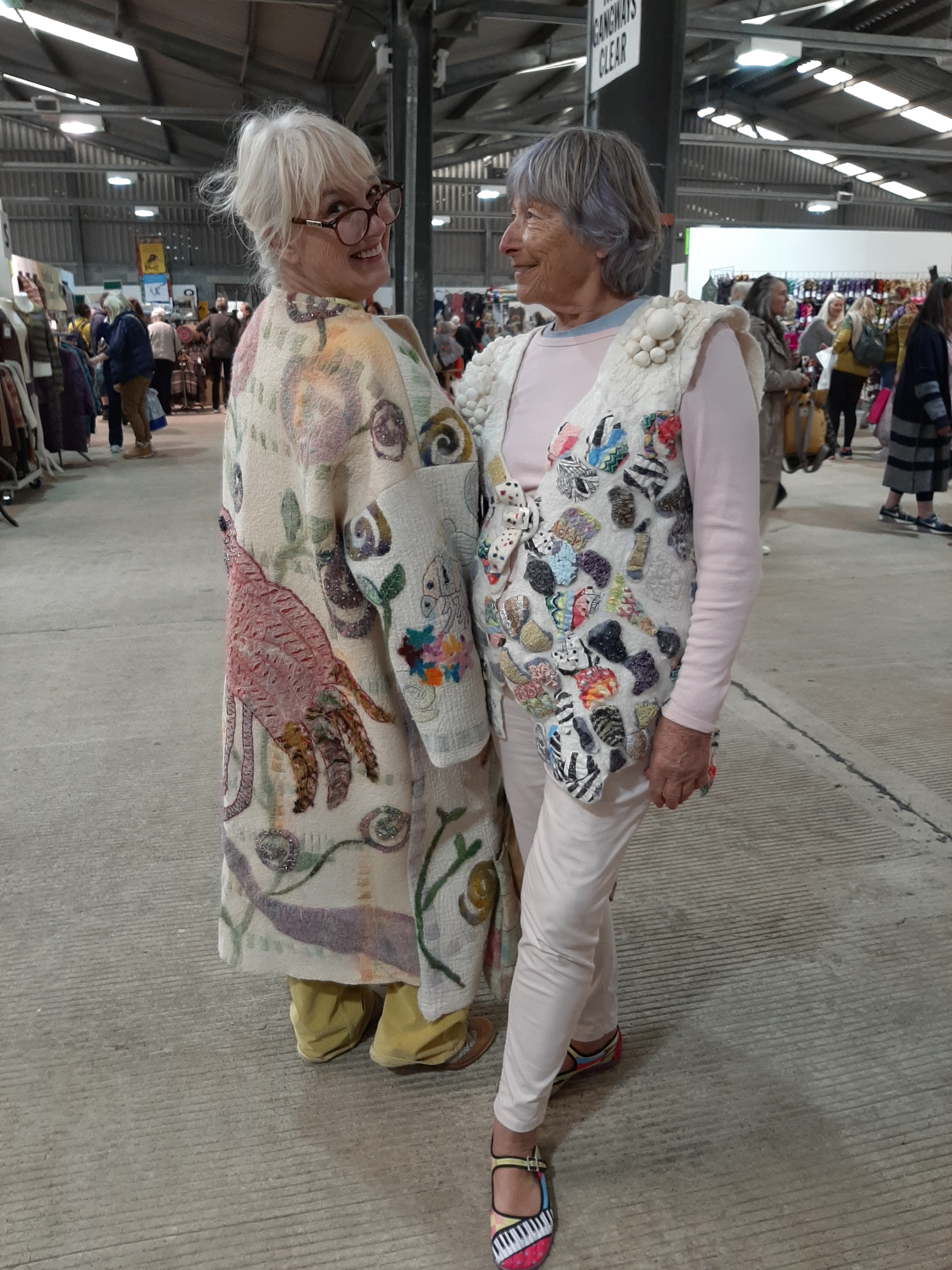
Two smiling ladies modelling a coat and waistcoat.
Ali and Christine modelling their creations

Over the years that I have been coming to Wonderwool, I have noticed trends within the fibre crafts world.  For example, a few years ago there was a plethora of yarns made from hemp/linen, organic cotton, and nettle fibres.  This year, when I specifically wanted some cotton yarn for a project, there was none to be found, and remarkably little linen either.  Neither was there any sign this year of the giant knitting – with yarn as thick as rope, and broomsticks for needles – which was all the rage the last time I went.  The theme I could see this year was traceability – there was a strong emphasis on the provenance of the yarn on sale, with information on the flock that the fleece came from and the mill or hand-spinner that had processed it.  One vendor was even able to show a prospective customer a picture on her phone of the individual sheep whose fleeces had contributed to the balls of undyed knitting yarn on sale!

Sacks of sheep's fleeces in a range of natural colours.
Sacks of raw fleece. British Coloured Sheep Breeders’ Association www.bcsba.org.uk
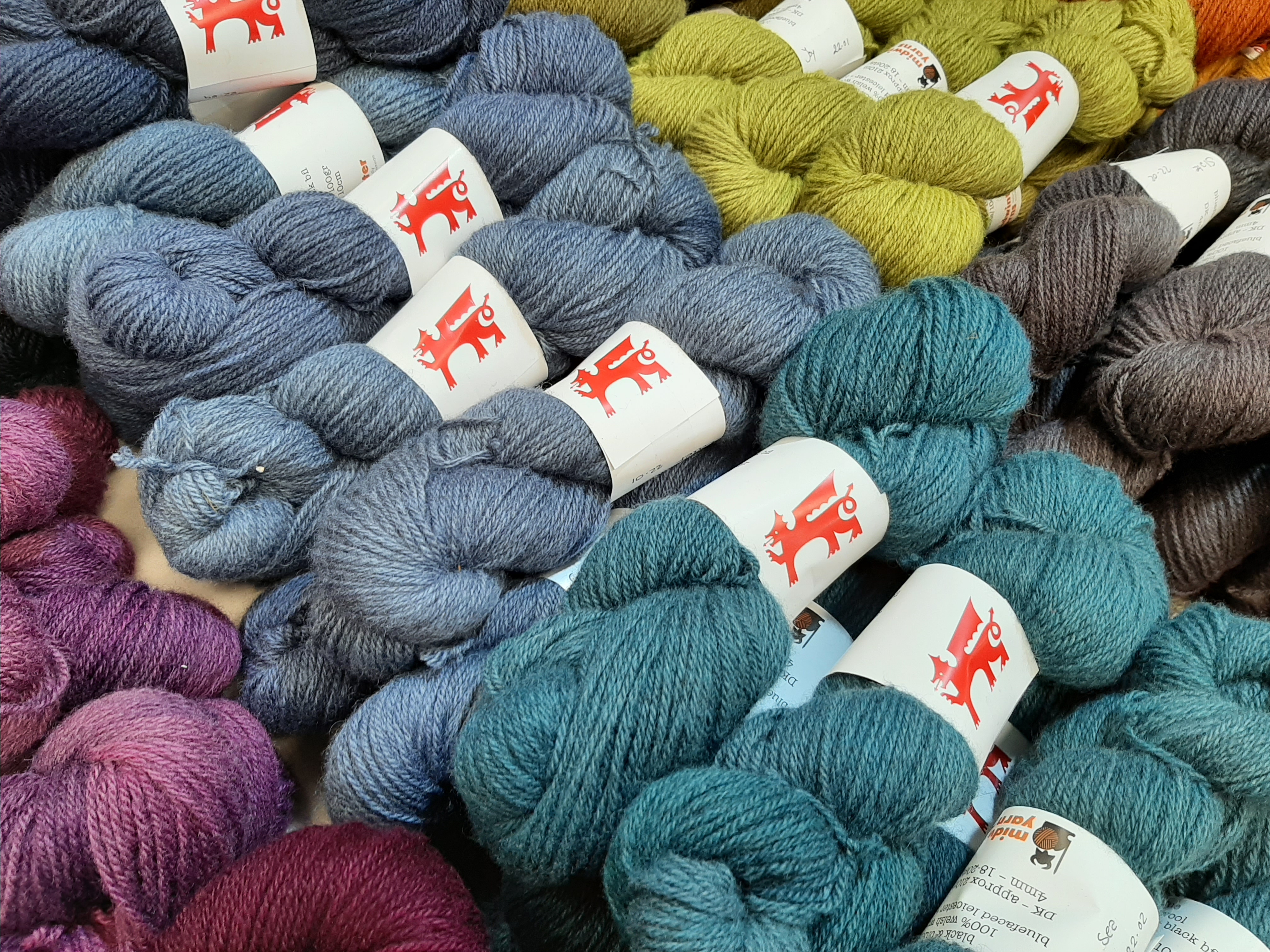
Skeins of coloured wool featuring the red Welsh dragon on the labels.
Yarn from Welsh flocks by Midwinter Yarns www.midwinteryarns.com

I was interested, too, to see an exhibit of natural dyestuffs – a range of plant products which have traditionally been used to dye yarn and fabric – together with the yarn that has been dyed with them.  There is increasing interest in natural dyes, with a number of how-to books now available (I have tried it myself, using onion skins to dye some silk fabric a vibrant, autumnal orange) and in view of the environmental impact of conventional (artificial) dyes it was good to see awareness of natural processes being raised in this way.

A selection of natural dyestuffs.
A selection of natural dyestuff from Allium Threads www.etsy.com/uk/shop/AlliumThreads
A selection of naturally-dyed yarns in shades of cream, wheat and green.
A selection of naturally-dyed yarns from Allium Threads www.etsy.com/uk/shop/AlliumThreads

Despite the name, it’s not all about the wool – one particularly eye-catching stall was selling yarn made from recycled saris.  The fabric is ripped into narrow strips, which can then be used to knit, crochet or weave.  The colours are luminous.

Photo of a woman winding a skein of bright orange recycled sari yarn.
Making a skein of recycled sari yarn at www.lalawithlove.co.uk
A display of recycled sari yarn in a range of bright colours.
Recycled sari yarns by www.lalawithlove.co.uk

Wonderwool sets out to showcase all the processes from sheep to finished article.  Some of the breed societies bring ewes, with their lambs, to the show, and these are always popular.  ‘Raw’ fleece – clipped from the sheep last summer – is available for those who like to process and spin their own fibre, as well as combed fibres for feltmakers and spinners who prefer a little less lanolin in their fibres!  And, of course, there is yarn – so much yarn.  Knitting patterns.  Spindles, carders, looms.  Knitting needles, crochet hooks, spinning wheels, buttons.  Embellishments, dyes, bags of dyed combed ‘tops’ for feltmakers.  Knitted toys.  Traditional ganseys.  Textile art.  Yarn.  And yet more yarn.
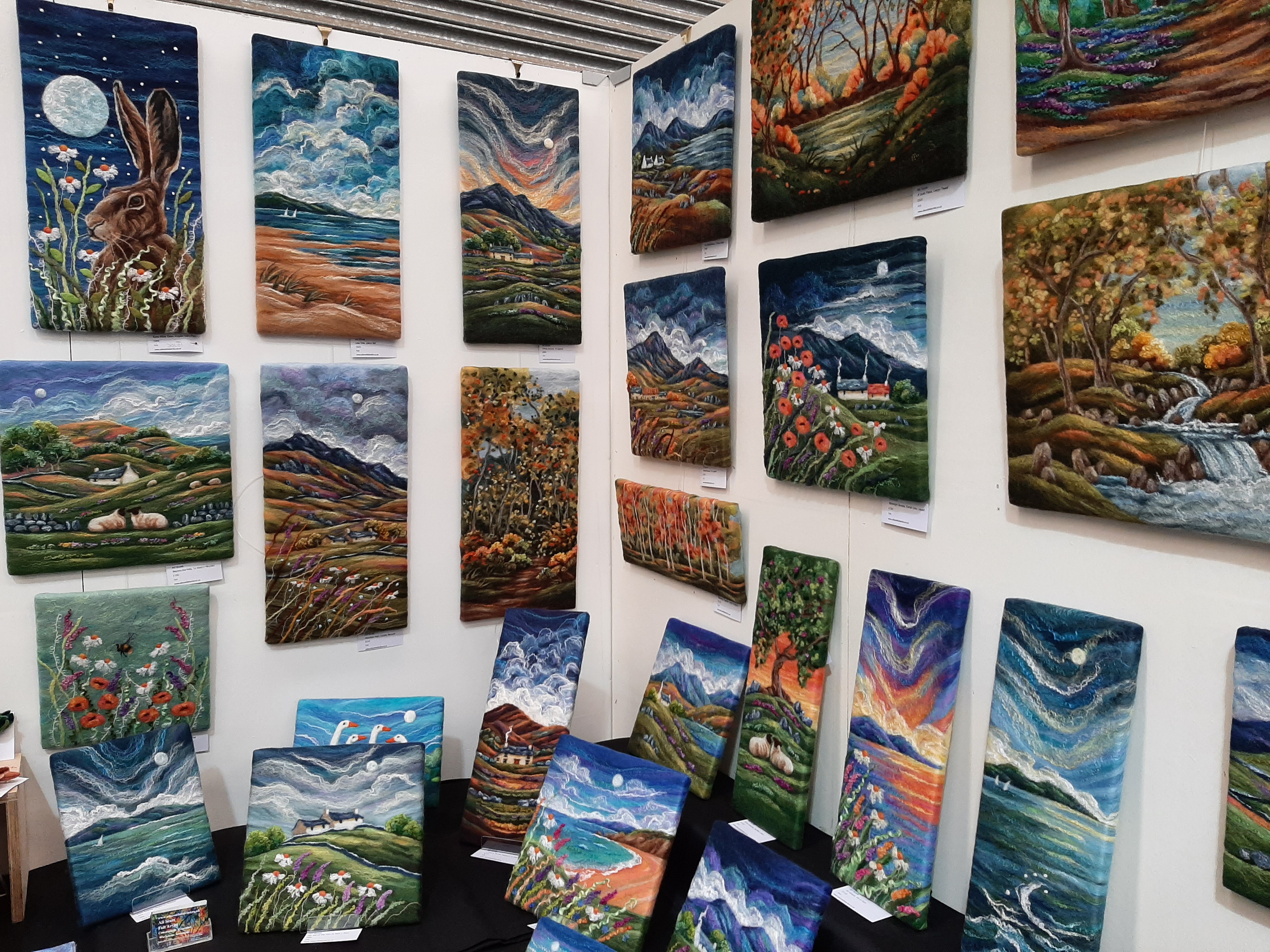
Felt art by Ali Scott www.aliscottfeltartist.co.uk
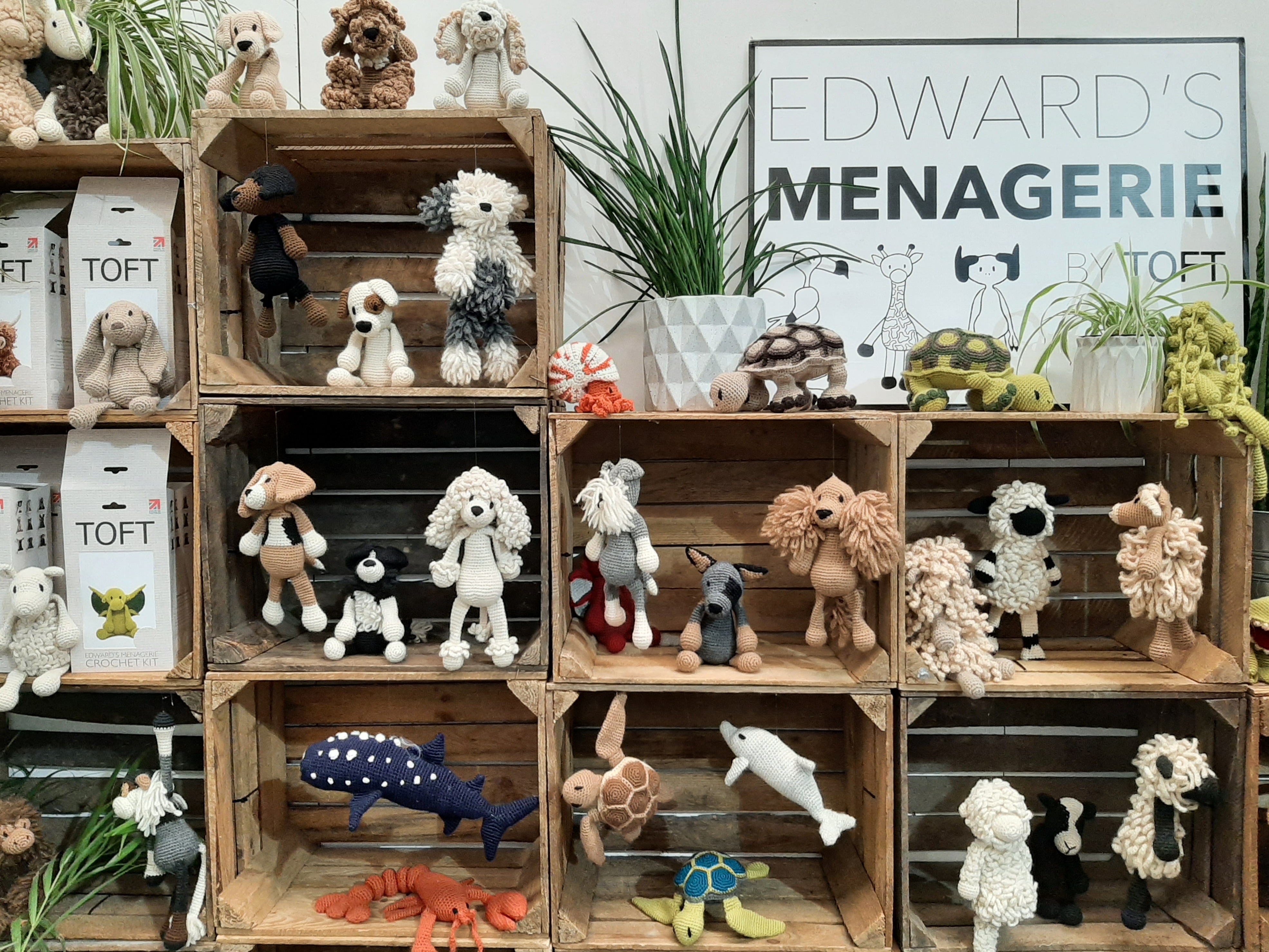
A display of knitted and crochet toy animals including a poodle, a whale and a lobster.
Kits for toys by Toft www.toftuk.com

For many of us, though, it isn’t only about the retail opportunity – although I very much doubt anyone leaves empty-handed!  There is an aspect of the event which is more like a pilgrimage, a gathering of like-minded people, an opportunity for people to connect around the passion for fibre crafts that unites us.  It serves an as annual reunion – in the weeks before Wonderwool, many of us were emailing each other to ask ‘are you going to Wonderwool?  Shall we meet up?’  Everywhere, there were greetings, especially enthusiastic this year because of the enforced separation of the pandemic which means it’s been several years since we’ve all got together like this.  I arranged to meet up with friends I haven’t seen since the last time I was at Wonderwool, texting ‘I’m here!  Where are you?’ and rendezvousing for coffee, where we compared purchases and recommended stalls as well as catching up on our lives.  And the world of wool is international – I encountered people from Sweden, Germany, and the USA, as well as from all over the UK.  Guilds and groups hire coaches to bus their members to Mid Wales.  Conversations start over a shared admiration for a yarn, a texture, a colour.  I know I’m not the only one to have made friends through casual meetings at Wonderwool.  Here, we all understand the enthusiasm for that amazing sock yarn, that beautiful spindle, the lustre of that fleece.  Here, we are amongst our own, our tribe.

A wall display of coloured yarns.
Yarns by John Arbon Textiles, Devon www.jarbon.com
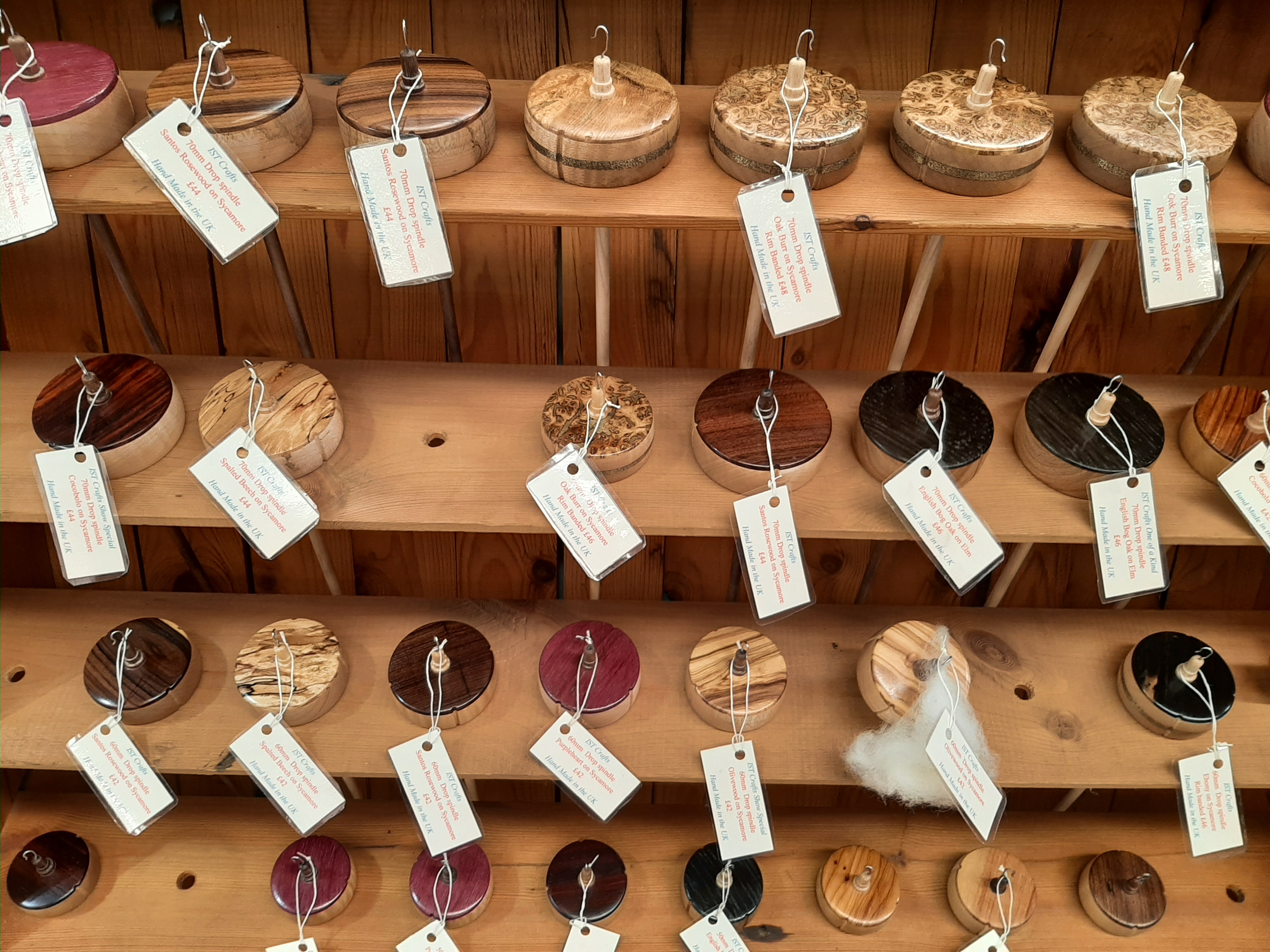
Display of hand-turned wooden spindles.
Spindles hand-turned by Ian Tait on the Isle of Wight www.thewoodemporium.co.uk

I am committed to making this blog freely available, and not putting material behind a paywall. As a writer, I am doing what I love – but I still have to make a living. If you have enjoyed this post, and if you are able to do so, perhaps you would consider supporting my work by making a small contribution via the Buy Me A Coffee button. Thank you!

Buy Me a Coffee at ko-fi.com

Judging a book by its cover – the book as art and artefact

I have always been fascinated by old books and their tooled and gilded bindings.  Years ago, when I worked at an academic library in Cambridge, a favourite part of my job was to carefully rub a special kind of polish into the leather covers to keep them fed and supple.  I would fetch the key to the climate-controlled, fireproof strong room in which the ‘special’ books were stored, select a volume which looked in need of attention, and get to work with a soft cloth.  As I worked, I would marvel at the intricate designs, and above all at the antiquity of these objects – we held books dating back to less than a century after Gutenberg’s revolutionary invention of printing with moveable type, most of them in their original bindings.  Whose hands had touched these covers and turned these pages before me?

Recently I was able to visit a remarkable exhibition at the National Library of Wales in Aberystwyth.  Entitled Beautiful Books, the exhibition consists of twenty-two books and an accompanying film which shows the bookbinding process.  Perhaps counterintuitively for a library, the emphasis is not on the content of the books, but on their bindings.  Created between 1849 and 1993, the books showcase the talents of remarkable bookbinders whose work goes far beyond simply making covers to protect the words within.

Colour photograph of the binding of Houses of Leaves, poems by Dafydd ap Gwylim, binding by Julian Thomas.  Image: Julian Thomas/National Library of Wales.
Houses of Leaves, poems by Dafydd ap Gwylim. Binding by Julian Thomas. Image: Julian Thomas/National Library of Wales

For a few years, I subscribed to the Folio Society, and a number of attractively-bound limited edition volumes were added to my bookshelves.  Apart from that, I have had little exposure to modern binding, and this exhibition was therefore quite an eye-opener for me.  As I worked my way around the glass cabinets, a few themes emerged.

These bindings are works of art, and not just in the way one says of something impressive, ‘wow, that’s a work of art!’  These fine bindings create pictures, images, in way that is reminiscent of textile art.  The use of blocks and lines of colour, gilding, texture, and motifs which respond to the subject of the book, combine to make artworks which stand in their own right.

Stylistically, they are very much of their time.  For example, the binding by Elizabeth Greenhill for Louis MacNeice’s The Burning Perch (1963) put me in mind of a tapestry by Graham Sutherland, and would not have looked out of place scaled up on the wall of a brutalist concrete building on the South Bank in London. 

In many cases, it really is possible to judge the book by its cover, as the binding gives a hint or preview of the contents.  For example, the cover created by Julian Thomas for Houses of Leaves, a translation of the work of fourteenth-century Welsh poet Dafydd ap Gwylim by Rachel Bromwich, published in 1993, takes its inspiration from the book’s title, and features lines based on the outlines of leaves and the tendrils of foliage which ornament medieval manuscripts.  And with the binding for Across the Straights by Kyffin Williams, Thomas’ collaboration with arguably Wales’ most famous artist results in Williams’ essential simplification of landscape being expressed on the book’s cover.

Colour photograph of the binding of Across the Straits by Kyffin Williams, binding by Julian Thomas.  Image: Julian Thomas/National Library of Wales
Across the Straits by Kyffin Williams, binding by Julian Thomas. Image: Julian Thomas/National Library of Wales

As a writer, it is a strange experience for me to be looking at books as artefacts as well as texts (or indeed as artefacts instead of texts – with the exhibits contained within glass cases, it is of course not possible to interact with the printed words within).  This has made me muse about the books I own.  Are some of these, too, artefacts rather than just texts?  Do I choose to have them because they symbolise my aspirations to be knowledgeable, cultured, or well-read (whether or not I’ve actually read them)?  Do some of them earn their place on the shelves because of the tactile quality of their bindings, or their attractive cover designs?  There are certainly some books I have bought because I was entranced by their covers, and others where I have been pleasantly surprised when their plain, worthy covers prove, on actually reading the book, to belie the fascinating content.  Book covers matter.

The exhibition Beautiful Books continues at the National Library of Wales until 9 December 2022- more details here: https://www.library.wales/visit/things-to-do/exhibitions/beautiful-books

Just upstairs from this exhibition is another, which also caused me to think about the significance of books.  Beibl i Bawb (A Bible for All) celebrates the four hundredth anniversary of the publication, in 1620, of the translation that became the standard text of the bible in Welsh until the 1980s.  The significance of the Welsh bible goes far beyond religion – as with many languages, the standard translation defined the language, providing a benchmark for written Welsh and a foundation for cultural and literary life to the present day.

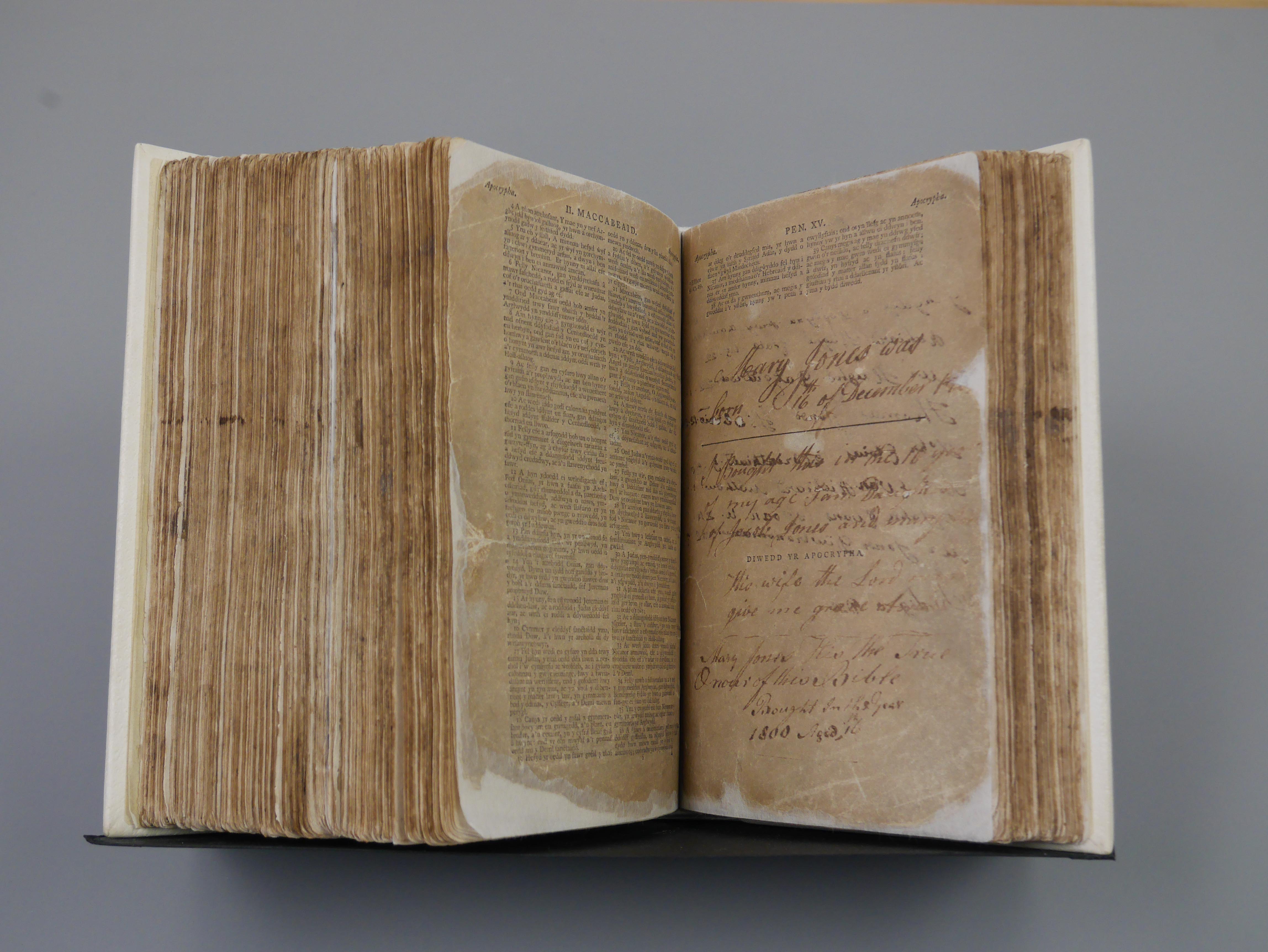
Colour photograph of Mary Jones' bible.  Image reproduced by kind permission of the Bible Society
Mary Jones’ bible. Image reproduced by kind permission of the Bible Society

Here, too, I am brought face to face with the book as artefact.  In this case, it is the bible owned by Mary Jones.  Her barefoot journey across North Wales in 1800 to buy her own copy of the bible in her own language has become a story that is told across the world.  This object – dark with use and age – is more than a book.  It connects us to an individual, a real person who held it and turned its pages, and also to a whole history of a language and the people who speak it.  And it tells the story of reading – at that time, Wales had one of the highest rates of literacy in the world thanks to the ‘circulating schools’ pioneered by Griffith Jones and his successors, which would come to a district for a while and teach people of all ages and genders to read, the aim being that they would be able to read the bible for themselves.  Literacy was perceived as what we still know it to be today – the gateway to knowledge and independent learning that can change lives.  Mary Jones’ bible is symbolic of the world of words and ideas that was opened up to her when she learned to read.  There can be few greater gifts than the ability to read.

The exhibition Beibl i Bawb (A Bible for All) is on until 2 April 2022 – more details here: https://www.library.wales/visit/things-to-do/beibl-i-bawb

I am committed to making this blog freely available, and not putting material behind a paywall. As a writer, I am doing what I love – but I still have to make a living. If you have enjoyed this post, and if you are able to do so, perhaps you would consider supporting my work by making a small contribution via the Buy Me A Coffee button. Thank you!

Buy Me a Coffee at ko-fi.com

In their own handwriting – connecting to the creators of the Lindisfarne Gospels

For the last few weeks I have been researching the Lindisfarne Gospels and writing an article about them for an e-magazine.  For those of you not familiar with the Lindisfarne Gospels, they are a lavishly illuminated hand-written book of the four Gospels (Matthew, Mark, Luke and John) of the New Testament, in Latin, produced by a scribe-artist called Eadfrith around 700CE, in the monastic community on the island of Lindisfarne (aka Holy Island) off the coast of Northumberland in North East England.  About 250 years later, a word by word translation (or ‘gloss’) in Old English was added above each line by a priest-scribe called Adred, at Chester-le-Street where the community was then living, having fled the island after raids by Vikings.

Incipit, Matthew’s gospel, Lindisfarne Gospels. British Library Cotton MS Nero D IV f.027r

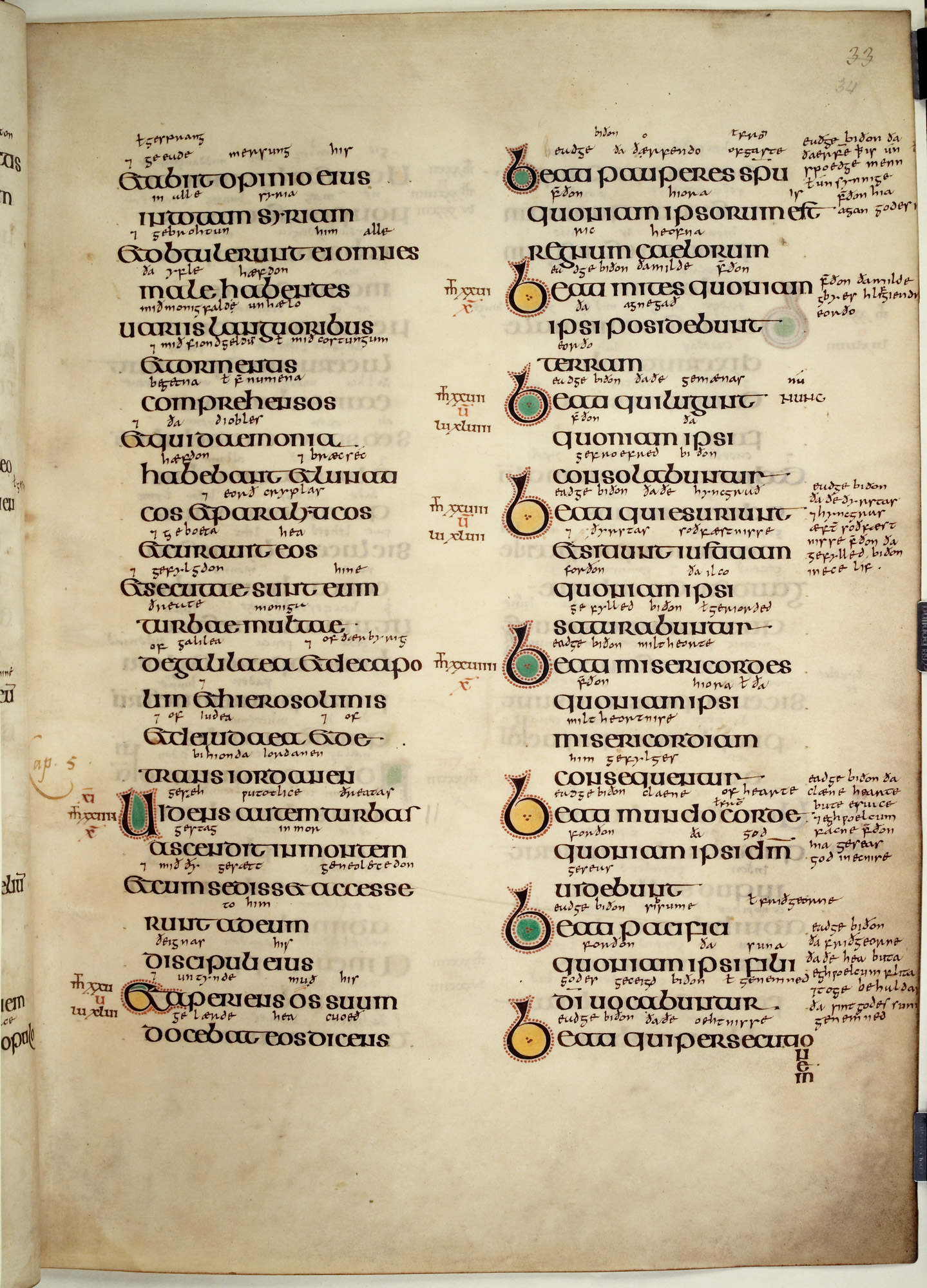
The art of the Lindisfarne Gospels is quite widely known today – the manuscript has been digitised and is available on the British Library website, and its motifs are used on all manner of historically-inspired merchandise.  But, though beautiful, the art is not what excites me about the Lindisfarne Gospels.  What makes my heart beat faster is that sense of glimpsing into the distant past something which connects us physically with the individuals who created it more than a millennium ago.

Far from being dry and academic, my research has been a fascinating journey into the England of the early medieval period – what used to be called the Dark Ages, between the departure of the Romans in the 5th century CE and the Norman Conquest in 1066, during which time it was thought that culture, learning and civilisation were largely absent.  Historians think differently now, in no small part due to the artefacts produced in this period which have been found in various excavated hoards, and probably most famously at the ship-burial at Sutton Hoo which was excavated on the eve of World War II and which was found to contain jewellery of breath-taking beauty and craftsmanship.  The sophistication shown in the illuminated manuscripts of the time is now seen, not as an exception, but as representative of the high standards of creative skill on the part of the peoples of the time.

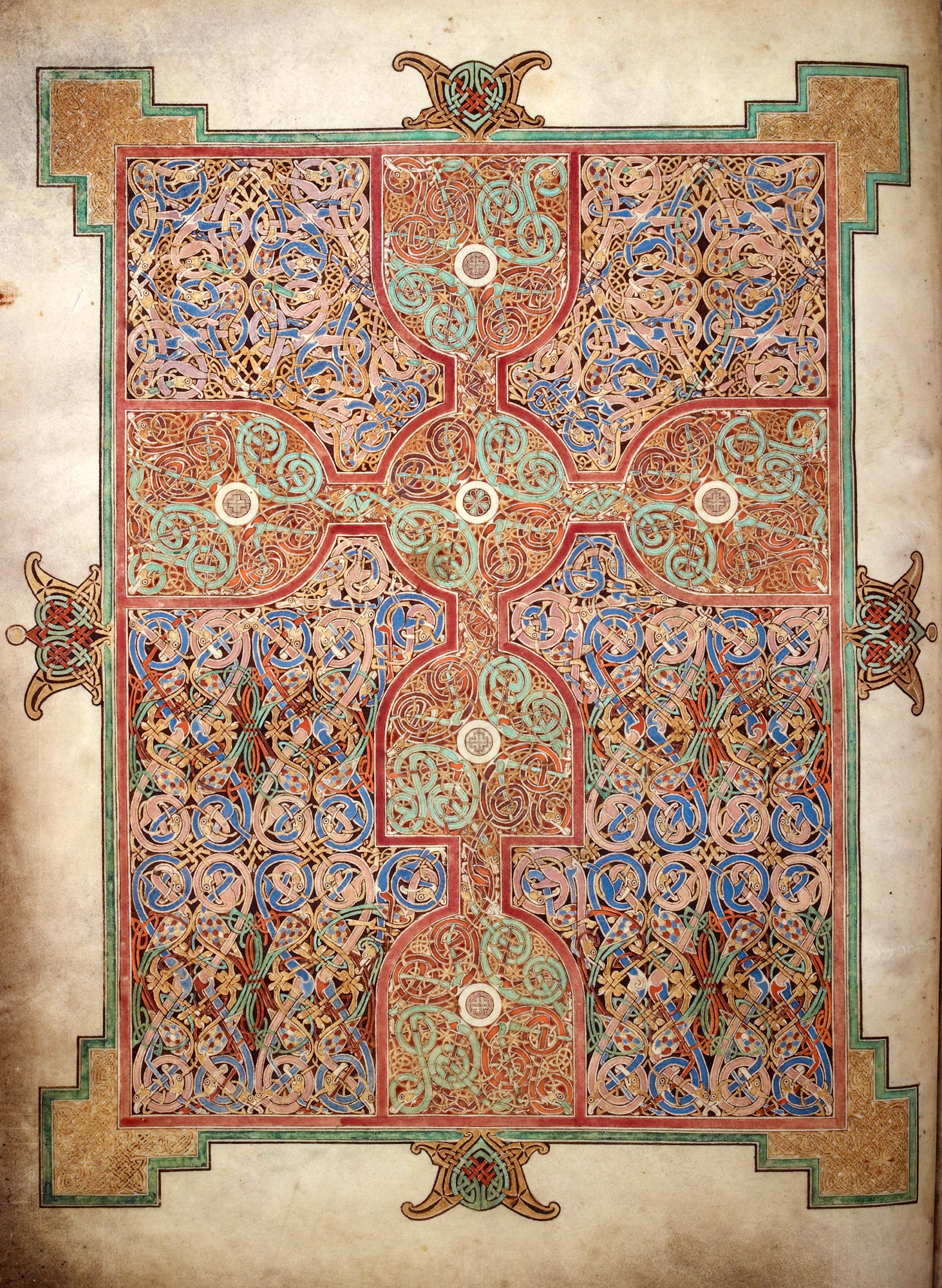
Carpet page, Matthew’s gospel, Lindisfarne Gospels. British Library Cotton MS Nero D IV f.026v

In an era before print, the production of a book – even the most plain and workaday one – was a major undertaking.  First, the vellum which formed the pages had to be prepared from the skins of young animals – calves or lambs – and trimmed and pricked in preparation for the binding process (making the Lindisfarne Gospels required the skins of almost 150 calves).  Lines had to be marked out on the page (Eadfrith invented the lead pencil, and the lightbox, to do this).  Ink had to be prepared, using oak galls and iron.  Feathers – ideally big sturdy ones like the flight feathers of swans – had to be trimmed into pens.  Then the scribe had to copy the book painstakingly from an exemplar, without the benefit of electric light.  It could take years to produce a book – years of dedication, focus, bad backs, cold, working in a scriptorium lit only by south-facing windows in the summer and candles in the winter.  A number of scribes left notes in the books they produced, complaining about their discomforts – issues around health and safety at work and RSI are not new!

The Beatitudes, Matthew’s gospel, Lindisfarne Gospels. British Library Cotton MS Nero D IV f.034r

What I love about these documents, though, is the immediacy of something which was produced by hand.  Just as our own handwriting is distinctive to each of us, it is possible to identify individual scribes by their handwriting.  Often, teams of up to half a dozen scribes and artists would work on a book – the Lindisfarne Gospels are unusual in having been written by just one man.  It is thought that it must have taken Eadfrith several years to produce the text and illustrations for this work.  It can be a stretch of the imagination, in 21st century Britain, to imagine the life of a 7th century monk on a windswept island in the North Sea, toiling on this work of great beauty, to the glory – as he would have seen it – of God.  Even as a visitor to Lindisfarne, it’s a challenge to look beyond the cafés and gift shops, the retreat centre and the museum, and the ruins of the later Norman priory, and picture this as a working monastery, its central work of prayer and worship buttressed by farming, fishery and the creation of high-quality books.  Seeing the personal handwriting of one of those monks, the strokes made by his pen, the drawings and embellishments he drew in the colours he chose (and created himself from mineral and plant pigments), brings him within reach.  Just as when, while researching your own family history you come across a 1911 census return in the handwriting of an ancestor you have never met and who died long before you were born, it makes them more real, so seeing Eadfrith’s handwriting brings him to life for us.

And in the Lindisfarne Gospels we are lucky enough to have the handwriting of two identified people.  I mentioned earlier that an Old English word-for-word translation (or gloss) was added in the middle of the 10th century.  We know that the man who did this was called Aldred, because he left us a note (a colophon) at the end of the Gospels to tell us so.  He also names Eadfrith as the original scribe/artist, as well as crediting the people who bound the book and made a jewelled cover for it.  By translating the text into English, Aldred was part of a movement championed by King Alfred (‘the Great’) in the late 9th century to make English a language not only of the people but also of learning and religion, alongside Latin.  Here we not only have Aldred’s handwriting, we can also see him wrestling with language as he frequently offers several alternative translations of Latin worlds into Old English.  Anyone who has ever attempted to translate from one language to another will relate to this!

Aldred’s colphon, Lindisfarne Gospels. British Library Cotton MS Nero D IV f.259r

In these times of emails, word-processing and SMS, handwriting is becoming a dying art.  In one way, that doesn’t matter – as long as we are communicating with words, it’s irrelevant how they are produced – but in other ways we are maybe losing something.  There is no digital equivalent of the personal, intimate legacy of someone’s handwriting – the notes and letters of past generations, which are often all we have left of our own families – and future generations will not experience the particular thrill of poring over a hand-written document produced by known, named people over a millennium ago.  I wonder what ways they will have instead to connect to the human individuality of the people whose words they are reading?

My article on the Lindisfarne Gospels is published in Issue 7 of The Pilgrim, which is available online here.

I am committed to making this blog freely available, and not putting material behind a paywall. As a writer, I am doing what I love – but I still have to make a living. If you have enjoyed this post, and if you are able to do so, perhaps you would consider supporting my work by making a small contribution via the Buy Me A Coffee button. Thank you!

Buy Me a Coffee at ko-fi.com

Making people proud of where they live – the public art of the Glastonbury Mural Trail

A year ago this week the Glastonbury Mural Trail was launched as part of Somerset Art Weeks.  Murals have been part of Glastonbury life for decades – at least since the 1960s when Pat Leyshon decorated the front of Pat Li Shun, her business at the top of the High Street, with colourful flowers – and have always sparked controversy.  I have been visiting Glastonbury since the 1990s, and for years have been aware of various murals springing up around the town (and sometimes disappearing again by my next visit), but the Mural Trail took the concept to a whole new level.  When I came to live in Glastonbury this summer, one of the first things I did was to pick up a Trail leaflet at the Glastonbury Information Centre, grab my camera, and walk the Trail.

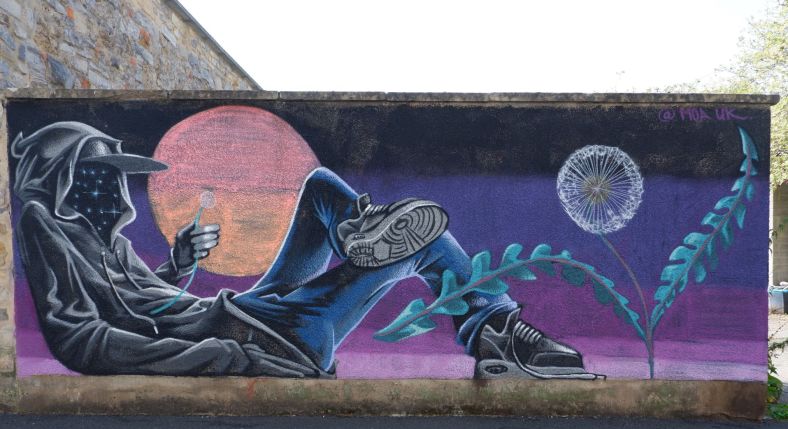
Image of mural

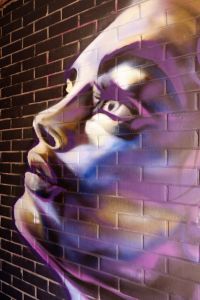
Glastonbury mural by M.O.A. (John Mason, LUVM, SYM, DMK, SIKOH)

Image of mural

Drapers – artist unknown

Following the Trail was great fun – the murals are not always in obvious places, or easy to find, and that’s part of the appeal, as it becomes a kind of artistic treasure hunt.  It was a great way to explore parts of the town I didn’t know, sparking many conversations as I enlisted the help of passers-by in searching for elusive murals.  The Glastonbury Mural Trail is also a showcase of serious artistic talent.  The variety of styles, subjects and scale means there must be something here for everyone, and I even came across a few that weren’t on the Trail Map (I was to find out why later).  There’s still one I haven’t found, because it’s in a pub garden and I just haven’t been organised enough to get there when the pub is open.

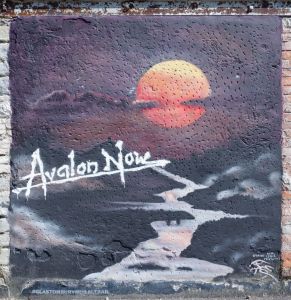
Image of mural

Avalon Now, by SYM

Having enjoyed the Mural Trail so much, I wanted to know more about how it came to exist, and what the motivations behind it were, so I arranged to meet Kim von Coels, who facilitated the creation of the Trail for last year’s Somerset Arts Weeks.  Socially distanced in the garden of her Glastonbury home, Kim tells me that there had previously been a leaflet produced by Jim and Caroline at the Pilgrim Reception Centre, listing the then existing murals.  Kim – who, like me, loves maps – had produced a Glastonbury town map, and was approached by the Town Clerk, Gerard Tucker, to design a map of the murals.  She agreed, but only if the Town Council would give its blessing to the creation of new murals (subject to the necessary permissions).  The project was born.

Image of mural

Goddess Hall, by Jon Minshull

Image of mural

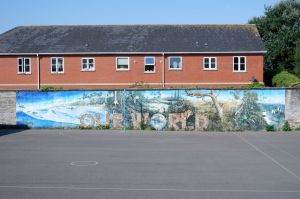
Our World, by Jon Minshull

A Facebook group was set up, and its members started researching the possibilities.  They found that, even in a conservation area, murals could be painted in most locations, with the permission of the wall owner, provided that the wall had been previously rendered or was of block construction, and that the subject matter was not offensive.

Image of mural

Wildwood (detail) by M.O.A.

Next came callouts – for artists who wanted to paint murals, for owners of walls who wanted murals, and for businesses willing to cover the costs with sponsorship.  Between April and September of 2019 Kim operated a kind of matchmaking service, connecting artists, wall owners and sponsors, and getting the necessary permissions.  As an example, she tells the story of the mural in Bere Lane, where the owner of the wall was keen to have a Viking theme for their mural, which meant that she was able to get sponsorship from Wyrdraven, the Viking shop in town.

Image of mural

Glastonbury Experience (detail) by Jon Minshull

Image of mural

I think this may be my favourite!  By Sikoh

The involvement of local businesses was key, says Kim, and Jill Barker of the Chamber of Commerce and Tourism helped make this happen.  Nobody got paid – there were just a few small honorariums for artist who would not otherwise have been able to participate – but sponsorship ensured that no one was out of pocket.  Support was both financial, and in kind (for example from Thorndown Paints), with some firms sponsoring the project as a whole and others sponsoring specific walls (for details of all sponsors, see the Glastonbury Mural Trail leaflet).  All wanted it to be good and successful, and the Town Council paid for the Mural Trail to be part of Somerset Art Weeks in September 2019.  At the official opening at the skate park, hundreds of people turned up, and Kim admits to being “totally blown away” by the positive response.

Image of mural

Avalon Marshes by Jon Minshull

What, I wondered, gives Kim most satisfaction about the project?  She has no hesitation in replying.  For her, the joy is that it’s free, it’s accessible to anyone, whenever you want – it’s public, it’s always open.  And it cheers people up and makes them happy.  It has, she admits, been a lot of hard work, but she wants there to be murals, to have people able to paint them, and people able to enjoy them.  She loves that people who normally don’t like graffiti are embracing the murals.  Kim feels it’s important that the subject matter of the mural is “universally pleasant – who doesn’t like nature, flowers, animals, landscapes?  It’s great when art creates a conversation but that’s not what the Mural Trail is for.”  Public art, says Kim, “makes people proud of where they live” and she’s keen to take the Mural Trail beyond the main thoroughfares into “the corners” of the town.

Image of mural

Sugar Skull by Sophie Alexi/The Krumble Empire

Image of mural

Winged Bug by Sophie Alexi/The Krumble Empire/Doodledubz

Kim has herself collaborated in the painting of four of the Trail’s murals – whichever way I walk from home to the High Street I pass one of her creations!  I ask her which is her own favourite, and she replies that she is very fond of the mural at the side of Abbey Park (number 25 on the current map) as it was painted by Oksana Gaidasheva from one of Kim’s photographs.

Image of mural

Globe Inn mural by Oksana Gadaisheva

The Glastonbury Mural Trail continues to grow.  At the time of the launch there were 26 murals, and Kim estimates that there are another 7 or 8 now – she thinks the total will be up to 36 by the time she produces the revised Trail leaflet in a few weeks.  Some have just happened – especially during lockdown – and then she is told about them so that she can add them to the Trail.  In other cases, artists contact her – “find me a wall!” – although that’s getting ever harder as “there are only so many walls!”

Image of mural

By DMK

Kim von Coels is an artist and photographer.  She also works at Heart of the Tribe, a new gallery in Glastonbury.  You can read more about the Glastonbury Mural Trail, and download a leaflet, here.  There is also a Glastonbury Mural Trail page on Facebook.  For more about colourful Glastonbury, take a look at this post on the Normal for Glastonbury blog.

The view from here – first impressions after relocation

Readers of my last post will be aware that I have just moved house, and will hopefully forgive the lack of posts over the last couple of weeks.  To begin with, of course, we weren’t able to engage with the town and surrounding area as much as we would have liked because of the tedious but necessary business of unpacking, spring cleaning the house for a nice fresh start, and generally getting very tired and achy!  However, the particular bonus of this house is the view from the study, which is on the top floor.  It has windows front and back, giving panoramic views of the town of Glastonbury and the surrounding countryside.

One way, the view includes the iconic Glastonbury Tor, with its medieval tower of St Michael (all that remains of the church which used to crown the hill).  A site of pilgrimage since at least medieval times, the Tor continues to draw modern day pilgrims and visitors, who climb it for a variety of reasons – spiritual, sightseeing or artistic.  Since we have been here, I have never seen the Tor without people on it.  Even at night, the lights of people’s torches (and, at Lammas, a fire spinning display) are visible, and when the Sturgeon Moon rose last week there were dozens of people on the Tor to witness the moonrise.

Photograph of Glastonbury Tor, with a road in the foreground and trees framing the view.

Country road leading to Glastonbury Tor – image copyright Robert Bruce 2020

Below and to the right of the Tor, the view takes in the rooftops of the town – mostly red pantiles – and the gardens of the townhouses, built on land which, a century or two ago, used to be orchards.  The tower of St John’s church rises above the rooflines, and at the moment a pair of peregrine falcons is raising a brood of chicks on the tower – the young’s raucous cries echo across the town when the parents arrive with food.  They are so loud, even at this distance, that for a couple of days I thought one of the neighbours had a particularly noisy parrot!  It’s such a privilege to see these amazing birds soaring above the town.

Further to the right again is Wearyall Hill, where Joseph of Arimathea is reputed to have planted his staff in the ground, which grew into the Holy Thorn, a thorn tree which bloomed twice a year – at Christmas and Easter – and whose successors still grow at various locations around Glastonbury.  Sadly the successor which grew on Wearyall Hill has now been removed due to persistent vandalism.

Beyond Wearyall Hill are the Polden Hills, where the modern A39 main road follows the ancient ridgeway to Avalon.  During the catastrophic floods in the winter of 2013/14, my usual commute across the Levels was under several feet of muddy water, so I drove along the A39 instead, looking out across floodwater as far as the eye could see, with only the odd tree or rooftop sticking up above the water.  It gave an insight into how these marshy lowlands might have looked before sea levels fell, and the land was ‘improved’ for farming.

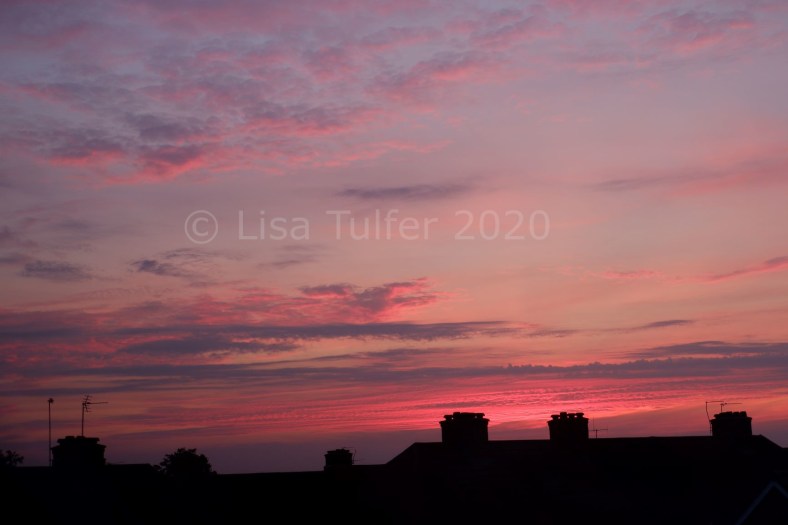
From the other window, the sweep of the Mendip Hills runs east to west in the distance.  From this window, we can see dramatic sunsets – the skies in this part of Somerset are particularly striking, which I have always attributed to the conjunction of the open flatlands of the Levels and the way the light reflects off the Bristol Channel.

Sunset over rooftops

In between the unpacking and cleaning, though, we have managed to wander into town from time to time.  Glastonbury’s High Street is not typical of a small town in a rural county – for ‘normal’ shopping, you need to go a couple of miles down the road to Street, which as well as a ‘normal’ high street has the country’s first shopping village, built on the former Clarks shoe factory site.  Glastonbury’s retail offering is something else entirely – crystals, books on esoteric subjects, tie-dyed clothing, Buddha statues, candles in all the colours of the chakra rainbow, Goddess figurines, Green Man car stickers, herbs and incense.  Buskers can include dreadlocked drummers, haunting folk singers, or jazz saxophonists.  At the Tuesday market, you’ll find the fast food outlets selling not hot dogs but vegan falafels.  It’s lively, chaotic, a bit ‘lived in’, and there’s something unexpected around every corner.  I’ve been walking – and photographing – the Glastonbury Mural Trail, which I will be writing about in a future post, and it has taken me to parts of the town centre I never knew.  And of course when the current heatwave abates a little, we will climb the Tor again (and take binoculars to try to locate our window!).

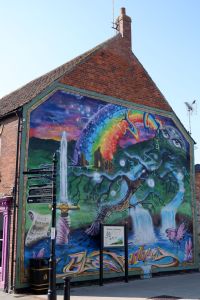
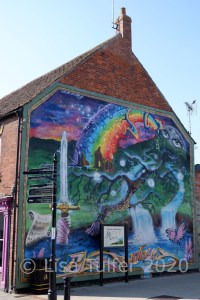
Photo of colourful mural in Glastonbury

I mentioned Joseph of Arimathea and Avalon in passing above  – Glastonbury is full of history, legend and myth, and a huge amount has been written about the various themes associated with it (Avalon, King Arthur, Joseph of Arimathea, Gwyn ap Nudd, the Holy Grail, the Glastonbury Zodiac, the Goddess, Nolava, the Chalice Well, Bridget, and Glastonbury Abbey as a site of Christian pilgrimage, to name just a few).  This isn’t the place to add to that, although I’m sure I will be touching on aspects of it in this blog from time to time – it’s impossible to live in Glastonbury and not engage with the various strands of spirituality and legend which are the town’s raison d’être and, frankly, why would you not want to?!  Glastonbury is unique, crazy, enchanting, infuriating, but never boring.  If you would like to know more about Glastonbury* and its vibe, I recommend Vicki Steward’s excellent blog, Normal for Glastonbury.  She has recently produced a book, also called Normal for Glastonbury (available as an e-book and in print), which pulls together a selection of her blog posts – her portrayal of Glastonbury life is humorous and well-observed, and makes a very good read.  Again, highly recommended.  And no, I’m not on commission!

* When I talk about Glastonbury, I mean the town in Somerset – not the world-famous festival, which in fact takes place in a field a few miles away.  If you watch footage of the festival, you can see the Tor in the distance, behind the Pyramid Stage.

Spirit of the sea – art, music and glass

There are few sounds more magical than the sound of the sea. Whether it’s the slow, breathing cadence of the beach at Aldeburgh, with the North Sea washing the pebbles up and down the shoreline with each wave of the swell, or the thunder of the storm waves hitting the breakwater at the Cob in Lyme Regis, sending a plume of white into the air, I find the sound of the sea compelling. Sadly I am rarely successful at taking photographs of the sea – in the time it takes for my eye to see the image, by brain to send instructions to my finger to press the shutter release, and the camera to respond, the scene has moved on, and the moment is lost. Writing about the sea is hard too, with words often feeling too solid to convey something so mercurial and transient.

Paintings can be more successful at evoking the sea – I am especially admiring of Maggi Hambling’s sea paintings (there’s a video here where she speaks about ‘painting the sound of the sea’, with images from her exhibition at the Fitzwilliam Museum in Cambridge in 2010). Music can do it too, and for me the most moving examples are by Benjamin Britten (his Four Sea Interludes from the opera Peter Grimes) and his teacher Frank Bridge (his symphonic poem The Sea). Britten lived and worked in Aldeburgh, on Suffolk’s North Sea coast, and when I walk on the quiet beach there the soundrack in my head is his first sea interlude (On The Beach: Dawn).

My love of the sea is not sentimental. I was brought up on or near it, and I know all too well how its moods can change, and the destruction and death it can cause. It’s not all blue, bathing beaches and bobbing boats. The sea demands respect, and takes revenge on those who trifle with it. It’s also merciless to those who are in the wrong place at the wrong time, those who have to make their living on it and risk their lives doing so. For me, the heroes of the sea are the volunteer lifeboat crews who set to sea in the worst of conditions in order to rescue those for whom they are the last resort. Yes, the sea is beautiful, but it is also powerful and cannot be tamed by humankind.

The British coastline is shaped by that power. Breakwaters and sea defences notwithstanding, the sea has created – and continues to create – a dynamic coast. Erosion and encroachment by the sea (to stick with the North Sea examples, think of Happisburgh which is being ‘lost’ to the sea at a sometimes dramatic rate) is balanced by the creative forces of deposition (for example the giant and ever-growing shingle bank of Orford Ness).

There has been much concern, and rightly so, about the amount of plastic debris being washed up on our coastlines, and the effect of this on wildlife and the marine ecosystem. But there is something else which is regularly washed up on our beaches, which to my mind is a great example of the power of the sea at work to create something beautiful from the cast-offs of our past. I think of it as a kind of recycling, the forces of nature reworking the mundane into unintended gems. I’m talking about sea glass.

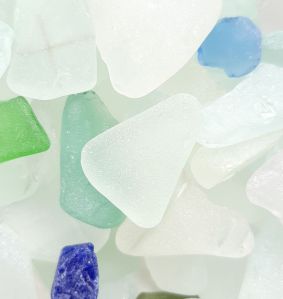
Sea glass is formed when pieces of waste glass are abraded by being tumbled in the sea for extended periods of time (sometimes decades or centuries), their sharp edges eventually ground down into a frosted smoothness and pleasing pebble shapes. I have collected sea glass for some years, and there is a vast network of collectors around the world – Instagram is a good place to see their finds.

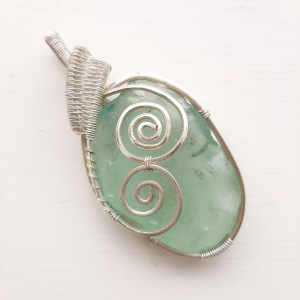
Sea glass can be found on beaches anywhere – as with any beachcombing, the best pickings are often to be found at the first low tide after a storm, when all manner of interesting things can be washed up. Some parts of the UK coastline, however, seem to yield more glass than others – I have found a lot in the North West, and also some on beaches in North Devon and East Anglia. I hear that the North East of England is a favourite location for collectors, due to the presence of several bottle works in the 19th and 20th centuries – the largest in the country was at Seaham – which dumped their waste glass into the North Sea. I have included a few photographs from my collection, most of which I display in a large glass vase, although the best way to see sea glass and the way it plays with light and colour is to handle it. The blue pendant is a gift from my partner, who found this unusual aqua-coloured and very large piece of sea glass at Lynmouth in North Devon (other people’s partners give them gemstones. Mine gives me sea glass. I am very lucky!).

Sea glass pendant

Most sea glass is a magical pale aqua colour, but some is white, a lot is green, and other rare colours include amber, blue, orange and (most prized of all) red. As most sea glass originated as glass bottles, the abundance of any colour depends on how common the bottles were – blue, for example, started life as medicine or poison bottles, while amber bottles held spirits. Glass bottle tops are sometimes found too, as are the glass marbles which formed the stoppers of early carbonated drinks. Keen collectors have researched the origins of sea glass, which is in itself a social history and archaeology of glass. Occasionally I am lured into researching a piece – for example the reinforced glass incorporating rusting metal wire grids which occur on Crosby beach on Merseyside, which are part of the debris from buildings destroyed in WWII air raids on the city of Liverpool which was dumped there. Mostly, though, I collect it because I am enchanted by what the sea has made from our thoughtless waste. The power that destroys coastlines and wrecks ships has formed something which, in its colour and ever changing reaction to light, is a kind of echo of itself. Have nothing in your homes, said William Morris famously, that you do not know to be useful or believe to be beautiful. Sea glass, I believe, is the most beautiful thing in my home.

I am committed to making this blog freely available, and not putting material behind a paywall. As a writer, I am doing what I love – but I still have to make a living. If you have enjoyed this post, and if you are able to do so, perhaps you would consider supporting my work by making a small contribution via the Buy Me A Coffee button. Thank you!

Buy Me a Coffee at ko-fi.com

A very British memorial – public art in a nation of animal-lovers

I have recently written an article about Aldeburgh, in Suffolk, which will be published in the next issue of The Pilgrim.  In it, I write about The Scallop, the controversial but, in my opinion, wonderful sculpture by Maggi Hambling on Aldeburgh beach which is a memorial to the composer Benjamin Britten.

Colour photograph of The Scallop sculpture by Maggi Hambling on Aldeburgh beach

There is, however, another memorial on the seafront at Aldeburgh, much loved by the town.  Between the Tudor Moot Hall and the shacks selling fresh seafood, overlooking the boating lake, stands the statue of Snooks.  Measuring approximately two feet tall, the bronze figure sits on a stone plinth, head on one side, as if watching the model yachts on the boating lake.

‘Mrs Snooks Chip Winkler,’ as the inscription on her collar says, was the canine companion of two local doctors and used to accompany them on their rounds.  She got her name from the tinned fish, ‘snook’, which was imported from African waters during the Second World War.  Although her statue is popular with the people of Aldeburgh, its seems that in her lifetime they were perhaps not always so animal-loving – there is a story that, when wandering the seafront, she would have a notice on her collar which read “Please do not throw stones at this dog.”

Dr Robin Acheson and Dr Nora Acheson were doctors in the town from 1931.  Following Dr Robin’s death in 1959, a memorial was commissioned and the original Snooks statue was created by sculptor Gwynneth Holt.  It was unveiled in 1961 by the couple’s grandchildren.   Dr Nora continued to practice medicine, including teaching first aid to the crew of the Aldeburgh Lifeboat, until her death in 1981, when her name was added to the inscription.

Snooks

This memorial
was erected
by the people
of this borough
to Dr ‘Robin’
P.M. Acheson
who cared for
them from
1931 to 1959
and to Dr Nora
his wife
who died 1981
whilst still caring.

Snooks oversaw the fun at the boating lake until February 2003, when the statue was stolen.  The consternation in Aldeburgh was such that fundraising was started and a replica was cast, which was installed later that year.  However, that was not the end of the story, because in 2012 the original Snooks was discovered at an antiques fair by dealer John O’Connor, and was returned to the town.  This original Snooks now overlooks the pond in the garden of Aldeburgh Community Hospital, which the Achesons helped found, and ‘Snooks 2’ remains on her plinth.

At Christmas 2017 an anonymous well-wisher ‘yarnbombed’ the statue – apparently fearing that Snooks might be feeling the cold, exposed to the winter gales on the seafront, the knitter kitted her out with a jacket, a scarf, and a Tam o’ Shanter  hat.

#Shelfie – books I am currently reading

Over the Christmas and New Year break, I have been enjoying a bit of leisure to catch up with my reading.  All writers read – it’s just a part of life, like breathing, and since I was very young I have not been able to imagine not having several books on the go at any given time.  This time of year is especially exciting as kind people tend to give books as Christmas presents!

As I like seeing other people’s #shelfies, I thought that today I would share mine with you.

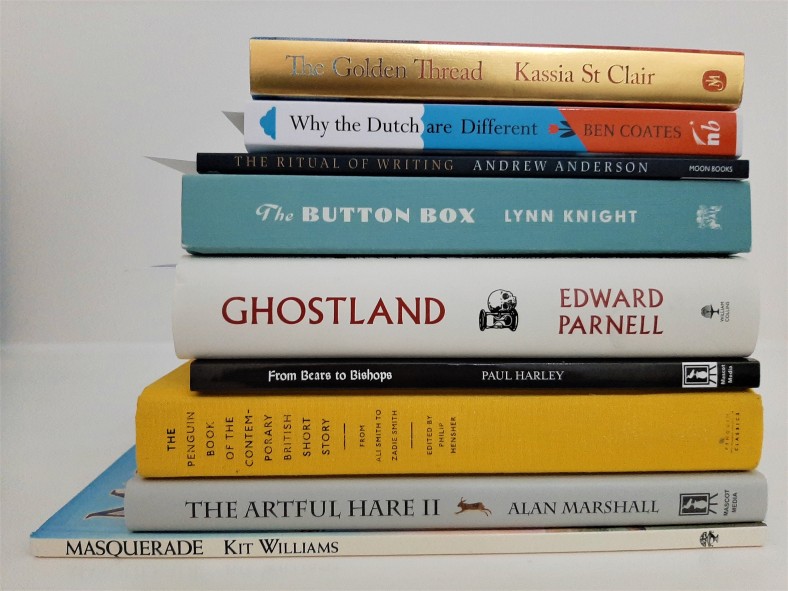
Photo of a pile of books on a shelf.

Starting from the bottom:  Masquerade, by Kit Williams.  Published in 1979 and long out of print, I was recently recommended this and managed to track down a secondhand copy.  The first of the ‘armchair treasure hunt’ genre, the frankly trippy illustrations and accompanying story of Jack Hare – written like a fairy tale with riddles twining through it – created a clue book.  The author buried a piece of jewellery, in the form of a bejewelled 18 carat gold hare necklace, and waited for it to be found by the first person to solve the riddle of the book.  It was claimed a couple of years later, amid some scandal, and the whole affair was chronicled by Bamber Gascoigne (who witnessed the burial of the treasure) in his book The Quest for the Golden Hare.  My interest in the book is, of course, primarily because of the hare who is the hero, and the hares secreted in every illustration – but also in the concept of a picture book for adults, where each image repays close observation, and where the image and text have a dialogue.  Regular readers of this blog will recall my recent review of The Hare and the Moon by Catherine Hyde, which does something like this.

For more on the story of Masquerade, have a look at https://www.bbc.co.uk/news/uk-england-beds-bucks-herts-47671776.

There are more hares in my next book – over 400 of them!  A Christmas present from my partner, this is one of a series of beautiful coffee table books by Alan Marshall, which feature the work of British printmakers.  This is The Artful Hare, and it’s gorgeous.  89 printmakers interpret the hare, in a variety of styles and techniques which both show the rich diversity of this art form, and also illustrate aspects of the life and mythology of the hare.  This will keep me very happy for a long time – if I treat myself to just one print a day, it will take me well into 2021!

The Penguin Book of the Contemporary British Short Story, edited by Philip Hensher, is more by way of work – I like to keep up to date with short form writing, both fiction and non-fiction.  So far I am still on Hensher’s excellent introduction, so I can’t comment yet on the stories themselves.

Another Christmas present is From Bears to Bishops: Norfolk’s Medieval Church Carvings by Paul Harley.  In over 130 stunning black and white photographs, this catalogues wood and stone carvings from Norfolk’s 659 medieval churches.  Several of these I’ve seen in person (for example, the Green Man at King’s Lynn Minster, the woodwoses on the font at Acle, and the cat on the font at Castle Rising), and I am keen to explore in search of more.

Regular readers will remember that I recently attended an event for writers at the National Centre for Writing in Norwich.  The highlight for me was meeting Edward Parnell, who spoke about his move from fiction to non-fiction, and the recent publication of his book Ghostland: In Search of a Haunted Country.  Edward kindly signed my copy!  Beginning with the ghost stories of M.R. James (which I re-discovered last year), Edward’s book is an intriguing exploration of place, haunting, and writers, interlaced with his own memoir.  I am less than a quarter through the book, and it’s fascinating – and it’s also inspiring me to go in search of authors I hadn’t previously encountered.

Social history is a major interest of mine, and I am also a textiles geek, so The Button Box by Lynn Knight was always going to find its way onto my bookshelf.  Using heirloom items from the family button box as the hooks on which to hang her narrative, Knight explores the intimate, domestic side of women’s lives through the stories of their clothes.  This is a book to be relished slowly – I am dipping into it a chapter at a time.

Completely different – and straddling the space between work-related reading and reading for leisure – is The Ritual of Writing: writing as spiritual practice by Andrew Anderson.  Purchased on a recent visit to Glastonbury, it covers topics such as responding to the spirit of place, working with old tales, and using the wheel of the year.  Again, a book to be read slowly – with time to reflect on each chapter before embarking on the next.

I can’t remember whether I’ve mentioned this before – I am half Dutch.  The older I get, the more pronounced my Dutch traits seem to be becoming (or so I am told!).  I was therefore attracted to Why the Dutch are Different: a Journey into the Hidden Heart of the Netherlands.  The Author, Ben Coates, is a Brit who has lived in the Netherlands for many years.  In this book, he explores the legacy of Dutch history on the culture, attitudes and behaviours of the Dutch – writing as an outsider observing from the inside, which is rather how I feel sometimes in Britain.  I am enjoying the book immensely – learning a great deal that I didn’t know about Dutch history and geography, and also recognising so much of the national psyche in myself.

Finally – did I mention I’m a textiles geek?!  Some time ago I spotted The Golden Thread: How fabric changed history by Kassia St Clair on the shelves of Waterstones, and promised myself I’d buy it when I had made a few more inroads into my ‘to read’ pile.  I was delighted, then, to find it amongst my Christmas presents!  A friend had also spotted it and thought it was my kind of thing.  St Clair tells the story of fabric , starting from prehistory, through the wrappings of Egyptian mummies, silk and the Silk Road, the sails of Viking longships, medieval wool wealth, cotton and slavery, to the clothing of arctic explorers, artificial fibres, space suits and modern sports fabrics.  This is yet another book to be dipped into and savoured – a rich tapestry of history, laced with literary quotations, which encourages us to look more closely at the fantastic textile creations we use every day, and so often take for granted.


Links to books cited are generally to Amazon UK, although where possible I give my custom to my local bookshop, or use Hive.co.uk and Abebooks.co.uk to buy new and used books online.  If you are in the UK, many of these titles may also be available through your county library service.

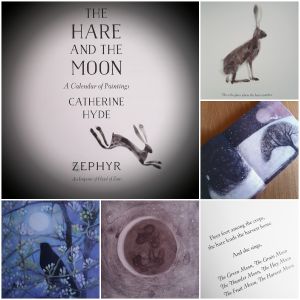
Book review. The Hare and the Moon: A Calendar of Paintings by Catherine Hyde

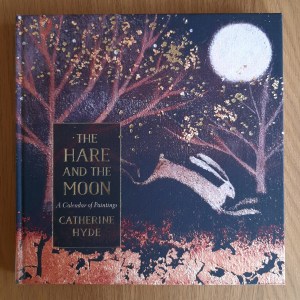
As regular readers of this blog may have gathered, I am a bit of a fan of the hare.  I was delighted, therefore, to find this rather wonderful little book with the evocative title The Hare and the Moon: A Calendar of Paintings.  It is pleasingly square, with a tactile cover, which is always a good start.  And it had me at the first page, which is an illustration of the three hares motif!

There are a number of elements to the ‘calendar’ aspect of the book.  A poem, with the refrain which recites the folk names for the full moons (The Snow Moon, The Wolf Moon, The Hunger Moon, The Sap Moon etc) is woven through it.  Each month then has six themes.  There are black and white illustrations of the moon phases.  There are double page colour paintings of the hare in the seasonal landscape (I especially like January, where the hare is joined in the snowy countryside by the barn owl and the raven).   There are Indian ink drawings of the hare in action and at rest.  For each month there is a flower, a tree, and a bird, each accompanied by a colour painting and a note about the folklore and alternative country names.  For example, June’s flower is honeysuckle:

“Used for rope-making in the Bronze Age and also known as woodbine, honeybind, trumpet flowers, Irish vine, Goat’s leaf, sweet suckle and fairly trumpets.  Honeysuckle grown around the entrance to the home prevented a witch from entering and would bring good luck.”

The Hare and the Moon subtly weaves poetry and art together, blurring the boundaries and creating what has been described as ‘visual poetry’.  This is so much more than a book of poems and folksy factoids with illustrations.  The images have a dreamy quality which lend a timeless air to this charming book.  Perfect for reading, as I did, while curled up on the sofa on a dark winter afternoon, a steaming mug of tea by my side (think hygge!), this would make a fine Christmas/Yule present for anyone who loves the natural world, folklore, or art.  Or indeed hares!


(For more about Catherine Hyde, take a look at https://catherinehyde.co.uk/)

Why Three Hares?

Why, you may well be asking, have I chosen ‘The Three Hares’ as the title for this blog?  I confess, it’s a bit of a self-indulgence.  It has to be called something, so it may as well be something I’m passionate about!

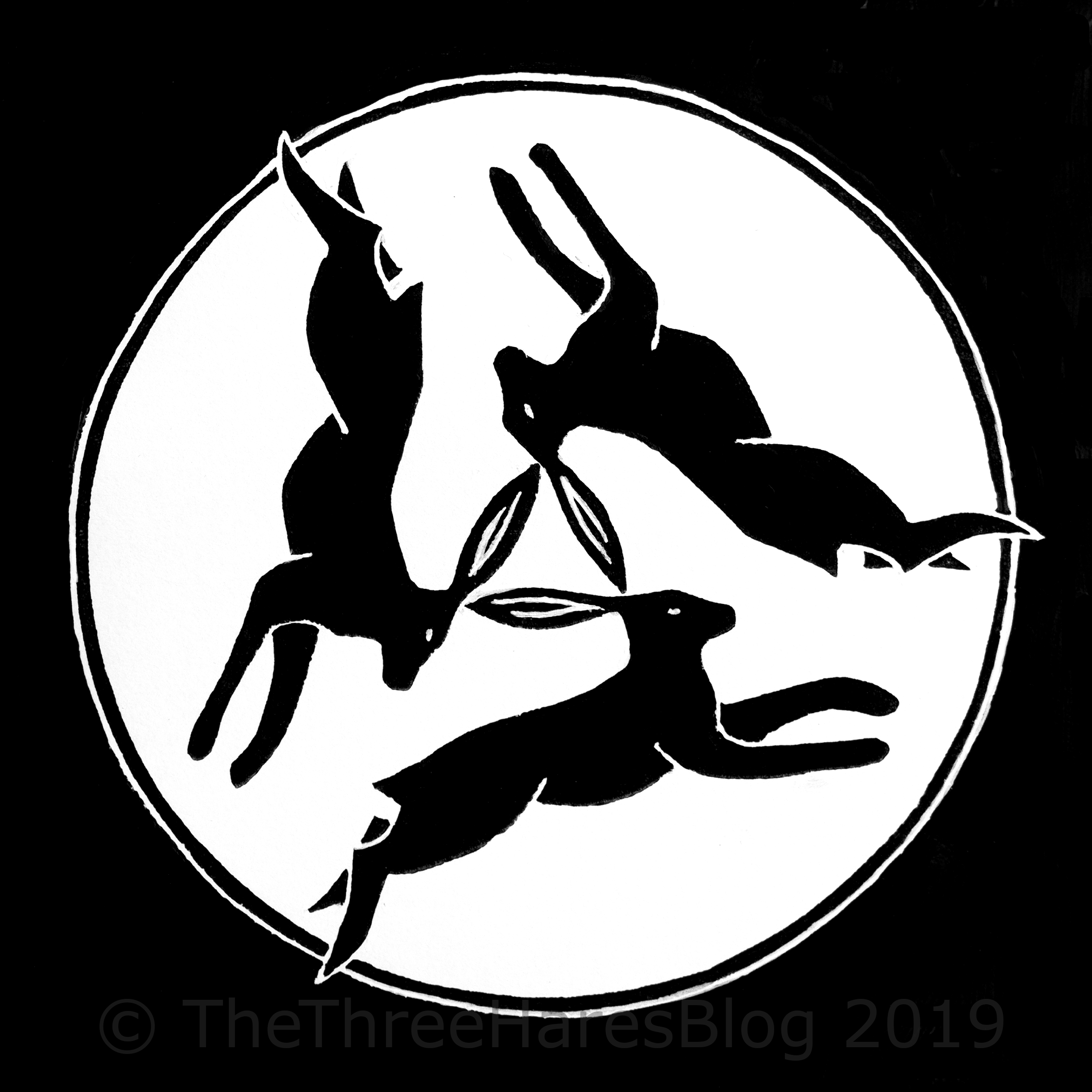
The motif of the three hares has fascinated me ever since I first encountered it, and I have been intrigued by its mysterious history and ambiguous meaning.  The motif consists of three hares (or possibly rabbits, in some cases) running in a circle, either clockwise or anti-clockwise, with each hare having two ears – but there are only three ears in total.  The ears form a triangle at the centre of the design (very occasionally, there are four hares sharing four ears, which form a square at the centre).

I first came across them in Devon, where there are nearly 20 examples of medieval roof bosses featuring the three hares in churches across the county.  (They are sometimes called “Tinners’ Rabbits” in the Dartmoor area, but this seems to be a bit of a red herring, as the origins of the motif are much older).

So, first, the history:  the earliest examples have been found in caves in China, which are believed to be early 6th century.  The theory is that the motif travelled west along the Silk Road, appearing in southern Russia, Iran, eastern Europe, Germany, France, Switzerland, and finally crossing the Channel to England and Wales in the early 14th century.  The hares transcend religious traditions, from Buddhism, through the Islamic world (where the motif appears on metalwork, glass, ceramics and textiles), Judaism (18th century synagogues in Germany have the motif, alongside the riddle “Three hares sharing three ears, yet every one of them has two”) to Christianity (they feature in churches across Western Europe).

The meaning is much more mysterious than the history.  Hares have had many associations, including as a symbol for resurrection in Chinese mythology.  The hare was the animal associated with the pagan goddess Oestara, along with the moon, possibly because the hare was believed (erroneously!) to have a gestation period of 28 days.  This association may account for the naming of the female cycle (oestrus) and the principal female hormone (oestrogen).  This female imagery may be the reason that the three hares are often found juxtaposed with the Green Man in English examples.  In another legend, the hare was believed to have laid the Cosmic Egg, which may be the precursor of the idea of the Easter Bunny, and Easter eggs!  And latterly, the three hares were believed to be a symbol of the Christian Trinity.

I leave you with my own interpretation, in a linocut print, of the three hares and moon motif, which is the logo for this blog, and some links to articles which have informed my understanding of the three hares and which you may find interesting.  If you are really lucky, you may manage to track down a copy of The Three Hares: A curiosity worth regarding by Tom Greeves, Chris Chapman and Sue Andrew, published by Skerryvore Productions but now sadly out of print – if you do, can I please borrow it?!

20190722_100029 classic - Copy - edited and watermarked

The Three Hares Project

Legendary Dartmoor

Wikipedia article

New Scientist article

The Three Hares Trail, Dartmoor

An artist’s blog about the three hares

The three hares as a Chines puzzle