Today is not World Book Day

Yesterday was World Book Day.  For various reasons which I won’t bore you with, I managed not to realise this until the evening, by which time it was a bit late to blog about it/post #shelfie pictures on Twitter along with the rest of the reading and writing community.

But it set me thinking.  One of the commissioning editors for whom I write a lot often commissions articles about World/International Days, and the range of topics I’ve researched and written about over the past few years is amazing.  I thought I would share a few of them with you.

International Women’s Day (Sun 8 March 2020)

This day has been around for a long while – it was first marked in 1911, and initially focussed on women’s right to work without discrimination.  Inevitably, it soon also started to campaign for women’s right to vote.  Following the day’s adoption by the feminist movement in the 1960s, the United Nations declared it an International Day in the 1970s.  It continues to raise awareness of issues affecting women around the world, which we might have hoped would have been addressed by now: inequality and discrimination, the impact of war and displacement, sexual violence, and the lack of access to education.

World Day Against Child Labour (Fri 12 June 2020)

A more recent development is World Day Against Child Labour, which started in 2002.  Its focus is the global extent of child labour, and the campaign to eliminate it.  The 2015 Sustainable Development Goals include a global commitment to end “child labour in all its forms” by 2025, but currently over 200 million children around the world work, many full-time.  This matters, not only because it deprives them of the chance to be children and to play, but because it means that they are denied the opportunity to go to school, and traps them in a cycle of poverty.  In the West we probably think of child labour in terms of having a paper round, or being a child actor, with legal protections in place.  Worldwide, however, 70% or working children work in agriculture, often hard and dangerous work.

World Bee Day (Wed 20 May 2020)

With so much publicity for the pollinator crisis over the past few years, we can’t fail to be aware that there’s so much more to bees than honey.  Until I began researching for this article, though, I hadn’t appreciated that as much as a third of world food production depends on bees for pollination.  This makes it very worrying that 10% of bee species worldwide are facing extinction.  Although there is dispute about what is causing the decline in bees, with possible culprits being the varroa mite, other viruses, diseases and pests, climate change, and neonicotinoid pesticides, the statistics suggest that bee numbers are down by a third in the USA, with significant losses being reported elsewhere including Europe.

It’s not all doom and gloom though – this is one area of environmental crisis where ordinary people like you and I can make a difference.  Bee-friendly gardening, providing bees with flowers which yield plentiful and easily-accessed nectar, can help to boost the health and numbers of these essential creatures, whose future survival is so closely entwined with our own.

World Braille Day (Mon 4 January 2021)

On this day in 1809, Louis Braille was born in France.  He was blinded by a childhood accident, but applied his intellect to the problems he faced, and by the age of 15 had created a system for reading and writing.  A system of military night-writing had been developed by Charles Barbier, at Napoleon’s request, to provide a tactile way for soldiers to communicate silently and without a light source.  It consisted of sets of dots which encoded sound.  Louis adapted this into a matrix of ‘cells’ of raised dots, 3 high by 2 wide, which can be used to read (and, with the right equipment, to write) in any language.

World Braille Day was declared by the United Nations to celebrate the system’s role in giving independence to people who are blind and visually impaired, and to encourage its use.  Sadly, there is a world shortage of trained Braille teachers, and Braille writing equipment is expensive.  Some years ago I was able to get funding to produce a Braille version of an adult education programme I had developed, but was saddened that so many users said this was the first time they had been able to take part in learning on an equal basis with their sighted colleagues.  I found that public bodies and businesses rarely use Braille to make their premises and services independently accessible to blind and partially sighted users – often the only place you will encounter Braille is on the buttons in the lift.

World Toilet Day (Tues 19 November 2020)

This day is particularly dear to my heart – having had IBS for 30 years, I have a personal interest in the provision of toilet facilities, and am the proud owner of a RADAR key which has come to my rescue many times.  I know how lucky I am to live in a country where flush toilets are the norm, widely available, and safe.

However, despite the United Nations declaring in 2010 that access to sanitation and water is a human right, over a third of the world’s population still doesn’t have access to a safe toilet.  Over a billion have no toilet at all.  Amazingly, more people own a mobile phone than have access to a toilet.

This lack of safe toilets has enormous implications worldwide.  Firstly, there are the health implications, with diseases such a cholera and dysentery being spread because of inadequate sanitation, and untreated sewage contaminating the environment and the food chain.  Secondly, one fifth of schools have no toilet facilities, effectively preventing girls from attending once they start menstruating.  And thirdly, women who have no alternative but to engage in ‘open defecation’, especially after dark, are vulnerable to attack and rape.  World Toilet Day seeks to address a subject which can be taboo or socially unacceptable, but which is really about basic human rights.

A number of organisations are involved in providing toilets where they are most needed.  One which I have supported is WaterAid – see https://www.wateraid.org/uk/the-crisis/toilets for more details.


This week I have been mostly – researching

I was recently commissioned by a literary webzine to write a piece on Strata Florida Abbey in West Wales.  This was one of a number of possible ideas I had pitched to the editor, but I must admit I was thrilled that this was the one they wanted, as it’s a place that’s very dear to my heart.

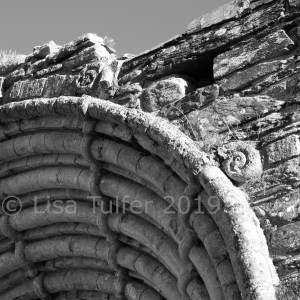
West doorway of Strata Florida Abbey. Mono photograph.

When I was 17 (a very long time ago), I was at school in North Wales and doing an innovative A level English course which included a large element of creative writing – this was very cutting edge in the 1980s!  My group – there were just 5 of us doing the course – was taken on a number of field trips to provide inspiration for our writing, and one of these was to Cymer Abbey, near Dolgellau.  Cymer was a small Cistercian abbey (the Cistercians were the ‘back to basics’ order of monks which emerged out of the Benedictine tradition at the end of the 11th century.  They were into simplicity, austerity and self-sufficiency).  Cymer was founded in 1198 and dissolved by Henry VIII in 1536.  We spent a couple of hours there, taking in the peaceful location between the hills and the Mawddach river, beside a small farm, in the spring sunshine.  We learned about the silver gilt chalice and paten (vessels used in the Mass) which had been discovered in the 19th century, treasure which was believed to have been hidden by the monks to keep it safe from the king’s men when they came to close and ransack the monastery.  This is the poem I wrote:

Cymer Abbey

The ruins lie like a cracked skull,
empty arches like toothless jaws:
bare homes of stolen treasure.
Each stone is a tombstone for a soul
through the processions of the past.
Chants sound in the vacant roof,
scents of incense in the mists of history.
The pale, thin, golden light of dawn
upon the parchment walls –
the candlelight of centuries.

OK, it’s a bit ‘A level creative writing course’, but I can kind of see why I ended up a writer, and especially a writer who loves writing about place.

My next brush with the Cistercians was a couple of years later – I was at university in West Wales, and every October a group of students would go to Strata Florida Abbey to hold a service in the remains of the abbey church.  In practice, this usually meant a service in the little Georgian parish church next door, as the weather in late autumn in Wales was rarely conducive to outdoor services in the ruins!  The video of that first visit still plays in my head – the little coach winding past the vastness of Tregaron Bog (Cors Caron), the village of Pontrhydfendigaid and the sudden right turn into an insignificant residential lane.  The lane continuing out into the countryside and then, round a corner, the first sight of the abbey ruins – in particular, the iconic west doorway.  At that point, I hadn’t read about the abbey or seen pictures of it, so I had no idea what to expect, except that the people who’d been before said it was rather special.  They weren’t wrong.

Mono photograph of detail of finial on west doorway, Strata Florida Abbey.

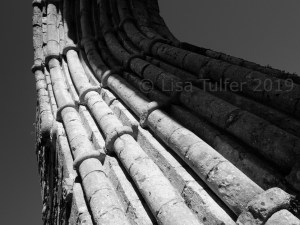
The abbey nestles between the foothills of the Cambrian Mountains and the River Teifi.  Even with the later house built over part of the cloister, the farmyard next door, and the parish church and extensive churchyard beside it, Strata Florida has the peace and beauty characteristic of Cistercian sites, chosen as they were for their remoteness from ‘the dwellings of men’.  The west doorway is unique in its architectural style, the spiral triscele finials a nod to the Celtic culture of the generations of Welsh princes and bards who were buried here.  I decided that I would love to be buried here, too.

In the years that passed, I visited Strata Florida whenever I could (easier once I was a grown up with a car!), and a few other abbeys too.  In my 30s, I went back to university part time for a Masters degree, and two of the modules available were on the Cistercians, because a professor in the history department just happened to be one of the world’s leading experts on the Cistercians.  Inevitably, perhaps, I ended up doing my dissertation on the Cistercians, with the title Living Water: a study of Cistercian water management in the context of twelfth and early thirteenth century monastic water systems, with particular reference to selected Cistercian sites in England and Wales (including, of course, Strata Florida!).  I have explored the latrines, drains, troughs and water pipes of almost every Cistercian monastery in England and Wales where there are any ruins remaining.  I have even infected my partner, who is, as I write this, wrangling an essay for a module on the Cistercians for her Masters degree.

Mono photograph of detail of west doorway, Strata Florida Abbey

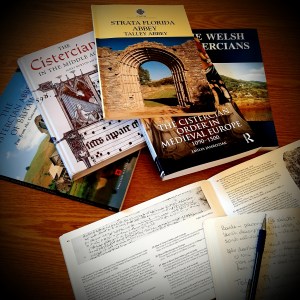
You would think, then, that I wouldn’t have to do any research for the article I’ve been commissioned to write.  But, frankly, any excuse to get the books out again!  And fact-checking (dates etc) is important.  Also, scholarship does move on.  There have been a number of archaeological digs and research projects since I last wrote about Strata Florida, and Cadw (the Welsh government’s heritage agency, who owns and cares for the site) now has a visitor centre and facilities, as well as an excellent web page.  My most recent visit was in late 2019, and I was able to take some photographs, to accompany the article and this post.

When the article is published, I’ll post a link to the webzine.  Meanwhile, if you don’t already follow this blog, and would like to have future posts drop into your inbox, why not follow TheThreeHaresBlog by email?  I post on average about once a week.  Thanks!

Colour photograph of books about Cistercians, and a notebook.

What do writers do all day?

What do writers do all day?  Well, obviously, we write.  But we also do a lot of other things in order to be able to write, and to make a living out of writing.

Reading

All writers read.  It’s inevitable.  Most of us are writers precisely because we love to read, because words are our ‘thing’.  It would be truly weird, therefore, if we didn’t devour words at every opportunity.  And if we are looking to be published, it helps to know what contemporary writing looks like.  While we all have our individual style or voice, it wouldn’t be helpful for our writing to sound like, for example, Chaucer or Austen or Wodehouse – every era has its language, and anachronisms don’t generally get published.  A 21st century writer needs to write like a 21st century writer.

Research

Most writing requires research.  At the very least, a writer needs to fact-check.  Fiction may originate in the mind of the writer, but in order for the reader to suspend disbelief and enter into the story, the facts need to be right because if they are wrong, it jars.  Journeys need to take the right amount of time.  Police procedures need to be correct.  Medical details must be accurate.  Characters need to speak and behave in a way that’s authentic to the time and place of the story.  The science needs to be right.

I mostly write non-fiction, so research is a major part of what I do.  Even when I am taking a creative, imaginative or whimsical approach, the facts have to be properly researched.  A lot of my topics are historical, so I am applying the academic research skills I acquired while studying history at postgraduate level, not only exploring the ‘facts’ but also how those facts have been interpreted through time.

Getting out there

The publishing industry – whether magazines or books, online or in print – is a mysterious world which any writer who wishes to make a living simply has to get to grips with.  As well as the necessary but tedious self-employment tasks of invoicing, accounts and tax returns, a writer has to learn the ins and outs of the industry: how to pitch, whom to pitch to, what the protocols are, which avenues are a waste of time and which are worth pursuing.  There are no short-cuts to learning this – it takes time and effort.

A significant part of being a writer (rather than someone who writes) is the publicity and networking which is part of the profession.  In practice, much of this now takes place online, and I need to spend some time every week keeping on top of this.  As well as this blog, I am active on Twitter (and to a much lesser extent on Instagram and Facebook).  I find Twitter is the place where I network with other writers, find out about events and opportunities, interact with literary agents and publishers, follow up research interests, and tell the world when I’ve posted a new blog post.  I have got several writing gigs as a direct result of being on Twitter, and it’s more than worth the 20-30 minutes I invest in it most days.

Yesterday, I attended a professional development event at the National Centre for Writing (which conveniently for me is located just down the road in Norwich).  It was led by Leena Norms, and was entitled ‘Creating an online presence for your writing’.  Whilst it might go against the grain for those writers who wish to practice their art in solitude in a garret or writing shed, aloof from the world and commercial concerns, the reality for a jobbing writer is that we have to be our own publicists in order to get, and sell, work, so it makes sense to learn how to do it as effectively as possible.  Leena’s approach is simple, effective and cuts through the mystique that surrounds social media in the creative industries, and although I was already doing much of what she suggested, I now feel better equipped for this aspect of my work.  After all, writing is all very well, but I want to get my writing out there and being read!

Writing

Ah, yes – writing!  This is, of course, what it’s all about, the one thing I really want to be doing with my life.  However, it will be apparent from everything I’ve just said that it’s not enough by itself.  The reading, the research, the social media work, and the engagement with the industry, and the self-employment tasks all underpin the writing itself.

I will post another time about the writing process itself – my writing process, because no two writers are the same.  But for now, I’ll just say this: I think a lot more than I write.  I call it ‘percolating’ because, like coffee, the slow process of ideas becoming infused with reading and research, and forming something new that is complex, nuanced and interesting, takes time.  I probably think for at least 2 hours for every hour spent actually writing.

The Three Hares Blog

If you would like to receive every new blog post direct into your inbox, why not sign up with your email address?  I usually blog every week to 10 days.

Writer’s block – can’t go over it, can’t go under it, got to go through it!

There’s a book by Michael Rosen called We’re Going On A Bear Hunt.  If you have had anything to do with small people in the last 25 years, there’s a high chance you’ll have come across it.  When faced by each new obstacle, the characters sing ‘we can’t go over it, we can’t go under it, we’ve got to go through it!’

I have been reminded of this refrain recently.  I usually write fluently and easily (editing is more of a pain for me than actually writing), but one particular commission has been causing me a problem.  Writer’s block is a well-known phenomenon – the curse of the blank page.  Block can take many forms – I refer to my two main ones as ‘research paralysis’ and ‘if I was going there, I wouldn’t start from here’.

Research paralysis

I’m one of those people who want to know everything it’s possible to know about a subject.  As a student, I felt very anxious about starting an essay if I didn’t feel I’d read every book and article available on the topic.  This is, of course, unrealistic.  Yes, research is important.  Especially if much of your subject matter is historical, as mine is, it’s vital to understand both the subject and the context, and in particular to avoid the heinous crime of being anachronistic – introducing ideas or objects that didn’t exist yet in the period you are writing about.  And if you are writing about living people, you need to get your facts right, and you can’t do that without research, lots of it, and using your critical faculties about what you are finding in your research.

However, the trick is to stop researching at some point, and start writing.  I find this difficult!  There’s always ‘just one more’ book, article or website that looks so interesting, and which might just yield that extra fact or perspective that would make all the difference to the piece you’re writing.  It takes a fair bit of confidence to say ‘OK, I now know enough about this to write a robust, accurate and informative piece on the subject’.  When is it ‘enough’?

If I was going there, I wouldn’t start from here

This is a reference to an apocryphal tale, sometimes set in Ireland or Scotland, where a tourist asks a local for directions to somewhere and is told ‘if I was going there, I wouldn’t start from here’.    Mostly I enjoy specific writing commissions, but occasionally it can feel as if I don’t know where to start.  Sometimes it can be about the format not matching the topic (‘write about this huge topic in 200 words’), or the style being inappropriate to the content (‘write about this complex argument, requiring lots of specialist knowledge and vocabulary, in a chatty tabloid style’).  Not doing it isn’t an option – I’m a writer, this is my job, I’m being paid to do it.  I can make lots of cups of coffee, go for a walk round the block, do the laundry, compulsively check Twitter, but the problem isn’t going to go away.

Can’t go over it, can’t go under it, got to go through it!

I’ve developed a few strategies for dealing with writer’s block.  One is to write – anything, not necessarily related to thing I’m supposed to be writing, but just writing – simply to get the writing muscles exercised and moving again.  Often, something will shift and the block will be removed.

Another is to go back and re-read the brief.  Have I understood it wrongly?  Is there some other way of approaching this?  If all else fails, can I get the reader to collaborate with me in wrestling with this topic?  For example, ‘I’ve been asked to write about X, but I didn’t know where to start, so first I tried looking at it from this point of view… what do you think?  Then I tried if from this other perspective… how about this?’

Having a lot of different projects on the go at once is, I find, hugely helpful with writer’s block.  If one article or post is not happening for me, there’s usually something else that’s going well, and it’s amazing how often one project will provide the solution to a block in another.  The human brain is an amazing thing.  And writer’s block must never be allowed to become permanent.  If you can’t go over it, and can’t go under it, you’ve got to go through it!

Maps: my obsession with the visual representation of place

I know exactly where my obsession with maps began.  My beloved  grandfather passed on many traits, including a love of history and an engineering mindset.  But the most tangible legacy is my ‘thing’ about maps.  When I was about 5 (and he was in his 70s) he treated himself to a new world atlas, and passed the old one on to me.  I adored that atlas.  It was huge, hardback, bound in chocolate brown cloth, its pages thick and sturdy.  Nowadays, with online maps available through every mobile phone, mapping is familiar and cheap.  But in the 1970s, a world atlas was a precious thing, the only real way of engaging with places around the world, seeing how they related to each other, learning how to use the index to find places I was hearing about on the BBC World Service: Tehran, Guyana, Buenos Aires.  I can still remember the excitement of opening the heavy cover and exploring the treasures within.

In my teens, when I was preparing for my Geography ‘O’ level, I was introduced to Ordnance Survey maps.  This was mapping at a whole new level!  The detail – down to individual buildings – was mesmerising.  The contour lines allowed me to visualise the rise and fall of the land.  It was the start of a love affair which has lasted to this day.

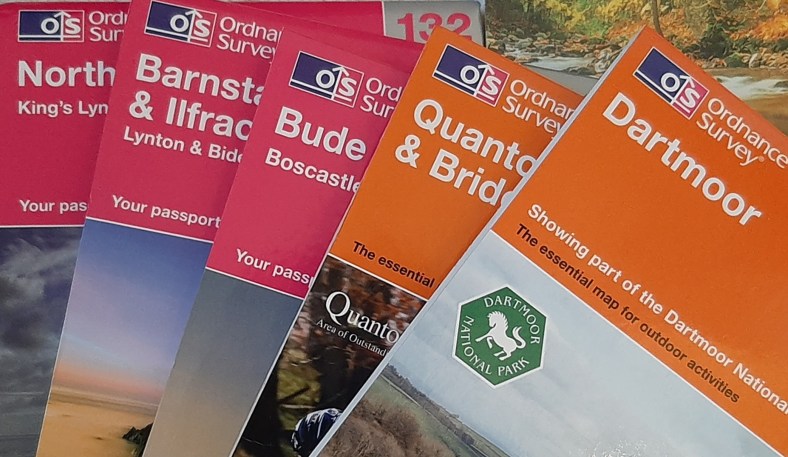
Image of a selection of Ordnance Survey maps

The Ordnance Survey’s somewhat military name refers to its original purpose, which was to map Scotland after the suppression of the Jacobite uprising against the Hanoverian monarchy in 1745, and more generally to provide accurate maps of Britain during the Napoleonic wars.  Now mostly producing digital maps, the OS continues to publish paper maps, many aimed at walkers and others who use the countryside for leisure.  I own quite a few of these…

To me, maps are not simply two-dimensional representations – I have learned to imagine them (especially Ordnance Survey maps) as three-dimensional landscapes.  This makes me a better than average navigator!  Sometimes, if I have spent a long time with a map, it can feel almost as if I’ve actually been to the place.  My grandfather’s world atlas helped me feel connected to parts of the world I had never seen, and helped me to conjure mental images of places I would probably never visit.

Detail of an Ordnance Survey map

My obsession with maps is now a standing joke with my partner.  If we are going anywhere, I have to look at the map.  In the car, even if my partner knows how to get to where we are going, I have to look at the road atlas to orientate myself.  Without a map, I feel as if I have been blindfolded and spun around – I lose my bearings, feel confused, get disorientated.  Wherever I am, I use maps to relate where I am to other places I know.  At some very basic level, I seem to need maps to know my place in the world.  Each time I move to a new part of the country, my first purchase is a 1:25,000 Ordnance Survey map of my new habitat.  You can imagine my delight when I discovered, a few years ago, that you can order customised OS maps centred on a location of your choice!  And I was even more thrilled to discover that there is now an OS app, giving me access to maps wherever I am (providing there’s 4G).  I also use Googlemaps a lot, and especially the satellite and Street View functions, particularly when I’m going somewhere new.  It’s a rare day that I don’t consult a map.

That world atlas is, sadly, long gone.  It finally disintegrated, and by then atlases, like dictionaries, were being replaced by the internet.  The smartphone has taken over the functions of the reference book.  But whatever the format, I’m never happier than when I’m engrossed in a map, and for that I have my grandfather to thank.

#Shelfie – books I am currently reading

Over the Christmas and New Year break, I have been enjoying a bit of leisure to catch up with my reading.  All writers read – it’s just a part of life, like breathing, and since I was very young I have not been able to imagine not having several books on the go at any given time.  This time of year is especially exciting as kind people tend to give books as Christmas presents!

As I like seeing other people’s #shelfies, I thought that today I would share mine with you.

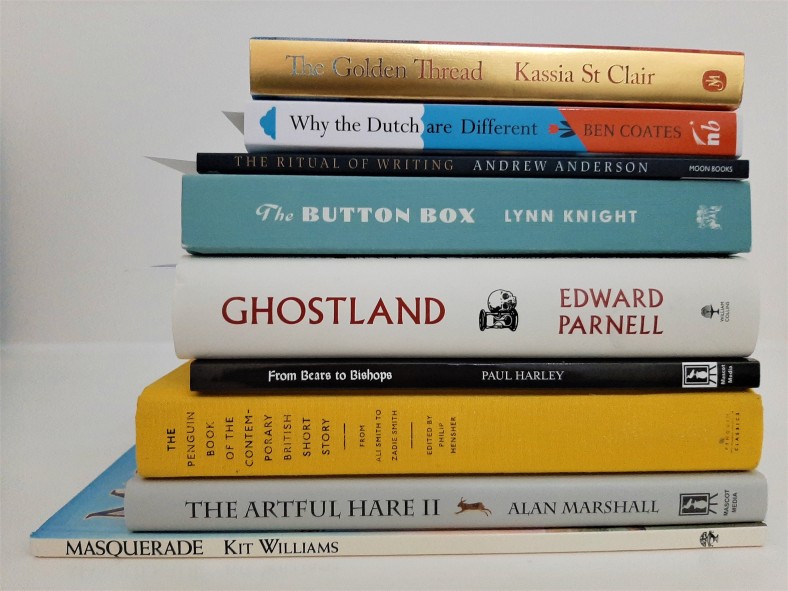
Photo of a pile of books on a shelf.

Starting from the bottom:  Masquerade, by Kit Williams.  Published in 1979 and long out of print, I was recently recommended this and managed to track down a secondhand copy.  The first of the ‘armchair treasure hunt’ genre, the frankly trippy illustrations and accompanying story of Jack Hare – written like a fairy tale with riddles twining through it – created a clue book.  The author buried a piece of jewellery, in the form of a bejewelled 18 carat gold hare necklace, and waited for it to be found by the first person to solve the riddle of the book.  It was claimed a couple of years later, amid some scandal, and the whole affair was chronicled by Bamber Gascoigne (who witnessed the burial of the treasure) in his book The Quest for the Golden Hare.  My interest in the book is, of course, primarily because of the hare who is the hero, and the hares secreted in every illustration – but also in the concept of a picture book for adults, where each image repays close observation, and where the image and text have a dialogue.  Regular readers of this blog will recall my recent review of The Hare and the Moon by Catherine Hyde, which does something like this.

For more on the story of Masquerade, have a look at https://www.bbc.co.uk/news/uk-england-beds-bucks-herts-47671776.

There are more hares in my next book – over 400 of them!  A Christmas present from my partner, this is one of a series of beautiful coffee table books by Alan Marshall, which feature the work of British printmakers.  This is The Artful Hare, and it’s gorgeous.  89 printmakers interpret the hare, in a variety of styles and techniques which both show the rich diversity of this art form, and also illustrate aspects of the life and mythology of the hare.  This will keep me very happy for a long time – if I treat myself to just one print a day, it will take me well into 2021!

The Penguin Book of the Contemporary British Short Story, edited by Philip Hensher, is more by way of work – I like to keep up to date with short form writing, both fiction and non-fiction.  So far I am still on Hensher’s excellent introduction, so I can’t comment yet on the stories themselves.

Another Christmas present is From Bears to Bishops: Norfolk’s Medieval Church Carvings by Paul Harley.  In over 130 stunning black and white photographs, this catalogues wood and stone carvings from Norfolk’s 659 medieval churches.  Several of these I’ve seen in person (for example, the Green Man at King’s Lynn Minster, the woodwoses on the font at Acle, and the cat on the font at Castle Rising), and I am keen to explore in search of more.

Regular readers will remember that I recently attended an event for writers at the National Centre for Writing in Norwich.  The highlight for me was meeting Edward Parnell, who spoke about his move from fiction to non-fiction, and the recent publication of his book Ghostland: In Search of a Haunted Country.  Edward kindly signed my copy!  Beginning with the ghost stories of M.R. James (which I re-discovered last year), Edward’s book is an intriguing exploration of place, haunting, and writers, interlaced with his own memoir.  I am less than a quarter through the book, and it’s fascinating – and it’s also inspiring me to go in search of authors I hadn’t previously encountered.

Social history is a major interest of mine, and I am also a textiles geek, so The Button Box by Lynn Knight was always going to find its way onto my bookshelf.  Using heirloom items from the family button box as the hooks on which to hang her narrative, Knight explores the intimate, domestic side of women’s lives through the stories of their clothes.  This is a book to be relished slowly – I am dipping into it a chapter at a time.

Completely different – and straddling the space between work-related reading and reading for leisure – is The Ritual of Writing: writing as spiritual practice by Andrew Anderson.  Purchased on a recent visit to Glastonbury, it covers topics such as responding to the spirit of place, working with old tales, and using the wheel of the year.  Again, a book to be read slowly – with time to reflect on each chapter before embarking on the next.

I can’t remember whether I’ve mentioned this before – I am half Dutch.  The older I get, the more pronounced my Dutch traits seem to be becoming (or so I am told!).  I was therefore attracted to Why the Dutch are Different: a Journey into the Hidden Heart of the Netherlands.  The Author, Ben Coates, is a Brit who has lived in the Netherlands for many years.  In this book, he explores the legacy of Dutch history on the culture, attitudes and behaviours of the Dutch – writing as an outsider observing from the inside, which is rather how I feel sometimes in Britain.  I am enjoying the book immensely – learning a great deal that I didn’t know about Dutch history and geography, and also recognising so much of the national psyche in myself.

Finally – did I mention I’m a textiles geek?!  Some time ago I spotted The Golden Thread: How fabric changed history by Kassia St Clair on the shelves of Waterstones, and promised myself I’d buy it when I had made a few more inroads into my ‘to read’ pile.  I was delighted, then, to find it amongst my Christmas presents!  A friend had also spotted it and thought it was my kind of thing.  St Clair tells the story of fabric , starting from prehistory, through the wrappings of Egyptian mummies, silk and the Silk Road, the sails of Viking longships, medieval wool wealth, cotton and slavery, to the clothing of arctic explorers, artificial fibres, space suits and modern sports fabrics.  This is yet another book to be dipped into and savoured – a rich tapestry of history, laced with literary quotations, which encourages us to look more closely at the fantastic textile creations we use every day, and so often take for granted.


Links to books cited are generally to Amazon UK, although where possible I give my custom to my local bookshop, or use Hive.co.uk and Abebooks.co.uk to buy new and used books online.  If you are in the UK, many of these titles may also be available through your county library service.

The gate of the year: musings on the New Year

As 2019 draws to its close, and we count down to 2020, it is perhaps inevitable that I have been musing on the nature of change.  Time passes – some things stay the same, other things evolve.  Change is sometimes gradual, sometimes sudden, often unwelcome, sometimes liberating.  At this point in the calendar, it feels as if we are poised on the threshold – at once looking back at how things have been, and forward to how things might be.  Depending on where we are on life’s journey, looking back can evoke joy, sadness, regret – or simply relief that it’s over.  Looking forward can be scary, or hopeful.  We close the door on the old year, and open the door to the new.

This is not a new concept.  The month of January is named after the Roman God Janus, the god of beginning s and endings.  He is associated with transitions of all kinds: doorways, gateways, arches, passageways.  He was also associated with war and peace, the doors of his temple in Rome being open during war, and closed during peacetime.  It is said they were rarely closed.   Janus is usually depicted in art as having two faces – one facing forwards, one back.   At this time of year, we probably all know how that feels.

All this talk of thresholds and gates reminded me of the words of a poem known as The Gate of the Year or God Knows, by Minnie Louise Haskins (1875-1957) – here is the first stanza:

And I said to the man who stood at the gate of the year:
“Give me a light that I may tread safely into the unknown.”
And he replied:
“Go out into the darkness and put your hand into the Hand of God.
That shall be to you better than light and safer than a known way.”
So I went forth, and finding the Hand of God, trod gladly into the night.
And He led me towards the hills and the breaking of day in the lone East.

The poem is perhaps most famous for being quoted by King George VI in his Christmas broadcast in 1939, with the deprivations of the Great Depression fresh in the collective memory, and the challenges of world war ahead.  “A new year is at hand,” the King said. “We cannot tell [what] it will bring. If it brings peace how thankful we shall all be.”  I wonder if he, too, being classically educated, was thinking of Janus, on the threshold between war and peace.

Despite my best efforts to avoid the news, in the interests of keeping my sanity, it’s impossible not to be depressed about the state of the world, with wars, natural disasters, and divided societies.  However, I am determined to step over the threshold of 2020 in a spirit of hope.  There is the opportunity of change.  The new year lies before us, like the blank pages of a new notebook, ready for what we create in it.  Let’s fill 2020 with adventure, flourishing, love, and above all, peace.

Happy New Year!


I was reading this piece aloud to make sure it was OK, and had the sudden thought that it might be fun to experiment with recording it as an audio file and adding it to this blog post as a link (below).  I’ve not used the technology before, and I’m just using the Voice Recording function on my laptop, not a proper mic, so the quality is a bit scratchy.  I wonder if you, dear reader, would mind testing it and letting me know if it works on your phone, tablet or laptop – and whether you’d like me to do this again from time to time?  Just a few words in Leave a Comment would be great.  Many thanks!

Audio – 31 December 2019 The Three Hares Blog

The Festivals of Midwinter: Solstice, Yule, Christmas

December is always a struggle.  I have found  this year worse than most, with relentless rain, gloomy skies, and the lights on by 2.00pm.  To be honest, here in the UK I find it increasingly difficult from late October, when the clocks go back and evening draws in when it’s still afternoon.  I count down until the shortest day, 21 December, the Winter Solstice, when the days start to lengthen again.

Apparently, it’s not just me.  This sense of the year dying around Samhain (the end of October) to be re-born with the lengthening days after the Solstice is a part of many pagan traditions.  Festivals at midwinter seem to have been a part of human life in the north of Europe for as long as anyone knows.  And of course there is Christmas!  Curious to understand more about the origins of how we celebrate, and which of those traditions are truly ancient, I have spent the last few days reading The Stations of the Sun: A History of the Ritual Year in Britain by Ronald Hutton, professor at Bristol University and an expert on folklore and paganism.

Professor Hutton’s research methods are very thorough, and he explores traditions and what we think we know about their origins, teasing out what the evidence really is, and establishing when traditions were actually first recorded (often much later than I expected).

Of course, some of this is more widely known and I’d come across it already.  For example, there is no biblical foundation for 25 December (or indeed any other date) for the birth of Jesus.  Professor Hutton identifies the first mention of that date in a calendar of Christian feasts in 354 CE, probably in Rome, and finds an intriguing quote from the Scriptor Syrus in the late 4th century, who refers to it being the ‘custom of the pagans’ to celebrate the birthday of the sun on 25 December.  This continued to cause confusion during the next couple of centuries at least, with church ‘fathers’ begging believers to remember that they should be worshipping Christ, not the sun, at these festivals!  In the 5th century, one Maximus of Turin wrote delightedly about the appropriation of a pagan festival of sun worship for Christian use.

And of course there’s Saturnalia, the Roman midwinter feast, held on 17 December and the days following.  It included, says Professor Hutton, a lot of the elements we still recognise:  gifts, candles as symbols of light, the closure of shops, schools and law courts for the duration of the festivities, and (a precursor to the medieval custom) the usual order turned upside down, with masters and mistresses waiting on their servants.  Kalendae – at the beginning of January, dedicated to the two-faced God, Janus, who looked both back at the old year and forwards into the new – saw more giving of gifts, this time figs, honey, pastries and coins.

Photo of a quarter of a wreath, in mono with a pop of red for the berries.  Image copyright Lisa Tulfer 2019

Evergreen wreath

Professor Hutton points out that the with the spread of Christianity in Mediterranean countries, Easter became the principal festival of the year – but in northern Europe, the colder, darker winters meant there was still a need for merrymaking at midwinter.  “The habits of a midwinter festivity had come by the dawn of history…to seem a natural one to the British,” he says.

The Christian calendar absorbed the idea of a season of festivities around midwinter, with the Nativity celebrated on 25 December, St Stephen (the first martyr) on the 26th, St John the Evangelist on the 27th, the Holy Innocents (the children massacred by King Herod in an attempt to eradicate the infant Jesus, mentioned in Matthew’s gospel) on the 28th, the Circumcision of Christ on 1 January, and Epiphany (originally the baptism of Christ, later eclipsed by the celebration of the visit of the wise men) on 6 January.

The Anglo Saxons didn’t use the word Christmas (‘Cristes Maessan’) until 1038 – before that it was simply ‘midwinter’.  It was obviously important though, as a 12-day break from work for servants was enshrined in law by Alfred the Great in 877 CE.  The word ‘Yule’ arrives with the invading Danes in the 11th century, although Professor Hutton says that the derivation of the word “has baffled linguists.”

However, he says, we know a fair bit about midwinter/Solstice/New Year revelries, because of the attacks of churchmen upon them – especially the various divination practices, to see what the new year would bring, some of which were still being recorded by 19th and 20th century folklorists.

Some practices which we may think of as ancient are, according to Professor Hutton’s researches, fairly recent (or in any event, there is no evidence for them, and they are not mentioned, before a relatively late date).  For example, the use of a wassail bowl was first recorded in the 1320s; mummers and other kinds of ‘disguising’ were a medieval phenomenon, and mistletoe does not put in an appearance until the 17th century, with the association with kissing being a whole century later still.  Yule logs were common from the 1600s to the late 1800s, and hobby horses were around from the late 15th century through the Tudor and Stuart periods, with other animal-head processions (including the Mari Lwyd in Wales) being mostly recorded in the 19th century.  Although folklorists believed they were of pagan (i.e. pre-Christian) origin, Professor Hutton can find no evidence for their earlier existence.

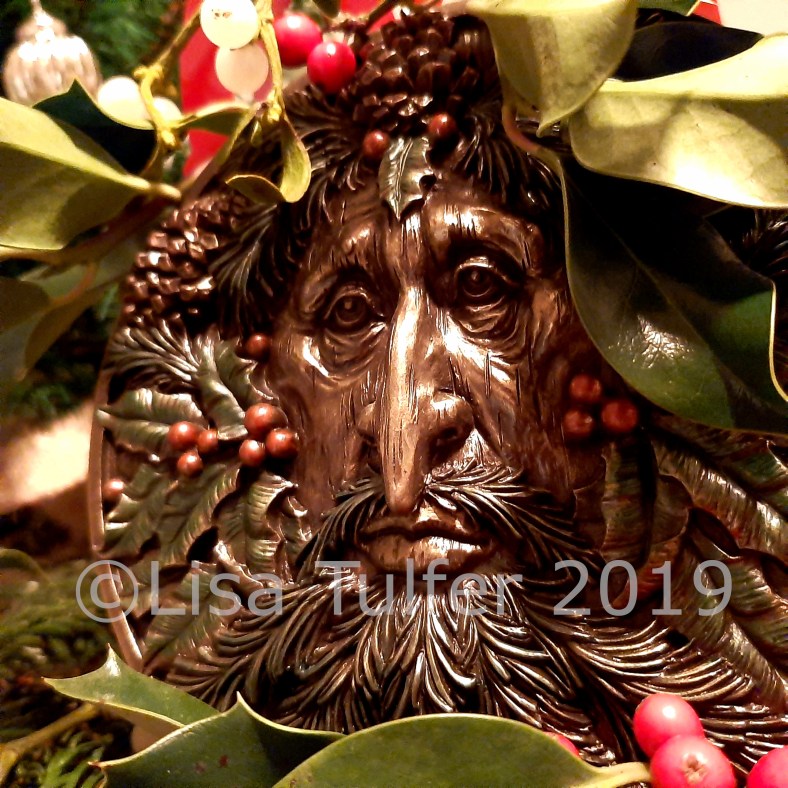
Colour photograph of Yuletide Green Man plaque surrounded by holly.  Image Copyright Lisa Tulfer 2019

Yuletide Green Man

So, what customs have persisted which actually, possibly, genuinely are ancient pagan customs, which have survived by being adopted and adapted by Christianity after the church very cannily decided to celebrate the Nativity at the time of the pagan midwinter festivals?

  • Evergreens. Greenery was used for festivals in pagan Europe, and its use was generally adopted by the Church, especially in England.  Holly and ivy were originally favourites, with bay, rosemary, yew and box (and, in the 17th century, mistletoe) being added in over the centuries.  Do remember, though, that most of these are poisonous, so keep them (and especially the berries) away from children and animals if you decorate your home with evergreens this midwinter.
  • Lights and candles. On the shortest day of the year (or thereabouts!) it’s traditional to have lights and candles to symbolise the lengthening days to come, light overcoming the darkness, the start of the ascent to summer.
  • Partying. The giving of feasts (especially by landowners/masters for their tenants/workers) has been a recurring theme for two millennia.  So, when you are at the office party, remember that this tradition goes back to Roman times!
  • Presents. The exchange of gifts has been a feature throughout much of the history of midwinter celebrations, although the exact timing (anywhere between 17 December and 6 January) has moved over time.
  • Misrule. In Tudor times, the Lord of Misrule would preside over often riotous jollification, where the usual norms of behaviour were cast aside, often with the assistance of masks to aid anonymity – even at the royal court had a Lord of Misrule.  The idea of turning the hierarchy of society upside down at midwinter has persisted since Roman times.  Its medieval incarnation as the Feast of Fools, where junior clergy and choristers took over (and subverted) the liturgy, persists in the practice of electing a ‘Boy Bishop’ in some English cathedrals.  And more generally in society there is a sense that anything goes at Christmas.

So, as the dark descends on the shortest day of the year, let us light candles and Christmas lights and affirm that the light will always triumph.  Let’s deck the hall with boughs of holly, toast each other with ‘Wassail!’, exchange gifts, and generally let our hair down.  Because in the ancient times when those customs originated, as now, in Professor Hutton’s words, “feasting and entertainment were in themselves fundamental responses to the tedium and melancholy which a northern winter could engender.”


This article is based on The Stations of the Sun: A History of the Ritual Year in Britain by Ronald Hutton, Oxford University Press 1996 (new edition 2001).


Norwich’s Writing Quarter – a day at the National Centre for Writing and other explorations

I wonder how many of you regard a day’s professional development as a self-indulgence?  I suspect it may be something unique to writers and other creatives, but I was struck by the use of the words ‘self-indulgence’ no fewer than three times in the first hour of Saturday’s event at the National Centre for Writing.  It seems that a lot of us have difficultly permitting ourselves the investment of time and money into our development as writers.

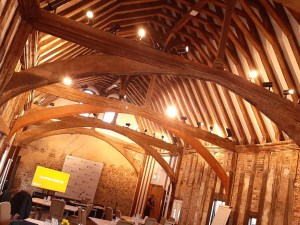
The National Centre for Writing (formerly the Writers’ Centre Norwich) is based at Dragon Hall on King Street in Norwich, and provides resources, mentoring and events for writers – both online and face to face.  Saturday’s event was entitled The Writer’s Roadmap, and took place in the great hall, upstairs at Dragon Hall.  The wonderful Florence Reynolds is the Programme Officer, and welcomed us to a superbly organised day in a unique venue.

I should warn you (if you haven’t already gathered from elsewhere in this blog) that I am something of a medieval history nerd, so spending a day in Dragon Hall was, frankly, distracting!  According to the Dragon Hall website, there has been a building on this site for more than a thousand years – Florence told me that there is evidence of a Saxon post hut beneath the undercroft.  The present building was built around 1430 by a merchant, Robert Toppes, although one of the outbuildings is believed to be a century older.  Originally a trading hall, it backed on to the River Wensum, which via the River Yare gave access to the North Sea at Great Yarmouth.  It was part of Norwich’s major role in the trading of wool and textiles, especially to and from the Low Countries, during the middle ages, on which the wealth of East Anglia was built.  Now a Grade I listed building, parts of it have at various points been houses, tenements (housing up to 150 people in the 19th century), a pub, a butchers, and the rectory for nearby St Julian’s Church (of which more later).

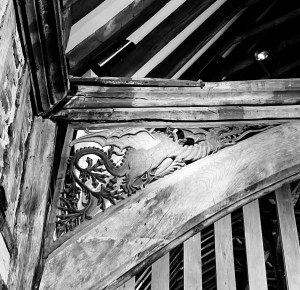
We were upstairs in the Great Hall, where the one remaining carved dragon (there were 14 originally) has been rescued from under a pile of rubbish in an outbuilding, restored, and put back where it belongs in the beams of the splendid roof.  Another treat was the remnants of Victorian wallpaper, which Florence pointed out.  It’s lovely that NCW are so evidently proud of the building, and great to see that it’s in daily use and living again.

The event was both enjoyable and very useful, an opportunity to meet with other writers (we tend to be a fairly solitary lot) and also to get some high-quality input from writers with a wide range of experience.  Molly Naylor, who described herself has having a portfolio career which includes poetry as well as writing for stage and screen, spoke about working across boundaries of genre, and the importance of finding our unique ‘voice’.  Victoria Adukwei Bulley spoke about opportunities for residencies and commissions, and showed us some of the output from her residency at the V&A.

But the highlight for me was Edward Parnell, who took us through his experiences with getting his first (prizewinning) novel published and then moving, almost by accident, into creative non-fiction.  As a writer of non-fiction, I often feel that writers’ events and courses aren’t really for me as they tend to focus on fiction and/or poetry (very occasionally scriptwriting) but never non-fiction.  It was a treat to be at something which was explicitly for writers like me – and as well as being an engaging speaker, Edward was generous with his time, staying around to chat afterwards (and signing a copy of his non-fiction book, Ghostland, for me!).

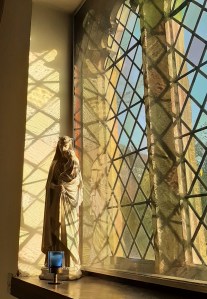
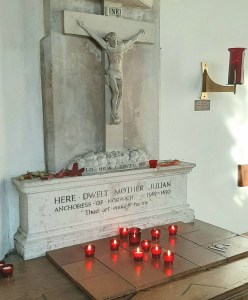
At lunchtime I went exploring.  The Church of St Julian is literally across the road from Dragon Hall, and I had intended visiting many times when in Norwich but never quite got around to it because it’s a little way from the city centre.  This is the place where the woman known as Mother Julian or Julian of Norwich lived as an anchoress (a hermit attached to a church) during the late 14th and early 15th centuries.  Her cell has not survived, but a chapel has been built on the presumed location, on the south side of St Julian’s Church, and there is a shrine to her there, as well as an information centre just up the hill from the church.  Julian (note – the name we know her by is the name of the church she was attached to; we don’t actually know what she was called) wrote the earliest surviving book in English by a woman, the Revelations of Divine Love.  This work was the result of a mystical experience when she was seriously ill and near death, and was revolutionary in its emphasis on God as ever-loving (not a concept the medieval church embraced).  It survived though convoluted channels of transmission in the UK and Europe, mostly treasured by nuns, and in the 20th century became a classic text of Christian spirituality.  Perhaps the most-quoted line is “All shall be well, and all shall be well, and all manner of things shall be well.”

This part of Norwich is becoming the Writing Quarter, with the National Centre for Writing now based here, and with the history of the first female author in English at St Julian’s.  And from 2020 the Norwich Printing Museum (formerly the John Jarrold Printing Museum) will be relocating to new premises in the restored St Peter Parmentergate Church on King Street.  The collection tells the story of the printed word since the middle of the 15th century when Johannes Gutenberg invented movable type for printing and the age of the printed book was born.  For anyone interested in the written word, a short walk around King Street in Norwich will take you from Julian’s quill, to the printed book, to the laptops of today’s writers.

Book review. The Hare and the Moon: A Calendar of Paintings by Catherine Hyde

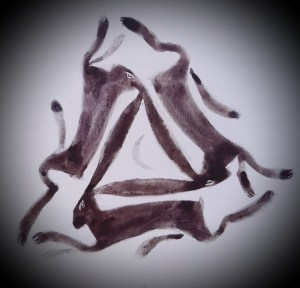
As regular readers of this blog may have gathered, I am a bit of a fan of the hare.  I was delighted, therefore, to find this rather wonderful little book with the evocative title The Hare and the Moon: A Calendar of Paintings.  It is pleasingly square, with a tactile cover, which is always a good start.  And it had me at the first page, which is an illustration of the three hares motif!

There are a number of elements to the ‘calendar’ aspect of the book.  A poem, with the refrain which recites the folk names for the full moons (The Snow Moon, The Wolf Moon, The Hunger Moon, The Sap Moon etc) is woven through it.  Each month then has six themes.  There are black and white illustrations of the moon phases.  There are double page colour paintings of the hare in the seasonal landscape (I especially like January, where the hare is joined in the snowy countryside by the barn owl and the raven).   There are Indian ink drawings of the hare in action and at rest.  For each month there is a flower, a tree, and a bird, each accompanied by a colour painting and a note about the folklore and alternative country names.  For example, June’s flower is honeysuckle:

“Used for rope-making in the Bronze Age and also known as woodbine, honeybind, trumpet flowers, Irish vine, Goat’s leaf, sweet suckle and fairly trumpets.  Honeysuckle grown around the entrance to the home prevented a witch from entering and would bring good luck.”

The Hare and the Moon subtly weaves poetry and art together, blurring the boundaries and creating what has been described as ‘visual poetry’.  This is so much more than a book of poems and folksy factoids with illustrations.  The images have a dreamy quality which lend a timeless air to this charming book.  Perfect for reading, as I did, while curled up on the sofa on a dark winter afternoon, a steaming mug of tea by my side (think hygge!), this would make a fine Christmas/Yule present for anyone who loves the natural world, folklore, or art.  Or indeed hares!


(For more about Catherine Hyde, take a look at https://catherinehyde.co.uk/)